
Top 10 Custom Solenoid Coil Manufacturers for OEM Projects
Custom solenoid coil manufacturers can look equally capable when we compare only websites, sample photos, and quoted prices. That similarity creates risk because a successful prototype may hide tooling, winding, insulation, or thermal problems. We built this engineer-first shortlist to help OEM teams evaluate suppliers for repeatable production, not merely sample approval.
The best custom solenoid coil manufacturer is the supplier that can identify design risks, balance force, power, temperature, space, materials, cost, and convert a working prototype into a stable production process. We recommend comparing manufacturers by engineering depth, application experience, quality controls, traceability, and long-term commercial fit rather than catalog size alone.
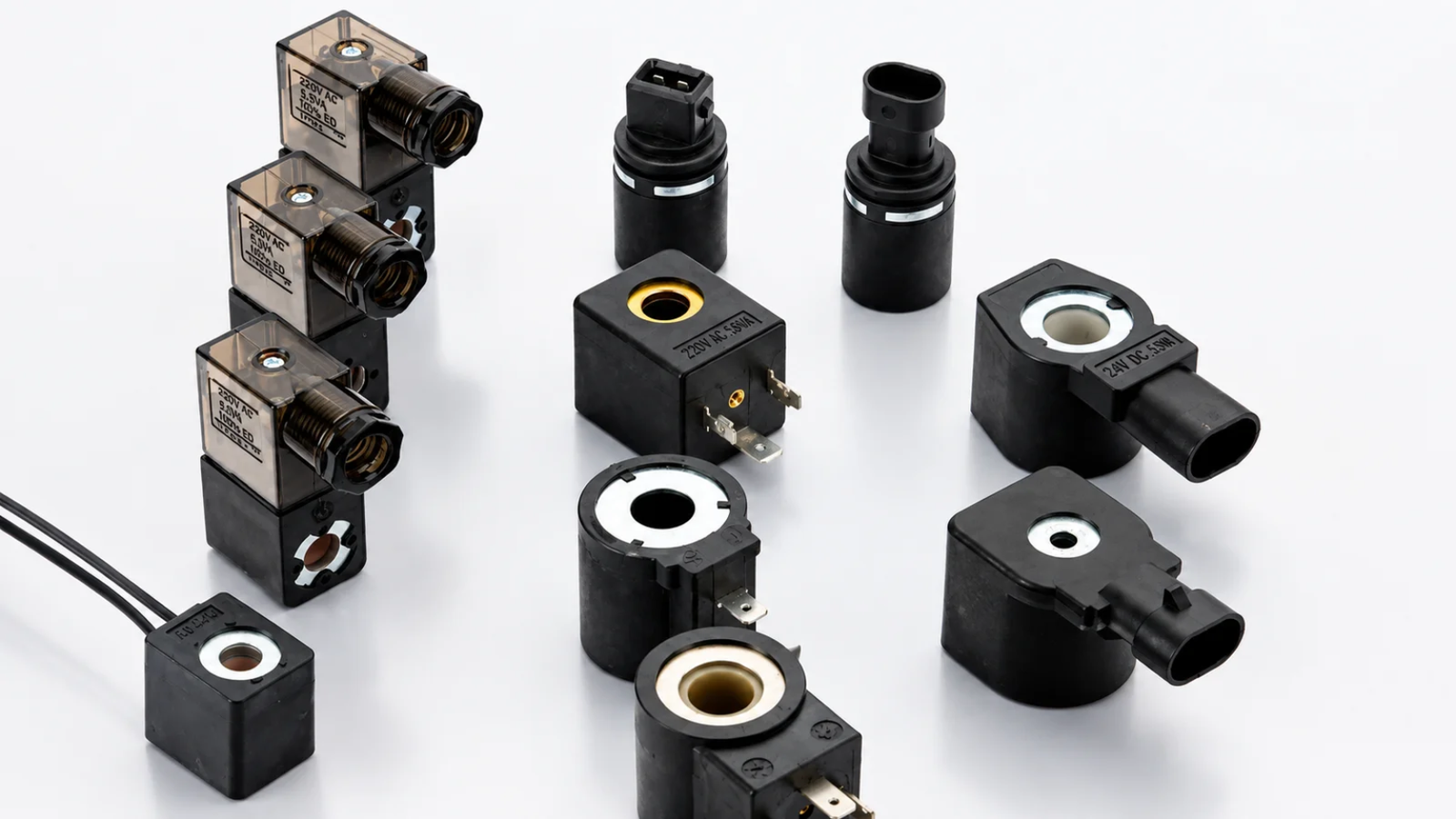
Our list does not treat every supplier as interchangeable. We first explain how we would qualify a coil manufacturer. We then compare ten established candidates according to the types of OEM projects they appear best suited to support.
Editorial note: We based this shortlist on the manufacturers’ publicly described product ranges and OEM capabilities available for a 2026 buyer review. Certifications, approvals, manufacturing locations, and product scope can change. We recommend verifying current, facility-specific documents directly during supplier qualification.
If you are specifying a coil rather than comparing brand catalogs, start from the application:
- Voltage: What voltage do solenoids use · 12V vs 24V for pneumatic OEMs
- Connector / interface: How to choose a DIN connector coil
- Valve body / application: Coil selection for pneumatic valves · Steam valve leakage on espresso machines
- Replacement fit: Drop-in coil compatibility checklist
- Operating temperature: How ambient temperature affects coil selection
- Products: Solenoid valves · Solenoid coil series
What Should OEM Engineers Look for in a Custom Solenoid Coil Manufacturer?
A polished sample can make supplier selection feel straightforward. However, the real problems often appear after tooling release, material substitution, or production ramp-up. We therefore look beyond initial electrical performance and examine whether the manufacturer understands the complete application and can control the process repeatedly.
A qualified custom solenoid coil manufacturer should understand the application, detect design risks before tooling, explain electromagnetic and thermal trade-offs, document materials, and reproduce prototype performance in production. We also expect the supplier to investigate failures systematically and offer pricing that remains sustainable throughout the expected OEM program.

Our six-question supplier audit
If we were selecting a supplier for our own OEM project, we would start with six questions:
- Does the supplier understand the application?
- Can the engineering team identify design risks before tooling?
- Can the team explain electromagnetic and thermal trade-offs?
- Can the production process reproduce the approved prototype?
- Can the supplier investigate failures instead of simply replacing parts?
- Is the commercial offer sustainable for long-term production?
These questions reveal more than a general statement such as “customized solutions are available.”
Application understanding comes first
We expect a supplier to ask where and how the coil will operate. A coil designed for an indoor appliance faces different conditions from one installed near a vehicle engine, hydraulic manifold, or outdoor irrigation valve.
Our initial technical review normally covers:
- Rated and maximum voltage
- AC or DC operation
- Continuous, intermittent, or pulse duty
- Maximum ambient temperature
- Permitted coil temperature rise
- Available installation space
- Required magnetic force or valve response
- Exposure to moisture, oil, refrigerant, chemicals, or vibration
- Lead wire, terminal, connector, and grounding requirements
- Expected operating life and annual volume
A supplier that immediately quotes from a drawing without asking these questions may be treating the coil as an isolated component. We believe the coil should instead be evaluated as part of the complete electromagnetic and mechanical system.
Electrical values should not be reviewed in isolation
Copper resistance changes with temperature.1 A useful engineering approximation is that copper resistance rises by about 0.393% per degree Celsius2. As the winding becomes hotter, its resistance rises and current falls at a fixed DC voltage. That change can affect magnetic force and actuator response.
We therefore ask how the supplier has evaluated:
- Cold and hot resistance
- Current draw and wattage
- Ampere-turn requirements
- Winding fill factor
- Duty cycle
- Heat transfer through the bobbin, encapsulation, housing, and surrounding assembly
- Insulation system temperature class
Typical insulation-system references include Class B, F, and H, commonly associated with temperature ratings of 130°C, 155°C, and 180°C3. However, a high-temperature wire class alone does not make the complete coil suitable for that temperature4. The bobbin, tape, lead wire, terminals, encapsulation material, and assembly process must support the same design intent.
Quality documents require verification
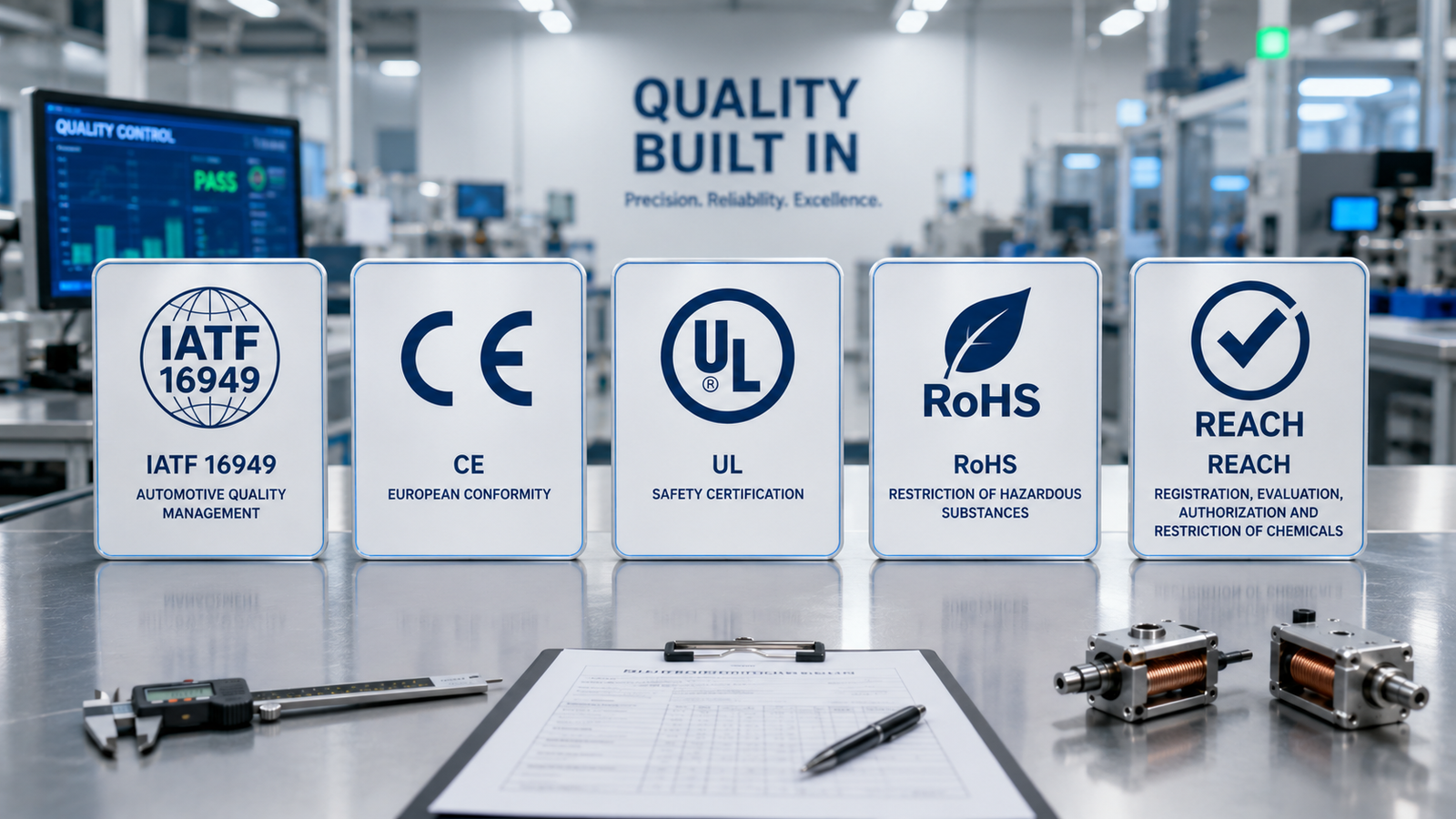
We treat certifications as evidence to examine, not marketing phrases to accept automatically. For each shortlisted supplier, we would request:
- A current ISO 9001 or applicable automotive quality certificate
- The certificate scope and covered manufacturing address
- Product-specific UL file numbers where UL recognition is required
- RoHS and REACH declarations tied to current materials
- CE or UKCA documentation where the final product requires it
- Control plans, inspection instructions, and test records
- Material traceability and change-control procedures
We also distinguish between a management-system certificate5 and a product approval. They serve different purposes. Qualified compliance professionals should confirm the standards required for the finished application.
Top 10 Custom Solenoid Coil Manufacturers Compared
A “top ten” list becomes misleading when every company receives the same generic description. Different manufacturers serve different volumes, technologies, regions, and regulatory environments. We therefore use the list as a project-fit comparison, not as a claim that one company is universally better than another.
Our shortlist includes manufacturers that publicly present custom electromagnetic, solenoid, valve, or coil-development capabilities. The order reflects useful starting points for different OEM requirements rather than a laboratory-tested quality ranking. Buyers should still complete technical audits, sample testing, capacity checks, and facility-specific certification reviews before nomination.
Quick comparison by project fit
| Manufacturer | Best-suited project profile | Publicly presented capability to examine | What we would verify before nomination |
|---|---|---|---|
| 1. Kendrion | Complex, regulated electromagnetic systems | Solenoids, actuators, brakes, valves, and application engineering | Relevant plant, capacity, project ownership, and current site certificates |
| 2. Magnet-Schultz | Advanced electromagnetic actuator development | Custom electromagnetic actuators and system-level development | Tooling control, validation scope, manufacturing location, and lead time |
| 3. SolenElec | Custom coil development and flexible OEM projects | Coil design, winding, injection molding, prototyping, and volume production | Product-specific approvals, process capability, and current quality documents |
| 4. TLX Technologies | Application-specific solenoids and motion-control projects | Custom solenoids, actuators, latching devices, and valves | Production location, environmental validation, and ramp-up capacity |
| 5. Johnson Electric / Ledex | Global programs and higher-volume actuator platforms | Solenoids, switches, motors, and motion subsystems | Division-specific support, minimum volume, and plant-specific approvals |
| 6. Geeplus | Projects requiring several electromagnetic technology options | Solenoids, voice coils, rotary devices, and haptic technologies | Manufacturing ownership, validation responsibility, and traceability |
| 7. NSF Controls | UK- or Europe-focused custom electromechanical development | Custom solenoids, switches, and related mechanisms | Volume fit, certification scope, tooling arrangements, and continuity planning |
| 8. Deltrol Controls | North American industrial valve and solenoid projects | Solenoids, valves, and application-specific control products | Customization depth, test coverage, and material-change controls |
| 9. ROSS DECCO | Industrial, pneumatic, and hydraulic coil applications | Solenoid operators, replacement coils, and related components | Custom versus standard capability, environmental ratings, and OEM support |
| 10. Sag Harbor Industries | Custom wound components and US-based sourcing | Coils, solenoids, transformers, and contract winding | Application testing, automation level, capacity, and inspection records |
1. Kendrion — Best fit for complex regulated electromagnetic systems
We would shortlist Kendrion when a project extends beyond a standalone winding and requires close integration among the coil, magnetic circuit, mechanics, electronics, or valve system. Its publicly presented portfolio covers several electromagnetic product categories and markets.
That breadth can benefit industrial, automotive, energy, and automation programs. However, a broad corporate portfolio does not automatically mean that every facility supports every custom coil project. We would confirm the responsible production plant, engineering location, annual-volume expectations, validation plan, and applicable certificates before sending an RFQ.
2. Magnet-Schultz — Best fit for advanced actuator co-development
We would consider Magnet-Schultz for technically demanding projects in which electromagnetic behavior, mechanical motion, sensing, or system integration requires substantial development work. The company publicly positions itself around electromagnetic actuators and application-specific solutions.
Its engineering scope may suit programs with formal validation and detailed performance requirements. Buyers should still clarify which design activities are included in non-recurring engineering charges, who owns the final design, where tooling will remain, and how engineering changes will be controlled after production release.
3. SolenElec — Best fit for custom solenoid coil development and flexible OEM projects
We place SolenElec third because its core focus aligns closely with the subject of this comparison: customized solenoid coils for OEM applications. Based on our business context, we support projects involving coil dimensions, voltage, resistance, power, temperature rise, winding structure, bobbin materials, terminals, connectors, and production tooling.
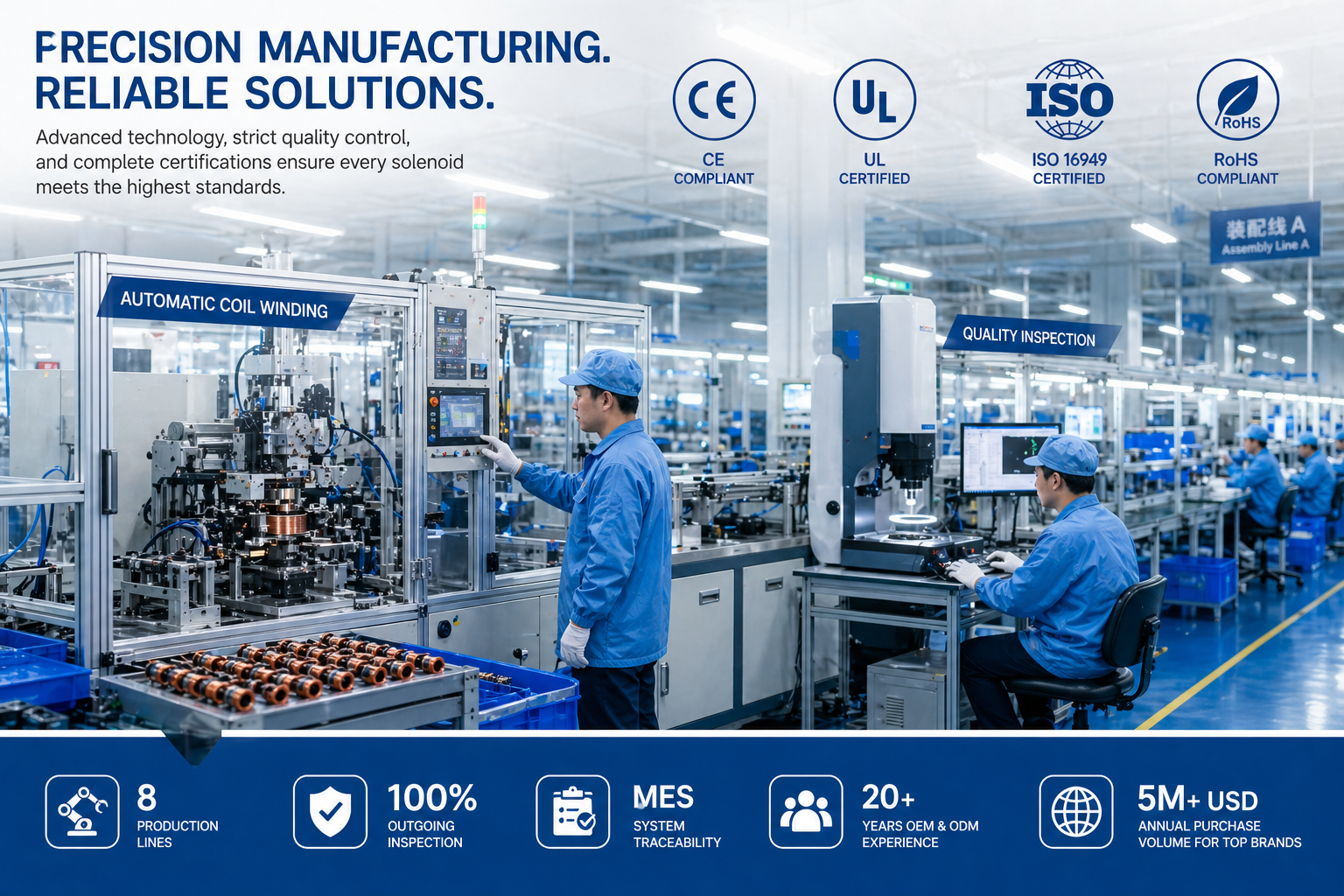
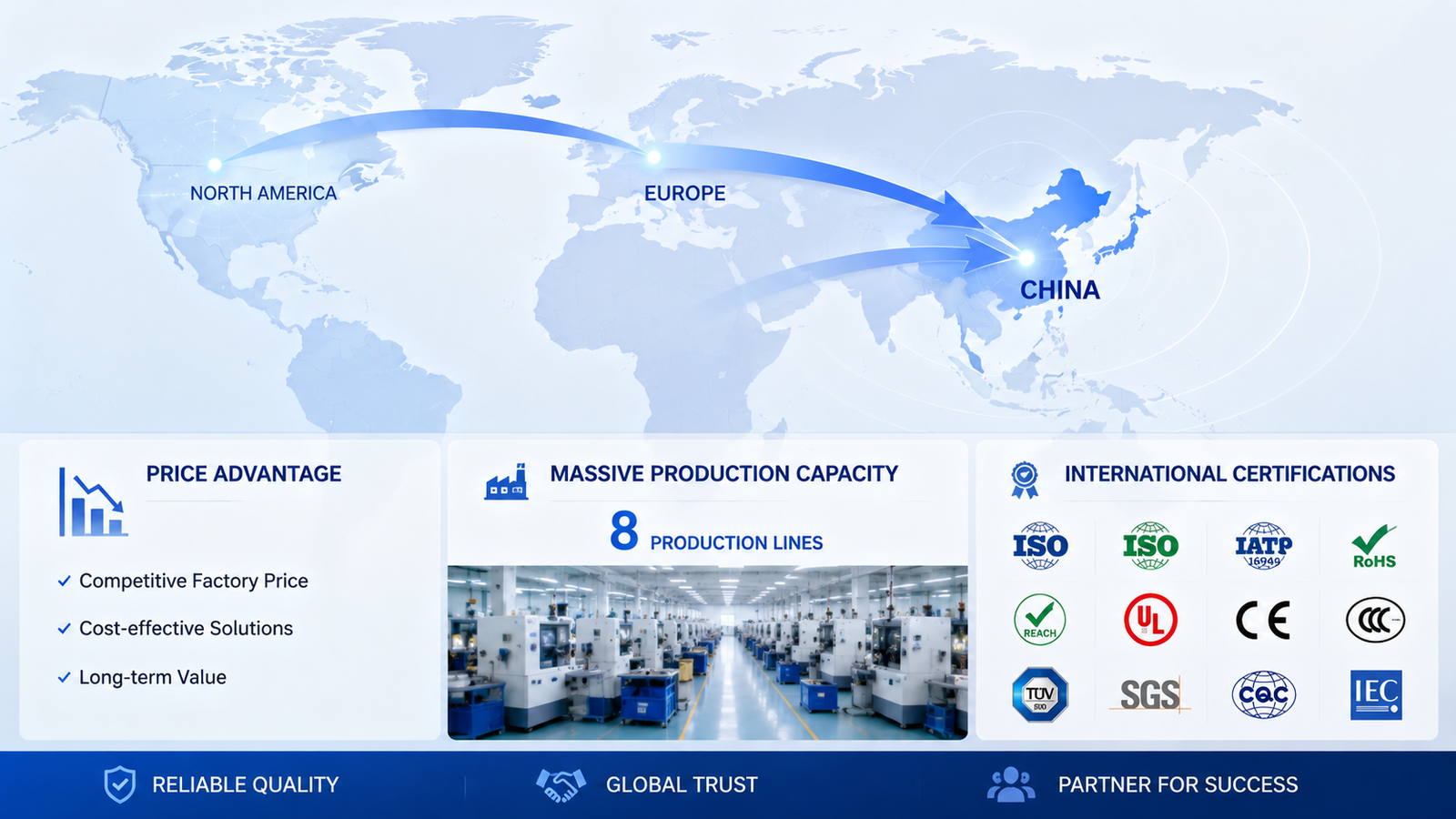
Our factory operates eight production lines and uses winding, injection molding, assembly, inspection, and MES-supported traceability processes. We have more than 20 years of OEM/ODM experience. Buyers should still verify our current facility certificates, product-specific declarations, UL recognition where required, quality records, and compliance scope for their particular application.
We see a strong fit in:
- Pneumatic valve coils
- Fluid-control components
- Home appliance assemblies
- Automotive component projects
- Miniature electromagnetic products
- Application-specific OEM coils
Most importantly, we try to review mass-production manufacturability before approving the design, rather than treating production planning as a separate step after the prototype works.
4. TLX Technologies — Best fit for application-specific motion control
We would examine TLX Technologies when a project needs more than a standard cylindrical solenoid. Its public portfolio includes custom solenoids, latching devices, actuators, valves, and related electromagnetic solutions.
This positioning can suit projects involving unusual motion profiles, space restrictions, holding-force requirements, or power limitations. During qualification, we would ask how prototype processes transfer to normal production, which environmental tests are available, and whether the proposed factory has enough equipment redundancy for the forecast volume.
5. Johnson Electric / Ledex — Best fit for global platform programs
We would shortlist Johnson Electric and its Ledex solenoid portfolio for global programs that may benefit from a large motion-products organization. The broader group publicly offers motors, solenoids, switches, pumps, and integrated motion solutions across multiple industries.
A large organization can offer scale, but it can also create practical questions for a specialized project. We would confirm whether our expected annual volume receives dedicated engineering support, which division owns the project, where samples and production units will be made, and how quickly the organization can approve drawing or material changes.
6. Geeplus — Best fit for comparing different actuator technologies
We would consider Geeplus when engineers have not yet decided whether a conventional solenoid coil, voice coil, rotary actuator, or another electromagnetic approach provides the best result. The company publicly presents a broad range of electromagnetic actuation technologies and custom-development support.
That breadth can help during concept selection. However, buyers should verify where design authority and manufacturing responsibility sit. We would also request a clear qualification plan covering life testing, temperature, vibration, electrical consistency, and the transition from development quantities to series production.
7. NSF Controls — Best fit for UK and European custom mechanisms
We would examine NSF Controls for custom solenoid and electromechanical projects that benefit from UK-based engineering communication. Its public product positioning includes solenoids, switches, and customized mechanisms.
This type of supplier can be attractive when engineers need close design discussions or lower-volume specialist production. We would ask about viable production volumes, tooling ownership, subcontracted processes, business-continuity arrangements, and the precise facility scope covered by current quality certificates.
8. Deltrol Controls — Best fit for North American industrial projects
We would consider Deltrol Controls for industrial solenoid, valve, and control applications, especially when North American engineering and supply support matter. Its public portfolio includes electromagnetic and fluid-control products.
For a custom coil program, we would determine whether the proposal modifies an established platform or creates a new design. That distinction affects tooling cost, technical freedom, testing requirements, and production risk. We would also verify coil sealing options, duty-cycle limits, temperature assumptions, and component change-control procedures.
9. ROSS DECCO — Best fit for established industrial coil applications
We would evaluate ROSS DECCO for industrial, pneumatic, and hydraulic environments where proven coil and solenoid-operator formats may already exist. Its public positioning covers solenoid components and replacement-coil applications.
This supplier may be especially relevant when the project can use or adapt an existing construction. We would not assume that a wide standard range equals full custom engineering capability. We would ask which parameters can be changed, what testing supports those changes, and whether a modified design receives a controlled new part number and validation record.
10. Sag Harbor Industries — Best fit for custom winding and US sourcing
We would shortlist Sag Harbor Industries when a buyer values custom wound-component experience and US-based production options. Its publicly presented capabilities include coils, solenoids, transformers, and related winding services.
We would examine whether its equipment matches the required wire gauge, bobbin geometry, termination method, and annual volume. We would also review automation, operator controls, resistance-test limits, winding-program security, material traceability, and capacity for repeat orders.
We recommend using this list to identify RFQ candidates. We do not recommend treating it as a substitute for an application-specific engineering review or on-site supplier audit.
What Customization Capabilities Matter Most When Comparing Custom Solenoid Coil Manufacturers?
Some suppliers describe a voltage change or a different lead wire as custom engineering. Those changes may be useful, but they provide limited evidence of development capability. The difficult work begins when electrical performance, thermal limits, available space, materials, tooling, and target cost conflict.
We do not consider changing a 24 V coil to 12 V, or replacing one lead wire, to be meaningful proof of custom engineering capability. A capable supplier should evaluate the interactions among force, current, power, temperature, space, insulation, materials, manufacturing repeatability, service life, and cost.
Custom engineering requires trade-off management
A coil design rarely has one independent objective. Increasing the number of turns may improve magnetomotive force under some conditions6, but it also changes resistance, wire size, winding space, and thermal behavior. Increasing wire diameter may lower resistance, but the winding may no longer fit inside the available bobbin window.
We use the following relationship as a simple review framework:
| Design variable | Potential benefit | Possible trade-off |
|---|---|---|
| More turns | Higher ampere-turn potential | Higher resistance, longer winding time, reduced wire diameter |
| Thicker wire | Lower resistance and higher current capacity | Fewer turns within the same space |
| Higher power | Faster actuation or greater force | More heat and shorter allowable duty cycle |
| Smaller coil | Compact assembly | Harder winding, molding, insulation, and heat dissipation |
| Higher-temperature materials | Improved thermal margin | Higher material and processing cost |
| Encapsulation | Moisture and mechanical protection | Added tooling, thermal stress, and rework difficulty |
| Tighter tolerances | Better assembly control | Higher tooling and inspection cost |
A serious design review should connect these variables to the magnetic circuit. The pole geometry, air gap, plunger material, return path, and spring or hydraulic load can matter as much as the coil itself.7
Our thin-wall miniature bobbin project
In one custom project, a customer required a very small coil for a miniature stepper motor. The electrical specification was not the main difficulty. The bobbin wall was extremely thin, which created risks in injection-molding stability, winding deformation, insulation integrity, and repeatable production.8
The development path followed several steps:
- We reviewed the customer drawing.
- We completed a design-for-manufacturing review.
- Our engineers discussed the thin-wall and winding risks with the customer.
- We optimized the design and process assumptions.
- We produced and evaluated prototypes.
- We transferred the controlled process into mass production.
The important lesson was simple: custom capability does not mean winding exactly to a customer drawing. A drawing can describe the intended geometry while still containing features that are difficult to mold, wind, terminate, inspect, or reproduce.
We believe a capable manufacturer should identify those problems before production tooling is finalized. In some projects, a small change to a bobbin radius, flange, wire path, terminal support, or molding gate can reduce risk without changing the customer’s functional interface.
Why Do Custom Solenoid Coil Manufacturers Need to Prove Mass-Production Reliability?
Several excellent prototypes can create false confidence. Prototype technicians can adjust winding tension manually, select ideal materials, and inspect every step under engineering supervision.9 Normal production cannot depend on constant intervention, so an uncontrolled process may fail after the order moves to higher quantities.
In our experience, approving a custom coil supplier based on several good prototypes is not enough. The real test is whether resistance, winding geometry, dimensions, insulation performance, terminal strength, and thermal behavior remain consistent after the design moves into normal mass production.
Prototypes and production have different conditions
A prototype batch may receive exceptional attention. Engineers may slow the winding machine, reposition wire manually, select the best molded bobbins, or apply additional insulation. These actions help prove the concept, but they may hide weaknesses in the planned production process.
Mass production introduces more variation10:
- Different wire and resin lots
- Multiple machines and operators
- Tool wear
- Changes in ambient temperature and humidity
- Normal machine speed
- Shift-to-shift setup differences
- Terminal and connector lot variation
- Maintenance and calibration cycles
We therefore ask for evidence of process capability and repeatability, not only a sample report.
What production validation should measure
A production trial should use representative equipment, materials, operators, tooling, and cycle times. Depending on the application, we would review:
- Resistance distribution at a defined reference temperature
- Coil dimensions and winding envelope
- Turn count or winding-program control
- Hi-pot or dielectric withstand results
- Insulation resistance
- Surge or shorted-turn testing, where applicable
- Lead-wire pull or terminal retention
- Encapsulation appearance and void control
- Temperature rise at rated and worst-case conditions
- Functional testing in the actual magnetic assembly
- Lot and material traceability
A common industrial benchmark for a stable critical process is Cpk ≥ 1.3311, although buyers and suppliers should agree on the actual requirement. A capability number also has little value if the measurement system is unreliable12 or if data come from a specially controlled prototype run.
We separate 100% tests from sampling inspections
Not every characteristic needs 100% inspection, and not every risk can be controlled through sampling. We generally treat resistance, continuity, and selected electrical safety checks as candidates for full outgoing testing. We may use statistically defined sampling for dimensions or destructive tests.
SolenElec’s stated process combines 100% outgoing inspection with sampling based on ISO 9001 quality procedures. For any real RFQ, we would define the exact test items, limits, instruments, sampling level, reaction plan, and record-retention period in the control plan.
Failure analysis also matters. A supplier should be able to contain suspect stock, trace affected lots, identify the root cause, and implement corrective action. Simply sending replacement coils does not protect an OEM from repeated warranty failures.
How Should We Choose the Right Custom Solenoid Coil Supplier for an OEM Project?
OEM teams often compare unit prices before they have aligned technical assumptions. That approach produces quotations that look comparable but may include different materials, testing, tooling life, quality controls, or logistics. A low initial quote can therefore create higher validation, warranty, and supply-chain costs later.
We choose a custom solenoid coil supplier through a staged process: define the application, issue a controlled RFQ, review engineering feedback, audit production controls, validate representative samples, run a pilot lot, and monitor early production. We also compare total program risk rather than unit price alone.

Step 1: Build a complete technical requirement
We recommend giving each shortlisted manufacturer the same controlled data package. It should include:
- 2D drawings and 3D models
- Electrical requirements and tolerances
- Duty cycle and operating sequence
- Ambient and maximum component temperatures
- Required force, stroke, response, or valve performance
- Insulation and dielectric requirements
- Environmental exposure
- Connector and lead-wire specifications
- Target life
- Annual forecast and peak demand
- Packaging and traceability requirements
- Applicable standards and customer-specific requirements
Qualified engineers should confirm the final design limits. Compliance specialists should determine which product approvals and regulatory documents apply to the finished equipment.
Step 2: Score the engineering response
We learn more from the supplier’s questions than from its sales presentation. A useful supplier should identify missing inputs and explain design risks.
| Evaluation area | Suggested weighting |
|---|---|
| Application understanding and engineering feedback | 25% |
| Production repeatability and quality control | 25% |
| Prototype and validation capability | 15% |
| Compliance documentation and traceability | 10% |
| Capacity, delivery, and continuity planning | 10% |
| Commercial sustainability | 10% |
| Communication and project management | 5% |
The weighting should change according to the application. An automotive safety-related program may assign more weight to traceability, change control, and facility-level automotive certification. A lower-volume industrial project may place more value on flexible engineering support.
Step 3: Audit the intended production process
We prefer to audit the factory that will make the parts, not just a corporate office or prototype workshop. The audit should follow the actual material and process flow:
- Incoming copper wire, resin, terminals, and insulation
- Material identification and storage
- Bobbin molding or incoming bobbin inspection
- Winding program setup and access control
- Wire termination and soldering
- Encapsulation or overmolding
- Electrical and dimensional inspection
- Nonconforming-product control
- Packaging and shipment
- MES or batch traceability records
We would also look for backup equipment, preventive maintenance, gauge calibration, operator training, and documented reaction plans.
Step 4: Compare total cost, not just piece price
The lowest quoted price may exclude essential costs or depend on unrealistic volume assumptions. We compare:
- Tooling and maintenance charges
- Engineering and validation fees
- Minimum order quantity
- Material escalation clauses
- Test coverage
- Packaging
- Freight and duties
- Inventory commitments
- Lead time
- Warranty responsibilities
- Change-control costs
- End-of-life support
A commercially sustainable quotation matters. If a supplier wins the project at an unsupportable price, it may later seek uncontrolled material substitutions, resist small orders, or reduce inspection effort. We want a price that supports stable production for both parties.
Step 5: Use a pilot run before full release
We do not recommend moving directly from a few hand-supported samples to unrestricted production. A pilot lot should use the intended tooling, work instructions, equipment, test limits, and normal operators.
The OEM team should review:
- Resistance distribution across the pilot lot
- Critical dimensions and winding consistency
- Electrical insulation and dielectric test results
- Temperature rise under representative operating conditions
- Functional performance in the final magnetic assembly
- Terminal, lead-wire, or connector retention
- Encapsulation and molding consistency
- Process capability for critical characteristics
- Traceability records
- Any deviations, rework, or manual adjustments required during production
We pay particular attention to the last point. A pilot lot that meets the drawing only because engineers repeatedly adjust the winding, select parts manually, or rework assemblies is not ready for mass production.
In our view, a successful pilot run should prove the process, not just the product.
If the supplier can manufacture representative parts using normal equipment, operators, cycle times, materials, and inspection controls while maintaining the agreed specifications, the OEM has much stronger evidence that the design is ready for production release.
Our Final Recommendation: Choose Engineering Capability Before Catalog Size
After working with custom solenoid coil projects, we have developed a clear view: the best custom solenoid coil manufacturer is not necessarily the company with the largest catalog, the lowest quotation, or the most impressive prototype.
For a standard replacement coil, those factors may be sufficient to build a shortlist. For a genuinely custom OEM project, we would prioritize suppliers in this order:
- Application understanding
- Engineering and DFM capability
- Ability to identify design risks before tooling
- Prototype and validation capability
- Mass-production repeatability
- Quality control and traceability
- Long-term engineering support
- Commercial sustainability
- Unit price
We deliberately place unit price near the end of the list.
That does not mean cost is unimportant. OEM programs must remain commercially competitive. However, saving a small amount on the coil has little value if the project later suffers from unstable resistance, excessive temperature rise, bobbin deformation, winding damage, inconsistent magnetic performance, or repeated field failures.
The earlier a coil supplier identifies these risks, the less expensive they usually are to correct.
A Working Prototype Is Only the Beginning
One of the most important lessons from our own custom projects is that prototype success and manufacturing success are not the same thing.
A coil can meet its voltage, resistance, force, and dimensional targets in a small prototype batch and still be difficult to manufacture consistently.
Our miniature thin-wall bobbin project demonstrated this clearly. The electrical specification was achievable, but the extremely thin bobbin created manufacturing risks that could not be solved simply by adjusting the winding machine. The design and manufacturing process had to be reviewed together before the product could move reliably into volume production.
That experience shaped how we evaluate custom coil projects today.
When we receive a new OEM coil requirement, our first question is not simply:
“Can we make this sample?”
The more important question is:
“Can we manufacture this design repeatedly, at the required quality, cost, and volume after the project enters mass production?”
We believe that is the question OEM engineers should also ask when comparing custom solenoid coil manufacturers.
When Should You Consider SolenElec for a Custom Solenoid Coil Project?
SolenElec is particularly relevant when an OEM project requires more than selecting an existing coil from a catalog.
We support custom development involving areas such as:
- Coil dimensions and winding-space optimization
- Voltage, resistance, and power requirements
- Magnetic and thermal design trade-offs
- Bobbin design and material selection
- Lead wires, terminals, and connector configurations
- Encapsulation and environmental protection
- Prototype development
- Design-for-manufacturing review
- Production tooling
- Pilot production
- Electrical and dimensional inspection
- Transition to repeatable volume manufacturing
Our strongest fit is not every electromagnetic project.
We are most useful when an OEM needs a supplier that can work through practical coil-manufacturing problems with its engineering team and then carry the resulting design into production.
This is particularly relevant for applications such as pneumatic valves, fluid-control systems, home appliances, automotive components, and other equipment requiring application-specific electromagnetic coils.
Questions to Ask Before Sending Your RFQ
Before contacting any manufacturer on this list, we recommend preparing the following information:
- What voltage will the coil actually receive?
- Is the application AC or DC?
- What resistance or power range is acceptable?
- What magnetic force or actuator performance is required?
- What is the available winding and installation space?
- What are the maximum ambient and operating temperatures?
- Is the coil continuous-duty, intermittent-duty, or pulse-operated?
- What insulation and dielectric requirements apply?
- Will the coil be exposed to water, oil, chemicals, vibration, or other environmental stresses?
- What lead wire, terminal, or connector is required?
- What annual production volume is expected?
- What service life or cycle requirement must the assembly achieve?
- Which certifications, approvals, and traceability documents are mandatory?
If several of these requirements are still unknown, we recommend discussing the application with the coil manufacturer before freezing the drawing.
In our experience, early engineering discussion is much less expensive than correcting a manufacturability or thermal problem after tooling has been released.
Need a Custom Solenoid Coil for Your OEM Project?
If you are developing a new solenoid coil or trying to improve an existing design, send us your drawing, electrical requirements, operating conditions, application details, and expected production volume.
The SolenElec engineering team can review the project from both the coil-performance and manufacturability perspectives, including winding space, resistance, power, temperature rise, bobbin structure, connection method, materials, tooling, and production feasibility.
We do not believe the goal of custom coil development should be merely to produce a prototype that works.
The goal should be to develop a coil that works in the application and can still be manufactured consistently when production reaches thousands of pieces.
If you already know the application, these pages are a faster starting point than the brand list:
- Coil selection for pneumatic valves
- Drop-in coil compatibility checklist
- DIN connector coil selection
- Solenoid coil series
- Solenoid valves
FAQ
What information does a custom solenoid coil manufacturer need for a quotation?
At minimum, we recommend providing the coil dimensions or drawing, operating voltage, AC or DC requirement, resistance or power target, duty cycle, ambient temperature, connection method, application information, expected annual volume, and any required certifications or environmental protection.
For a new design, magnetic-force, stroke, air-gap, and actuator information can also help the manufacturer evaluate the coil as part of the complete electromagnetic system.
Can a solenoid coil manufacturer customize an existing coil design?
Yes. Depending on the design, manufacturers may be able to modify voltage, resistance, power, winding configuration, bobbin dimensions, lead wires, terminals, connectors, insulation materials, or encapsulation.
However, we recommend reviewing the complete design whenever a major electrical or dimensional parameter changes. Changing one parameter can affect temperature rise, magnetic performance, winding space, insulation, and manufacturing repeatability.
What is the difference between a custom coil sample and a production-ready coil?
A custom sample proves that the proposed design can potentially meet the required performance.
A production-ready coil should additionally demonstrate that the same result can be reproduced using normal production equipment, tooling, materials, operators, cycle times, and quality controls.
We consider this distinction one of the most important parts of custom solenoid coil development.
How should OEMs compare custom solenoid coil manufacturers?
We recommend comparing application understanding, engineering capability, DFM support, prototype validation, manufacturing repeatability, quality controls, traceability, supply stability, and long-term commercial support.
Price should be compared only after the suppliers are quoting against equivalent technical and quality requirements.
Should OEMs choose the solenoid coil manufacturer with the lowest price?
Not automatically.
For a mature standard coil with several qualified sources, price can become an important differentiator. For a new custom design, however, we believe engineering capability and production repeatability should come first.
A lower piece price rarely compensates for tooling revisions, production instability, assembly problems, warranty failures, or an unexpected supplier change after product launch.
How do I know whether a custom solenoid coil design is ready for mass production?
We would look for successful prototype validation followed by a representative pilot run using the intended production process.
Critical electrical, dimensional, thermal, insulation, and functional characteristics should remain within agreed limits without excessive manual adjustment or rework. The supplier should also have defined process controls, traceability, inspection methods, and reaction plans before full production release.
"Resistivity and Temperature Coefficient at 20 C", http://hyperphysics.phy-astr.gsu.edu/hbase/Tables/rstiv.html. University or NIST materials data describe copper as having a positive temperature coefficient of resistance, supporting the statement that copper winding resistance increases with temperature. Evidence role: mechanism; source type: education. Supports: Copper conductors have a positive temperature coefficient of resistance, so winding resistance increases as temperature rises.. ↩
"A method of adjusting the temperature coefficient and ...", https://nvlpubs.nist.gov/nistpubs/jres/12/jresv12n2p147_A2b.pdf. Reference data for copper list a temperature coefficient of resistance near 0.0039 °C⁻¹ at room temperature, supporting the engineering approximation of about 0.393% resistance increase per degree Celsius. Evidence role: statistic; source type: government. Supports: The temperature coefficient of resistance for copper near room temperature is approximately 0.0039 per degree Celsius.. Scope note: The coefficient is an approximation around a reference temperature and varies somewhat with copper purity, alloying, and temperature range. ↩
"Isolierstoffklasse", https://de.wikipedia.org/wiki/Isolierstoffklasse. Electrical insulation standards such as IEC 60085 and related NEMA references define thermal classes in which Class B, Class F, and Class H are associated with 130°C, 155°C, and 180°C respectively. Evidence role: definition; source type: institution. Supports: Electrical insulation thermal classes B, F, and H correspond to common maximum temperature designations of 130°C, 155°C, and 180°C.. Scope note: The class rating applies to the insulation system or material classification under specified test assumptions and does not by itself prove suitability of a complete coil assembly. ↩
"How Ambient Temperature Affects Solenoid Coil Selection ...", https://solenelec.com/how-ambient-temperature-affects-solenoid-coil-selection-preventing-overheating-and-performance-failure/. Standards and certification guidance for electrical insulation systems treat thermal class as a property of the evaluated system of insulating materials, supporting the statement that high-temperature wire alone does not qualify the complete coil for the same temperature. Evidence role: expert_consensus; source type: institution. Supports: Thermal suitability is evaluated at the insulation-system or assembly level, not solely by the temperature rating of magnet wire.. Scope note: Such references provide a general compliance principle; final suitability depends on the exact materials, geometry, temperature profile, and applicable product standard. ↩
"ISO 9000 family", https://en.wikipedia.org/wiki/ISO_9000_family. ISO guidance distinguishes management-system certification from product certification, supporting the article’s distinction between a quality-management certificate and a product-specific approval. Evidence role: definition; source type: institution. Supports: Management-system certification, such as ISO 9001, certifies organizational processes rather than approving a specific product.. ↩
"How Should You Design a Coil for Better Performance and Long ...", https://solenelec.com/how-should-you-design-a-coil-for-better-performance-and-long-term-reliability/. Electromagnetics texts define magnetomotive force as proportional to ampere-turns, supporting the statement that increasing turns can increase magnetic drive when current and circuit conditions permit. Evidence role: mechanism; source type: education. Supports: Magnetomotive force in a coil is proportional to ampere-turns, the product of current and number of turns.. Scope note: The relationship is contextual because adding turns also changes resistance, current, heating, and magnetic saturation behavior in a real actuator. ↩
"Why Doesn't My Solenoid Valve Release? Common Causes of ...", https://solenelec.com/why-doesnt-my-solenoid-valve-release-common-causes-of-residual-magnetism/. Educational treatments of electromagnetic actuators show that force depends on magnetic-circuit geometry, air-gap reluctance, magnetic materials, and load conditions, supporting the article’s statement that these factors can be as important as the coil winding. Evidence role: mechanism; source type: education. Supports: Solenoid force and response are influenced by magnetic-circuit geometry, air gap, ferromagnetic materials, and opposing mechanical or fluid loads.. ↩
"Custom Stepper Motor Coil Case Study: Solving Thin-Wall Bobbin ...", https://solenelec.com/custom-stepper-motor-coil-case-study/. Research and design guidance on thin-wall injection molding report increased sensitivity to filling, cooling, warpage, and dimensional control, providing contextual support for the article’s concern that very thin bobbin walls can raise molding and repeatability risks. Evidence role: general_support; source type: research. Supports: Thin-wall plastic parts are more sensitive to molding defects, dimensional instability, and process variation, which can affect downstream assembly.. Scope note: The source would support the general manufacturability mechanism rather than directly verifying the specific bobbin project described. ↩
"How Do OEMs Evaluate Parker Solenoid Valve Alternatives Beyond ...", https://solenelec.com/how-do-oems-evaluate-parker-solenoid-valve-alternatives-beyond-price-and-specifications/. Manufacturing process-validation and production-approval guidance emphasizes representative production conditions, supporting the article’s distinction between manually supported prototypes and normal mass production. Evidence role: general_support; source type: institution. Supports: Production validation should use representative materials, equipment, tooling, operators, and process conditions rather than relying only on engineering prototypes.. Scope note: This is contextual support; the exact controls required vary by industry, product risk, and customer-specific quality requirements. ↩
"Why Do Some Solenoid Valves Last Longer? Engineering Factors ...", https://solenelec.com/why-do-some-solenoid-valves-last-twice-as-long-a-field-technicians-perspective/. Statistical process control references, including NIST engineering statistics materials, identify equipment, material, operator, environmental, and measurement effects as sources of process variation, supporting the article’s statement that mass production introduces additional variation. Evidence role: mechanism; source type: government. Supports: Manufacturing processes are affected by variation from materials, equipment, operators, environment, setup, and measurement systems.. ↩
"6.1.6. What is Process Capability?", https://www.itl.nist.gov/div898/handbook/pmc/section1/pmc16.htm. Quality-engineering references commonly describe Cpk = 1.33 as corresponding to a process whose natural variation fits within specification limits with a four-sigma margin, supporting its use as a common industrial capability benchmark. Evidence role: statistic; source type: research. Supports: Cpk values around 1.33 are widely used as a practical minimum capability benchmark in industrial quality control.. Scope note: The threshold is a convention rather than a universal rule; required capability depends on product risk, customer requirements, sample size, and measurement-system validity. ↩
"6.1.6. What is Process Capability?", https://www.itl.nist.gov/div898/handbook/pmc/section1/pmc16.htm. Measurement-system analysis references explain that gauge error and measurement variation can bias or obscure observed process variation, supporting the statement that a capability number has limited value when the measurement system is unreliable. Evidence role: mechanism; source type: government. Supports: Measurement-system variation can distort process data and undermine conclusions drawn from capability indices.. ↩