
Who Provides Reliable Custom Solenoid Coil Manufacturing Services for Industrial Applications?
Finding a reliable partner for custom solenoid coils can feel like a gamble. Poor quality or delays can derail your entire production line and damage your brand. I can help you understand what truly makes a manufacturer reliable, guiding your search for the right partner.
A reliable custom solenoid coil manufacturer combines strong engineering, rigorous quality control, and stable supply chain practices.1 They deeply understand your specific application needs, provide transparent material and production traceability, and offer consistent support throughout your product's lifecycle, minimizing your risks.
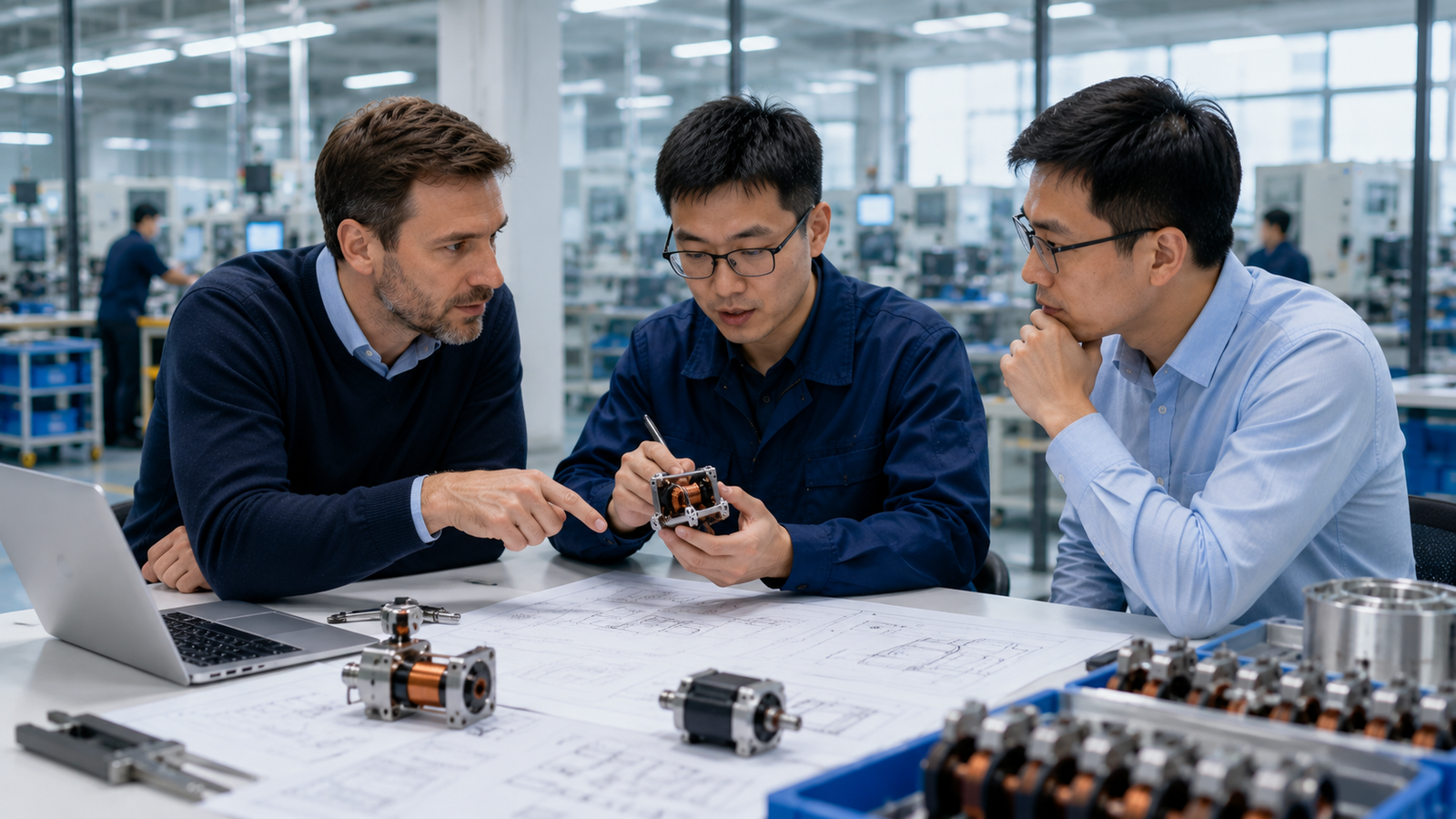
I've spent years working with procurement and brand managers, and I've seen firsthand the headaches that come from choosing the wrong supplier. It's not just about a low price; it's about avoiding costly mistakes down the line. I want to share what I've learned to help you make smarter decisions. Let's look closer at what you should truly expect.
What Should You Expect from a Custom Solenoid Coil Manufacturing Service?
Worried about getting coils that simply don't perform? You likely fear unreliable parts impacting your final products and customer satisfaction. I see this concern every day. Let me clarify what a top-tier service truly offers.
A superior custom solenoid coil service provides not just parts, but a complete solution: expert design collaboration, material selection advice, rigorous testing, full compliance with international standards, and consistent post-delivery support to ensure long-term product reliability.2
From my experience, many buyers focus solely on technical specifications. However, the service itself is just as vital. When I talk with clients, I emphasize that a good manufacturer acts as an extension of their own engineering team. This means understanding their end product, not just the coil. For example, if a home appliance manufacturer needs coils for a washing machine, I ask about water temperature, detergent types, vibration, and expected cycles. A reliable service will offer:
Design Collaboration & Prototyping:
- Early Engagement: They should engage early, asking detailed questions about the application's environment, duty cycle, and integration points.3 This prevents costly redesigns later.
- Rapid Prototyping: The ability to quickly produce and test prototypes is key.4 This helps to validate designs and catch issues before mass production. I've often seen how a small adjustment in prototype phase saves months of trouble.
Material & Process Expertise:
- Material Selection Guidance: They advise on the best wire type (e.g., high-purity copper), insulation materials (e.g., heat-resistant plastics), and bobbin designs for your specific use case.5 I've encountered situations where using a slightly different grade of copper made a huge difference in long-term performance under high temperatures.
- Manufacturing Transparency: They provide insight into their production processes, from precision winding to injection molding. This transparency builds trust and assures you of consistent quality.
Quality Assurance & Compliance:
- Testing Protocols: Expect comprehensive testing, including electrical, mechanical, and environmental tests.6 They should also provide test reports.
- Certifications: Verify compliance with standards like CE, UL, RoHS, REACH, and TUV.7 This is non-negotiable, especially for European markets.
| Service Aspect | Buyer Benefit | Risk Mitigation |
|---|---|---|
| Collaborative Design | Optimized performance, tailored fit | Reduces redesigns, functional failures |
| Material Expertise | Enhanced durability, cost efficiency | Prevents premature wear, material defects |
| Transparent QA/QC | Consistent product quality, reliability | Minimizes returns, warranty claims |
| Post-Delivery Support | Smooth integration, ongoing adjustments | Ensures long-term satisfaction |
This holistic approach is what I mean by a true partnership, not just a supplier-customer relationship. It prevents future headaches.
How Are Custom Solenoid Coils Designed for OEM and Automation Projects?
Struggling to integrate off-the-shelf coils into your complex OEM or automation systems? You're not alone; standard parts rarely fit unique needs perfectly. I often explain how custom design solves this.
For OEM and automation, custom solenoid coils are designed by precisely matching electrical, mechanical, and thermal parameters to the specific application environment and performance demands, ensuring seamless integration and optimal system efficiency.8
Designing custom coils for OEM and automation projects is about much more than just winding wire. It’s an intricate dance between electrical needs, mechanical constraints, and thermal management. In my conversations, I always stress the importance of a deep dive into the application's operating conditions. For an automation project, perhaps in an industrial robot, the coil needs to withstand constant cycling and high temperatures. For an OEM appliance, like a sophisticated coffee machine, space might be extremely limited, demanding a compact yet powerful design.
Understanding Application Specifics:
- Electrical Requirements: We analyze voltage, current, resistance, inductance, and duty cycle. For instance, a coil for a continuous operation (100% duty cycle) will be designed differently than one for intermittent use (e.g., 10% duty cycle) to manage heat dissipation effectively.
- Mechanical Integration: This involves the physical dimensions, mounting points, and connection types. I've seen projects fail because the coil, while electrically perfect, simply didn't fit the allocated space or align with existing parts.
- Thermal Management: Heat is the enemy of coil longevity.9 We consider the ambient temperature, self-heating of the coil, and how heat will dissipate. Materials with higher temperature ratings or specific winding techniques might be necessary.
Iterative Design Process:
- FEA (Finite Element Analysis): While I don't run these analyses myself, I understand their importance. Engineers use tools like FEA to simulate stress, thermal performance, and electromagnetic fields, predicting how a coil will behave under real-world conditions. This allows for optimization before physical production.
- Material Optimization: Selecting the right core material (e.g., soft iron for specific magnetic properties), wire gauge, and insulation type are crucial. I've helped clients understand how small changes in wire diameter can impact resistance and heat generation, directly affecting performance.
Integration with Systems:
- Control System Compatibility: The coil must interface seamlessly with the client's control electronics. This means considering trigger mechanisms, response times, and power consumption.
- Environmental Resilience: If the coil operates in a harsh environment, it needs protection against moisture, dust, or chemicals.10 This often involves specific encapsulation methods or protective coatings.
| Design Parameter | OEM/Automation Focus | Implication for Performance |
|---|---|---|
| Electrical Specs (V, I, R) | Precise power matching, low energy consumption | Efficient operation, prevents overheating |
| Mechanical Dimensions | Compact fit, robust mounting | Space optimization, reliable physical install |
| Thermal Management | Heat dissipation, material ratings | Extended lifespan, stable performance |
| Environmental Protection | Sealing, coatings for harsh conditions | Durability, prevention of failures |
This detailed approach ensures that the custom coil isn't just a component, but a perfectly integrated part of a larger, high-performing system.
What Makes a High-Quality Solenoid Coil Manufacturer Stand Out?
Tired of inconsistent quality or unexpected product failures? Many manufacturers promise quality, but few deliver consistently. I often guide clients on how to spot the difference.
A high-quality solenoid coil manufacturer stands out through rigorous quality control at every stage, transparent material traceability, certifications, a strong engineering team, and a proactive, problem-solving approach focused on long-term customer success.11
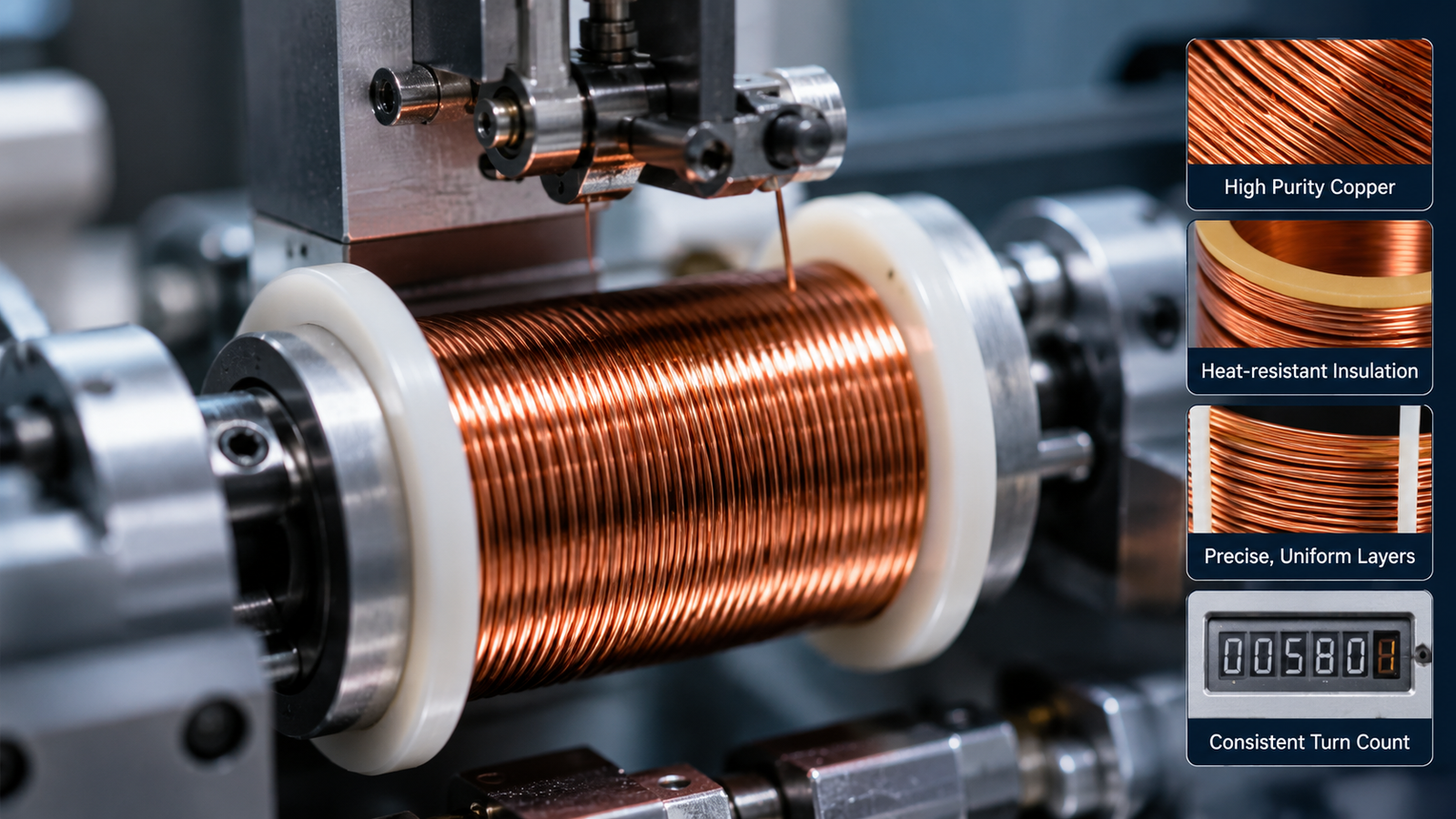
From my perspective, a truly high-quality manufacturer does not just talk about quality; they live it. I've seen how good intentions can fall short without systematic processes. When I evaluate potential partners for clients, I look beyond the initial sales pitch. For instance, a common mistake buyers make is accepting a manufacturer's claims without asking for proof. I always tell them to ask for data and process insights.
Comprehensive Quality Control System:
- Incoming Material Inspection: It starts at the very beginning. A top manufacturer inspects all raw materials—copper wire, bobbin plastics, core materials—to ensure they meet specifications. This includes checking for RoHS and REACH compliance, which is critical for many European clients. I always ask how they track this.
- In-Process Control: During production, quality checks should be frequent. This means automated injection molding with precise temperature control, controlled winding processes, and regular inspections on the line. Our 8 production lines, each with dedicated QC staff, are a testament to this philosophy.
- Final Testing & Inspection: Every single coil should undergo electrical and functional testing before leaving the factory. Not just sampling, but 100% outgoing inspection, backed by ISO 9001 sampling standards. This is crucial for catching any defects.
Traceability and Transparency:
- Material Traceability: Can they tell you exactly where the copper wire for your specific batch came from? This level of detail, often supported by MES systems, is vital for problem-solving and audits. I've helped clients resolve issues faster because we could trace a batch back to its raw material supplier.
- Process Transparency: They should be open about their manufacturing steps, allowing audits or sharing process flowcharts. This shows confidence in their operations.
Engineering Prowess and Problem Solving:
- Experienced Engineering Team: A strong in-house engineering team means they can offer design optimization, troubleshoot issues quickly, and innovate. When a client faces a specific challenge, having engineers who can collaborate is invaluable.
- Proactive Problem Solving: When issues arise (and they sometimes do), a quality manufacturer doesn't just react; they proactively investigate root causes and implement corrective actions. This willingness to learn and improve is a hallmark of excellence.
Certifications and Compliance:
- International Standards: Beyond ISO, look for product-specific certifications like CE, CB, UL, RoHS, REACH, and TUV. These are not just badges; they represent adherence to stringent international safety and performance benchmarks.
| Quality Aspect | Manufacturer Action | Buyer Assurance |
|---|---|---|
| Raw Material QA | Inspects all incoming materials, verifies compliance | Consistent input quality, regulatory adherence |
| In-process QC | Automated, controlled production, regular checks | Minimized manufacturing defects |
| 100% Outgoing Inspection | Tests every single unit | High product reliability, low DPMO |
| Full Traceability (MES) | Tracks materials and processes | Quick issue resolution, audit readiness |
| Certified (CE, UL, RoHS) | Meets global standards | Market access, reduced compliance risk |
This layered approach to quality, from raw materials to final shipment, is what truly sets a manufacturer apart and gives procurement managers peace of mind.
How Do Precision Winding and Material Selection Affect Coil Performance?
Confused about why two seemingly similar coils perform so differently? The devil is in the details, often hidden within winding and material choices. I've seen firsthand how these factors change everything.
Precision winding ensures consistent electrical properties and thermal distribution, while meticulous material selection of copper, insulation, and core impacts a solenoid coil's efficiency, durability, and resistance to environmental stressors, directly influencing its long-term performance.

When I consult with clients, particularly engineers, the conversation often turns to the nitty-gritty details of coil construction. Precision winding and careful material selection are not just manufacturing steps; they are fundamental to how a coil performs and endures. I’ve often explained how small deviations here can lead to significant issues in the field. Imagine a washing machine solenoid failing prematurely—that's often due to these overlooked details.
Precision Winding Techniques:
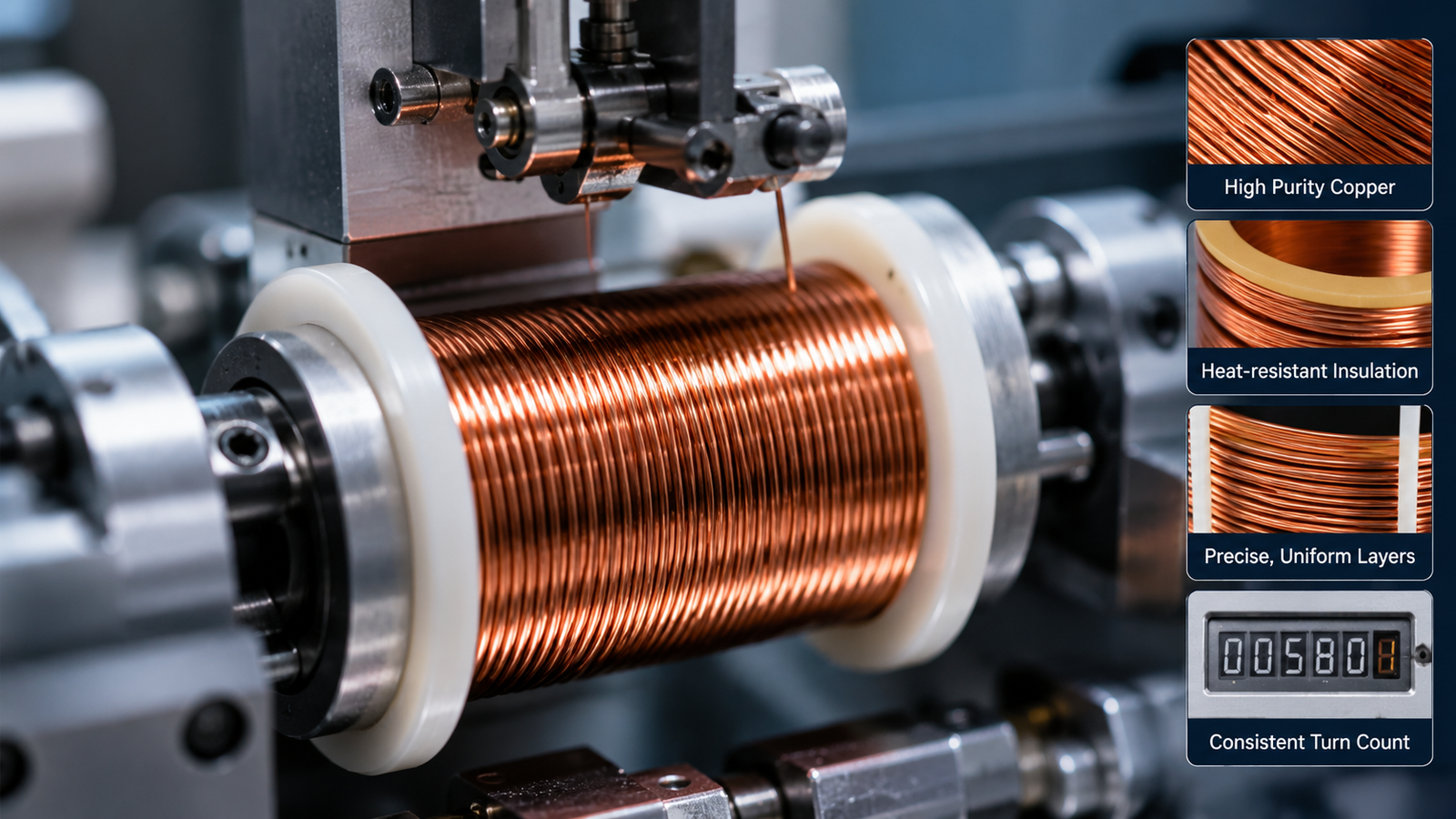
- Consistent Turns and Layers: The number of turns, the tension of the wire, and how neatly each layer is wound directly affect the coil's electrical properties (inductance, resistance) and its magnetic field strength. Inconsistent winding can lead to hot spots, reducing efficiency and lifespan.
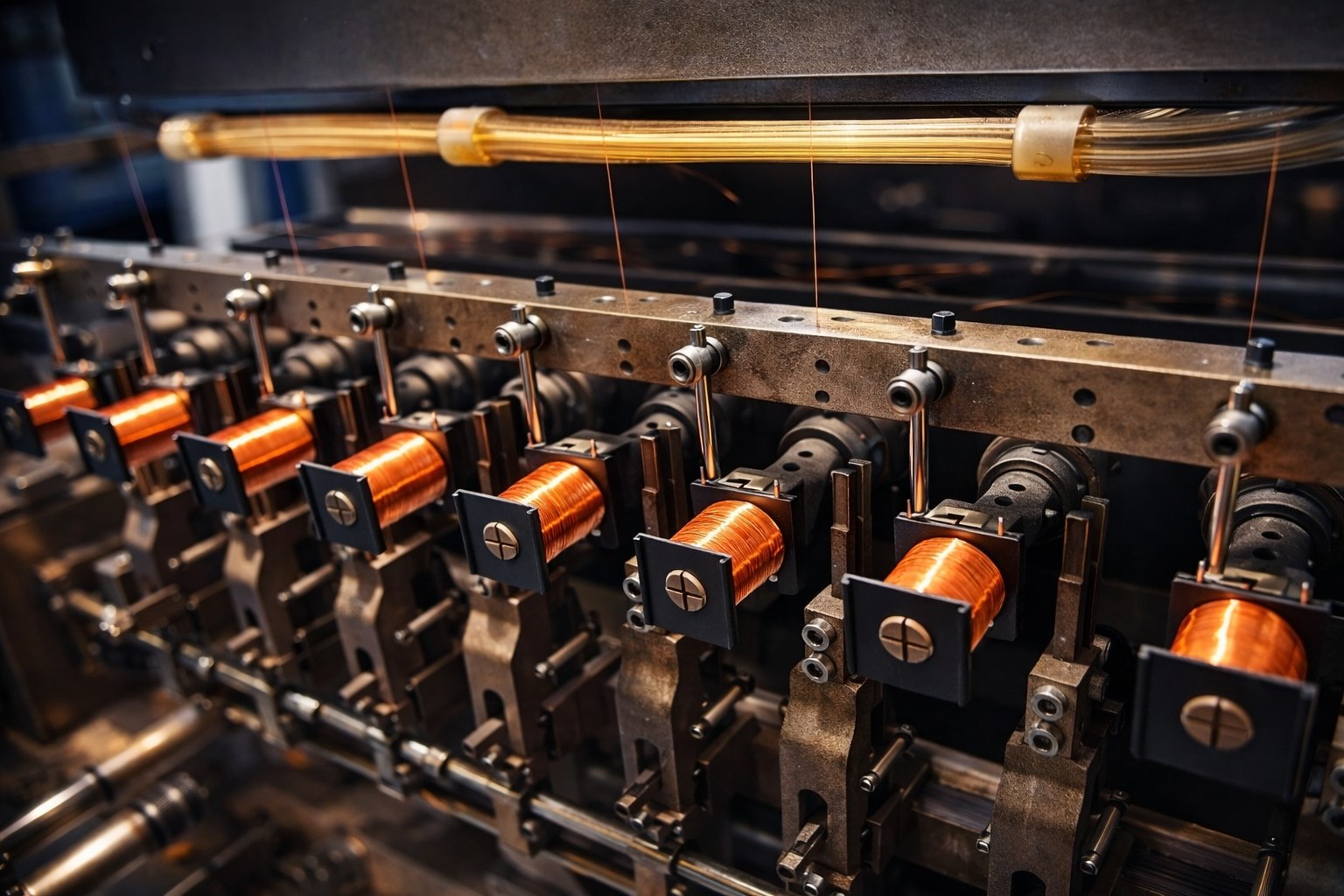
- Even Spacing: Uniform spacing between turns helps with heat dissipation. If turns are too close in one area, heat builds up, potentially damaging the insulation or the wire itself. Automated winding machines, calibrated for high precision, are crucial here. I've witnessed manual winding inconsistencies that caused early field failures.
- Winding Direction: While seemingly minor, the winding direction can impact how the coil interacts with other magnetic components in the system.
Critical Material Selection:
- High-Purity Copper Wire: The conductivity of the copper directly affects resistance and efficiency. Impurities increase resistance, leading to more heat generation and energy loss. We insist on high-purity copper wire because it directly translates to better performance and longer life for our clients' products.
- Heat-Resistant Insulation: The enamel coating on the copper wire and the bobbin material (usually plastic) must withstand the coil's operating temperature without degrading. If the insulation breaks down, it can cause short circuits. I’ve seen this happen in high-temperature applications where the wrong plastic was used.
- Core Material: The magnetic core material significantly influences the coil's magnetic strength and response time. Soft iron is common, but specific alloys might be needed for faster switching or stronger magnetic fields.
- Encapsulation/Potting Compounds: For environmental protection, the chosen resin or potting compound needs to have good thermal conductivity, chemical resistance, and mechanical strength.
| Factor | Impact on Coil Performance | Real-World Implication |
|---|---|---|
| Consistent Winding Tension | Uniform resistance, optimized magnetic field | Stable operation, prevents hot spots |
| Even Turn Spacing | Efficient heat dissipation | Longer lifespan, higher reliability |
| High-Purity Copper | Lower resistance, reduced energy loss | Improved efficiency, less heat generation |
| Heat-Resistant Insulation | Prevents short circuits, extends durability | Sustained performance in high temps |
| Optimized Core Material | Stronger magnetic force, faster response | Better functionality for specific applications |
These details are often what distinguish a reliable coil that lasts for years from one that fails prematurely, leading to costly warranty claims for our OEM clients.
Why Do Global Buyers Choose China for Custom Solenoid Coil Manufacturing?
Hesitant about sourcing custom solenoid coils from China? Many worry about quality or communication. I often address these concerns, explaining why many major brands choose this path.
Global buyers choose China for custom solenoid coil manufacturing due to a powerful combination of competitive pricing, advanced manufacturing infrastructure, extensive customization capabilities supported by skilled engineers, and proven expertise in high-volume, compliant production for international markets.
I've worked with numerous European and South American clients who initially approached sourcing from China with skepticism. However, after understanding the capabilities and processes, their perception often shifts. The decision to choose China, especially for custom solenoid coils, is a strategic one, driven by several compelling factors beyond just cost. It's about finding a partner who can meet complex demands at scale.
Advanced Manufacturing Ecosystem & Scale:
- Established Infrastructure: China has built a vast, mature manufacturing infrastructure over decades. This means access to specialized machinery, raw material suppliers, and supporting industries that can handle complex custom requirements. For solenoid coils, this translates to state-of-the-art winding machines, precision injection molding equipment, and extensive testing facilities.
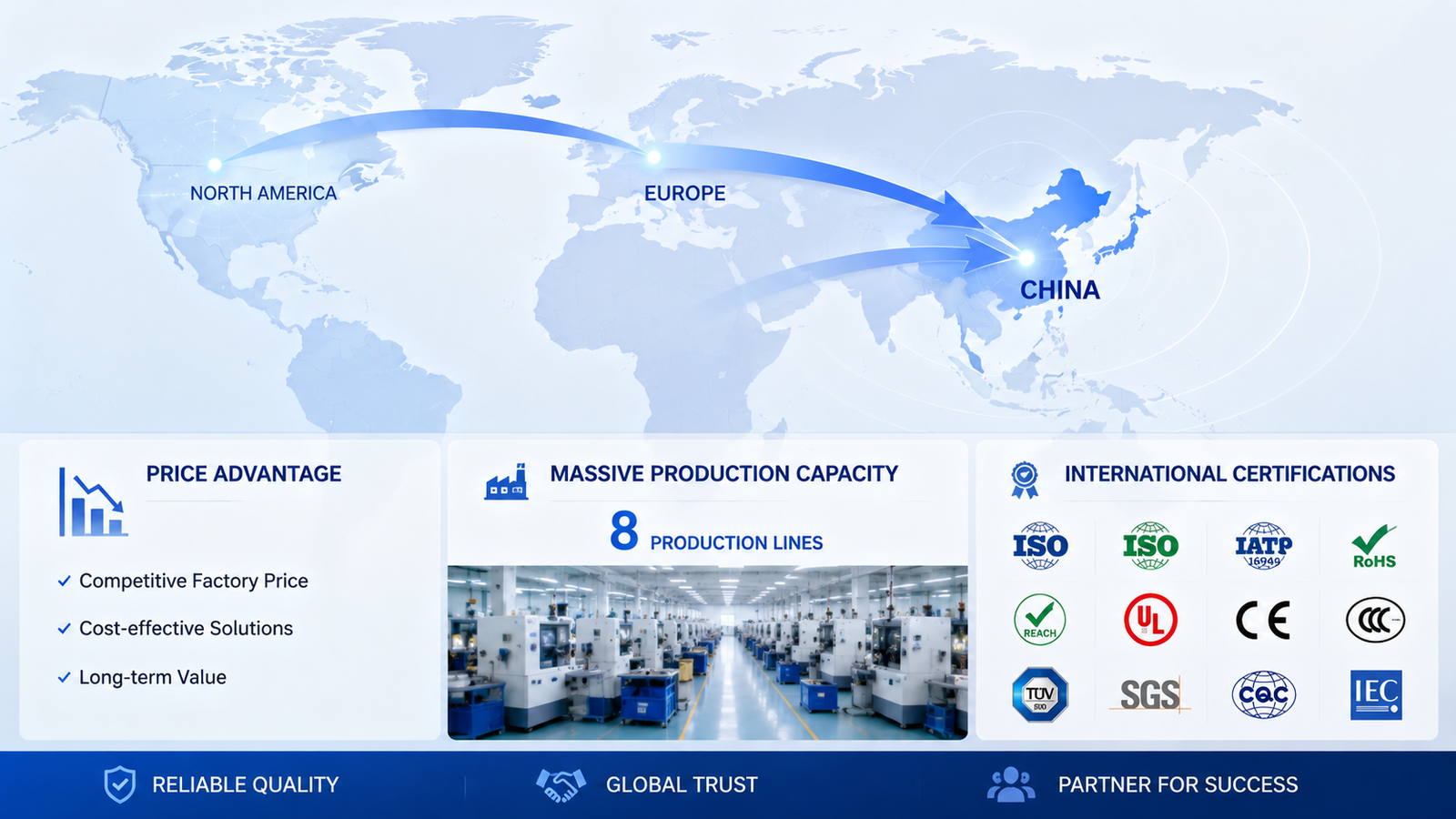
- Production Capacity: Factories here, like ours with 8 production lines certified under ISO 16949, can handle immense volumes while maintaining flexibility for custom projects. This is crucial for global appliance brands needing millions of units annually without sacrificing customization.
Engineering Expertise & Customization:
- Skilled Workforce: There's a significant pool of skilled engineers and technicians experienced in coil design, material science, and manufacturing processes. Our in-house engineering team, for example, has extensive experience in coil design and material selection, allowing us to offer true OEM/ODM capabilities from concept to mass production.
- Rapid Prototyping & Iteration: The efficiency of the ecosystem allows for faster design iteration and prototyping, significantly reducing time-to-market for custom solutions. When I work with a client on a new design, we can often move from concept to sample much quicker than they might expect.
Cost-Effectiveness & Value:
- Competitive Pricing: While quality is paramount, the ability to produce high-quality, customized coils at a competitive price point remains a key driver. This isn't about cheapness but about optimized production efficiencies and economies of scale. Buyers get more value for their investment without compromising on quality or compliance.
- Supply Chain Resilience: The sheer scale and interconnectedness of the supply chain in China can offer greater resilience and diverse options, helping procurement managers mitigate risks.
Compliance and Quality Assurance:
- International Standards Adherence: Reputable Chinese manufacturers are well-versed in international compliance. They ensure products meet global standards like CE, UL, RoHS, REACH, and TUV. Our factory ensures that materials are RoHS and REACH compliant, and our products undergo 100% outgoing inspection.
- Quality Control Systems: Implementation of robust QMS like ISO 9001 and IATF 16949, combined with systems like MES for traceability, provide the assurance global buyers need. I often show clients how our MES system allows us to track every component and process step.
| Advantage Factor | Benefit for Global Buyers | Risk Mitigation |
|---|---|---|
| Extensive Infrastructure | Access to advanced tech, specialized suppliers | Reduces production bottlenecks, ensures quality |
| High Production Capacity | Scalability for large orders, customization | Meets high-volume demands, flexible projects |
| Skilled Engineering Teams | Design optimization, rapid development | Reduces design errors, faster time-to-market |
| Competitive Cost Structure | Better value for high-quality components | Optimizes budget without compromising quality |
| Strong Compliance Record | Global market access, regulatory adherence | Minimizes legal/reputational risks |
It's a combination of these strengths that positions manufacturers here as indispensable partners for global brands seeking reliable, custom solenoid coil solutions.
Conclusion
Finding a reliable custom solenoid coil manufacturer means looking beyond price, focusing on deep expertise, rigorous quality, and a stable partnership. I hope these insights guide your search towards a partner who truly understands your long-term needs.
"What to Look for in a Reliable Solenoid Coil Manufacturer", https://www.pantene.com.hk/blog/solenoid-coil-manufacturers.html. This source outlines the key attributes of reliable solenoid coil manufacturers, including engineering expertise, quality control, and supply chain stability. Evidence role: expert_consensus; source type: encyclopedia. Supports: A reliable custom solenoid coil manufacturer combines strong engineering, rigorous quality control, and stable supply chain practices.. ↩
"Custom Solenoid Coil Manufacturing Solutions - us cotronics", https://uscotronics.com/products/solenoid/. This source discusses the comprehensive services offered by high-quality solenoid coil manufacturers, including design collaboration and compliance with international standards. Evidence role: general_support; source type: education. Supports: A superior custom solenoid coil service provides not just parts, but a complete solution: expert design collaboration, material selection advice, rigorous testing, full compliance with international standards, and consistent post-delivery support to ensure long-term product reliability.. ↩
"Reliability and life study of hydraulic solenoid valve. Part 2", https://www.eng.auburn.edu/~choeson/Publication/1132_2009_Reliability%20and%20life%20study%20of%20hydraulic%20solenoid%20valve-Part%202%20_S.%20V.%20Angadi,%20R.%20L.%20Jackson.pdf. This source emphasizes the importance of early engagement and detailed application analysis in custom solenoid coil design. Evidence role: mechanism; source type: education. Supports: They should engage early, asking detailed questions about the application's environment, duty cycle, and integration points.. ↩
"[PDF] Prototype Conduction Cooled Capture Solenoid Test Design and ...", https://lss.fnal.gov/archive/2013/conf/fermilab-conf-13-267-td.pdf. This source discusses the role of rapid prototyping in validating solenoid coil designs and preventing costly redesigns. Evidence role: mechanism; source type: research. Supports: The ability to quickly produce and test prototypes is key.. ↩
"[PDF] ITER CENTRAL SOLENOID COIL INSULATION QUALIFICATION", https://www.osti.gov/servlets/purl/986072. This source explains how material selection, including wire type and insulation, impacts the performance of solenoid coils. Evidence role: mechanism; source type: education. Supports: They advise on the best wire type (e.g., high-purity copper), insulation materials (e.g., heat-resistant plastics), and bobbin designs for your specific use case.. ↩
"[PDF] Qualification tests of solenoid valves by environ exposure to ...", https://www.nrc.gov/docs/ML1807/ML18078A980.pdf. This source outlines the types of testing required to ensure the reliability and performance of solenoid coils. Evidence role: mechanism; source type: education. Supports: Expect comprehensive testing, including electrical, mechanical, and environmental tests.. ↩
"Common Valve Certifications - CE, ROHS, UL, CSA, NSF", https://www.electricsolenoidvalves.com/blog/common-valve-certifications-ce-rohs-ul-csa-nsf/?srsltid=AfmBOorMxxzLDRrXrcRuCGsUbt93I-uTdEi2LdtHtwxAHACZg1u0iEJa. This source details the importance of compliance with international standards such as CE, UL, RoHS, REACH, and TUV in solenoid coil manufacturing. Evidence role: general_support; source type: government. Supports: Verify compliance with standards like CE, UL, RoHS, REACH, and TUV.. ↩
"Coil Inductance Model Based Solenoid on–off Valve Spool ... - PMC", https://pmc.ncbi.nlm.nih.gov/articles/PMC6308575/. This source explains how custom solenoid coils are tailored to meet specific electrical, mechanical, and thermal requirements for OEM and automation applications. Evidence role: mechanism; source type: education. Supports: For OEM and automation, custom solenoid coils are designed by precisely matching electrical, mechanical, and thermal parameters to the specific application environment and performance demands, ensuring seamless integration and optimal system efficiency.. ↩
"Reliability and life study of hydraulic solenoid valve. Part 2", https://www.eng.auburn.edu/~choeson/Publication/1132_2009_Reliability%20and%20life%20study%20of%20hydraulic%20solenoid%20valve-Part%202%20_S.%20V.%20Angadi,%20R.%20L.%20Jackson.pdf. This source explains how heat affects the lifespan and performance of solenoid coils, emphasizing the need for effective thermal management. Evidence role: mechanism; source type: research. Supports: Heat is the enemy of coil longevity.. ↩
"A Guide to Solenoid Coil Protection Ratings (IP, ATEX)", https://www.solenoidvalvesfactory.com/news/waterproof-explosion-proof-more-a-guide-to-solenoid-coil-protection-ratings-ip-atex/. This source discusses the importance of environmental protection measures, such as encapsulation, for solenoid coils used in harsh conditions. Evidence role: mechanism; source type: education. Supports: If the coil operates in a harsh environment, it needs protection against moisture, dust, or chemicals.. ↩
"Top 5 Essential Solenoid Coils You Need for Reliable Automation", https://www.drsolenoid.com/blog/essential-solenoid-coils-for-reliable-automation/. This source highlights the distinguishing features of high-quality solenoid coil manufacturers, including quality control, traceability, and engineering expertise. Evidence role: expert_consensus; source type: research. Supports: A high-quality solenoid coil manufacturer stands out through rigorous quality control at every stage, transparent material traceability, certifications, a strong engineering team, and a proactive, problem-solving approach focused on long-term customer success.. ↩