
Why Is Your Espresso Machine Not Heating? How Steam Solenoid Valve Leakage Causes Pressure and Temperature Problems
Steam solenoid valve leakage can undermine an espresso machine even when its heater operates normally. In our OEM development work, we have seen hot-state sealing problems cause continuing steam loss, weak pressure recovery, and unstable control behavior. I therefore focus here on valve-related leakage, not on diagnosing every possible espresso machine heating fault.
Steam solenoid valve leakage allows energy and mass to escape from the pressurized steam circuit.1 The boiler may heat normally but recover pressure slowly, cycle excessively, or fail to stabilize at its target. Engineers should confirm whether the valve fails to actuate fully or fails to seal after actuation before replacing the heater, coil, or seal.
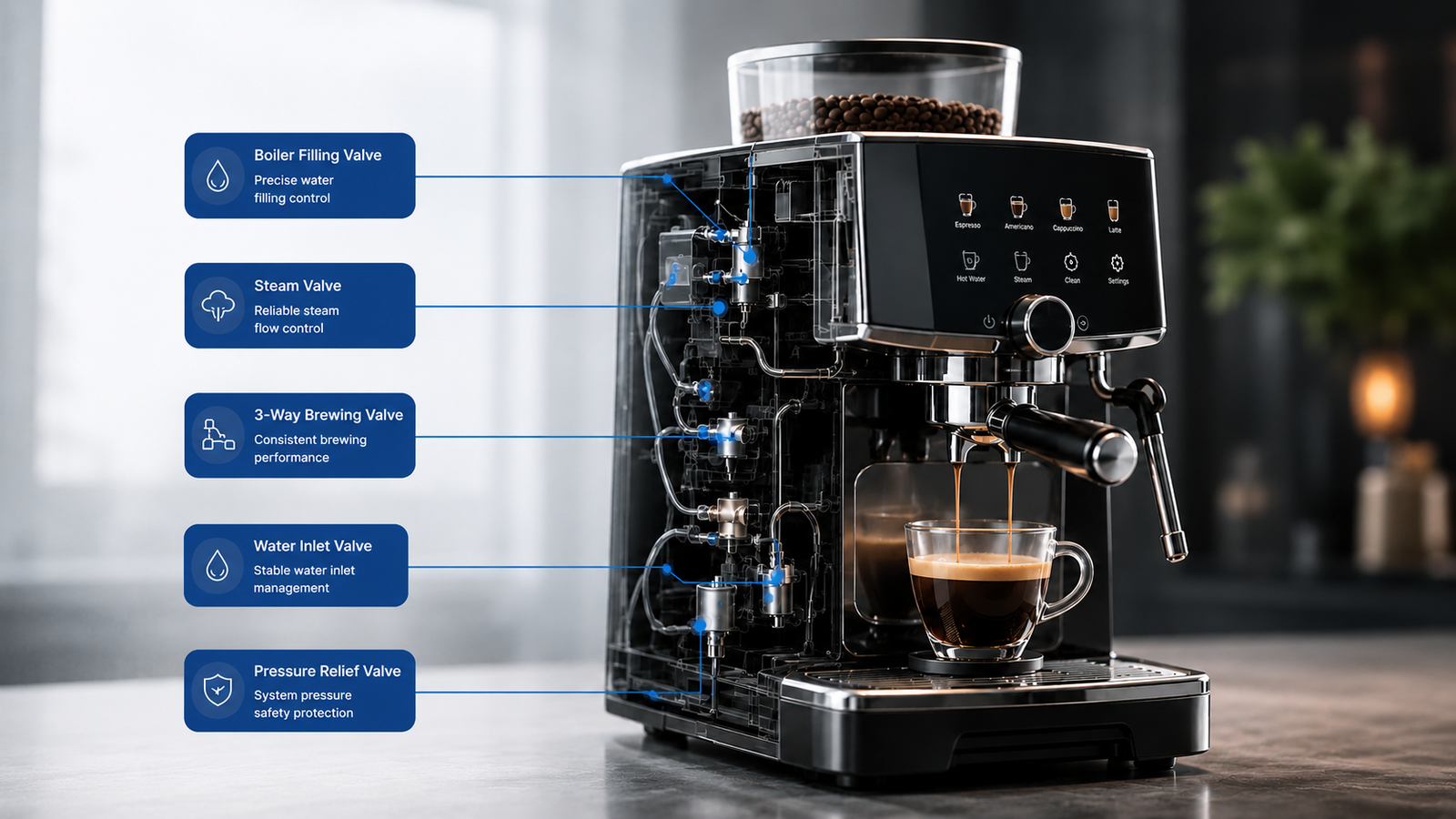
We treat this problem as a hot-state valve-system matching issue. The coil, plunger, spring, valve seat, seal, orifice, body, pressure direction, and water quality interact. A room-temperature pass result alone does not prove that the assembled valve will remain tight after repeated steam exposure.
How Does a Steam Solenoid Valve Control Boiler Temperature and Pressure?
A steam solenoid valve may appear to control boiler conditions directly, but that description can mislead an engineering team. The temperature controller and heater usually create the thermal input. The valve controls a pressure boundary.2 If that boundary does not close, the entire control loop may respond to an unintended energy loss.
A steam solenoid valve opens or closes a steam path when the machine controller energizes or de-energizes its coil. By retaining or releasing steam, it influences boiler pressure recovery and thermal stability. It does not normally generate heat or independently regulate temperature, but its sealing performance directly affects whether the system can retain energy.
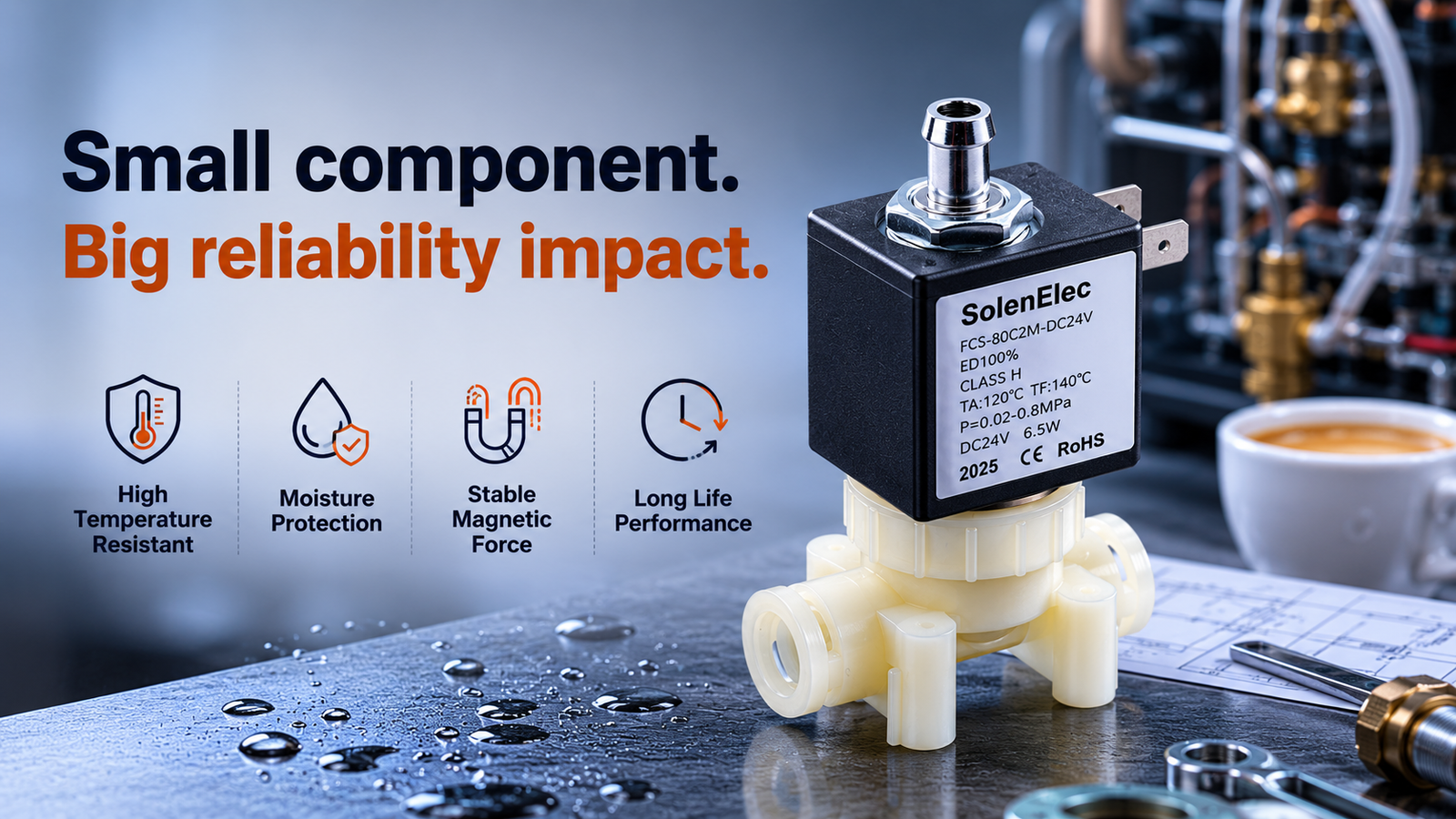
We view the valve as an electromechanical pressure boundary
When voltage reaches the coil, the resulting magnetic field moves an armature or plunger. That movement either opens or closes the flow path, depending on whether the design is normally closed, normally open, direct acting, or pressure assisted.
The complete operating chain includes:
- The controller supplies voltage within a defined tolerance.
- The coil converts electrical energy into magnetic force.3
- The armature moves through the required stroke.
- The spring and pressure forces oppose or assist movement.
- The seal contacts the valve seat.
- The seat and seal maintain acceptable leakage under hot pressure.
A defect at any link can produce similar machine-level symptoms. For example, low coil voltage may leave the plunger short of its intended position4. Scale may also prevent full travel.5 Alternatively, the plunger may return correctly while a deformed seal or damaged seat still allows steam to pass.
We separate control response from valve performance
A leaking valve may cause the boiler sensor to report a falling temperature or pressure. The controller can then command additional heater operation. That response does not prove that the heater is defective. It may show that the heater is trying to replace heat continuously lost through the valve path.
| Observed behavior | Possible valve-related interpretation | What we would verify first |
|---|---|---|
| The heater stays active longer than expected. | Steam loss may increase the thermal load. | We would measure leakage and confirm heater input separately. |
| Pressure rises slowly after steam use. | The valve may not reseal completely. | We would inspect hot-state closure and pressure direction. |
| Pressure fluctuates during idle periods. | Intermittent leakage or sticking may be present. | We would compare coil command, plunger movement, and leakage timing. |
| The machine reaches temperature when cold but not after cycling. | Thermal expansion or hot-state force loss may affect the valve. | We would repeat tests at stabilized operating temperature. |
We would not conclude that every pressure drop comes from the steam solenoid valve. Boiler insulation, sensor accuracy, relief components, pipe connections, heater output, and control logic can create similar signs. We would first prove a flow path through the valve before recommending a valve redesign.
Why Does a Steam Solenoid Valve Leak After Repeated High-Temperature Operation?
A valve that passes a cold test can still leak after repeated heating. This gap creates a serious approval risk because incoming inspection may accept the part while the finished machine performs poorly. In our view, engineers should reproduce the thermal state before changing specifications or assigning the fault to one component.
A steam solenoid valve may leak after heating because temperature changes magnetic force, component clearances, spring behavior, seal properties, and body geometry. Steam exposure can also move scale or contamination onto the seat. We evaluate these variables as a connected system because a stronger coil or a new seal cannot correct every hot-state leakage mechanism.
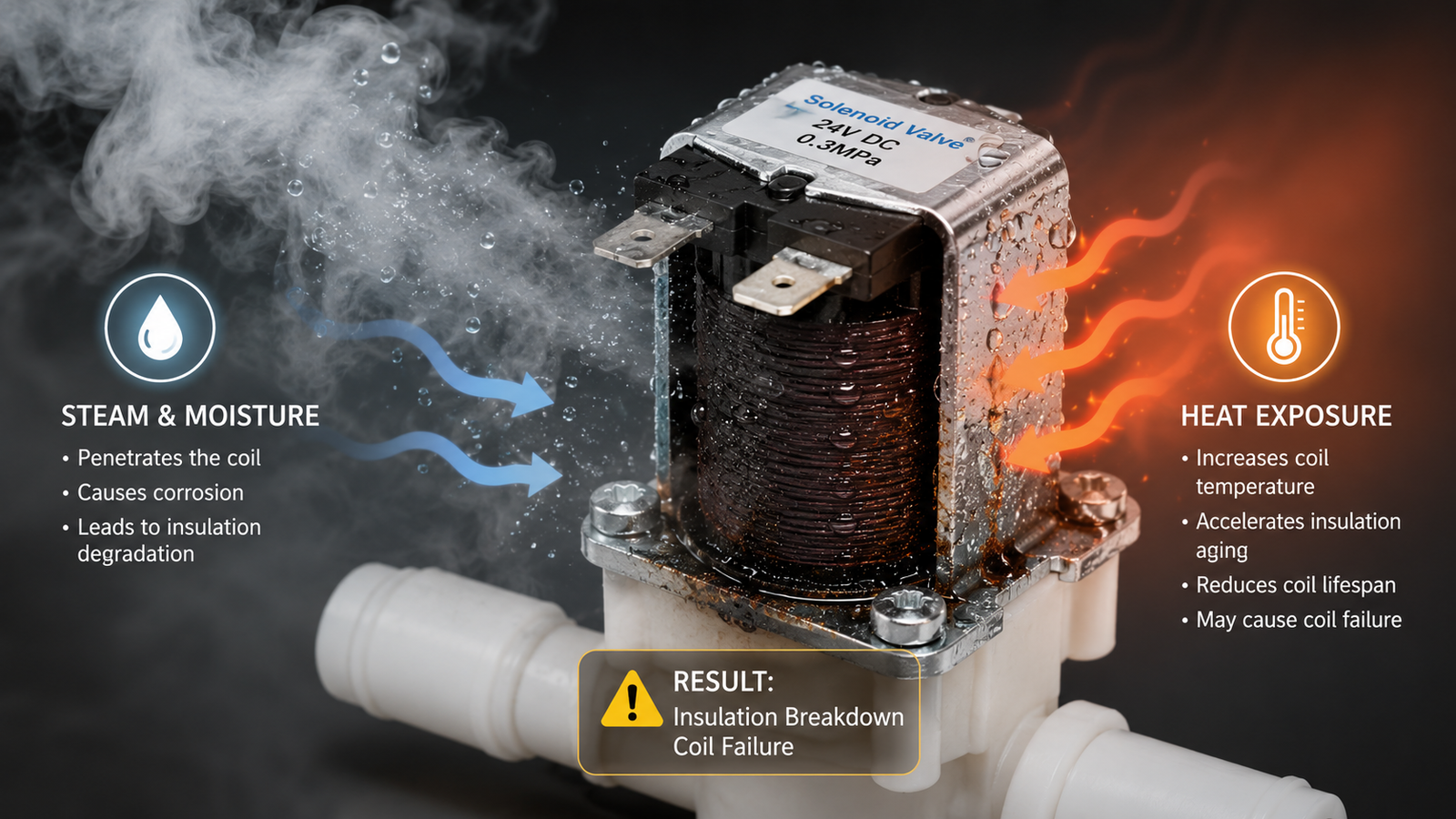
We first distinguish actuation failure from sealing failure
This distinction guides our design decision.
Actuation failure means the moving assembly does not reach or return to the required position. Possible causes include:
- The supply voltage falls below the validated operating range.
- The hot coil produces insufficient magnetic margin.
- The plunger sticks because of contamination, misalignment, or changed clearance.
- The spring force does not match the stroke and pressure load.
- Thermal expansion causes interference between moving parts.
- The applied differential pressure exceeds the validated operating condition.
Sealing failure means the plunger reaches its intended position, but the closed interface still passes steam. Possible causes include:
- The seal develops excessive compression set.
- The seal becomes too soft, too hard, or less resilient at temperature.
- Scale or particles sit between the seal and seat.
- The seat has scratches, poor concentricity, or inadequate surface quality.
- The body distorts enough to change seat alignment.
- The pressure direction lifts the sealing element.
- The material combination does not tolerate the actual steam and water chemistry.
We do not start by increasing coil power. Higher power can increase magnetic force, but it can also raise coil temperature and accelerate stress on the insulation system or surrounding polymer parts.6 It also cannot repair a scratched seat.
We do not start by changing only the seal either. A new elastomer may still leak if the armature does not complete its stroke. Material names such as EPDM or FKM are not sufficient selection criteria.7 We verify the grade, formulation, temperature range, steam behavior, food-contact documentation, compression set, and compatibility with the machine’s cleaning chemistry.
An anonymized bench-test pattern
In one type of OEM investigation, a valve can pass room-temperature leakage checks but lose steam pressure after repeated heating. We would compare four conditions:
- We would record the electrical input and coil temperature.
- We would confirm whether the plunger completes its movement while hot.
- We would inspect the seat for scale, indentation, or mechanical damage.
- We would examine the seal for deformation after cooling.
If the plunger does not return fully, we investigate magnetic margin, spring load, friction, and thermal clearance. If the plunger returns but leakage continues, we prioritize the sealing interface, pressure direction, and material behavior. This test pattern narrows the fault without turning one result into a universal rule.
How Can Steam Solenoid Valve Leakage Prevent an Espresso Machine from Reaching Temperature?
When an espresso machine cannot reach its temperature target, replacing the heater may seem like the obvious response. We consider that decision premature if steam is visibly or measurably escaping through a closed valve. Continuing leakage can create a heat-loss path that competes with the boiler’s available heating capacity.
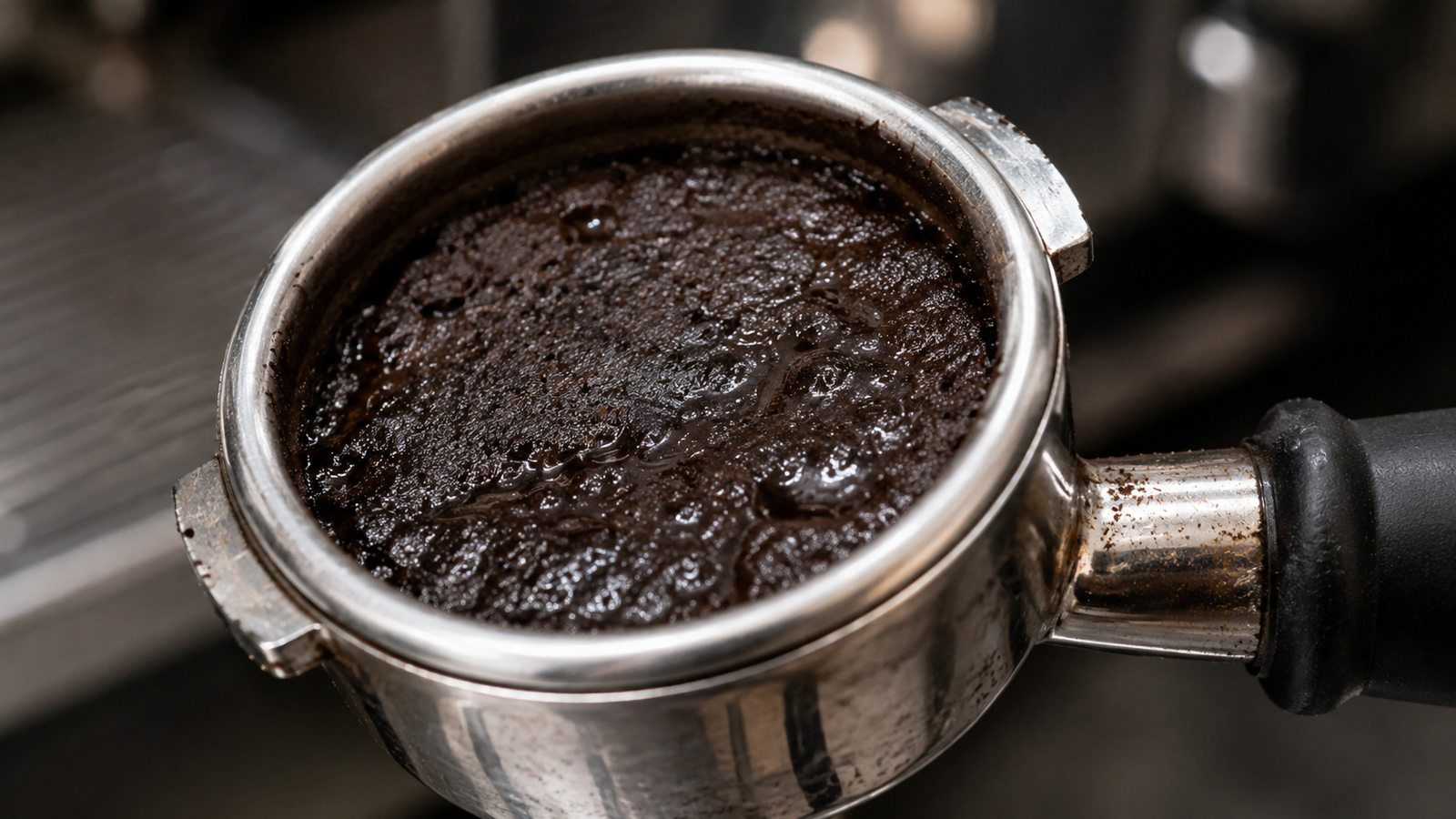
Steam solenoid valve leakage can prevent temperature recovery by continuously releasing hot vapor and replacement water energy from the boiler circuit.8 The heater must offset both normal losses and the unintended discharge. If the loss approaches the system’s recovery capacity, pressure and temperature may rise slowly, fluctuate, or remain below their targets.
We trace the fault chain before blaming the heater
A typical valve-related fault chain looks like this:
An incomplete hot-state closure permits steam flow. The boiler loses pressure and thermal energy. The control system extends heater operation. The machine then shows slow recovery, unstable pressure, or an inability to maintain its setpoint.
Pressure and saturation temperature are closely related in a steam environment.9 When steam escapes, boiler pressure can fall. The controller may add heat, but the valve can continue releasing part of that energy. The measured symptom may therefore appear electrical even though the initiating fault is mechanical or electromechanical.
The size of the effect depends on the system. A very small leakage rate may cause only longer heater cycles. A larger flow can prevent stable recovery. Boiler volume, heater power, control hysteresis, valve location, operating pressure, and usage pattern all influence the outcome. We therefore avoid assigning a universal “acceptable” leakage threshold without the machine manufacturer’s performance requirements.
We use a staged diagnostic decision
If this were our OEM project, we would use the following sequence:
- We would confirm the heater input. We would verify voltage, current, controller command, and basic sensor behavior using qualified electrical procedures.
- We would prove the leakage path. We would determine whether steam passes through the closed valve rather than from a fitting, relief device, or another connection.
- We would reproduce the fault while hot. We would not rely only on a cold pneumatic or water test.
- We would observe actuation. We would compare the electrical command with actual plunger movement.
- We would inspect the sealing interface. We would examine the seat, seal, contamination, and alignment.
- We would compare system recovery. We would test the machine or representative rig before and after the verified valve correction.
This order prevents blind component replacement. If leakage stops but the machine still cannot reach temperature, we would return the investigation to the broader heating system. A qualified espresso-machine engineer should evaluate heater safety, boiler pressure, electrical protection, and control settings. Our manufacturing scope is the valve and coil system, not every part of the appliance.
What Should Engineers Check When Selecting a Steam Solenoid Valve?
A data-sheet pressure rating can make valve selection look simple. However, a nominal rating does not show whether the valve will seal after thermal cycling, tolerate real water quality, or operate at low supply voltage. We select around the actual operating envelope rather than one attractive maximum value.
Engineers should evaluate a steam solenoid valve as a matched electrical, magnetic, mechanical, sealing, and fluid system. We prioritize hot-state leakage, duty cycle, differential pressure, voltage tolerance, stroke, seal recovery, body stability, insulation performance, media compatibility, contamination tolerance, and documented regulatory requirements before approving the valve for production.

Our selection priorities
If we were selecting a valve for a new espresso-machine platform, we would define these requirements first:
| Selection factor | Why we prioritize it | Evidence we would request |
|---|---|---|
| Actual steam temperature and pressure | Nominal ratings may not represent repeated hot operation. | We would request an operating envelope and hot-test results. |
| Minimum and maximum differential pressure | Pressure can alter opening force and sealing direction. | We would request validation at both limits. |
| Voltage tolerance | Low voltage can reduce actuation margin, while high voltage can increase heat. | We would request hot and cold voltage-limit tests. |
| Coil duty cycle | Continuous energization can produce a different thermal state from intermittent use.10 | We would request temperature-rise data in the intended installation. |
| Stroke and force margin | The plunger must complete its movement despite heat, friction, and pressure. | We would request hot/cold force and travel evaluation. |
| Seal behavior | Steam, cleaning chemicals, and compression can change resilience. | We would request grade-specific compatibility and aging evidence. |
| Body and seat stability | Distortion or misalignment can create hot leakage. | We would request dimensional and post-cycle inspection results. |
| Water quality tolerance | Scale and particles can block full sealing. | We would request contamination testing and filtration assumptions. |
| Compliance documentation | Appliance markets may require multiple regulatory documents. | We would verify current certificates, reports, models, and scope. |
We choose margin, not unnecessary oversizing
We want enough magnetic force to complete the required movement at the lowest validated voltage and the hottest expected condition. However, we do not automatically specify the highest-power coil. Excess power can increase temperature rise, energy consumption, and material stress.
We also avoid selecting by pressure rating alone. A valve rated for a higher pressure may use a spring, orifice, or pilot structure that behaves differently in the machine’s real pressure range. We select the working combination of pressure, flow, stroke, voltage, temperature, and duty cycle.
At SolenElec, our practical advantage is that we can review the coil and mechanical valve structure together. Our in-house engineering work includes coil design, material selection, tooling, winding, injection molding, prototyping, and leakage or bench testing. Our production context includes eight lines, outgoing inspection, sampling-based quality control, and MES-supported traceability. Buyers should still audit the factory, verify current quality-system certificates and their scope, and check CE, UL, RoHS, REACH, TÜV, CB, IEC, or food-contact documents against the exact model and target market.
For application-specific approval, we recommend that the appliance manufacturer and qualified compliance professionals define the final acceptance criteria.
How Can Steam Valve Design Be Improved for Long-Term Reliability?
A valve redesign can fail if the engineering team changes parts without identifying the failure mode. A harder seal, stronger spring, or more powerful coil may solve one symptom while creating another. We prefer a measured redesign that preserves hot-state force margin and seat integrity across the intended operating life.
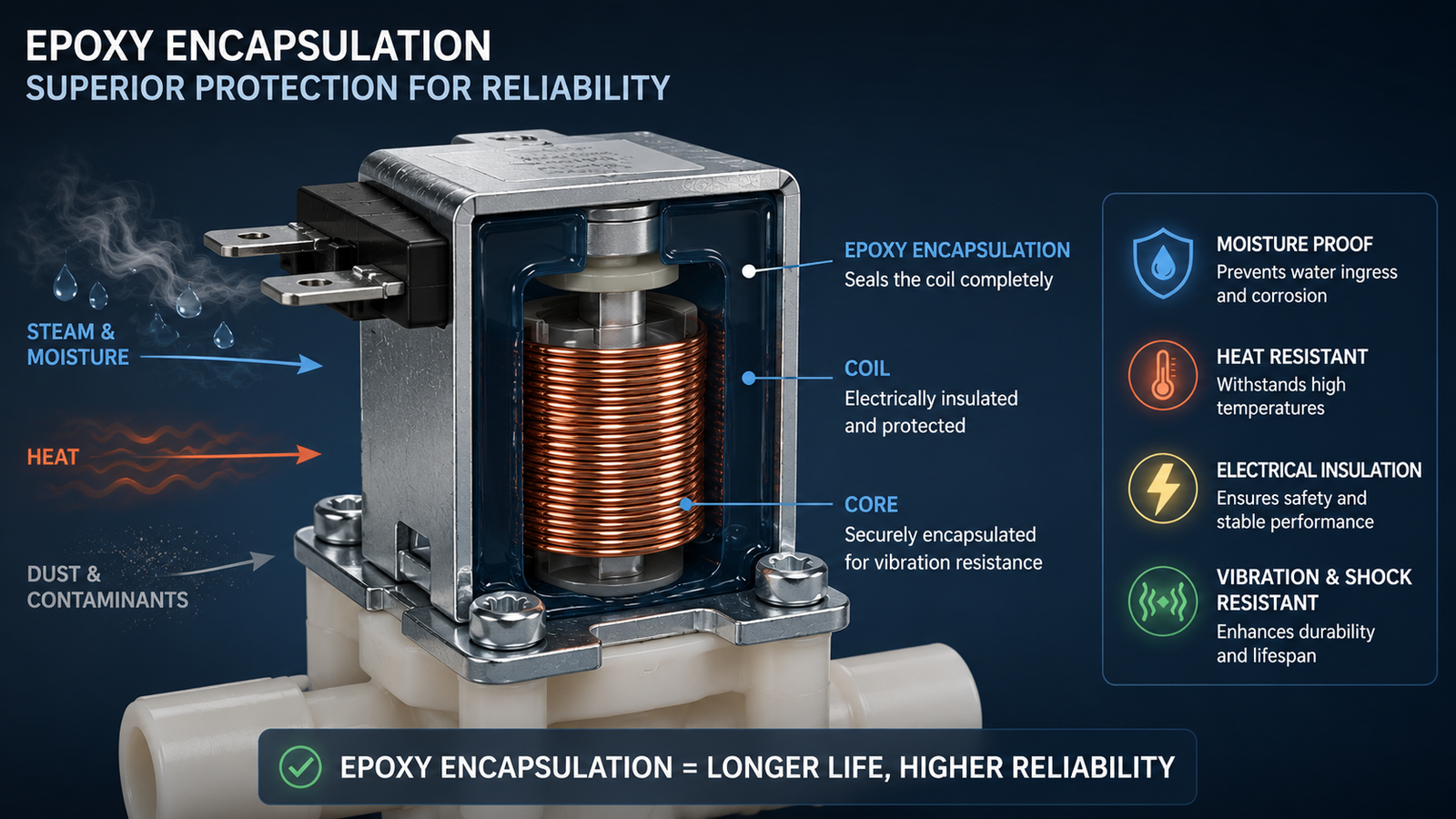
We improve steam valve reliability by matching the coil, plunger, spring, seal, seat, body, and orifice as one system. We then validate that design under hot pressure, voltage limits, repeated cycling, contamination, and continuous-duty temperature rise. We approve changes only when testing connects the modification to the confirmed leakage mechanism.
We improve the confirmed weak link
If testing shows incomplete actuation, we may adjust:
- We may revise the magnetic circuit or working air gap.
- We may reduce avoidable friction or improve plunger guidance.
- We may rebalance spring force against pressure and available magnetic force.
- We may revise thermal clearances between moving components.
- We may optimize coil winding parameters while controlling temperature rise.
- We may change the installation so the coil can dissipate heat more predictably.
If testing shows sealing failure, we may adjust:
- We may improve seat geometry, concentricity, or surface finish.
- We may revise seal compression to preserve recovery without excessive stress.
- We may evaluate a different seal grade after media and food-contact review.
- We may stabilize the body or seat against thermal distortion.
- We may change the orifice or pressure direction when the architecture permits it.
- We may improve upstream filtration or design tolerance to scale movement.
We would not approve a material simply because it carries a familiar name. For example, EPDM and FKM families contain many grades with different steam, compression-set, chemical, and regulatory characteristics. We require technical verification under the intended temperature, pressure, cleaning regime, and contact conditions.
Our preferred validation plan
We would normally propose a conditional validation matrix rather than one pass/fail bench check:
- Cold leakage testing establishes a production and assembly baseline.
- Hot leakage testing checks sealing at stabilized operating conditions.
- Voltage-limit testing verifies movement at the defined electrical extremes.
- Continuous-duty testing measures coil and surrounding material temperature rise.
- Thermal cycling exposes expansion, contraction, and seal-recovery problems.
- Pressure cycling checks repeated mechanical loading of the seat and moving assembly.
- Contamination testing evaluates realistic particles or scale assumptions.
- Endurance cycling reveals wear and progressive deformation.
- Post-test inspection connects leakage results to seat, seal, plunger, and coil condition.
- Production correlation confirms that prototypes and mass-produced valves behave consistently.
We also build traceability into the validation process. Material lots, coil winding parameters, injection-molding conditions, assembly results, and outgoing inspection records should be linked where practical. This approach helps us determine whether a later failure comes from the design, process variation, material variation, or application conditions.
Our preferred decision is clear: We do not release an espresso steam valve based only on cold leakage and nominal voltage testing. We require representative hot-state validation because that is where thermal clearances, magnetic margin, seal behavior, and pressure loading converge. The exact test limits must come from the appliance’s risk assessment and operating specification.
Frequently Asked Questions
Can a leaking steam solenoid valve damage an espresso machine heater?
A leaking valve does not automatically damage the heater, but it may increase heater operating time because the boiler keeps replacing lost energy. We recommend checking heater duty, over-temperature protection, and valve leakage together. A qualified appliance engineer should assess any electrical or pressure-safety risk.
Does a stronger coil always stop steam valve leakage?
No. A stronger coil may help when inadequate magnetic force prevents complete actuation. It cannot repair seat damage, contamination, seal deformation, incorrect pressure direction, or body distortion. We first determine whether the fault is incomplete movement or leakage after complete movement.
Why can a steam solenoid valve pass a cold test but fail when hot?
Heat can change coil resistance, magnetic margin, plunger clearance, spring behavior, seal resilience, and body geometry.11 Steam can also move scale onto the seat. We therefore combine cold testing with stabilized hot leakage, voltage-limit, cycling, and post-test inspection.
Should engineers replace the seal before replacing the complete valve?
We would replace the seal only when inspection and testing identify the sealing interface as the cause and when the design supports safe service replacement. If the plunger sticks or lacks force, a new seal may not help. Production teams should follow the appliance manufacturer’s approved service procedure.
What supplier evidence should procurement teams request?
We recommend requesting model-specific hot and cold leakage data, voltage and duty-cycle validation, material declarations, traceability records, inspection plans, and relevant compliance documents. Buyers should verify that certificates and test reports cover the actual valve, coil, production site, and destination market rather than accepting a general supplier statement.
Conclusion
Steam solenoid valve leakage can reduce pressure recovery and disturb temperature stability even when the heater operates correctly. We treat the issue as a complete hot-state system problem, and we separate actuation failure from sealing failure before changing the coil, spring, seal, or body. Cold testing alone is not enough for production approval.
SolenElec can support espresso-machine engineering and procurement teams with joint valve-and-coil design review, OEM/ODM prototyping, material evaluation, and representative hot-state validation. Contact us to review your operating envelope, leakage requirements, and production-quality plan before finalizing the valve specification.
"Steam System Survey Guide", https://www.energy.gov/sites/prod/files/2014/04/f15/steam_survey_guide.pdf. Steam-system energy guidance treats steam leakage as a loss of both steam mass and useful thermal energy from the pressurized boundary, supporting the interpretation of a leaking valve as an energy-and-mass loss path; the source would establish the general mechanism rather than the leakage rate in this specific espresso machine. Evidence role: mechanism; source type: government. Supports: Steam leakage from a pressurized system removes steam mass and the heat energy carried by that steam.. Scope note: Contextual support only; it would not quantify the article's particular valve or boiler. ↩
"Rancilio", https://en.wikipedia.org/wiki/Rancilio. Educational descriptions of solenoid valves define them as electromechanical devices for opening or closing fluid passages, while boiler-control references assign thermal input to the heater and its controller; this supports the functional distinction, although it is not proof of every espresso-machine layout. Evidence role: definition; source type: education. Supports: A solenoid valve functions as an electromechanical device that opens or closes a fluid path, while heating elements and controllers provide thermal input in boiler systems.. Scope note: Contextual support only because espresso-machine designs vary. ↩
"Solenoid valve", https://en.wikipedia.org/wiki/Solenoid_valve. Electromagnetism and actuator references explain that current in a solenoid winding generates a magnetic field that can attract or move a ferromagnetic armature, supporting the stated coil-to-force mechanism. Evidence role: mechanism; source type: education. Supports: Electrical current through a [solenoid coil](https://solenelec.com/what-are-the-types-uses-and-manufacturing-processes-of-solenoid-coils/) creates a magnetic field that exerts force on a movable ferromagnetic armature.. ↩
"Diesel engine", https://en.wikipedia.org/wiki/Diesel_engine. Studies of solenoid actuators describe pull-in force as dependent on coil current, magnetic circuit geometry, and air gap, supporting the claim that low supply voltage can reduce actuation margin and prevent full plunger travel; the evidence is general to solenoid actuators rather than specific to espresso valves. Evidence role: mechanism; source type: paper. Supports: Solenoid actuator force and pull-in behavior depend on electrical input and can fail to complete travel when voltage or current is insufficient.. Scope note: Contextual support only unless the cited study tests a comparable steam-valve geometry. ↩
"Hard water", https://en.wikipedia.org/wiki/Hard_water. Water-quality guidance explains that hard-water minerals can form scale deposits in heated water systems and appliances, supporting the plausibility that scale can interfere with valve travel or seating; the source would establish the general fouling mechanism rather than diagnose a particular valve failure. Evidence role: mechanism; source type: government. Supports: Hard-water mineral scale can form deposits in water-handling equipment and may obstruct passages, moving parts, or sealing surfaces.. Scope note: Contextual support only; a specific failure would still require inspection of the valve. ↩
"Degradation Monitoring of Insulation Systems Used in Low-Voltage ...", https://pmc.ncbi.nlm.nih.gov/articles/PMC7374401/. Electromagnetic-actuator and insulation-aging literature links coil current to magnetic force and Joule heating, and links elevated winding temperature to accelerated insulation aging, supporting the stated design tradeoff; the source would not determine the safe power limit for this specific valve without model-specific testing. Evidence role: mechanism; source type: paper. Supports: Higher coil current or power can increase electromagnetic force while also increasing Joule heating and thermal stress on insulation systems.. Scope note: Contextual support only; actual thermal limits depend on coil design, insulation class, ambient temperature, and installation. ↩
"EPDM rubber", https://en.wikipedia.org/wiki/EPDM_rubber. Elastomer materials references describe EPDM and FKM as material families whose compounds can differ in temperature capability, compression set, chemical resistance, and regulatory formulation, supporting the claim that family names alone are insufficient selection criteria. Evidence role: expert_consensus; source type: research. Supports: Elastomer performance depends on compound formulation and test conditions, so a family designation such as EPDM or FKM is not enough to establish suitability.. ↩
"Steam System Survey Guide", https://www.energy.gov/sites/prod/files/2014/04/f15/steam_survey_guide.pdf. Government steam-system efficiency materials describe steam leaks as losses of useful heat and steam that must be replaced by additional boiler output, supporting the mechanism by which continuous leakage can slow temperature or pressure recovery; the source would not establish the exact threshold for a particular espresso boiler. Evidence role: mechanism; source type: government. Supports: Steam leakage removes enthalpy and can require additional heating of replacement water or steam, increasing the system heat load.. Scope note: Contextual support only; the magnitude depends on heater power, boiler size, and leak rate. ↩
"Thermophysical Properties of Fluid Systems - the NIST WebBook", https://webbook.nist.gov/chemistry/fluid/. Standard steam-property tables, such as NIST or IAPWS-based references, tabulate a unique saturation temperature for each saturation pressure, supporting the statement that pressure and saturation temperature are closely related in a steam environment. Evidence role: definition; source type: government. Supports: Saturated water and steam have a defined pressure-temperature relationship recorded in standard steam tables.. ↩
"Duty cycle", https://en.wikipedia.org/wiki/Duty_cycle. Thermal analyses of solenoid actuators relate coil temperature rise to duty cycle, input power, and heat dissipation, supporting the statement that continuous energization can produce a different thermal state from intermittent use. Evidence role: mechanism; source type: paper. Supports: Solenoid coil temperature depends on electrical duty cycle and heat dissipation conditions, with continuous energization generally producing a higher steady thermal state than intermittent duty.. ↩
"The impact of pre-compression and temperature on perfluoroalkoxy ...", https://pmc.ncbi.nlm.nih.gov/articles/PMC10943739/. Engineering materials and actuator references document that temperature changes conductor resistance, magnetic-actuator force margins, dimensional clearances through thermal expansion, and elastomer recovery behavior, supporting the article's multi-factor hot-state leakage explanation; the support is distributed across mechanisms rather than from one espresso-valve study. Evidence role: mechanism; source type: research. Supports: Temperature affects electrical resistance, magnetic actuator performance, thermal expansion, spring behavior, and elastomer properties relevant to valve operation.. Scope note: Contextual support only because a single source may not cover every listed mechanism in one valve. ↩