
How Do You Choose the Right Materials for a Pneumatic Solenoid Valve?
Pneumatic solenoid valve materials can become a hidden source of leakage, sticking, corrosion, and early warranty claims1 when they do not match the real operating conditions. I often see teams compare stainless steel, brass, FKM2, or PTFE3 before they have fully defined the medium, temperature, pressure, and expected service life. The better approach is to start with the application, then select the materials that fit it.
I recommend choosing pneumatic solenoid valve materials by first identifying the actual medium, operating temperature range, pressure, external environment, and required service life. Engineers should then select a compatible valve body and seal combination instead of automatically choosing the highest-grade or highest-temperature material. The right choice balances reliability, manufacturability, compliance requirements, and total cost.

Material selection is not a race to specify the most expensive metal or the most chemically resistant elastomer. I view it as a practical engineering chain: working medium → temperature and pressure → body material → seal material → failure risk → service life and cost. Each decision affects the next one.
Why Does the Working Medium Determine Solenoid Valve Material Selection?
I find that many projects begin with a simple assumption: a pneumatic valve handles compressed air, so almost any standard material should work. That assumption can create problems when the air contains compressor oil, moisture, cleaning residues, particles, or chemical vapors4. The actual medium can change the material decision completely.
The working medium should be the first input in pneumatic solenoid valve material selection because every wetted component must tolerate what it contacts5. Engineers should identify whether the valve controls dry air, lubricated air, humid air, inert gas, water vapor, vacuum, or a chemically exposed gas stream before choosing the valve body or seal.

The Medium Is More Than “Compressed Air”
I recommend that buyers ask what is truly moving through the valve, not simply what the system is called. A “compressed-air” circuit may have conditions that are very different from clean, dry shop air.
For example, an air line may contain:
- Compressor lubricant aerosols
- Condensed water
- Corrosion particles from old piping
- Detergent or disinfectant residues
- High humidity from food, laundry, or appliance environments
- Ozone, cleaning chemicals, or external chemical exposure
- Intermittent vacuum or pressure pulses
Each condition can affect the valve differently. Oil contamination may cause some elastomers to swell.6 Water and steam exposure may make a seal choice that performs well with dry air unsuitable.7 Chemical exposure can attack both elastomers and metal surfaces.
I have seen engineering discussions focus on the valve body first because it is visible and seems easier to compare. However, the seal is often the more sensitive component. A brass, aluminum, or stainless-steel body may remain structurally sound while an incompatible seal loses elasticity, becomes hard, or swells enough to affect movement.
I Use a Media-First Decision Path
Before I compare material grades, I would collect the following operating information:
-
What does the valve control?
Identify the gas, air quality, fluid traces, and contaminants. -
Does the medium contain oil or moisture?
This question is especially important for pneumatic systems supplied by lubricated compressors. -
Does the valve face internal or external chemicals?
Cleaning processes, household appliance environments, and factory washdown conditions can matter. -
Is the medium static, flowing, pulsing, or cycling frequently?
Repeated cycles can amplify small compatibility issues. -
What happens during idle periods?
A valve that sits in humid or chemically exposed conditions may age differently from one that cycles continuously.
I do not consider a material “suitable” simply because it survives a short test. I want evidence that it remains stable through the intended medium, temperature, pressure, and life cycle.
For procurement teams, this means supplier discussions should begin with an application sheet, not only a drawing or a target price. At SolenElec, I would encourage buyers to document the actual operating medium early so that engineering teams can assess the body, plunger, seat, and seal materials as one system.
Aluminum vs Brass vs Stainless Steel: Which Valve Body Material Should You Choose?
I often hear the question, “Should we upgrade to stainless steel?” The concern is understandable because stainless steel can signal durability. Yet I do not believe stainless steel is automatically the best choice for every pneumatic solenoid valve. An unnecessary upgrade can add cost, weight, machining complexity, and sourcing pressure without improving real field performance.
Engineers should choose aluminum, brass, or stainless steel valve bodies based on corrosion exposure, pressure, temperature, medium compatibility, weight targets, and cost. For ordinary industrial compressed-air applications, aluminum or brass may provide adequate performance, while stainless steel is usually justified when corrosion, aggressive media, hygiene requirements, or severe environments demand it8.

I Compare Valve Bodies by Application Risk
I avoid treating valve body materials as a simple ranking from low grade to high grade. Each option solves a different engineering problem.
| Material | Media Compatibility | Temperature Considerations | Corrosion Resistance | Relative Cost | Typical Application |
|---|---|---|---|---|---|
| Aluminum alloy | Often suitable for clean, dry compressed air and many standard pneumatic duties | Actual limit depends on design, coating, seals, and surrounding heat | Moderate; may need protection in humid or corrosive settings | Lower to medium | Lightweight pneumatic assemblies, appliance systems, general industrial air |
| Brass | Commonly suitable for air, water-compatible designs, and many general-purpose valve applications | Depends on alloy, design, and seal system | Good in many normal environments; not suitable for every aggressive chemical condition | Medium | General industrial valves, fittings, appliance and fluid-control applications |
| Stainless steel | Suitable where corrosion resistance, washdown exposure, or demanding media justify it | Can support demanding environments, but the seal and coil system still set application limits | High, depending on stainless grade and medium | High | Corrosive environments, food-related equipment, chemical exposure, outdoor or humid service |
| NBR9 seal | Often suitable for air and oil-containing pneumatic systems | Typical published limits vary by compound | Not applicable to body corrosion | Low | Standard pneumatic air with oil resistance needs |
| EPDM10 seal | Often suitable for water, steam-related conditions, and some cleaning environments | Typical published limits vary by compound and steam exposure | Not applicable to body corrosion | Low to medium | Water-compatible, humid, and selected cleaning applications |
| FKM seal | Often selected for oils, fuels, and higher-temperature service | Often offers higher heat capability than common elastomers, depending on compound | Not applicable to body corrosion | Medium to high | Oil-resistant and elevated-temperature applications |
| PTFE seal | Broad chemical resistance in many applications | Often supports a wide published temperature range; design remains critical | Not applicable to body corrosion | High | Chemically demanding media, specialized sealing arrangements |
I recommend verifying actual temperature, pressure, chemical compatibility, and compound data against the supplier’s technical documentation and application test results. Published ranges vary by alloy, elastomer formulation, valve geometry, and duty cycle.
When I Would Choose Aluminum
Aluminum can be a sensible choice when weight, cost control, and efficient production matter. In standard pneumatic assemblies using clean or appropriately conditioned compressed air, an aluminum alloy body may provide the needed performance without the extra cost of stainless steel11.
I would consider aluminum when:
- The medium is clean, dry, or suitably filtered compressed air.
- The external environment is not highly corrosive.
- Weight reduction supports the product design.
- The valve does not require exceptional chemical resistance.
- The customer needs cost-efficient volume production.
I would be cautious with aluminum when the valve sees persistent condensation, salt exposure, aggressive cleaning agents, or chemical vapors. Surface treatment and design details may improve performance, but they do not replace a proper compatibility review.
When I Would Choose Brass
Brass is often a practical middle-ground material.12 It has a long history in valve and fitting applications because it is machinable, stable, and suitable for many general service conditions. I would consider brass where the application needs a robust body but does not justify stainless steel.
However, I would not assume that every brass alloy is suitable for every water chemistry or chemical environment. Buyers should still review alloy composition, fluid exposure, regulatory needs, and any local compliance requirements.
When I Would Choose Stainless Steel
I would specify stainless steel when the service conditions clearly justify it, such as:
- Continuous humidity or washdown exposure
- Corrosive external environments
- Chemical process exposure
- Higher hygiene expectations
- Outdoor installations
- Long-life applications where corrosion risk creates significant downtime cost
The key point is simple: stainless steel is not automatically more valuable in a standard compressed-air valve. If corrosion, temperature, pressure, and medium requirements do not demand it, stainless steel may be over-specification rather than an engineering improvement.
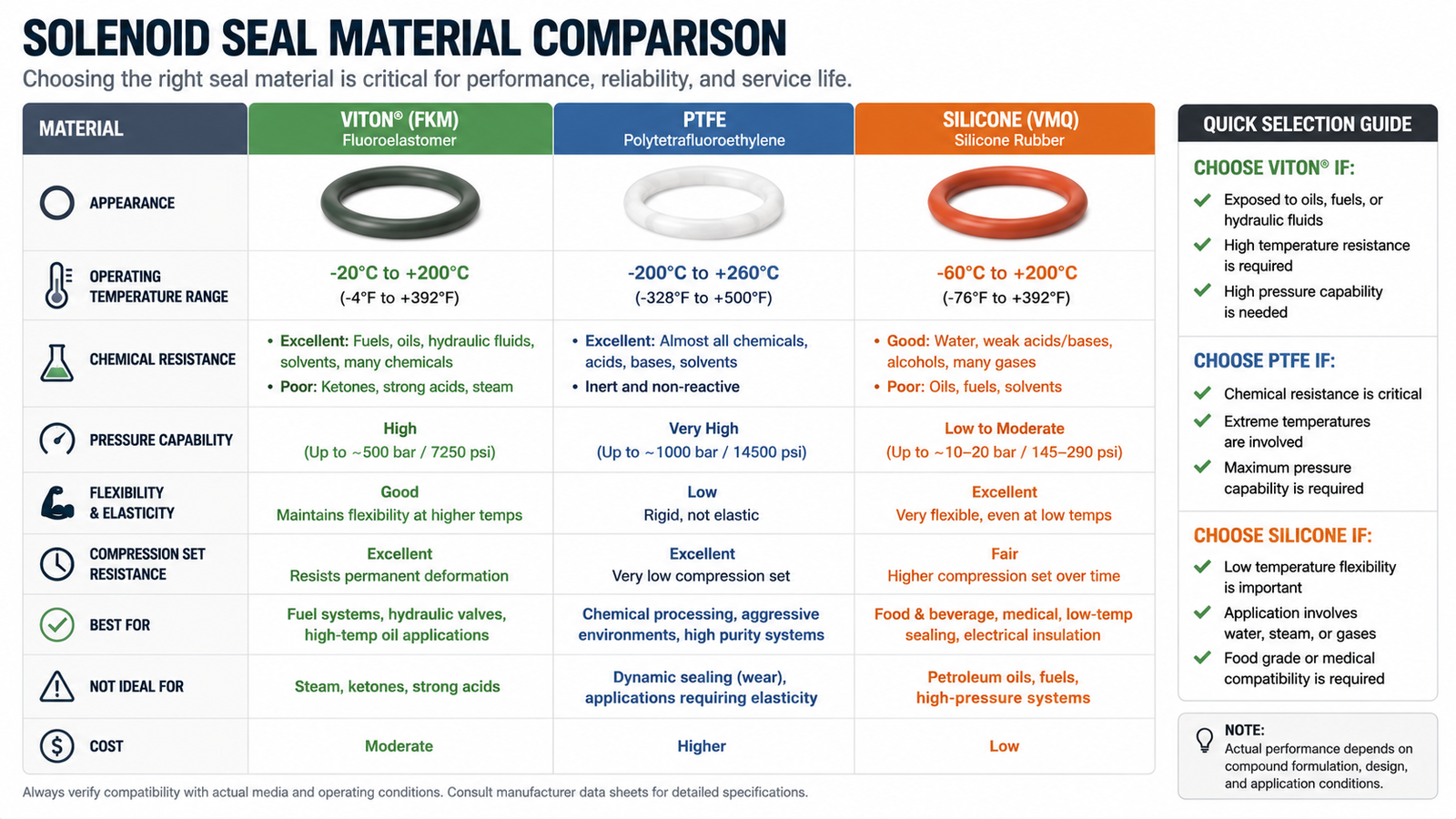
NBR vs EPDM vs FKM vs PTFE: How Do You Select the Right Seal Material?
I consider seal selection one of the highest-risk decisions in a pneumatic solenoid valve. A valve body can look perfect after years of service while a small seal causes leakage, slow response, or sticking. The wrong seal may fail even if its published maximum temperature appears higher than the alternatives.
Engineers should select NBR, EPDM, FKM, or PTFE by evaluating media compatibility first, then actual temperature, pressure, cycle rate, friction requirements, aging behavior, and required life. A higher-temperature seal does not automatically last longer if it is poorly matched to oil, water, steam, chemicals, or the valve’s mechanical design.
I Start With Compatibility, Not Temperature Ranking
A common mistake is to treat seal materials as a temperature leaderboard:
- NBR has one maximum temperature.
- EPDM has another.
- FKM has a higher number.
- PTFE has the highest number.
That comparison is incomplete. The real question is whether the seal remains stable in the actual medium. A higher-rated material can still be the wrong material if it swells, loses elasticity, or creates excessive friction in the valve design.
For example, I would usually evaluate these materials in the following way:
| Seal Material | I Would Consider It When | I Would Avoid or Review Carefully When |
|---|---|---|
| NBR | The pneumatic system may contain mineral oil or compressor lubricant, and normal industrial temperature conditions apply | Hot water, steam, strong oxidation, ozone exposure, or media outside the compound’s compatibility range |
| EPDM | Water, humidity, steam-related duty, or selected cleaning environments are important | Mineral oils, petroleum-based lubricants, and media known to be incompatible with EPDM compounds |
| FKM | Oil resistance, fuel resistance, chemical resistance, and elevated operating temperature are needed | Low-temperature flexibility, hot steam, certain chemicals, or cost-sensitive applications without a real performance need |
| PTFE | Broad chemical resistance and low chemical reactivity are critical | Applications requiring high elastic recovery from a soft elastomer, or designs where friction and sealing geometry are not optimized |
Seal Aging Is a System Problem
I do not evaluate a seal only as a material sample. I evaluate it as part of the moving valve system. The seal may be static, dynamic, compressed, sliding, or repeatedly exposed to pressure pulses. These details influence how quickly it ages.
The key factors I would review include:
- Compression set: Can the seal recover after long-term compression?
- Swelling: Does the medium cause dimensional growth?
- Hardening: Does heat, oxidation, or chemical exposure reduce elasticity?
- Cracking: Does repeated cycling or temperature change create surface damage?
- Friction: Will the seal increase resistance on the plunger, spool, or moving core?
- Pressure extrusion: Can the seal deform into gaps at high pressure?
- Cycle life: Does the application need thousands, hundreds of thousands, or millions of operations?
I have learned that an apparently premium seal can create avoidable cost if the application is standard dry air at moderate temperature. In that case, a well-selected NBR compound may offer the better balance of oil tolerance, manufacturability, and cost.
On the other hand, I would not use a standard economical material merely because it works in a short prototype test. If a valve will operate near heat sources, in humid conditions, or with lubricant-laden air over a long life, the material decision should be supported by qualified testing.
What Happens When the Wrong Valve or Seal Material Is Used?
I think material failures become easier to prevent when engineers connect the wrong choice to the failure sequence it can create. A small material mismatch rarely remains a small issue. It can develop into leakage, unstable valve behavior, production downtime, customer complaints, and avoidable replacement cost.
Wrong pneumatic solenoid valve materials can cause seal swelling, hardening, cracking, corrosion, or increased friction. These changes can lead to internal or external leakage, slow response, sticking, unstable switching, and premature valve failure. The failure may appear electrical at first, but the root cause can be mechanical or chemical incompatibility.

The Typical Failure Chain
I use the following sequence to explain why material selection deserves early engineering attention:
Wrong material selection
↓
Swelling, hardening, cracking, or corrosion
↓
Leakage, increased friction, or dimensional change
↓
Slow response, sticking, and unstable operation
↓
Premature valve failure
How Seal Failures Develop
When an elastomer is incompatible with the operating medium, it can absorb part of that medium and swell. Even a small dimensional change may increase friction between moving components or alter the sealing force. A swollen seal can make a plunger or spool move more slowly. In a fast-cycling system, that extra resistance can affect response consistency.
Heat and aging can cause another failure mode: hardening. A hardened seal may no longer conform properly to the seat surface. The result can be internal bypass leakage, loss of pressure control, or inconsistent switching.
Cracking can occur when a seal loses flexibility, faces repeated pressure cycling, or experiences harsh temperature changes. Once cracks form, leakage may increase quickly.
How Valve Body Failures Develop
Valve bodies can also fail through corrosion or surface degradation. Moisture, chemical exposure, unsuitable media, and external environmental conditions can attack a material or coating. Corrosion particles can then enter the flow path and create contamination. In precision valve mechanisms, particles may interfere with moving elements and contribute to sticking.
I would also consider galvanic corrosion risks when dissimilar metals are assembled in a wet environment. The valve body itself may not be the only concern; fittings, springs, fasteners, and nearby components can influence the system.
Why Material Failures Can Look Like Coil Failures
A sticking valve may lead users to suspect the solenoid coil. Sometimes the coil is indeed the problem. However, I would not assume that first. Increased mechanical friction can raise the force needed to actuate the valve. If the plunger sticks because of a swollen seal, corrosion, or contamination, the valve may fail to shift even when the coil receives the correct electrical signal.
This distinction matters for quality control. Replacing the coil without investigating the material and media compatibility may only hide the real cause temporarily.
For buyers, I recommend requesting clear failure-analysis support from suppliers when field issues occur. The review should include the actual medium, temperature history, pressure, cycling conditions, disassembled parts, and material identification where possible.
What Should Engineers Check Before Finalizing Solenoid Valve Materials?
I believe a material decision should be documented before tooling, pilot production, or volume purchasing begins. A structured review reduces late engineering changes and helps procurement teams compare suppliers on more than price. It also gives quality teams a clear basis for incoming inspection and change control.
Before finalizing pneumatic solenoid valve materials, engineers should confirm the medium, temperature range, operating pressure, environmental exposure, compatible body material, compatible seal material, expected service life, and commercial justification. The objective is to achieve required reliability without paying for material performance the application does not need.

My Material Selection Checklist
I would use this sequence during product development and supplier evaluation:
-
What medium will the valve control?
Identify gases, moisture, oil aerosols, cleaning chemicals, particles, and possible contaminants. -
What are the minimum and maximum operating temperatures?
Review both normal operating conditions and abnormal but credible conditions, such as transport, startup, nearby heat sources, or cleaning cycles. -
What is the operating pressure?
Confirm normal pressure, peak pressure, pressure differential, vacuum conditions, and pulse frequency. -
Is corrosion or chemical exposure expected?
Assess both internal exposure and the external installation environment. -
Which body materials are compatible?
Compare aluminum, brass, and stainless steel against corrosion risk, mechanical requirements, weight, and cost. -
Which seal materials are compatible?
Compare NBR, EPDM, FKM, and PTFE based on actual media compatibility, not only maximum temperature. -
What service life is required?
Define cycle count, years in service, maintenance access, and the cost of failure. -
Is the additional material cost actually justified?
I would ask whether a material upgrade reduces a real and measurable risk or only improves the specification on paper.
I Recommend Supplier Verification, Not Assumptions
For technical B2B procurement, I would request evidence that connects the proposed material set to the application. Useful supplier documentation may include:
- Material specifications and part drawings
- Seal compound identification
- Compatibility statements for the defined medium
- Pressure and temperature ratings for the specific valve configuration
- Life-test method and sample size
- Incoming material inspection controls
- Traceability records
- Change-control procedures for material substitutions
- Compliance documents relevant to the destination market
At SolenElec, I would also encourage buyers to verify claimed certifications and compliance documents for the specific product configuration rather than relying on general marketing statements. A CE, UL, RoHS, REACH, TUV, CB, or IEC-related document may apply only to certain designs, materials, markets, or test conditions.
Material Selection Is Also a Supply Chain Decision
A technically suitable material still needs to be available consistently. I would review whether the supplier can maintain the approved alloy, copper wire, plastic, seal compound, and tooling process over the planned production life.
For larger OEM programs, material control should include:
| Supplier Evaluation Area | What I Would Check |
|---|---|
| Material traceability | Can the supplier link finished valves to approved incoming materials and production batches? |
| Process control | Are molding, winding, assembly, and inspection processes controlled consistently? |
| Change management | Does the supplier require approval before changing a seal compound, alloy, or sub-supplier? |
| Quality inspection | Are critical dimensions, leakage performance, coil parameters, and appearance checked? |
| Capacity planning | Can the supplier support volume demand without using unapproved substitute materials? |
| Engineering support | Can the supplier help evaluate prototypes and application-specific risks? |
SolenElec states that it uses MES-based traceability, eight production lines, incoming material inspection, and 100% outgoing inspection combined with ISO 9001 sampling practices. For an application-specific project, I would still advise buyers to confirm which controls apply to the proposed valve model and to arrange qualified validation testing before mass production.
Frequently Asked Questions
Is stainless steel always the best valve body material?
No. I would choose stainless steel when corrosion resistance, chemical exposure, washdown conditions, or demanding environments justify its higher cost. For clean, standard compressed-air applications, aluminum or brass may meet the functional requirements at a lower total cost.
Is FKM always better than NBR for pneumatic solenoid valves?
No. FKM often provides stronger resistance to oils and elevated temperatures, but it costs more and may not be the best choice for every medium or temperature range. I would select NBR when its compatibility and service-life performance fit the actual pneumatic application.
Can the wrong seal material cause a solenoid valve to stick?
Yes. An incompatible seal can swell, harden, crack, or create increased friction. These changes can restrict plunger or spool movement, leading to delayed response, inconsistent switching, or complete sticking even when the coil is electrically functional.
What information should I give a solenoid valve supplier?
I recommend providing the medium, contamination level, temperature range, pressure range, flow requirements, duty cycle, installation environment, target service life, compliance needs, and expected annual volume. This information allows the supplier to propose a more suitable body and seal combination.
How should I verify pneumatic solenoid valve material compatibility?
I would review supplier material data, application-specific compatibility statements, pressure and temperature ratings, and test reports. For high-risk, regulated, or unusual applications, I recommend qualified engineering evaluation and prototype testing under realistic operating conditions.
Conclusion
I believe the best pneumatic solenoid valve materials are not simply the most expensive or highest-rated options. The right choice starts with the actual medium and then considers temperature, pressure, corrosion exposure, seal compatibility, expected life, and total cost. Aluminum, brass, stainless steel, NBR, EPDM, FKM, and PTFE all have valid roles when correctly matched to the application. If you are sourcing an OEM or customized solenoid valve project, I recommend sharing your operating conditions with SolenElec’s engineering team so the material selection can be evaluated before production begins.
"Fault Diagnostic Opportunities for Solenoid Operated ...", https://www.academia.edu/15348865/Fault_Diagnostic_Opportunities_for_Solenoid_Operated_Valves_using_Physics_of_Failure_Analysis. A failure-analysis or materials-compatibility study documents that chemical incompatibility and corrosion can alter seal dimensions, surface condition, and friction, which can lead to leakage or impaired valve motion. Evidence role: mechanism; source type: paper. Supports: A technical source should support the mechanism by which incompatible metals or elastomers can produce swelling, hardening, corrosion, friction increase, leakage, or sticking in valve assemblies.. Scope note: The source may describe valves, seals, or elastomer components generally rather than pneumatic solenoid valves specifically. ↩
"FKM Fluoroelastomer Rubber | Grades, Properties & ...", https://waynerubber.com/materials/fkm-rubber/. Reference sources on fluoroelastomers report strong resistance to oils, fuels, many chemicals, and elevated temperatures, while also identifying limitations in low-temperature flexibility and certain steam or chemical environments. Evidence role: general_support; source type: encyclopedia. Supports: A materials reference should support FKM’s resistance to oils, fuels, chemicals, and heat, while noting limits with steam, some chemicals, and low-temperature flexibility.. Scope note: The exact resistance profile varies substantially among FKM grades and cure systems. ↩
"PTFE Properties: Mechanical, Thermal & Electrical Data", https://www.readyplastics.com/resources/materials/ptfe-teflon/properties. Polymer references describe polytetrafluoroethylene as chemically inert and low-friction, with mechanical behavior distinct from elastic rubber compounds used for resilient sealing. Evidence role: definition; source type: encyclopedia. Supports: A polymer reference should support PTFE’s chemical inertness, low friction, broad service range, and distinction from elastomeric rubber behavior.. Scope note: The source supports general PTFE material behavior and does not determine whether a particular PTFE seal geometry will perform adequately. ↩
"Understanding ISO classes for compressed air quality", https://www.atlascopco.com/en-us/compressors/air-compressor-blog/understanding-iso-classes-for-compressed-air-quality. Compressed-air quality classifications identify water, oil, and solid particles as principal contaminants in compressed-air systems, supporting the need to consider actual air quality when selecting wetted materials. Evidence role: definition; source type: institution. Supports: A compressed-air quality standard or institutional guide should support that compressed air can contain water, oil, and solid particles.. Scope note: Such sources classify common contaminants but may not address cleaning residues or chemical vapors in every installation. ↩
"How Can Wetted Materials Affect Your Application?", https://www.clippard.com/cms/wiki/how-can-wetted-materials-affect-your-application. An engineering materials-selection reference states that materials in contact with a working fluid must be assessed for chemical compatibility, corrosion, swelling, and degradation under the intended service conditions. Evidence role: expert_consensus; source type: institution. Supports: A standards, engineering handbook, or institutional source should support that wetted materials must be selected for compatibility with the process medium.. Scope note: The source is likely to establish a general materials-selection principle rather than validate one specific valve design. ↩
"Systematic Investigation on the Swelling Response and Oil ...", https://pmc.ncbi.nlm.nih.gov/articles/PMC11478506/. Studies of elastomer-fluid interaction report that exposure to oils can cause solvent uptake and dimensional swelling in susceptible elastomer compounds, affecting seal geometry and performance. Evidence role: mechanism; source type: paper. Supports: A polymer or seal-material study should support that elastomers can absorb oils and swell depending on compound chemistry and exposure conditions.. Scope note: The degree of swelling depends on the exact elastomer formulation, oil chemistry, temperature, and exposure time. ↩
"Rubber Chemical Resistance Chart", https://www.fernco.com.au/wp-content/uploads/2022/07/Fernco-Rubber-Chemical-Resistance-Chart-V002JUL22-LR.pdf. Elastomer compatibility literature shows that water and steam exposure can accelerate degradation or cause unsuitable swelling, hardening, or loss of mechanical properties in some seal compounds. Evidence role: general_support; source type: research. Supports: A neutral elastomer compatibility or aging source should support that water and steam exposure impose different material requirements than dry air.. Scope note: Compatibility conclusions are compound-specific and may not apply uniformly to all commercial grades within a generic elastomer family. ↩
"Stainless Steel and Miniature Flow Control Valves | ISM", https://www.industrialspec.com/resources/stainless-steel-and-miniature-flow-control-valves/?srsltid=AfmBOopxJXSncwNYKVhhKfbM6Oh3GoRfdr2hPxxMNo_l-ikDiIdqKWEI. Materials references describe stainless steels as iron-based alloys selected for their passive chromium oxide surface and corrosion resistance, which explains their use in corrosive, hygienic, or washdown environments. Evidence role: general_support; source type: education. Supports: A university or materials reference should support that stainless steels are used where corrosion resistance, cleanability, and demanding environments are required.. Scope note: The source supports stainless steel’s general suitability but does not prove that it is necessary for every pneumatic solenoid valve application. ↩
"Nitrile Butadiene Rubber (NBR)| Oil, Fuel & Wear-Resistant ...", https://www.canyoncomponents.com/nbr-buna-n-nitrile-o-rings-gaskets. Reference sources on nitrile rubber describe its resistance to oils and fuels and its comparatively weaker resistance to ozone, weathering, and some high-temperature aqueous environments. Evidence role: general_support; source type: encyclopedia. Supports: A materials reference should support that nitrile rubber is known for oil resistance but has limitations with ozone, weathering, or certain high-temperature water or steam exposures.. Scope note: Generic NBR properties vary with acrylonitrile content, curing system, fillers, and compound formulation. ↩
"Why EPDM Should Not Be Used With Oil-Based Fluids", https://www.titanfittings.com/articles/why-epdm-should-not-be-used-with-oil-based-fluids?srsltid=AfmBOoo91uF5TIV88MD5WabE78hYSdBaKSRIej7a2BPNw6uCRzad7JDW. Materials references describe EPDM as resistant to water, steam, ozone, and weathering, while noting poor compatibility with petroleum oils and hydrocarbon lubricants. Evidence role: general_support; source type: encyclopedia. Supports: A neutral materials source should support EPDM’s resistance to water, steam, and weathering and its poor compatibility with petroleum oils.. Scope note: The statement is contextual because EPDM performance depends on the compound and specific steam temperature, pressure, and exposure duration. ↩
"Corrosion behavior of 2A12 and 5A02 aluminum alloy in ...", https://www.sciencedirect.com/science/article/pii/S2238785425013092. Engineering materials references note that aluminum alloys combine low density, machinability, and moderate corrosion resistance, supporting their use in non-severe pneumatic component applications. Evidence role: general_support; source type: education. Supports: A materials or mechanical engineering source should support aluminum’s common use in lightweight components and its suitability limits in corrosive environments.. Scope note: The source provides contextual material properties rather than direct performance data for the specific valve model. ↩
"Types of Brass", https://dixonvalve.com/en/news-and-events/news/types-brass. Materials references describe brass as a copper-zinc alloy valued for machinability and corrosion resistance in many ordinary service environments, consistent with its widespread use in valves and fittings. Evidence role: general_support; source type: encyclopedia. Supports: A neutral materials reference should support brass’s machinability, corrosion resistance in many environments, and common use in fittings or valves.. Scope note: The source does not establish compatibility with every water chemistry, chemical medium, or regulatory requirement. ↩