Solenoid Coil Selection Guide for Pneumatic Valves
Choosing the wrong solenoid coil leads to valve failure and expensive downtime. A tiny component choice can halt your entire production line, but understanding key specs prevents this.
The best solenoid coil matches your pneumatic system's specific operational needs. You must consider voltage, power, duty cycle, insulation class, environmental protection (IP rating), and the correct DIN 43650 Form A/B/C connector to ensure reliability and prevent costly failures in your application.
When I talk with procurement managers, they often have a spec sheet with basic requirements like size and voltage. But the conversation can't stop there. The most critical failures I've seen over my 20 years in this industry come from factors not listed on a standard datasheet. Selecting a coil is really an exercise in risk management for your specific product. The initial price of the coil is small compared to the cost of equipment downtime or a damaged brand reputation. To make the right choice, we need to look beyond the basics and understand how the coil will actually be used.
How Do You Match Solenoid Coil Voltage and Power Ratings to Your Pneumatic System?
A voltage mismatch causes immediate failure. Incorrect power ratings lead to slow, unreliable valve performance. Getting both right is crucial for dependable operation from the very start. For AC vs DC and nameplate-voltage mistakes, see AC vs DC Solenoid Coils: How to Choose the Right Voltage and Power Supply.
Match the coil's voltage (e.g., 24V DC, 120V AC) to your system's power supply. The power rating, measured in Watts, must be high enough to overcome the valve's internal spring and pressure forces.1 Higher power gives stronger actuation but generates more heat.
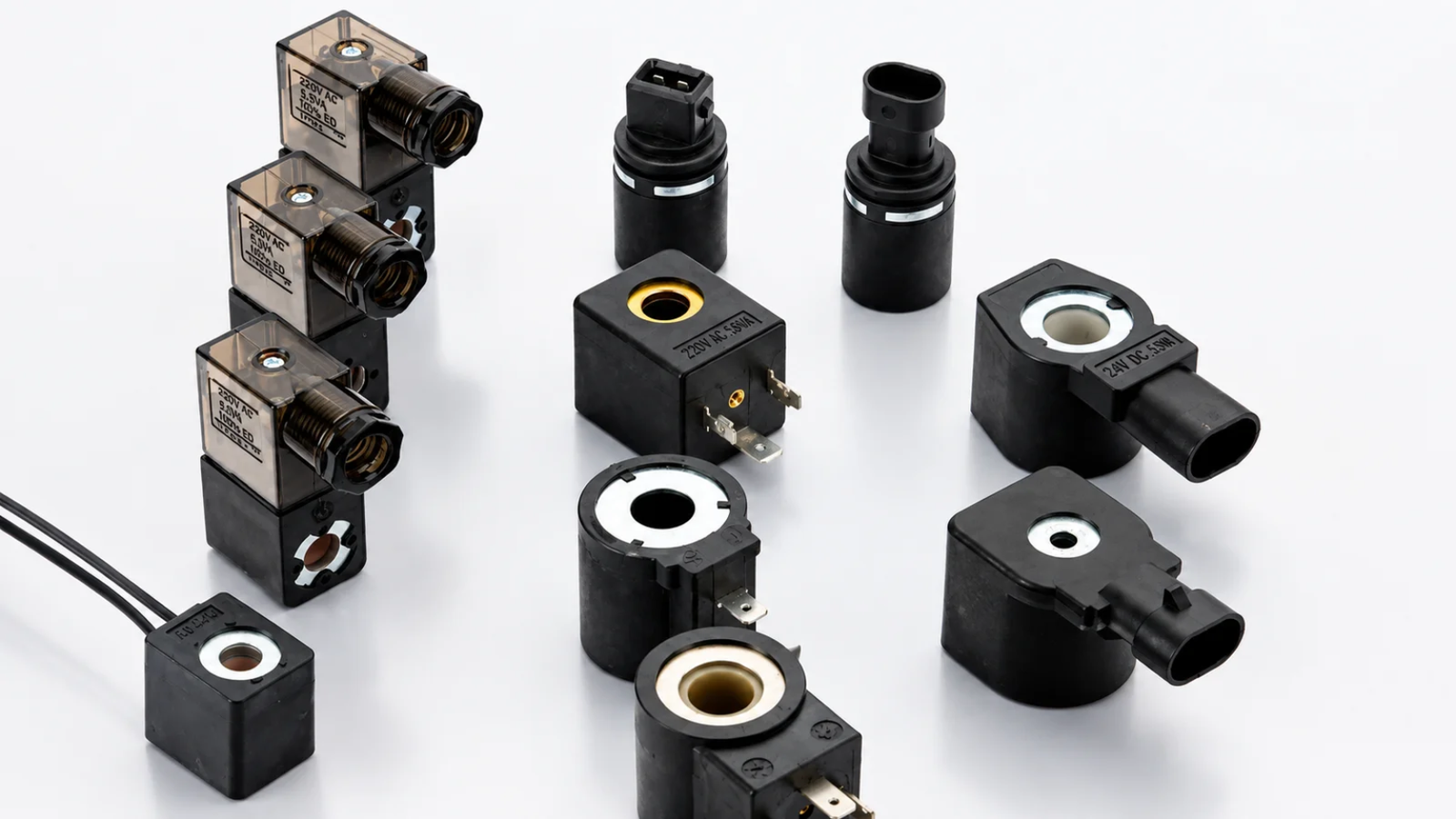
Voltage is straightforward; it has to be compatible. If your system provides 24V DC, you need a 24V DC coil. But power, or wattage, is where you make a performance trade-off. Many buyers think "more power is better," but that's a common misunderstanding. A higher wattage coil will actuate the valve with more force, which is good for high-pressure systems. However, that extra power generates more heat. Heat is the number one enemy of a solenoid coil because it degrades the wire's insulation over time, leading to a short circuit and failure.2 You need just enough power to operate the valve reliably, and no more. Choosing a coil with excessive wattage can actually shorten its lifespan, especially in applications where heat cannot dissipate easily.
Power Rating vs. Heat Generation
| Power Rating | Actuation Force | Heat Generation | Best For... |
|---|---|---|---|
| Low | Standard | Low | Standard pressure, long life applications |
| High | Strong | High | High-pressure systems, fast actuation |
What Is the Difference Between Form A, Form B, and Form C DIN connector?
Your coil is perfect, but the connector doesn't fit the cable. This simple oversight can stop an assembly line. It is a frustrating and easily avoidable problem you must solve.
The main difference is the pin spacing and physical size. Form A has 18mm pin spacing, Form B has 10mm or 11mm, and Form C has 8mm or 9.4mm.3 Your choice depends on the space you have and the connection standard used in your machinery.
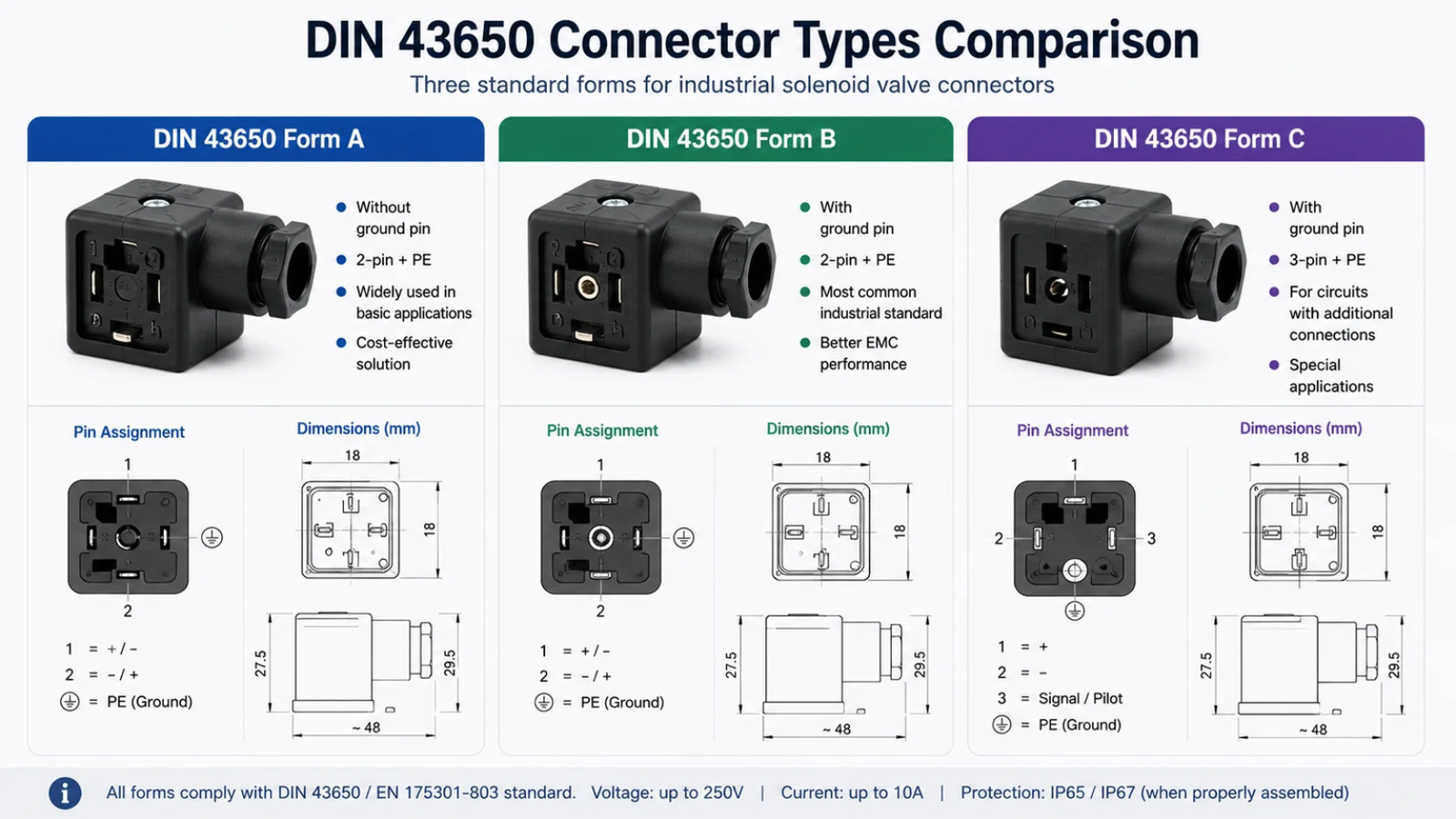
The choice of DIN connector goes beyond just fitting the pins. It impacts the robustness and design of your final product. Form A is the largest and most common in general industrial machinery.4 Its size makes it durable and easy to handle during installation. However, as equipment gets smaller, space becomes a premium. This is where Form B and Form C become important. A customer of ours in the home appliance industry recently switched their designs from Form A to Form C. This allowed them to build a more compact valve assembly, which was a key selling point for their new product line. When choosing, consider your space constraints, but also think about your supply chain. Standardizing on one connector type can simplify your inventory and reduce the risk of assembly errors.
DIN Connector Comparison
| Connector Type | Pin Spacing | Typical Application | Key Feature |
|---|---|---|---|
| Form A | 18 mm | General industrial machinery | Robust, common |
| Form B | 10/11 mm | Hydraulic and pneumatic valves | Medium size |
| Form C | 8/9.4 mm | Compact devices, small valves | Space-saving |
How Does the Choice of Insulation Class (Class F vs. Class H) Affect Coil Lifespan?
Your coils are failing from heat, but you do not know why. The environment seems normal. The hidden problem could be the wrong insulation class for your application's true operating temperature.
Insulation class sets the coil's maximum safe operating temperature. Class F is rated for 155°C, while Class H handles up to 180°C.5 Choosing Class H gives a larger safety margin in hot environments or high-duty applications, directly extending the coil's operational life.
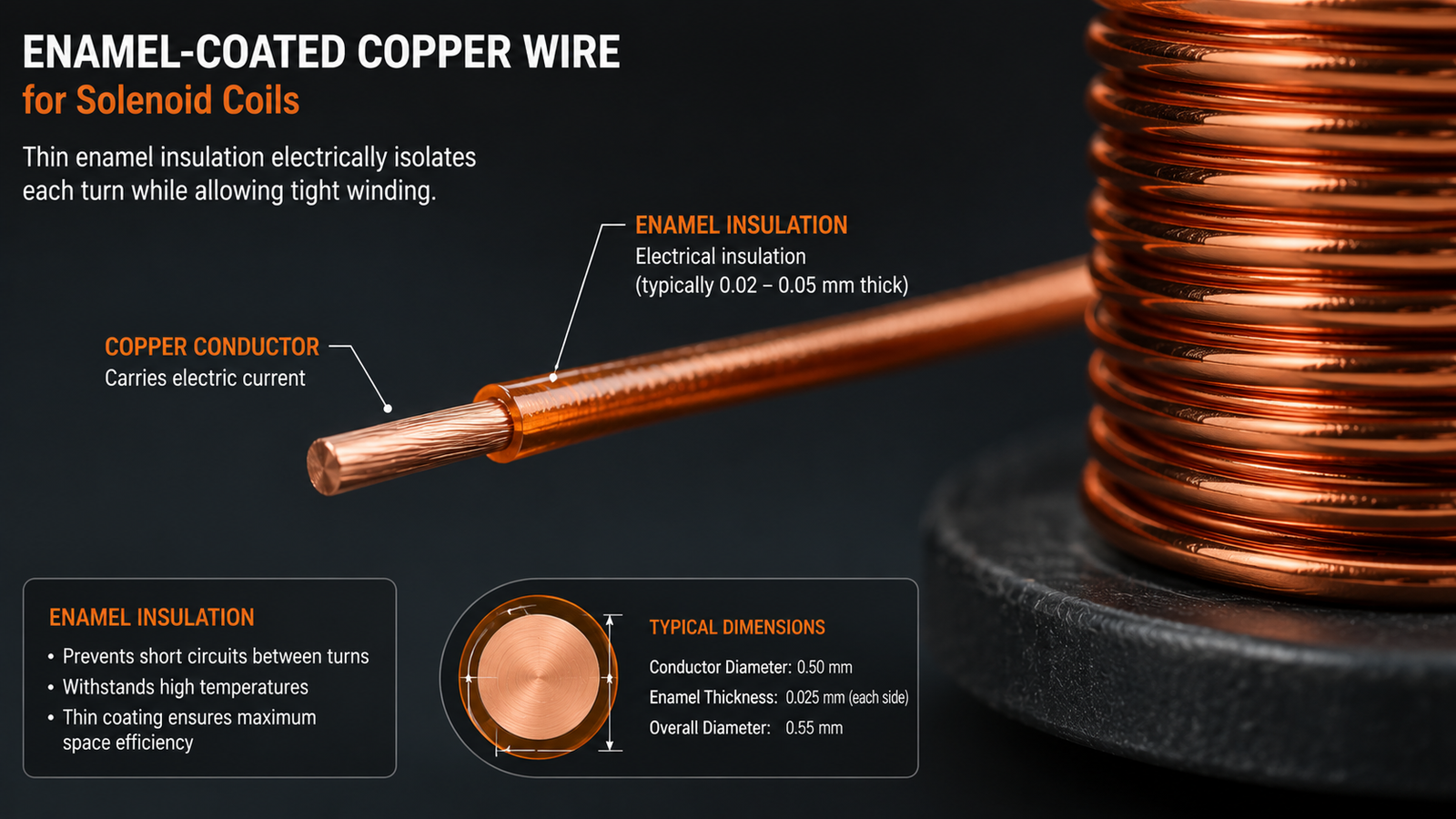
A frequent oversight is ignoring the total heat a coil must endure. The final temperature is not just the heat the coil generates itself; it is the ambient temperature + the temperature rise6 from being energized. I often ask procurement managers about the environment where the machine will operate. A coil with a 90°C temperature rise running in a 30°C factory operates at 120°C. A Class F coil (155°C limit) works fine here. But put that same machine in a facility that reaches 50°C, and the operating temperature is now 140°C. This leaves a very small safety margin. For a little extra cost, a Class H coil (180°C limit) provides a much larger buffer, ensuring reliability and a longer lifespan. It's an investment in durability.
Insulation Class Trade-Offs
| Insulation Class | Max Temperature | Relative Cost | Ideal Use Case |
|---|---|---|---|
| Class F | 155°C (311°F) | Standard | Moderate ambient temperatures, standard duty cycles |
| Class H | 180°C (356°F) | Higher | High ambient temperatures, continuous duty, high power |
Why Do You Need Continuous Duty (100% ED) Solenoid Coils for Automated Machinery?
Your automated line runs 24/7, but the solenoid coils keep burning out. You face constant interruptions. The problem is not the coil quality; it is the duty cycle rating.
Continuous duty (100% ED) coils are designed to stay energized indefinitely without overheating.7 Standard coils are for intermittent use and will fail if left on. For automated machinery, 100% ED is essential for system reliability and preventing thermal failure.
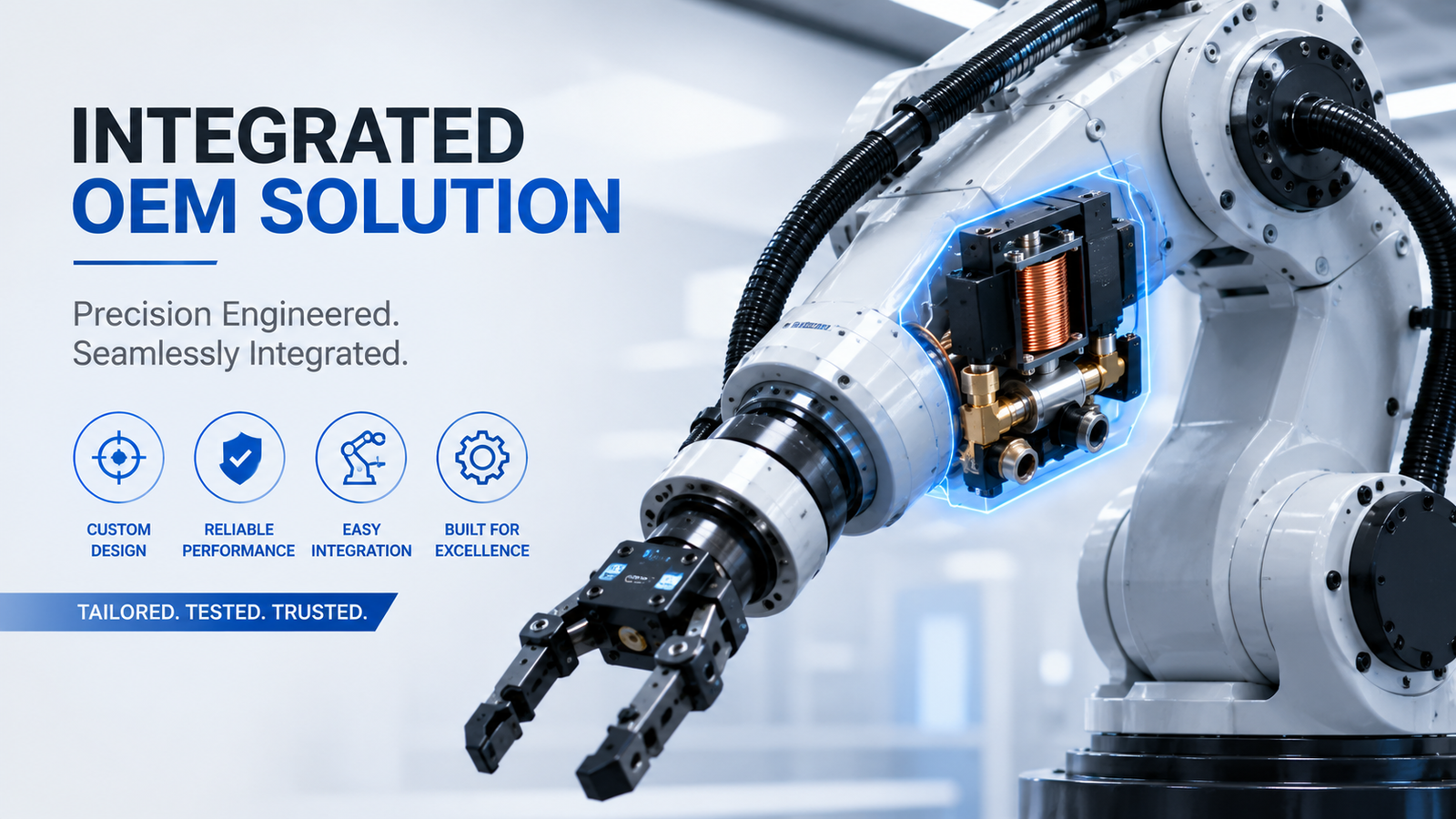
Duty cycle, or 'ED' from the German term Einschaltdauer8, defines how long a coil can be powered on within a given time frame. A 100% ED rating means it can be left on forever. Many purchasing managers see a lower price for an intermittent-duty coil and think they are saving money. This is a critical mistake for automated systems. An intermittent coil might be fine for a pneumatic clamp that operates a few times an hour. But for a sorting gate on a conveyor belt that stays energized for an entire shift, that same coil is guaranteed to overheat and fail. The real cost is not the few dollars saved on the coil; it is the thousands of dollars lost when your production line stops. We design 100% ED coils with superior heat dissipation and higher-grade materials for this exact reason. They are not just better; they are necessary.
What IP Ratings Are Required for Pneumatic Solenoid Coils in Wet or Dusty Environments?
Dust and moisture are destroying your pneumatic components. These common factory conditions cause short circuits and premature failure. You need a coil assembly that can withstand its working environment.
For dusty areas, you need at least an IP65 rating to prevent dust from getting inside. In places with water spray or washdowns, IP67 is essential, as it ensures protection against temporary immersion in water.9 The right IP rating prevents corrosion and electrical shorts.
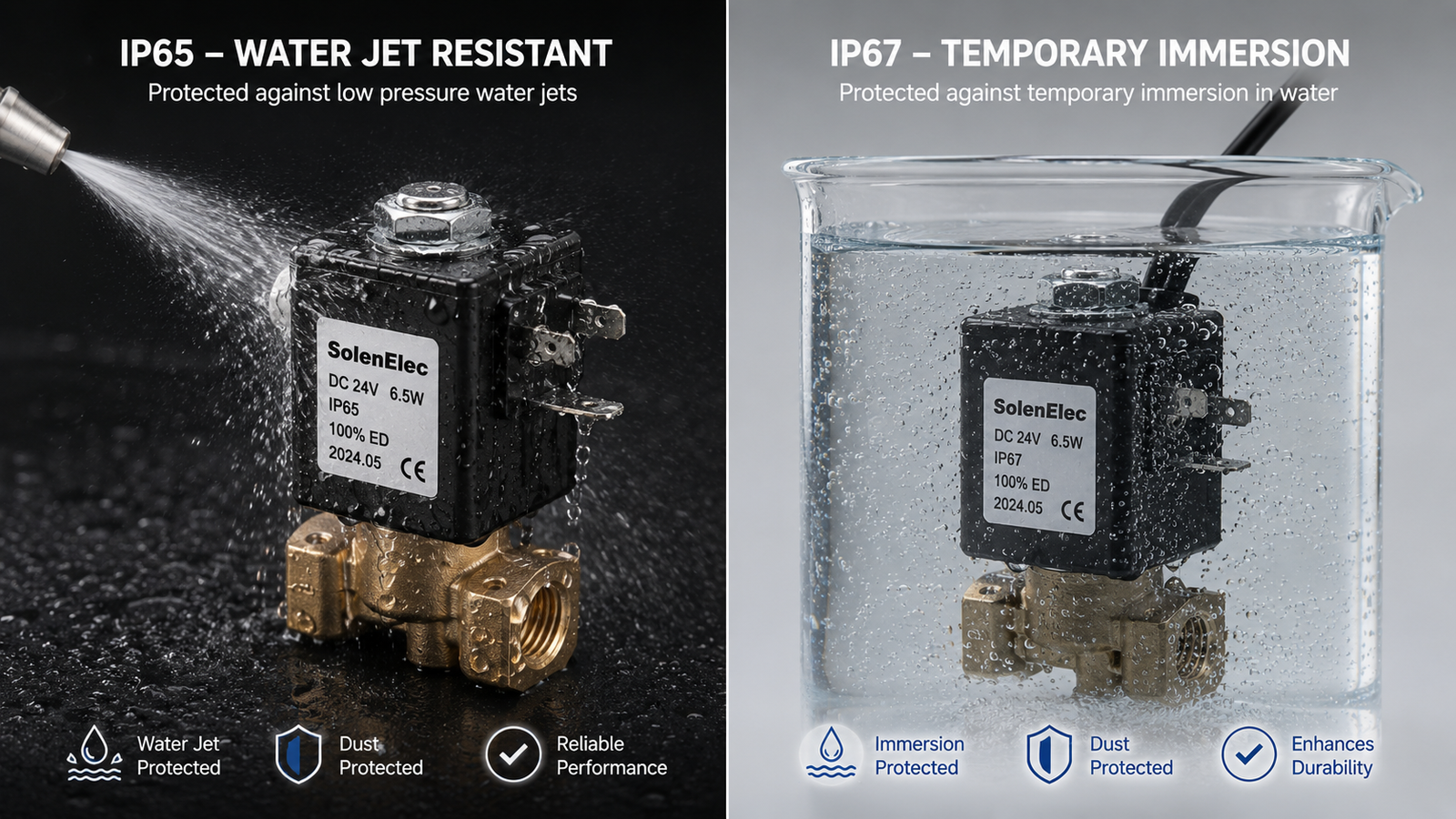
The IP (Ingress Protection) rating tells you how well a component is sealed against solids and liquids. The first number is for solids like dust, and the second is for liquids like water.10 It’s a detail that has huge consequences. For example, a customer in the food processing industry must wash their equipment daily with high-pressure water jets. For them, an IP67 rating is the absolute minimum. A standard coil would fail in days. In contrast, a woodworking facility might only have to worry about airborne sawdust, so an IP65-rated coil, which is fully dust-tight, would be sufficient. It is also important to remember that the IP rating is a system. It depends on both the coil and the electrical connector being installed correctly with its gasket in place. An IP67 coil with a poorly fitted connector offers no protection at all.
Common IP Ratings Explained
| IP Rating | Protection Against Solids | Protection Against Liquids | Common Application |
|---|---|---|---|
| IP65 | 6: Dust-tight | 5: Water jets from any direction | General factory automation, dusty environments |
| IP67 | 6: Dust-tight | 7: Temporary immersion in water (1m) | Equipment subject to washdowns, outdoor use |
| IP69K | 6: Dust-tight | 9K: High-pressure, high-temp water jets11 | Food & beverage, heavy vehicle cleaning |
Conclusion
Selecting the right coil is about matching its specifications to your application's risk. This focus on context ensures system reliability, reduces downtime, and protects your brand's reputation.
Need Help Selecting the Right Solenoid Coil?
Whether you need a standard pneumatic valve coil or a fully customized solution, our engineering team can help you evaluate voltage, duty cycle, insulation class, connector type, and environmental requirements.
If you are qualifying a factory rather than a catalog part, use How to Choose a Pneumatic Solenoid Coil Manufacturer.
If you are qualifying a factory rather than a catalog part, use How to Choose a Pneumatic Solenoid Coil Manufacturer.
👉 Explore our OEM Manufacturing Solutions or Contact Us to discuss your project.
"Solenoid valve - Wikipedia", https://en.wikipedia.org/wiki/Solenoid_valve. Technical summaries of solenoid valves explain that in direct‑acting designs the coil’s magnetic force must overcome the return spring and the pressure differential across the valve seat to actuate. Evidence role: mechanism; source type: encyclopedia. Supports: That direct-acting solenoid valves rely on magnetic force to oppose a return spring and fluid pressure for opening/closing.. Scope note: Pilot‑operated (servo‑assisted) valves have different force requirements, so the statement applies primarily to direct‑acting valves. ↩
"EN IEC 60216-1:2026 - Thermal Endurance of Electrical ...", https://standards.iteh.ai/catalog/standards/clc/2fe00eb3-c409-4682-ae91-14a2f023eb8d/en-iec-60216-1-2026?srsltid=AfmBOoqOQcFpMPrhS3bY8itD-JcTRck4U9u1sZs75Tgd2e6-JCHSKiIJ. IEC 60216 defines methods for determining the thermal endurance of electrical insulating materials and shows that increased temperature accelerates insulation aging, which can culminate in breakdown and failure. Evidence role: mechanism; source type: institution. Supports: That higher temperatures accelerate the aging and degradation of electrical insulating materials, which can lead to dielectric breakdown and failure.. Scope note: The standard addresses insulating materials in general and not solenoid coils specifically, but the principle applies to coil windings. ↩
"DIN 43650 Form A, Form B, Form C Comparison Chart", https://www.productsforautomation.com/din-43650-connector-characteristics-a/301.htm. Reference summaries of EN 175301-803 (DIN 43650) list connector types A, B, and C with typical pin spacings of about 18 mm (A), 10/11 mm (B variants), and 8/9.4 mm (C variants). Evidence role: definition; source type: encyclopedia. Supports: The nominal pin spacing dimensions associated with EN 175301-803 (formerly DIN 43650) connector Forms A, B, and C.. Scope note: Connector variants and tolerances exist; consult the specific connector’s datasheet for exact dimensions. ↩
"Type 2513 - Cable plug, form A according to DIN EN 175301-803", https://www.burkert-usa.com/en/type/2513. Overviews of EN 175301-803 (DIN 43650) note that the Form A connector is the most common variant and is physically larger than Forms B and C. Evidence role: general_support; source type: encyclopedia. Supports: That Type/Form A is widely used and has the largest footprint compared to Forms B and C.. Scope note: Actual usage patterns can vary by region and industry segment. ↩
"Insulation system - Wikipedia", https://en.wikipedia.org/wiki/Insulation_system. IEC 60085 specifies insulation thermal classes, listing Class F at 155°C and Class H at 180°C. Evidence role: definition; source type: institution. Supports: The standardized temperature limits associated with insulation classes F (155°C) and H (180°C).. ↩
"[PDF] INSULATION CLASS / TEMPERATURE RISE CLASS", https://www.leroy-somer.com/documentation_pdf/5202_en.pdf. IEC 60034-1 describes temperature limits for windings in terms of ambient temperature plus permissible temperature rise, a framework commonly applied to coil windings. Evidence role: mechanism; source type: institution. Supports: That permissible operating temperature is determined by adding temperature rise to ambient temperature for electrical windings.. Scope note: IEC 60034-1 pertains to rotating electrical machines; it is used here to support the general principle for electrical windings. ↩
"[PDF] Information solenoids - Wandfluh", https://www.wandfluh.com/fileadmin/user_upload/Wandfluh/Products/Components/DataSheets/Englisch/1.1%20SolenoidsManual%20override/1_1_400_e.pdf. DIN VDE 0580 standardizes the duty-cycle designation ED for electromagnetic devices; 100% ED denotes continuous duty operation without required de-energization at the specified ambient and mounting conditions. Evidence role: definition; source type: institution. Supports: That the ED designation defines permissible energized duration, with 100% ED indicating continuous operation.. Scope note: Compliance assumes the coil is operated within the manufacturer’s specified environmental and thermal limits. ↩
"Duty cycle - Wikipedia", https://en.wikipedia.org/wiki/Duty_cycle. In DIN VDE 0580, the duty cycle parameter is denoted 'ED', derived from the German term 'Einschaltdauer' (on-time), which defines allowable energized duration within a cycle. Evidence role: historical_context; source type: institution. Supports: That ED is derived from the German 'Einschaltdauer' and is used in standards to describe duty cycle for electromagnetic devices.. Scope note: This terminology is standardized in German and European contexts; other regions may use different terms for duty cycle. ↩
"IP67 Testing: Dust Test and Temporary Immersion IEC 60529", https://www.ingressprotectiontest.com/?l=test-ip67-protection-against-dust-ip6x-immersion-ipx7-cei-en-iec-60529. Per IEC 60529, IP67 denotes dust tightness (6) and protection against temporary immersion up to 1 m depth for 30 minutes (7) when tested as specified. Evidence role: definition; source type: encyclopedia. Supports: That IP67 specifies dust tightness and protection against temporary immersion under defined conditions.. Scope note: The rating applies under standardized test conditions and does not imply resistance to high-pressure cleaning. ↩
"IP code - Wikipedia", https://en.wikipedia.org/wiki/IP_code. Summaries of IEC 60529 explain that the IP Code’s first numeral denotes protection against solid ingress and the second numeral denotes protection against water ingress. Evidence role: definition; source type: encyclopedia. Supports: The interpretation of the first and second numerals in the IP Code per IEC 60529.. ↩
"IP69K: IP6X Dust and IPX9K High Pressure Water Protection", https://www.ingressprotectiontest.com/?l=ip69k-testing-dust-high-pressure-water-jets-iso-20653. ISO 20653 (originating from DIN 40050-9) defines the 9K rating as resistance to high‑pressure, high‑temperature water jets in wash‑down conditions. Evidence role: definition; source type: institution. Supports: That the 9K code (as defined in ISO 20653, derived from DIN 40050-9) corresponds to protection against high-pressure, high-temperature water jets.. Scope note: IP9K is defined by ISO 20653 rather than IEC 60529, and applicability depends on adherence to specified test parameters. ↩