

Why Is a Solenoid Pump Noisy? Causes and Design Fixes for OEM Applications
A solenoid pump noisy enough to affect the finished product can become a serious OEM design problem. The pump may meet pressure, flow, and life requirements, yet vibration can still trigger customer complaints or delay approval. I address this issue by separating electromagnetic, mechanical, and fluid noise before selecting a design fix.
A solenoid pump becomes noisy when electromagnetic force fluctuations, plunger impact, spring behavior, fluid pulsation, and equipment resonance interact. The best solution is usually not one softer component. Engineers should identify the dominant noise path, balance noise against pump performance, and optimize the coil design, moving assembly, fluid path, and mounting during prototyping.

In my experience, noise rarely comes from one defective part. The pump, tubing, mounting bracket, and equipment enclosure form one acoustic system. A useful investigation therefore starts with controlled noise and vibration testing rather than immediately changing the spring, adding rubber, or replacing the complete pump.
What Causes a Solenoid Pump to Make Noise During Operation?
Engineers often hear an objectionable sound but cannot locate its source. This uncertainty can lead teams to modify several components at once, making the result difficult to interpret. I first classify the sound as electromagnetic excitation, mechanical impact, fluid pulsation, or structure-borne noise.
A solenoid pump makes noise when its alternating magnetic force moves the plunger, the moving assembly contacts a stop, and pressure pulses travel through the fluid system.1 Manufacturing tolerances, trapped air, valve behavior, mounting stiffness, and enclosure resonance can amplify these normal operating forces until the finished equipment sounds unacceptable.

I Separate the Noise Into Three Systems
I generally avoid calling the problem a “motor noise” issue. Many oscillating solenoid pumps do not use a conventional rotating motor. Their sound comes from three connected systems:
-
Electromagnetic system
- Alternating magnetic force
- Flux variation and magnetic imbalance
- Coil supply frequency and waveform
- Air-gap variation
- Magnetic material properties
-
Mechanical system
- Plunger or armature impact
- Spring preload and stiffness
- Guide clearance
- Stop geometry
- Component wear or tolerance accumulation
-
Fluid system
- Inlet and outlet valve motion
- Pressure pulsation
- Cavitation or inadequate inlet supply
- Trapped air
- Hydraulic shock in rigid tubing
Each source needs a different response. A rubber mount may reduce vibration transmitted to a metal housing, but it will not correct unstable valve motion. A revised spring may reduce plunger impact, but it can also change stroke, flow, starting behavior, and pressure capability.
The Pump Can Be Acceptable While the Machine Is Noisy
A pump that sounds reasonable on a laboratory bench may become much louder after installation. The surrounding parts can act as resonators or sounding boards.2
| Noise path | Typical symptom | Useful engineering check |
|---|---|---|
| Direct airborne noise | Sound remains similar when mounting changes | Measure near the pump in a controlled environment |
| Structure-borne vibration | Enclosure panels buzz or amplify a tonal sound | Compare rigid and isolated mounting |
| Fluid-borne pulsation | Tubes shake or fittings create clicking sounds | Change tube routing or add a test pulsation damper |
| Mechanical impact | Sharp, repetitive knocking | Review stroke, spring force, and stop contact |
| Electromagnetic excitation | Strong hum at the drive frequency or its harmonics | Review voltage, frequency, waveform, and magnetic gap |
I once saw an equipment prototype in which the pump was replaced twice without a meaningful improvement. The dominant problem was a thin sheet-metal bracket that amplified vibration at the operating frequency. A temporary stiffener changed the sound immediately. That simple test prevented an unnecessary pump redesign.
For OEM troubleshooting, I recommend changing one controlled variable at a time. Engineers should record the pump sample, voltage, pressure, flow, mounting torque, tubing configuration, and test environment. Otherwise, two recordings that appear comparable may represent very different operating conditions.
Why Does a Solenoid Pump Produce Excessive Vibration and Humming?
A steady hum and a sharp impact sound may seem like one problem, but they usually have different causes. If engineers treat every sound with additional damping, they can hide the symptom while reducing response speed or increasing heat. I investigate excitation frequency and mechanical movement separately.
Excessive solenoid pump vibration usually results from periodic magnetic force, plunger acceleration, impact at the end of travel, or resonance in the pump mounting and equipment structure. Humming becomes more noticeable when the drive waveform, air gap, spring characteristics, component tolerances, or enclosure natural frequency reinforce the pump’s operating frequency.

Magnetic Force Is Not Constant
The magnetic force acting on the plunger changes with current, air gap, magnetic saturation, and drive timing.3 In an AC-operated design, this varying force creates regular excitation. The resulting tone may appear at the supply frequency, at twice that frequency, or at related harmonics4, depending on the electrical and mechanical design.
I review the following factors when humming dominates:
- Actual voltage under load
- Supply frequency
- Rectified or unrectified waveform
- Duty cycle and switching method
- Coil temperature
- Initial and operating air gaps
- Magnetic core alignment
- Local saturation in the magnetic circuit
A coil should not be evaluated by resistance alone. Inductance, current rise, thermal behavior, magnetic geometry, and operating conditions all influence force generation. A design that has sufficient force at room temperature may behave differently after the coil reaches thermal stability.
Plunger Impact Creates Broadband Noise
A plunger that reaches a hard stop with excessive velocity can create a sharper, broadband sound.5 The impact also enters the pump body and mounting structure as vibration. Engineers can reduce the impact by changing mass, stroke, spring force, force profile, stop geometry, or damping. However, every modification carries a performance trade-off.
For example:
- A stiffer spring may return the plunger faster but demand more magnetic force.
- A softer spring may reduce one impact but cause unstable return or lower pressure.
- A shorter stroke may reduce impact energy but also reduce displacement.
- A soft stop may lower high-frequency noise but change durability and stroke accuracy.
- More damping may reduce vibration but slow response and lower flow.
I treat low-noise design as an optimization problem, not a search for the softest possible assembly.
Resonance Can Multiply a Small Excitation
The pump produces periodic forces, but the complete machine determines how strongly users hear them. If the pump excitation is close to a natural frequency of a bracket, panel, tank, or tube, the equipment can amplify a modest vibration.6
I use simple diagnostic steps before commissioning a complex analysis:
- Measure vibration on the pump body, bracket, and enclosure.
- Compare the sound with the enclosure open and closed.
- Temporarily add mass or stiffness to a suspected panel.
- Change mounting compression without exceeding specified limits.
- Re-route tubing to remove contact with panels.
- Review the frequency spectrum before and after each change.
These checks help distinguish a pump-generated force from an equipment-level amplification problem. For medical devices, coffee machines, and beverage equipment, that distinction can determine whether the supplier changes the pump or the OEM changes the surrounding structure.
How Do Solenoid Pump Design Parameters Affect Noise Performance?
A pump can meet the nominal flow specification and still create an unacceptable acoustic signature. Noise performance depends on dynamic behavior, not only a static data sheet. I therefore evaluate how magnetic force, plunger movement, spring matching, valve timing, pressure, and manufacturing variation interact across the operating range.
Solenoid pump design parameters affect noise by controlling force, acceleration, impact energy, pressure pulsation, and vibration transmission. Air gap, stroke, plunger mass, spring rate, valve response, coil drive, fluid restriction, and material selection must be matched. Optimizing one parameter in isolation can reduce sound while damaging flow, pressure, efficiency, or life.
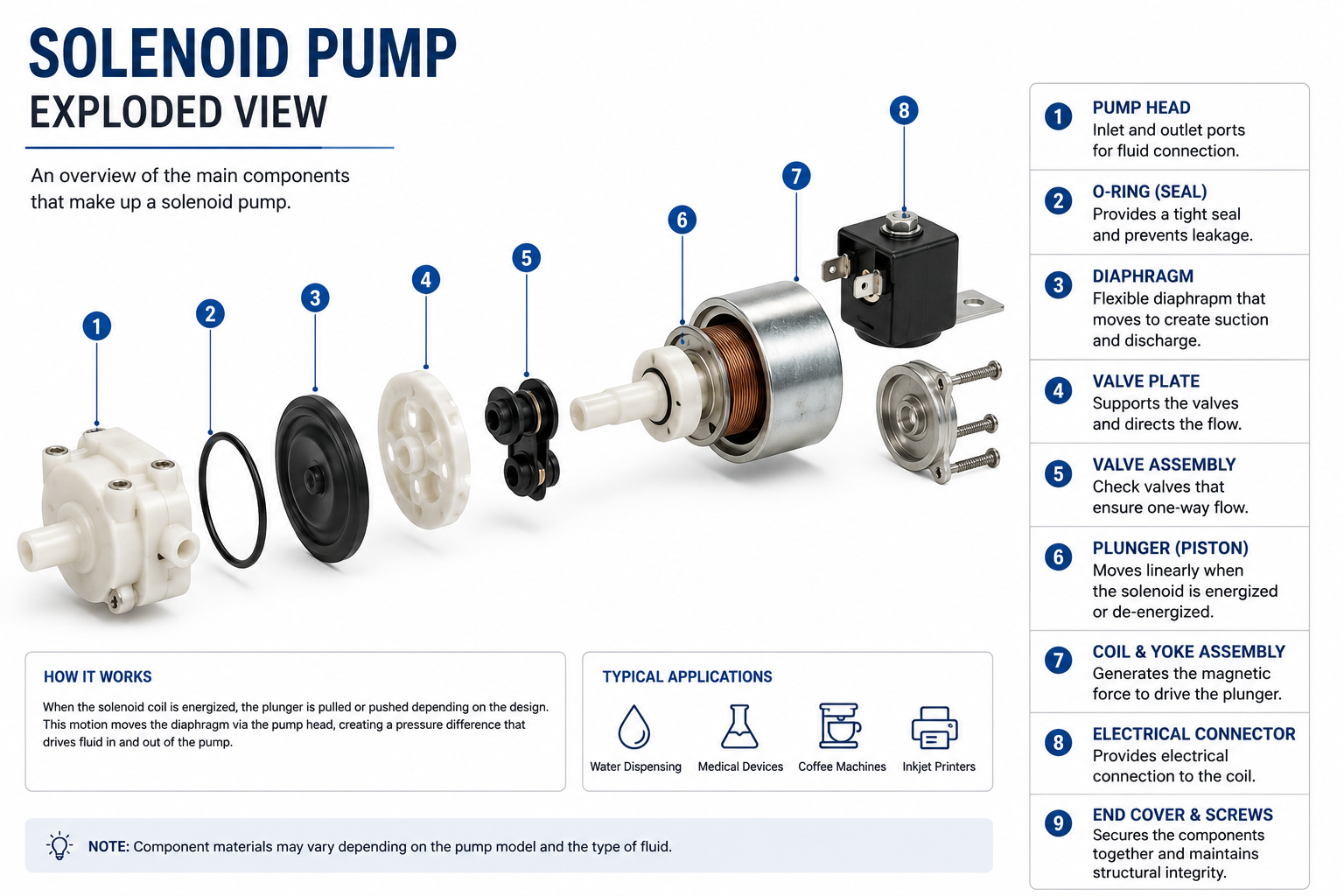
Magnetic Circuit Design
The magnetic circuit determines how electrical input becomes plunger force. Key variables include:
- Core and plunger material
- Effective air gap
- Pole-face geometry
- Flux path cross-section
- Coil turns and wire size
- Current waveform
- Magnetic saturation margin
- Assembly concentricity
An excessive air gap may require more current or create weaker force. A very small or inconsistent gap can increase sensitivity to tolerance and alignment. Saturation can also limit useful force even when electrical input continues to rise. The design target should provide adequate force throughout the stroke without creating unnecessary acceleration near impact.
Spring Matching and Moving Mass
The spring controls return behavior and contributes to the dynamic balance of the moving assembly. I evaluate spring rate, preload, free length, fatigue behavior, and tolerance together. A nominal spring value alone does not describe the complete response.
A simplified comparison illustrates the trade-offs:
| Parameter change | Possible noise benefit | Possible performance risk |
|---|---|---|
| Reduce plunger mass | Lower impact energy | Reduced momentum for valve or fluid action |
| Shorten stroke | Less travel and impact velocity | Lower displacement and flow |
| Increase spring stiffness | Faster return and improved control | Higher force demand and harder impact |
| Reduce spring stiffness | Lower resistance in one direction | Slow return or unstable operation |
| Add compliant stop | Less high-frequency impact noise | Wear, dimensional drift, or heat sensitivity |
| Increase structural isolation | Less transmitted vibration | Excess movement or tubing stress |
Production tolerances matter as much as nominal values. A low-noise prototype assembled from selected parts may not represent mass production. I prefer to test samples near the expected tolerance limits, including spring force, plunger mass, guide clearance, valve dimensions, and molded component geometry.
Fluid Path and Pressure Pulsation
A solenoid pump delivers discrete fluid volumes, so some pulsation is inherent.7 The fluid circuit determines whether that pulsation remains controlled or becomes audible.
Important variables include:
- Inlet restriction
- Outlet back pressure
- Tube diameter and length
- Fluid viscosity and temperature
- Valve opening and closing speed
- Gas or air in the fluid
- Accumulator or pulsation damper volume
- Proximity of tubes to enclosure panels
In a coffee machine, for example, pressure may satisfy brewing requirements while the rigid tube carries pulsation into the chassis. In beverage equipment, repeated cycles can make valve clicking and tube movement more noticeable. In medical equipment, a moderate tonal sound may still be unacceptable because the operating environment is quiet and the device may run near a patient for long periods.
I recommend evaluating both pump-level performance and installed-system noise. The first supports supplier comparison. The second confirms whether the selected design works inside the actual OEM product.
How Can Engineers Reduce Solenoid Pump Noise Without Sacrificing Performance?
Noise reduction projects often begin after pressure and flow have already been approved. At that point, engineers may have limited space and tooling flexibility. Randomly adding damping can reduce sound in one condition while causing low flow, slow response, excess heat, or shortened life elsewhere.
Engineers can reduce solenoid pump noise without sacrificing performance by identifying the dominant source, setting measurable acoustic targets, and optimizing force, stroke, spring behavior, valve timing, fluid pulsation, and mounting together. Engineers should validate every modification against pressure, flow, temperature rise, response time, durability, and production tolerance requirements.
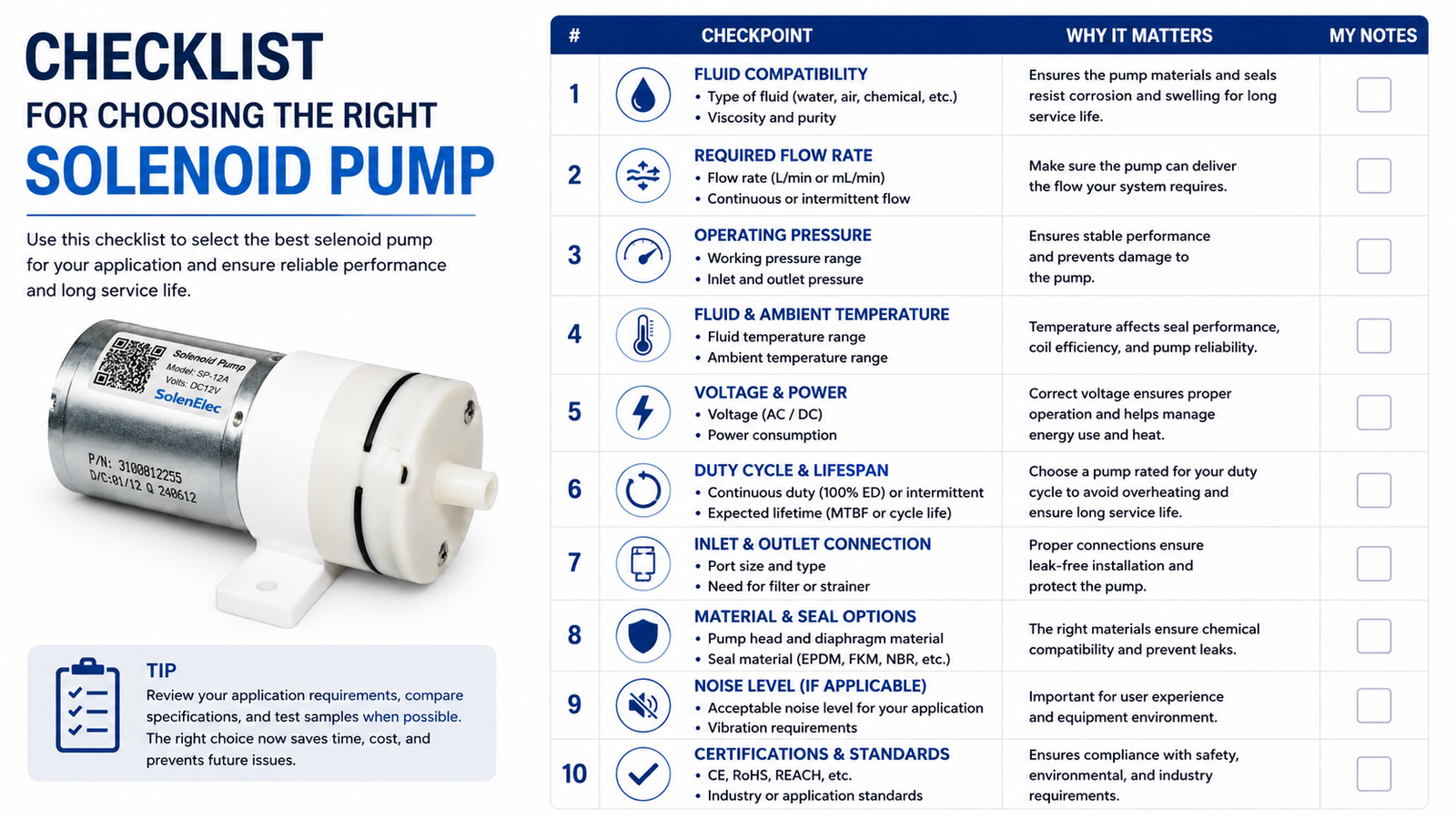
Start With a Repeatable Noise Test
A statement such as “the new pump sounds quieter” is not enough for OEM approval. I recommend a written test method that specifies:
- Sound metric, such as dB(A) and, where useful, unweighted spectral data
- Microphone position and orientation
- Test distance, such as 0.5 or 1 metre
- Background noise level
- Room or acoustic enclosure conditions
- Pump voltage, frequency, and waveform
- Inlet condition and outlet pressure
- Measured flow rate
- Fluid type and temperature
- Mounting material, torque, and isolator compression
- Tubing diameter, length, and routing
- Warm-up time and coil temperature
- Number of samples and operating cycles
The distance alone can materially change the reported value.8 The same pump can also produce different readings at free flow and at working pressure. Engineers should therefore avoid comparing supplier data unless the test conditions are equivalent.
Use Frequency Analysis to Find the Source
An overall dB(A) value shows the sound level but does not explain the cause. Frequency spectrum analysis can reveal narrow tonal peaks, harmonics, or broadband impact energy.9
I use the pattern as a diagnostic clue:
- Strong peak at an excitation frequency: Review drive conditions and magnetic force.
- Harmonic series: Check periodic impact, waveform, and structural resonance.
- Broadband high-frequency content: Investigate hard contact and valve clicking.
- Low-frequency modulation: Check unstable flow, trapped air, or inconsistent strokes.
- Peak on the enclosure but not the pump: Investigate mounting and panel resonance.
Engineers can then compare before-and-after spectra. A modification may lower the overall value only slightly while removing an irritating tone. In user perception, that change can be more important than a small reduction in the headline dB(A) figure.
Apply Fixes at the Correct Level
I group possible fixes by system:
Electromagnetic changes
- Optimize pole geometry and magnetic gap
- Improve concentricity and alignment
- Adjust coil design or drive waveform
- Reduce force overshoot near the end of travel
- Control magnetic material consistency
Mechanical changes
- Match spring rate and preload to the stroke
- Reduce unnecessary moving mass
- Control guide clearance
- Modify the stop interface
- Improve dimensional tolerances
- Add carefully validated damping
Fluid changes
- Reduce inlet restriction
- Optimize valve dynamics
- Remove trapped air
- Adjust tube compliance and routing
- Add a suitable pulsation damper
- Avoid direct tube contact with resonant panels
Equipment integration changes
- Use correctly selected isolating mounts
- Increase bracket stiffness where needed
- Move the pump away from large panels
- Control mounting torque
- Prevent tubing from bypassing the isolator
The most effective electromagnetic pump noise reduction normally occurs during prototype development. Once tooling, bracket geometry, tubing routes, and electrical control are frozen, engineers have fewer options. SolenElec’s OEM/ODM context allows our engineering team to review coil design, material selection, tooling, winding, and molded components before mass production. Buyers should still validate the final design under their own application conditions.
How to Select a Low-Noise Solenoid Pump for OEM Equipment?
A “low-noise” label does not guarantee quiet operation in a finished machine. Supplier measurements may use different pressures, distances, mounting conditions, or drive methods. I compare pumps with a common specification and then test shortlisted samples inside a representative OEM assembly.
To select a low-noise solenoid pump, engineers should define pressure, flow, duty cycle, sound limits, test conditions, mounting, fluid properties, and expected life before requesting samples. Buyers should compare suppliers using identical tests, review design and process controls, and complete application-level noise, thermal, performance, and durability validation before approval.
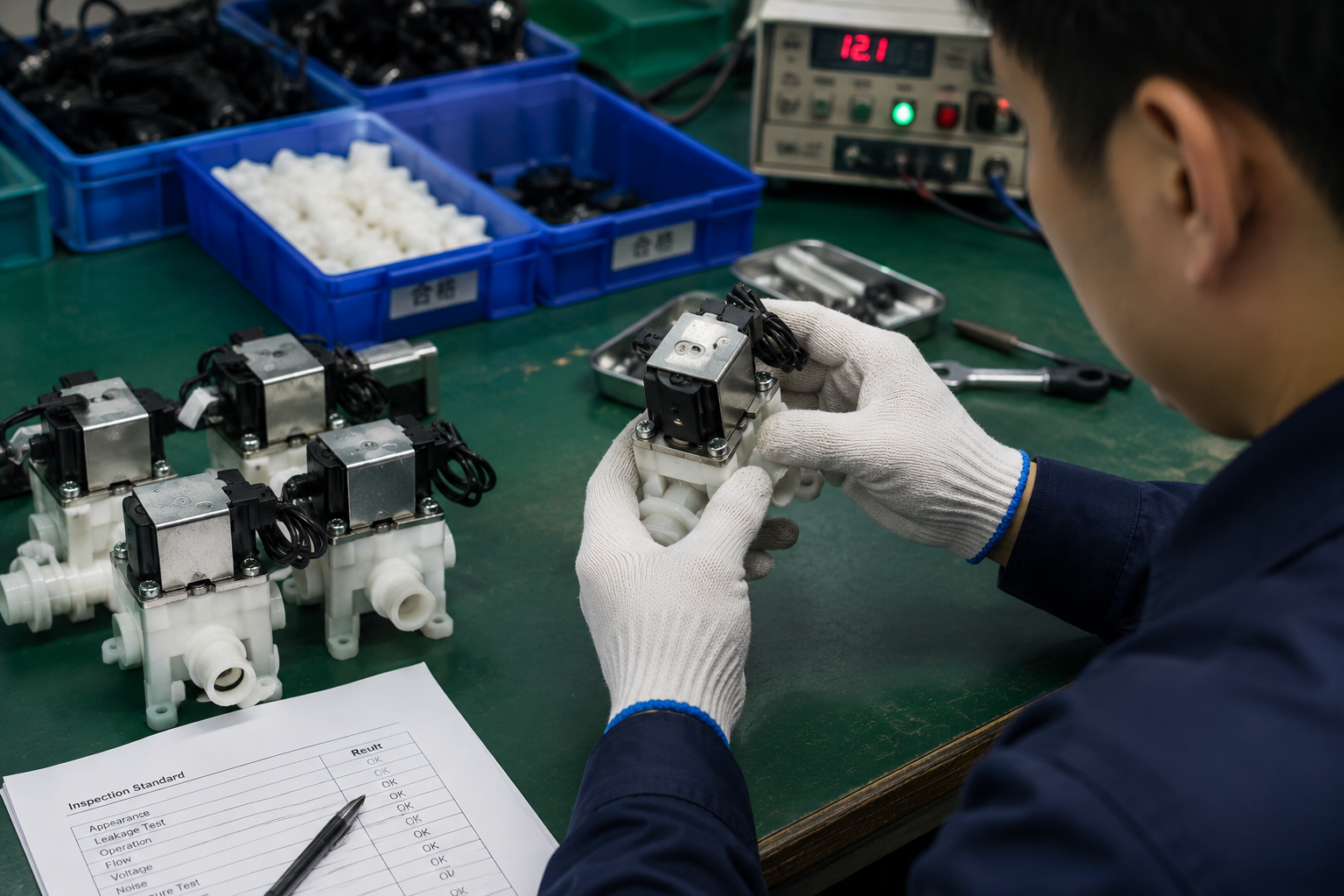
Build an Application-Based Specification
I recommend that engineers provide more than nominal voltage, pressure, and flow. A useful request for quotation should include:
- Rated and allowable voltage range
- Frequency or electronic drive waveform
- Target flow at defined back pressure
- Maximum pressure
- Fluid type, viscosity, and temperature range
- Prime and restart requirements
- Continuous or intermittent duty cycle
- Maximum coil temperature or temperature rise
- Target sound level and measurement method
- Permitted vibration level, if applicable
- Mounting orientation and available space
- Tube and fitting details
- Expected service life
- Regulatory and material requirements
- Annual volume and traceability expectations
For coffee equipment, I would also examine sound during pressure build-up, brewing, and restart. For medical equipment, I would include tonal limits, long-duration operation, and patient proximity. For beverage machines, I would evaluate repeated cycles, temperature variation, and the effect of cabinet panels and tubing.
Compare More Than a Catalog Noise Figure
A qualified supplier should be able to explain how it controls the variables that affect noise. Procurement and engineering teams can use a structured evaluation table:
| Evaluation area | Evidence to request | Why it matters |
|---|---|---|
| Acoustic test capability | Written method, equipment details, raw data, spectra | Confirms whether claims are comparable |
| Design capability | Magnetic, mechanical, and fluid design review | Supports application-specific optimization |
| Prototype control | Sample records and revision management | Prevents confusion between design versions |
| Process capability | Winding, molding, assembly, and inspection controls | Reduces unit-to-unit noise variation |
| Traceability | Material lots, process records, and test history | Supports root-cause analysis |
| Change management | Notification and approval procedure | Prevents unapproved acoustic changes |
| Compliance documents | Current certificates and test reports | Supports buyer due diligence |
| Capacity and continuity | Production lines, tooling plan, and contingency measures | Reduces supply risk |
In SolenElec’s supplied business context, we operate eight production lines and use MES-supported traceability, incoming inspection, production controls, outgoing inspection, and ISO-based sampling. We also support customized coil and solenoid development. Buyers should audit these capabilities and verify the scope, validity, model coverage, and issuing body of any ISO, CE, UL, RoHS, REACH, TÜV, CB, IEC, or automotive-related document before relying on it.
Validate Production Variation
A quiet engineering sample does not prove that thousands of units will perform the same way. Noise can vary with spring force, air gap, plunger finish, molded dimensions, assembly alignment, and mounting interface.10
I recommend a staged approval process:
- Benchmark testing: Compare current and candidate pumps under identical conditions.
- Prototype integration: Install samples in representative equipment.
- Design verification: Test noise, pressure, flow, temperature, and endurance.
- Pilot production: Evaluate multiple units from a normal manufacturing process.
- Tolerance review: Include samples across relevant dimensional and electrical ranges.
- Reliability testing: Recheck acoustic performance after life cycling.
- Mass-production control: Define critical characteristics and change controls.
A qualified acoustics, electrical, mechanical, fluid, or compliance professional should evaluate application-specific risks. This review is especially important for medical, automotive, and safety-critical equipment.
Frequently Asked Questions
Why is my solenoid pump noisy only after it warms up?
The sound may change because coil resistance rises with temperature, which changes current and magnetic force.11 Heat can also affect plastic dimensions, fluid viscosity, clearances, and damping materials. I recommend comparing cold and thermally stable measurements while recording voltage, current, pressure, flow, and coil temperature.
Can rubber mounts completely eliminate solenoid pump vibration?
Rubber mounts can reduce structure-borne vibration, but they rarely remove noise at its source.12 Incorrect isolator stiffness or compression may also allow excessive movement or transfer vibration through tubing. Engineers should match the mount to pump mass and excitation frequency, then validate tube loads, durability, and installed performance.
Does a quieter solenoid pump deliver less pressure or flow?
Not necessarily. A well-balanced design can reduce impact and resonance while maintaining the required output. However, excessive damping, a softer spring, or a shorter stroke may lower response, pressure, or flow. I always compare acoustic improvement with hydraulic output, temperature rise, efficiency, and life.
What is the best way to measure solenoid pump noise?
Engineers should define a repeatable method that controls microphone distance, orientation, background sound, mounting, voltage, pressure, flow, fluid temperature, tubing, and warm-up time. I recommend recording both dB(A) and frequency spectrum data, then testing the pump alone and inside the complete equipment.
When should OEM engineers begin solenoid pump noise optimization?
Engineers should begin during concept and prototype development. Early work allows changes to the magnetic circuit, spring, plunger, valve, fluid path, mounting, and enclosure. After tooling and system architecture are fixed, teams usually have fewer options and may need compromises that add cost or reduce performance.
Conclusion
A solenoid pump noisy enough to affect an OEM product is rarely explained by poor quality or one defective component alone. Electromagnetic force, plunger impact, spring matching, pressure pulsation, mounting, and enclosure resonance all influence the result. I recommend defining a repeatable noise test, identifying the dominant transmission path, and balancing every design change against pressure, flow, heat, response, and life. If you are developing a quieter coffee, beverage, medical, pneumatic, or fluid-control product, Contact SolenElec to discuss prototype evaluation and a customized OEM/ODM solenoid pump or coil solution.
Need Help Developing a Low-Noise Solenoid Pump Solution?
Noise performance depends on more than the pump itself. Magnetic design, moving components, fluid conditions, mounting structure, and production consistency all influence the final equipment performance.
SolenElec supports OEM projects with solenoid pump and coil development, engineering evaluation, prototyping, and mass-production support.
Contact SolenElec to discuss your application requirements.
"Improved Performance of the Electromagnetic Fuel Injector ...", https://www.academia.edu/16724512/Improved_Performance_of_the_Electromagnetic_Fuel_Injector_Solenoid_Actuator_Using_a_Modelling_Approach. Engineering literature on solenoid actuators and reciprocating pumps describes electromagnetic force variation, impact of moving components, and pressure pulsation as distinct mechanisms that can generate noise and vibration in such systems. Evidence role: mechanism; source type: education. Supports: A neutral engineering source should support that electromagnetic actuation, moving-member impact, and pulsating fluid flow can each generate vibration or noise in solenoid-driven pump systems.. Scope note: The source may address solenoid actuators and reciprocating pumps separately rather than the exact pump model discussed in the article. ↩
"Influence of the vibrational properties of the resonance board ...", https://bioresources.cnr.ncsu.edu/resources/influence-of-the-vibrational-properties-of-the-resonance-board-on-the-acoustical-quality-of-a-piano/. Texts on mechanical vibration and structure-borne sound explain that panels, brackets, and enclosures can radiate amplified noise when external excitation coincides with structural resonances. Evidence role: mechanism; source type: education. Supports: A source should explain that surrounding structures can radiate or amplify sound when excited near their natural frequencies.. Scope note: This supports the general physical mechanism of resonance amplification, not a measured result for the specific OEM assembly. ↩
"Why Doesn't My Solenoid Valve Release? Common Causes of ...", https://solenelec.com/why-doesnt-my-solenoid-valve-release-common-causes-of-residual-magnetism/. Electromagnetic actuator references show that solenoid force is governed by coil current, air-gap geometry, magnetic circuit properties, and saturation effects. Evidence role: mechanism; source type: education. Supports: A source should support the relationship between solenoid force and current, magnetic circuit geometry, air gap, and saturation.. Scope note: The citation would establish the governing design principles rather than validate the article's specific pump configuration. ↩
"Common Solenoid Valve Problems in Industrial Automation Systems ...", https://solenelec.com/common-solenoid-valve-problems-in-industrial-automation-systems/. Research on AC electromagnetic devices reports that magnetic force ripple and structural response can produce vibration components at the supply frequency, twice the supply frequency, and associated harmonics. Evidence role: mechanism; source type: paper. Supports: A source should support that electromagnetic excitation in AC magnetic devices can occur at line frequency, twice-line frequency, and harmonics depending on waveform and mechanical response.. Scope note: The harmonic pattern depends on rectification, magnetic design, and mechanical boundary conditions, so the source provides contextual support rather than a universal diagnostic rule. ↩
"Improving Broadband Noise Filter for Audio Signals", https://digitalcommons.calpoly.edu/cgi/viewcontent.cgi?article=1789&context=theses. Acoustics and vibration references describe mechanical impact as a transient excitation that can generate broadband vibration and sound, especially when hard surfaces collide at high relative velocity. Evidence role: mechanism; source type: education. Supports: A source should explain that mechanical impacts excite a broad range of frequencies and can create sharp, broadband noise.. Scope note: The citation supports the physics of impact noise generally, not a measured spectrum from the pump discussed. ↩
"(PDF) Resonant frequency of mass-loaded membranes for ...", https://personal.stevens.edu/~ffisher/pubs/Dong-AIMS_Energy15_membrane_mass.pdf. Mechanical vibration theory establishes that a structure subjected to periodic forcing can exhibit amplified response when the forcing frequency approaches one of the structure's natural frequencies. Evidence role: mechanism; source type: education. Supports: A source should support that forced vibration amplitudes increase near a system's natural frequency.. ↩
"How Does a Solenoid Pump Work and Why Is It Used in Precision ...", https://solenelec.com/how-does-a-solenoid-pump-work-and-why-is-it-used-in-precision-fluid-control/. Pump engineering references describe reciprocating positive-displacement pumps as producing periodic, pulsating flow because fluid is displaced in discrete strokes. Evidence role: definition; source type: institution. Supports: A source should support that reciprocating or metering pumps produce pulsating flow because delivery occurs in strokes rather than continuous rotation.. Scope note: The source may describe reciprocating pumps broadly rather than solenoid pumps specifically. ↩
"Estimating Sound Levels With the Inverse Square Law", http://hyperphysics.phy-astr.gsu.edu/hbase/Acoustic/isprob2.html. Acoustics guidance on sound propagation explains that measured sound pressure level depends on distance from the source, with free-field levels decreasing as distance increases. Evidence role: mechanism; source type: government. Supports: A source should support that sound pressure level varies with measurement distance, especially in free-field conditions.. Scope note: The exact change in a pump test may differ from ideal free-field behavior because rooms, enclosures, and mounting structures affect reflections and radiation. ↩
"Pink noise", https://en.wikipedia.org/wiki/Pink_noise. Noise-control references describe frequency-spectrum analysis as a standard method for distinguishing tonal components, harmonic series, and broadband noise signatures. Evidence role: general_support; source type: education. Supports: A source should support that frequency-domain analysis is used to identify tonal components, harmonics, and broadband noise in acoustic diagnostics.. Scope note: The citation supports the diagnostic method generally and does not identify the dominant source in any particular pump. ↩
"Why Is Your Espresso Machine Not Heating? How Steam Solenoid ...", https://solenelec.com/how-steam-solenoid-valve-leakage-affects-espresso-machine-temperature-and-pressure/. Studies of solenoid actuators and precision electromechanical assemblies report that tolerances in air gap, spring characteristics, alignment, and moving-part interfaces can alter dynamic response and contribute to unit-to-unit performance variation. Evidence role: general_support; source type: paper. Supports: A source should support that solenoid actuator performance and vibration can be sensitive to tolerances such as air gap, spring properties, alignment, and surface conditions.. Scope note: The evidence is likely to support tolerance sensitivity in comparable actuator systems rather than provide direct statistical noise data for this pump family. ↩
"How Ambient Temperature Affects Solenoid Coil Selection ...", https://solenelec.com/how-ambient-temperature-affects-solenoid-coil-selection-preventing-overheating-and-performance-failure/. Electrical engineering references show that copper winding resistance increases with temperature and that solenoid force is related to coil current, providing a mechanism by which warm-up can alter actuator behavior. Evidence role: mechanism; source type: education. Supports: A source should support that copper winding resistance rises with temperature and that solenoid force depends on current.. Scope note: The citation supports the mechanism; the direction and magnitude of the acoustic change depend on the pump drive circuit and magnetic design. ↩
"Introduction to Designing Elastomeric Vibration Isolators ...", https://wp.optics.arizona.edu/optomech/wp-content/uploads/sites/53/2016/10/521_Tutoral_Hopkins.pdf. Vibration-isolation references explain that elastomeric mounts reduce transmitted force between a vibrating machine and its support structure, while the original excitation remains present at the source. Evidence role: mechanism; source type: education. Supports: A source should support that rubber or elastomeric mounts reduce transmitted vibration when properly selected but do not remove the excitation generated by the machine.. Scope note: Actual isolation depends on mount stiffness, damping, loading, and excitation frequency, so the citation is contextual rather than proof of performance for a specific mount. ↩