Common Solenoid Valve Problems in Industrial Automation Systems
Industrial downtime is costly, and a single faulty valve can halt your entire line. You need a reliable fix, but reactive troubleshooting is a losing game.
Most solenoid valve problems stem from a mismatch between the valve and its application.1 The most effective prevention is selecting the right valve by carefully considering your system's specific media, pressure, temperature, and duty cycle before you even make a purchase.
Over my 20 years in solenoid manufacturing, I've seen it all. A frantic call from a plant manager about a line that's completely stopped, all because of a small, inexpensive component. The truth is, most of these "surprises" aren't surprising at all. They are predictable outcomes of small oversights during the selection process. Let's break down these common issues not just to fix them, but to stop them from ever happening in the first place.
Why Is My Solenoid Valve Not Working?
Your automation line is down, and the valve won't open or close. You're losing time and money trying to figure out why the system isn't responding.
A non-working solenoid valve is often due to electrical issues like incorrect voltage or a burnt-out coil. It can also be a mechanical problem, such as insufficient pressure differential or debris blocking the orifice, which prevents the valve from actuating correctly.2
When a customer tells me their valve "just stopped working," the first thing we do is separate the problem into two categories: electrical and mechanical. It's a simple diagnostic step that solves the issue nine times out of ten. From our experience, the problem isn't a defective valve but an environmental factor that was overlooked.
Electrical Faults
The coil is the engine of the valve, and it's sensitive to the power it receives.
- Incorrect Voltage: A coil rated for 24VDC won't open reliably with only 20VDC. Conversely, applying 30VDC will cause it to overheat and burn out quickly.3 Always match your power supply to the coil's specifications.
- Coil Burnout: This is a symptom, not the root cause. It's usually caused by over-voltage, high ambient temperatures exceeding the coil's insulation class (e.g., using a Class F coil in a Class H environment), or a continuous power supply to a non-continuous duty cycle.
Mechanical Obstructions
If the coil is getting the right power, the problem is likely inside the valve body.
- Pressure Differential: Many solenoid valves are "pilot-operated," meaning they use the system's own pressure to help open or close.4 If the pressure difference between the inlet and outlet is too low, the valve won't have enough force to shift. This is a common mismatch in gravity-fed or low-pressure systems.
- Debris: The internal passages and orifices in a solenoid valve are very small. Any particulate matter, sludge, or rust from your media can clog them, preventing movement.5
| Fault Type | Common Cause | How to Prevent |
|---|---|---|
| Electrical | Incorrect voltage supplied to the coil. | Verify power supply matches coil rating. |
| Electrical | Coil burnout from overheating. | Match coil duty cycle and temp class to application. |
| Mechanical | Insufficient pressure differential. | Choose a direct-acting valve for low-pressure systems. |
| Mechanical | Debris blocking internal orifice. | Install an upstream filter; ensure media is clean. |
What Causes a Solenoid Valve to Stick?
The valve is stuck open or closed, causing system overflows or blockages. Manual intervention is required, halting your automated process and creating safety risks.
A solenoid valve sticks due to mechanical friction or chemical reactions. Common causes include worn-out internal parts, swelling of seals from incompatible media, sticky residue from the fluid, or low voltage that fails to fully actuate the plunger.
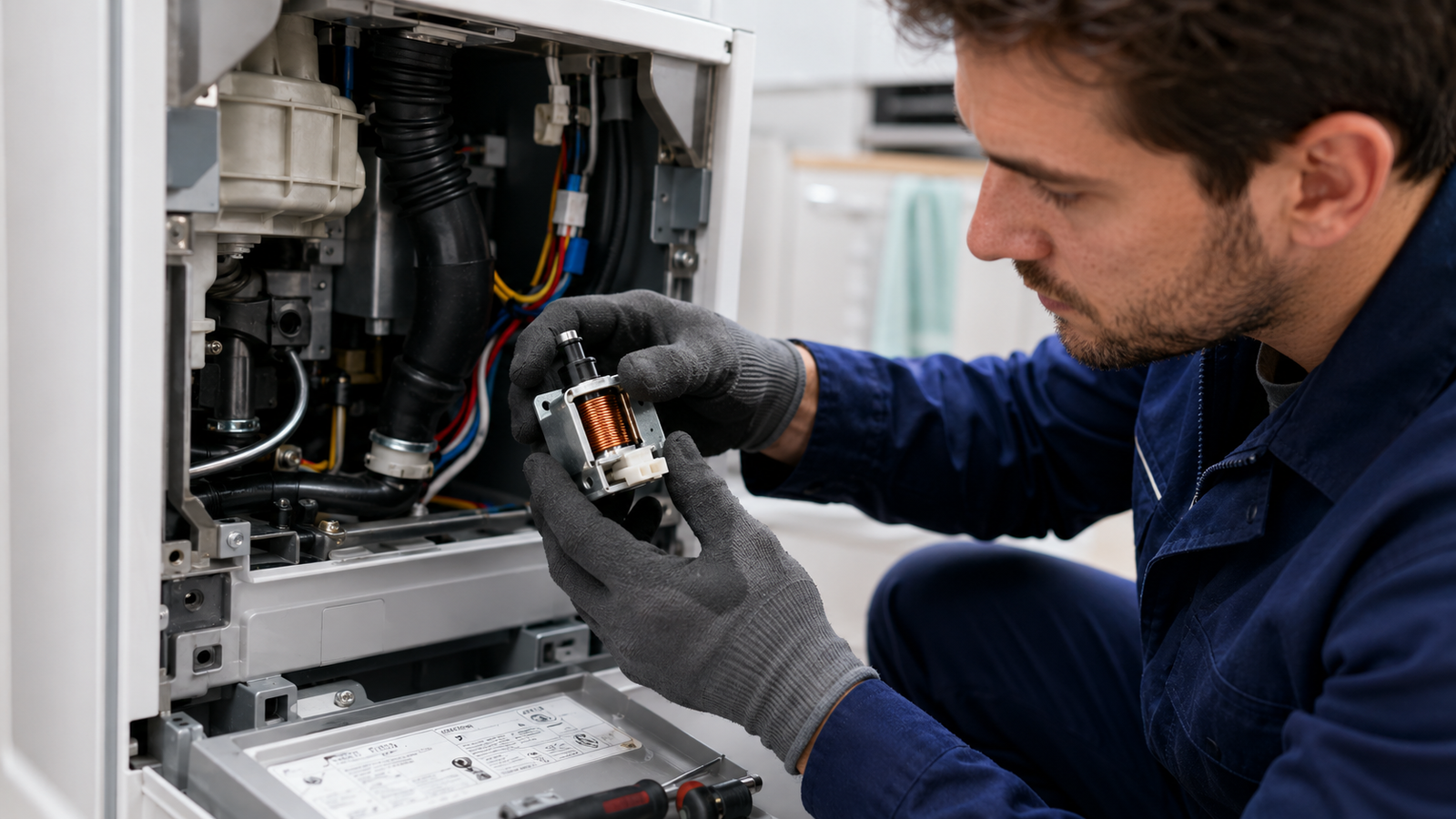
A stuck valve is frustrating because the system thinks everything is fine electrically, but mechanically, nothing is happening. A procurement manager once called me about a valve that kept sticking in their chemical dosing system. The problem wasn't the valve's quality; it was the seal material. The specified NBR seal was slowly degrading from contact with their proprietary chemical, causing it to become gummy and create friction. Switching to a Viton™ (FKM) seal, which was more expensive, solved the problem permanently and saved them thousands in downtime.
Root Causes of Sticking
- Media Incompatibility: This is the most common cause I see. The wrong seal or diaphragm material can swell, harden, or become sticky when exposed to certain fluids or high temperatures.6 This increases friction on the moving plunger (armature), preventing it from shifting. Always verify the chemical compatibility of your media with all wetted parts of the valve, especially the seals.
- Wear and Tear: Every valve has a mechanical life, rated in cycles. In a high-frequency automation application, a valve can reach its end-of-life faster than expected. The internal guide tube or plunger can wear down, causing a poor fit and leading to sticking.
- Low Voltage: If the voltage supplied to the coil is too low, it may not generate a strong enough magnetic field to fully pull the plunger into its final position. The plunger might move partway and then get stuck.
Why Is My Solenoid Valve Leaking?
A slow drip or a steady stream from your valve is wasting resources and creating a mess. It compromises system pressure and can lead to bigger failures.
Leaks are almost always due to a compromised seal. This can happen when the seal material is incompatible with the media, worn out from age or use, or when debris gets trapped between the seal and the valve seat.
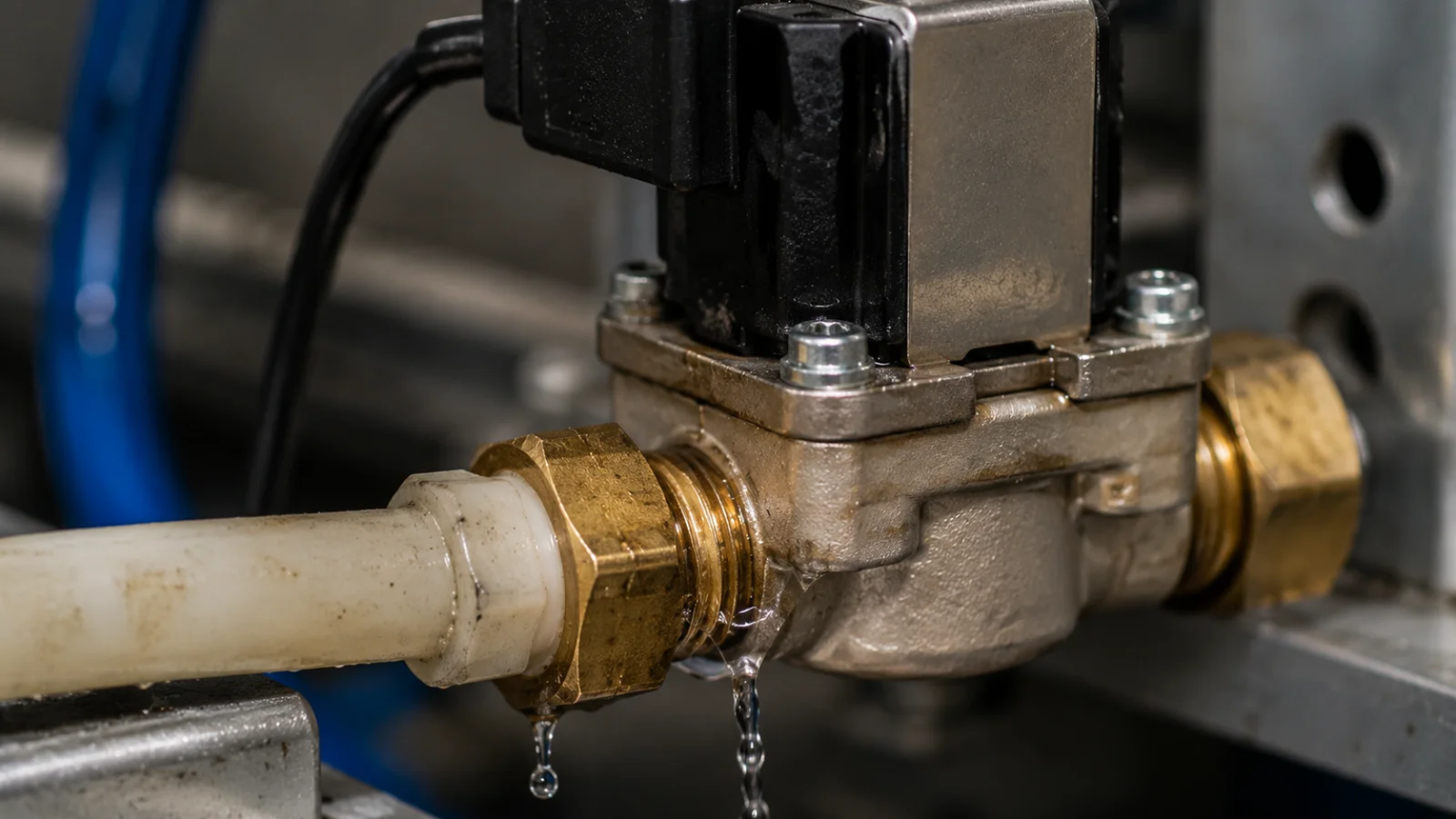
A leak seems like a simple problem, but it points to a deeper issue. It tells you that the barrier between the "wet" side and the "dry" side has failed. The first question I ask a customer with a leaking valve is, "What is running through it, and at what temperature?" The answer almost always reveals a mismatch between the seal material and the application's reality. A valve datasheet is a starting point, but your specific operational context is the final word.
Understanding Seal Failure
- Material Mismatch: The single biggest cause of leaks. A standard NBR seal is great for air or water, but it will quickly degrade if used with acetone or brake fluid.7 Choosing the right material from the start is critical.
- Debris on the Valve Seat: A tiny particle of dirt, rust, or Teflon tape can get lodged on the valve's sharp-edged seat. This prevents the seal from seating flush, creating a small channel for fluid to escape. This is why system cleanliness and upstream filtration are so important.
- Wear and Aging: Seals are not permanent. Over thousands of cycles, the material can become compressed, hardened, or cracked, losing its ability to create a tight seal. High temperatures can accelerate this aging process significantly.
Here is a simple guide we use to help clients choose the right seal material:
| Seal Material | Common Name | Good For | Bad For |
|---|---|---|---|
| Nitrile Butadiene Rubber | NBR, Buna-N | Water, Air, Mineral Oils | Ozone, Ketones, Solvents |
| Ethylene Propylene Diene | EPDM | Hot Water, Steam, Glycols | Mineral Oils, Gasoline |
| Fluoroelastomer | Viton™, FKM | Chemicals, Fuels, Oils, Acids | Ketones, Low Temperatures |
Why Does a Solenoid Valve Buzz or Overheat?
Your solenoid valve is making a loud buzzing noise or is hot to the touch. This is a clear warning sign of an impending failure that could be dangerous.
Buzzing is often caused by an incomplete magnetic circuit in AC coils, due to low voltage, debris, or a bent plunger. Overheating is a symptom of incorrect voltage, high ambient temperatures, or the valve being energized for too long.
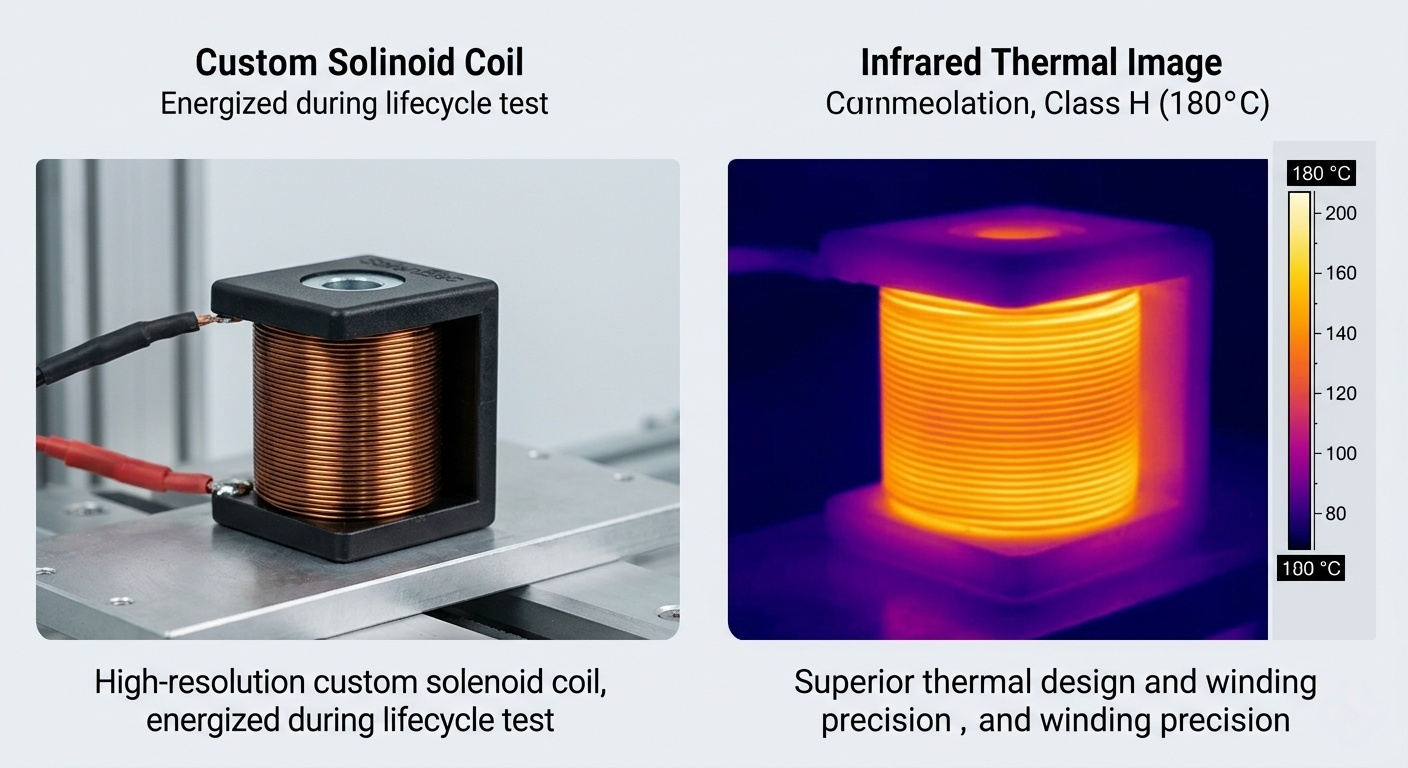
Coils are designed to get warm—that's normal. But if it's too hot to touch, that's a red flag. We often get inquiries from engineers who are concerned about coil temperature. The first thing we check is the application's duty cycle. A common purchasing error is selecting a cheaper, intermittent-duty coil for an application that requires the valve to be on for hours. That solenoid coil is guaranteed to fail from overheating. It's a classic case of a small cost-saving measure leading to a major reliability problem.
Decoding the Warning Signs
- AC Coil Buzzing: AC power cycles 50 or 60 times per second, which can cause the plunger to chatter if it's not held firmly in place.8 A loud buzz means the magnetic field is not strong enough to overcome the spring force completely. This can be due to low voltage, debris preventing the plunger from seating fully, or a worn-out component.
- Overheating from Duty Cycle Mismatch: Coils are rated for a specific duty cycle. A "100% ED" or "continuous duty" rating means the coil can be left on indefinitely. An "intermittent duty" coil is designed to be on for only short periods and needs time to cool down.9 Using it continuously will generate more heat than it can dissipate, melting the coil's insulation and causing a short circuit.
- Overheating from High Temperature: Every coil has an insulation class (e.g., Class F: 155°C, Class H: 180°C10). This is the maximum temperature the coil's wire insulation can withstand. You must account for both the ambient temperature and the heat from the media. If the combined temperature exceeds the insulation class, the coil will fail.11
How to Prevent Solenoid Valve Failures in Automation Systems?
You're tired of firefighting valve issues and dealing with unexpected downtime. You need a reliable strategy to ensure your automation systems run smoothly without interruption.
Prevention starts with a thorough pre-purchase assessment. By defining your operational context—media, pressure, temperature, and duty cycle—and sharing it with your supplier, you can select a valve designed specifically for your application's demands.
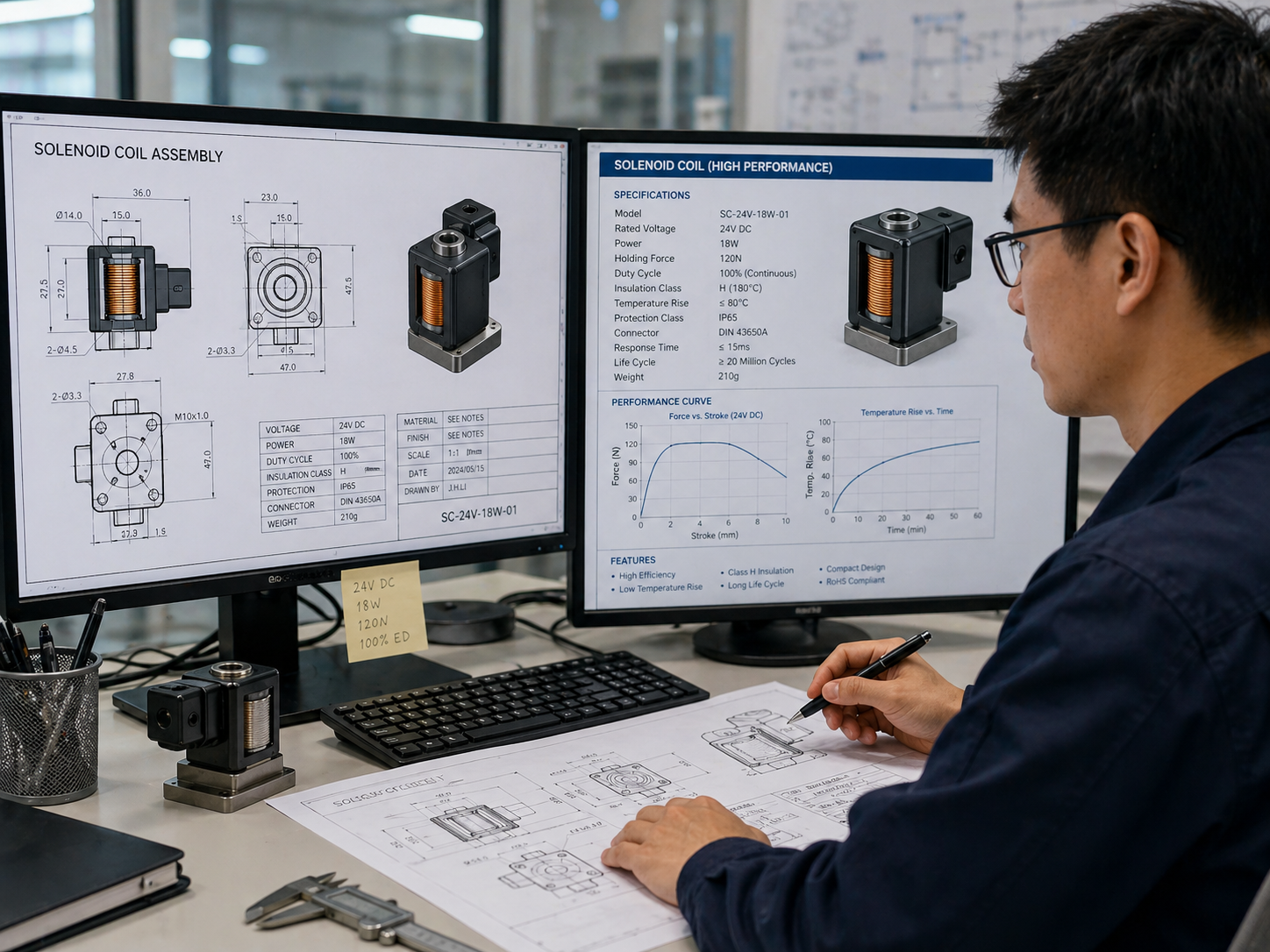
The most successful projects I've worked on are those where the client treats us as a partner, not just a supplier. They don't just send us a part number; they send us their problem. They tell us what they are trying to achieve, what the operating conditions are, and what their concerns are. This allows us to use our 20+ years of experience to help them select—or even custom-design—a valve that is built for reliability in their specific environment. Instead of troubleshooting problems later, we design them out from the very beginning.
Your Pre-Mortem Checklist for Valve Selection
Ask yourself these questions before you ever issue a purchase order. This framework turns you from a reactive buyer into a proactive risk manager.
| Category | Key Questions to Ask | Why It Matters |
|---|---|---|
| 1. Media Properties | What is the fluid or gas? Is it corrosive? What is its viscosity and temperature? | Determines the required body and seal materials (e.g., Brass vs. Stainless Steel, NBR vs. Viton™). |
| 2. System Parameters | What are the minimum and maximum operating pressures? What is the required flow rate (Cv)? | Determines the valve type (direct-acting vs. pilot-operated) and orifice size. |
| 3. Electrical Specs | What is the available voltage and type (AC/DC)? Are there any power limitations? | Ensures you select a coil that is compatible with your control system and won't fail prematurely. |
| 4. Operational Demands | What is the duty cycle (continuous or intermittent)? How many cycles per minute? | Determines if you need a continuous-duty coil and a valve built for high-cycle life. |
| 5. Environment | What is the ambient temperature? Is there moisture, dust, or vibration present? | Determines the required coil insulation class and enclosure rating (e.g., IP65). |
Conclusion
Proactive selection based on your specific application is the key to solenoid valve reliability. Understand your system's needs to prevent common failures, reduce downtime, and protect your operations.
Need Help Choosing the Right Solenoid Valve?
Most solenoid valve failures can be prevented by selecting the right valve for your application—not simply replacing failed components.
Whether you're designing automation equipment, water treatment systems, coffee machines, or other OEM products, our engineering team can help you select or customize the right solution.
👉 Contact us to discuss your project.
"[PDF] Reliability and life study of hydraulic solenoid valve. Part 2", https://www.eng.auburn.edu/~choeson/Publication/1132_2009_Reliability%20and%20life%20study%20of%20hydraulic%20solenoid%20valve-Part%202%20_S.%20V.%20Angadi,%20R.%20L.%20Jackson.pdf. Guidance from a recognized industry or standards organization notes that mismatches between valve design (materials, pressure/temperature ratings, duty) and service conditions are a frequent cause of solenoid valve malfunction and downtime. Evidence role: expert_consensus; source type: institution. Supports: Industry or standards guidance that identifies improper valve selection relative to operating conditions as a common cause of solenoid valve malfunctions.. Scope note: Such guidance typically characterizes the issue as common but does not quantify that it accounts for “most” failures across all industries. ↩
"Solenoid valve", https://en.wikipedia.org/wiki/Solenoid_valve. An engineering reference on solenoid valves explains that pilot-operated designs rely on a minimum pressure differential and are sensitive to contamination in small passages, while electrical mismatches can prevent actuation. Evidence role: mechanism; source type: encyclopedia. Supports: Reference material that explains that pilot-operated solenoid valves require a minimum pressure differential and that contamination can block small orifices, and that electrical mismatches can prevent actuation.. Scope note: General references may not enumerate every electrical cause (e.g., coil burnout specifics) or provide prevalence data. ↩
"Joule heating - Wikipedia", https://en.wikipedia.org/wiki/Joule_heating. Educational materials on electromagnets and resistive coils explain that magnetic force depends on current (reduced by undervoltage) and that coil heating scales with electrical power (increasing with overvoltage), which can prevent pull-in or cause thermal damage. Evidence role: mechanism; source type: education. Supports: Basic electromagnetism showing magnetic force depends on current and that coil heating scales with electrical power, which increases with applied voltage for a resistive coil.. Scope note: Such sources establish the principles but do not endorse specific numeric thresholds for a given coil, which vary by manufacturer and design. ↩
"Solenoid valve", https://en.wikipedia.org/wiki/Solenoid_valve. Reference descriptions of pilot-operated solenoid valves explain that these designs use line pressure across an internal pilot stage to assist opening and closing, requiring sufficient pressure differential. Evidence role: mechanism; source type: encyclopedia. Supports: A reference that describes pilot-operated solenoid valve mechanisms and their reliance on system pressure to open or close.. Scope note: General references may not specify minimum differential values for particular models. ↩
"Solenoid valve - Wikipedia", https://en.wikipedia.org/wiki/Solenoid_valve. General references on solenoid valves note that their small internal orifices make them susceptible to blockage by particulates, which can prevent proper operation. Evidence role: general_support; source type: encyclopedia. Supports: Material indicating that solenoid valves have small orifices and can fail to operate properly if particulates or debris obstruct internal passages.. Scope note: Sources typically discuss this as a general susceptibility rather than documenting specific failure rates for contamination. ↩
"Investigation of Radial Shaft Seal Swelling Using a Special ...", https://pmc.ncbi.nlm.nih.gov/articles/PMC9017097/. Materials science references describe how exposure to incompatible chemicals and heat alters elastomer properties—such as swelling, hardening, and tackiness—which can impair sealing and motion. Evidence role: mechanism; source type: education. Supports: Materials science explanations that incompatible solvents and temperature can change elastomer properties (swelling, hardening, tack), affecting seal performance.. Scope note: Effects depend on specific polymer formulations and fluid compositions, so outcomes vary by product and service conditions. ↩
"[PDF] Chemical-Compatibility.pdf - The Rubber Group", https://rubber-group.com/wp-content/uploads/2018/01/Chemical-Compatibility.pdf. Polymer references report that nitrile rubber is generally resistant to oils but not to ketones such as acetone, and that brake systems typically employ elastomers compatible with glycol-based fluids rather than NBR. Evidence role: general_support; source type: encyclopedia. Supports: Reference information indicating that NBR shows poor compatibility with ketones and that brake systems typically use elastomers compatible with glycol-based fluids (e.g., EPDM), not NBR.. Scope note: Compatibility depends on exact formulations of both the elastomer and the fluid; some references may discuss typical use rather than an absolute prohibition. ↩
"How to solve AC humming / vibration / chattering sound in ...", https://www.eng-tips.com/threads/how-to-solve-ac-humming-vibration-chattering-sound-in-ac-solenoid-valve.462261/. Reference discussions of AC solenoids attribute audible hum or chatter to the alternating magnetic field at 50/60 Hz and insufficiently closed magnetic circuits, commonly mitigated by shading techniques. Evidence role: mechanism; source type: encyclopedia. Supports: A description of how the alternating nature of AC at mains frequency can cause solenoid hum/chatter and the role of incomplete magnetic closure.. Scope note: Descriptions are general and may not address specific designs or noise thresholds for a given valve. ↩
"Duty cycle - Wikipedia", https://en.wikipedia.org/wiki/Duty_cycle. Educational references on electromagnetic actuators define continuous-duty (100% duty cycle) coils as suitable for indefinite energization, whereas intermittent-duty coils require periodic off-time for thermal management. Evidence role: definition; source type: education. Supports: Educational material defining duty cycle ratings for electromagnetic actuators, distinguishing continuous-duty (100% ED) from intermittent-duty operation and cooling needs.. Scope note: Duty-cycle nomenclature and allowable on-times can vary among manufacturers and specific product standards. ↩
"Insulation system - Wikipedia", https://en.wikipedia.org/wiki/Insulation_system. An international standard on electrical insulation thermal classes defines Class F with a 155°C thermal limit and Class H with a 180°C limit. Evidence role: definition; source type: institution. Supports: Standards documentation that defines electrical insulation thermal classes and their associated maximum temperature ratings, including Classes F and H.. Scope note: Standards specify class limits but actual component temperature margins and testing methods may vary by product design. ↩
"Insulation system - Wikipedia", https://en.wikipedia.org/wiki/Insulation_system. Standards on electrical insulation systems explain that operation above the designated thermal class accelerates insulation degradation and can result in coil failure. Evidence role: mechanism; source type: institution. Supports: Standards-based explanation that insulation systems are designed for specified thermal classes and that exceeding those temperatures accelerates degradation leading to failure.. Scope note: Actual time-to-failure depends on duration and degree of over-temperature, environmental factors, and insulation system construction. ↩