How Does a Solenoid Pump Work and Why Is It Used in Precision Fluid Control?
Struggling to achieve precise, repeatable fluid dosing with conventional pumps? This inconsistency can ruin product quality, from the perfect espresso shot to critical medical dosages, leading to waste and unreliable performance. A solenoid pump offers a compact and highly controllable solution, delivering the exact amount of fluid you need, every single time.
A solenoid pump is a type of positive displacement pump that uses an electromagnetic coil to drive a plunger back and forth.1 This reciprocating motion draws in a fixed volume of fluid on one stroke and expels it on the next.2 It is used for precision fluid control because its digital, on-off operation allows for exact and repeatable dosing, which is difficult to achieve with traditional continuous-flow pumps.
Now that you understand the basic principle, you might be wondering what really sets this technology apart. Let's dive deeper into its unique design, step-by-step operation, and the key applications where it has become an indispensable component.
What Is a Solenoid Pump and How Is It Different from Other Pumps?
Wondering if a solenoid pump is just another name for a small motor-driven pump? The differences are significant and can impact your entire system's design, performance, and reliability. Understanding this distinction is the first step to choosing the right technology for your application.
A solenoid pump is a positive displacement pump that uses an electromagnetic coil to create linear motion, moving a plunger or diaphragm. This is fundamentally different from centrifugal or gear pumps, which use continuous rotation to move fluid.3 The key differentiator is its pulsatile, on-demand operation, which enables unparalleled precision in dosing.
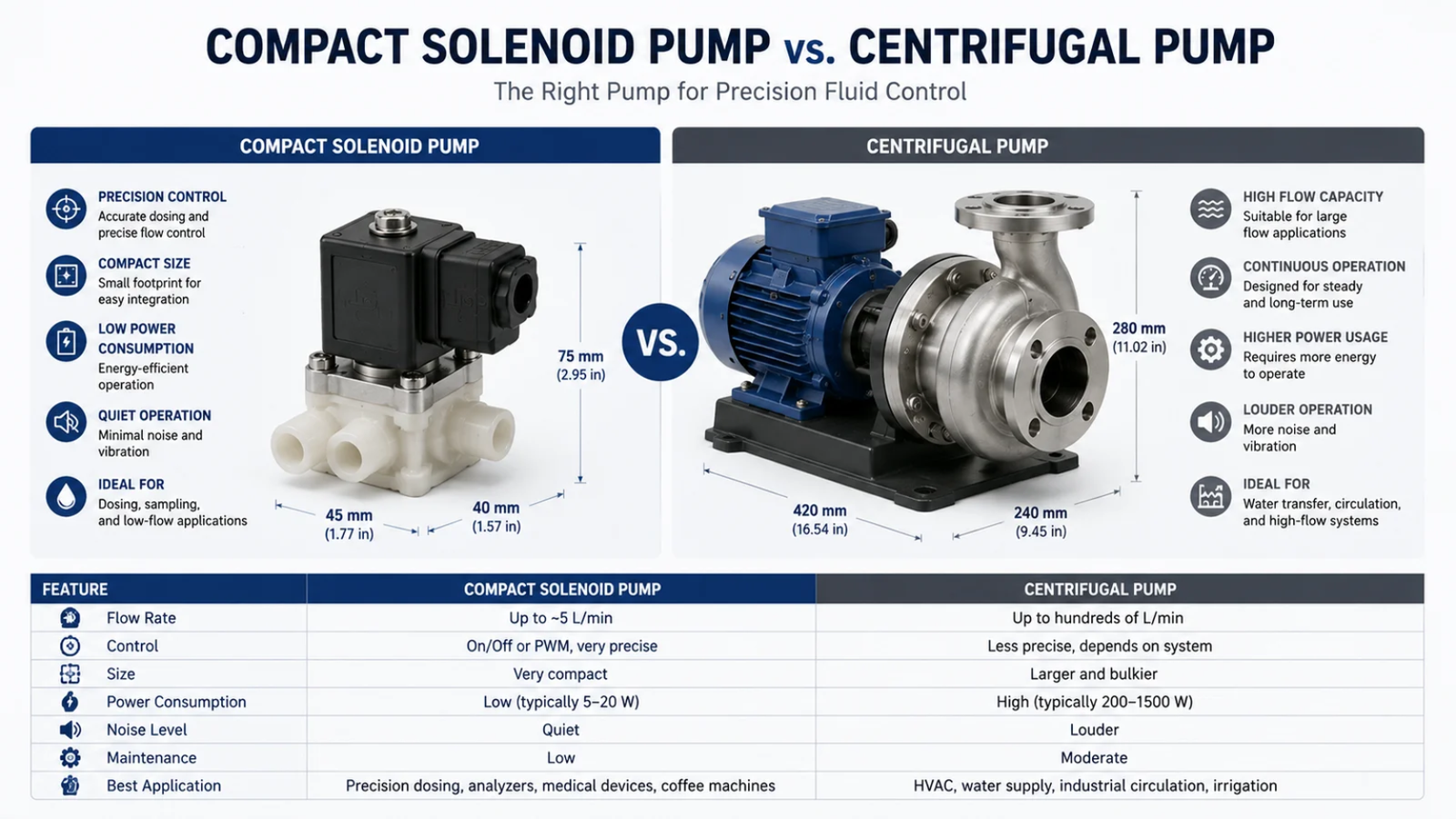
The Core Differences in Pump Technology
At its core, a solenoid pump is a positive displacement pump. This means it traps a fixed, known volume of fluid within a chamber and then forces it out. This action is direct and proportional: one electrical pulse equals one fixed volume of fluid discharged. This is what makes it a "metering" or "dosing" pump.
Let's contrast this with other common pump types to see why the solenoid design is unique:
- Centrifugal Pumps: These use a spinning impeller to accelerate fluid, converting velocity into pressure. They are excellent for moving large volumes of fluid at low pressure (like a water circulation pump). However, their flow rate varies significantly with system pressure, making them unsuitable for precise dosing.4
- Gear Pumps: These are also positive displacement pumps, but they use a pair of meshing gears to trap and move fluid. They offer smooth, continuous flow and can handle high pressures. However, they are mechanically more complex, larger, and the constant rotation and friction can lead to wear over time, especially with abrasive fluids.
- Peristaltic Pumps: These work by squeezing a flexible tube with a series of rotating rollers. They are fantastic for sterile or hygienic applications because the fluid never touches the pump mechanism5. Their main drawbacks are the limited pressure capabilities and the need to frequently replace the tube, which wears out from the constant squeezing.
The solenoid pump carves out its niche with a unique combination of advantages.
| Feature | Solenoid Pump | Centrifugal Pump | Peristaltic Pump |
|---|---|---|---|
| Operating Principle | Reciprocating Plunger (Pulsatile) | Rotating Impeller (Continuous) | Squeezing Tube (Pulsatile) |
| Flow Control | Excellent (Frequency-based) | Poor (Pressure-dependent) | Good (Speed-based) |
| Precision | Very High | Low | Moderate to High |
| Pressure Handling | Moderate to High | Low to Moderate | Low |
| Size | Very Compact | Varies, generally larger | Varies |
| Power Consumption | Low (only when pulsing) | High (continuous operation) | Moderate |
| Maintenance | Low (few moving parts) | Low | High (tube replacement) |
Because it only consumes power when energized and has very few moving parts (typically just a plunger and a spring6), a well-designed solenoid pump is incredibly reliable and energy-efficient, making it a favorite for integrated OEM applications.
How Does a Solenoid Pump Work Step by Step?
The inner workings of a solenoid pump might seem like a black box, but they follow a simple and elegant cycle. Misunderstanding this cycle can lead to troubleshooting headaches down the line. Let's break it down to see exactly how electrical energy is converted into precise fluid movement.
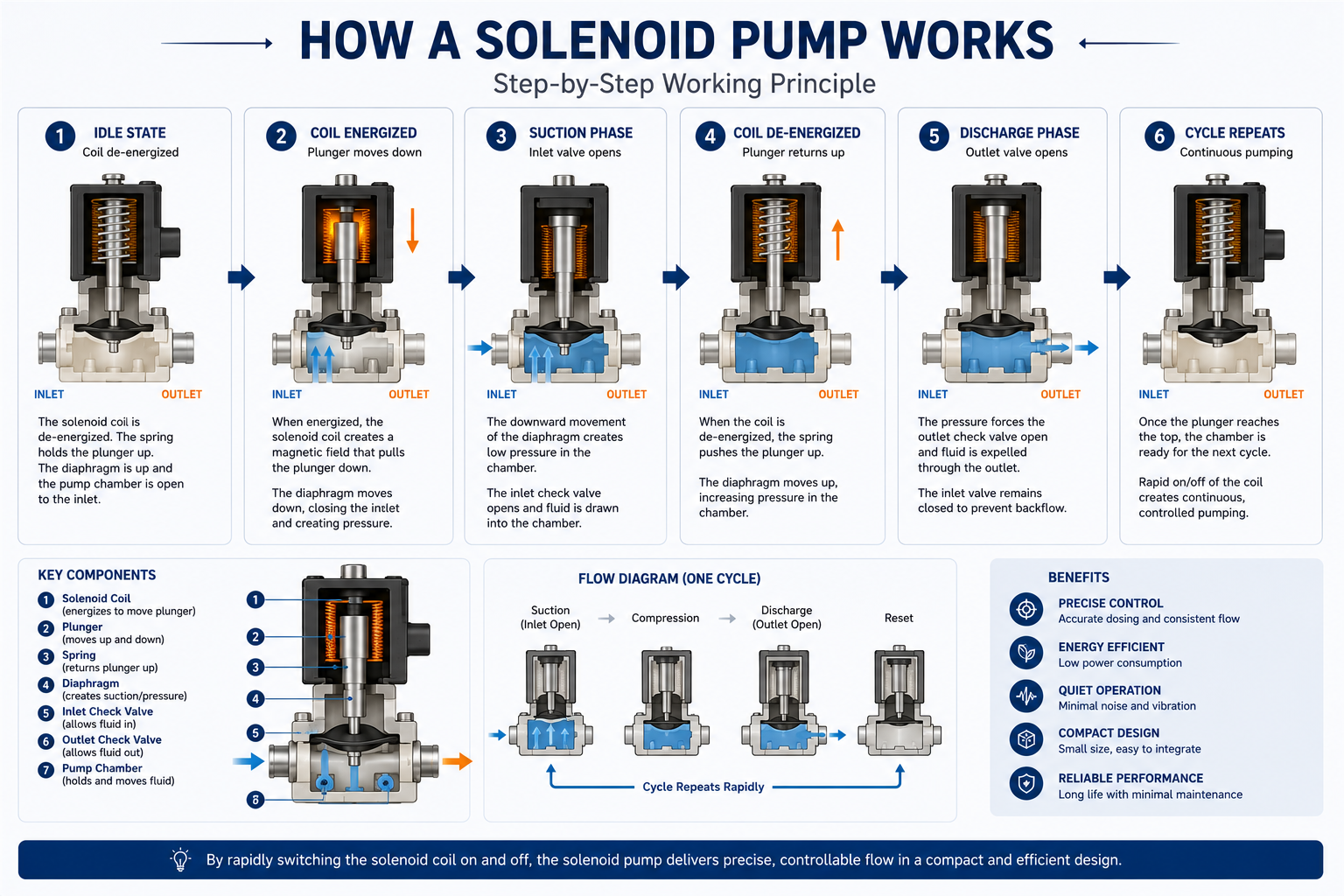
A solenoid pump works in a two-stroke cycle driven by electromagnetism. First, an electrical current energizes the solenoid coil, creating a magnetic field that pulls a plunger backward, drawing fluid into a chamber (the suction stroke). When the current is cut, a spring pushes the plunger forward, expelling the trapped fluid (the discharge stroke).
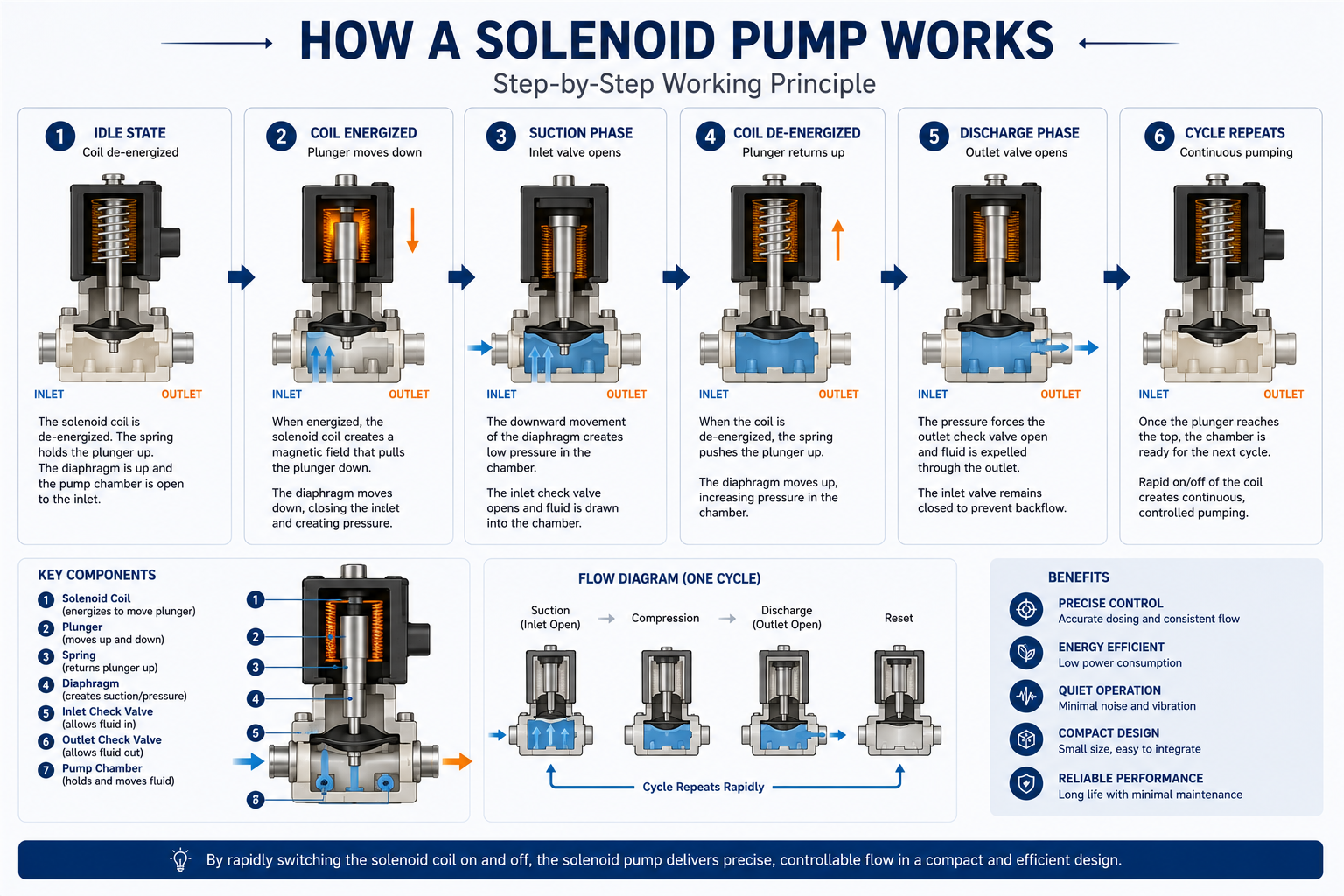
The Two-Stroke Cycle of Precision
The magic of a solenoid pump lies in its ability to repeat a simple mechanical cycle with extreme speed and consistency. The entire process can be broken down into five distinct steps, which can repeat up to several dozen times per second7.
- Energization: The cycle begins when the pump's electronic controller sends a pulse of electricity (AC or DC) to the solenoid coil.
- Suction Stroke: The current flowing through the coil generates a powerful magnetic field. This field attracts the ferromagnetic plunger (armature), pulling it rapidly backward against a return spring. This movement creates a vacuum inside the pump chamber. The lower pressure inside the chamber causes the inlet check valve to open, and a fixed volume of fluid is drawn in from the reservoir. The outlet check valve remains closed, preventing backflow from the outlet line.
- De-Energization: The electrical pulse ends, and the magnetic field instantly collapses. The force holding the plunger back is now gone.
- Discharge Stroke: The compressed return spring now takes over, pushing the plunger forward with significant force. This action pressurizes the fluid trapped in the chamber. The high pressure forces the inlet check valve to close (preventing fluid from returning to the reservoir) and pushes the outlet check valve open. The fixed volume of fluid is expelled into the system.
- Repetition: The pump is now back in its resting state, ready for the next electrical pulse. By controlling the frequency of these pulses (the number of cycles per second, measured in Hertz), you can precisely control the overall flow rate.
This relationship is simple and linear: Flow Rate = Volume per Stroke × Frequency8. If a pump dispenses 1 ml per stroke and is pulsed 30 times per minute, its flow rate is exactly 30 ml/minute. This direct, digital control is the foundation of its precision.
What Are the Main Components of a Solenoid Pump?
A solenoid pump looks simple from the outside, but its performance and longevity depend on a handful of critical internal components working in perfect harmony. Knowing what these parts are and, more importantly, what they do is essential for specifying a custom solution or troubleshooting an existing one.
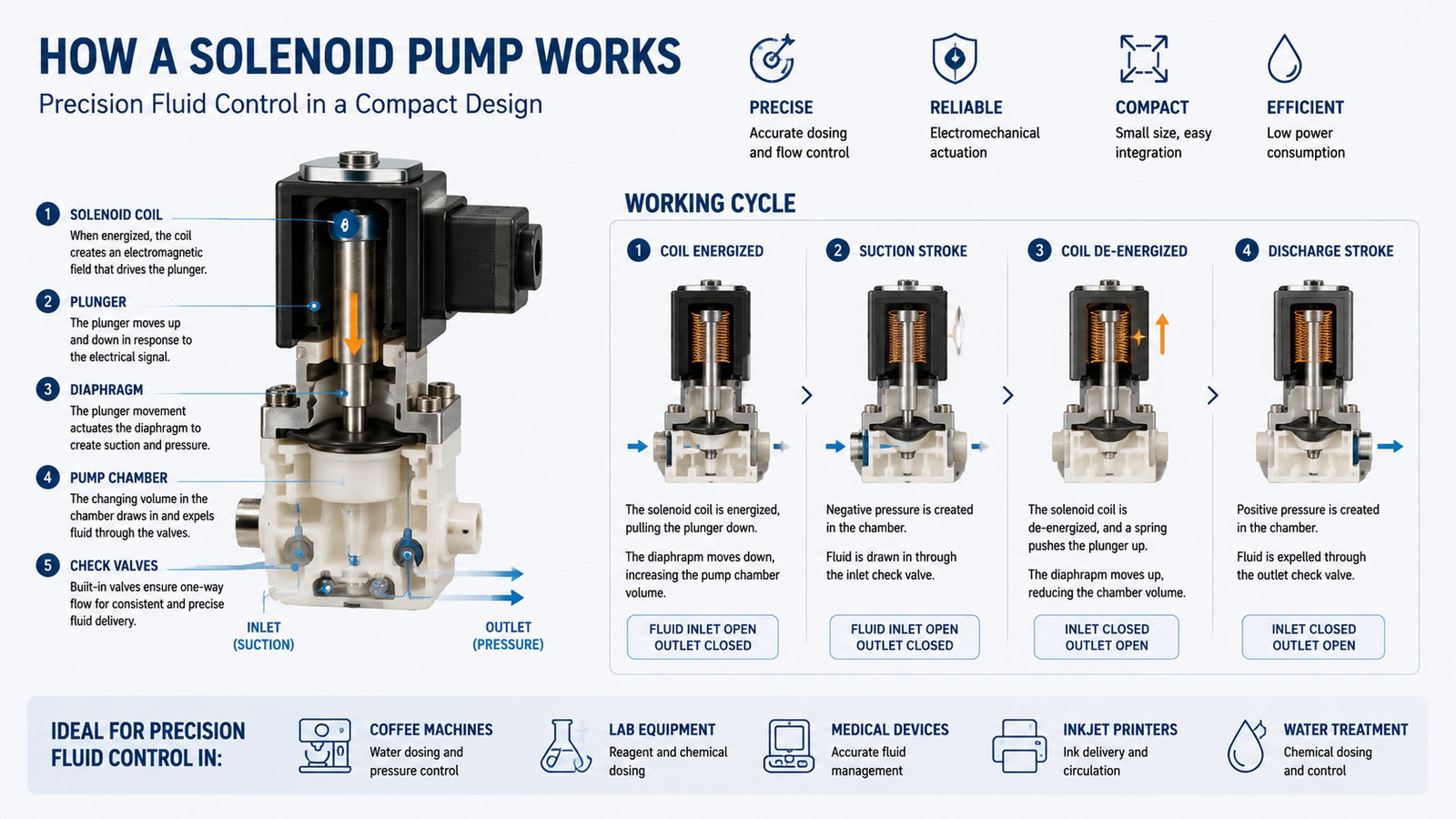
The primary components of a solenoid pump are the solenoid coil, which creates the magnetic force; the plunger or piston, which is the moving part that displaces the fluid; a return spring, which provides the force for the discharge stroke; inlet and outlet check valves to control flow direction; and the pump body, which houses the fluid path.
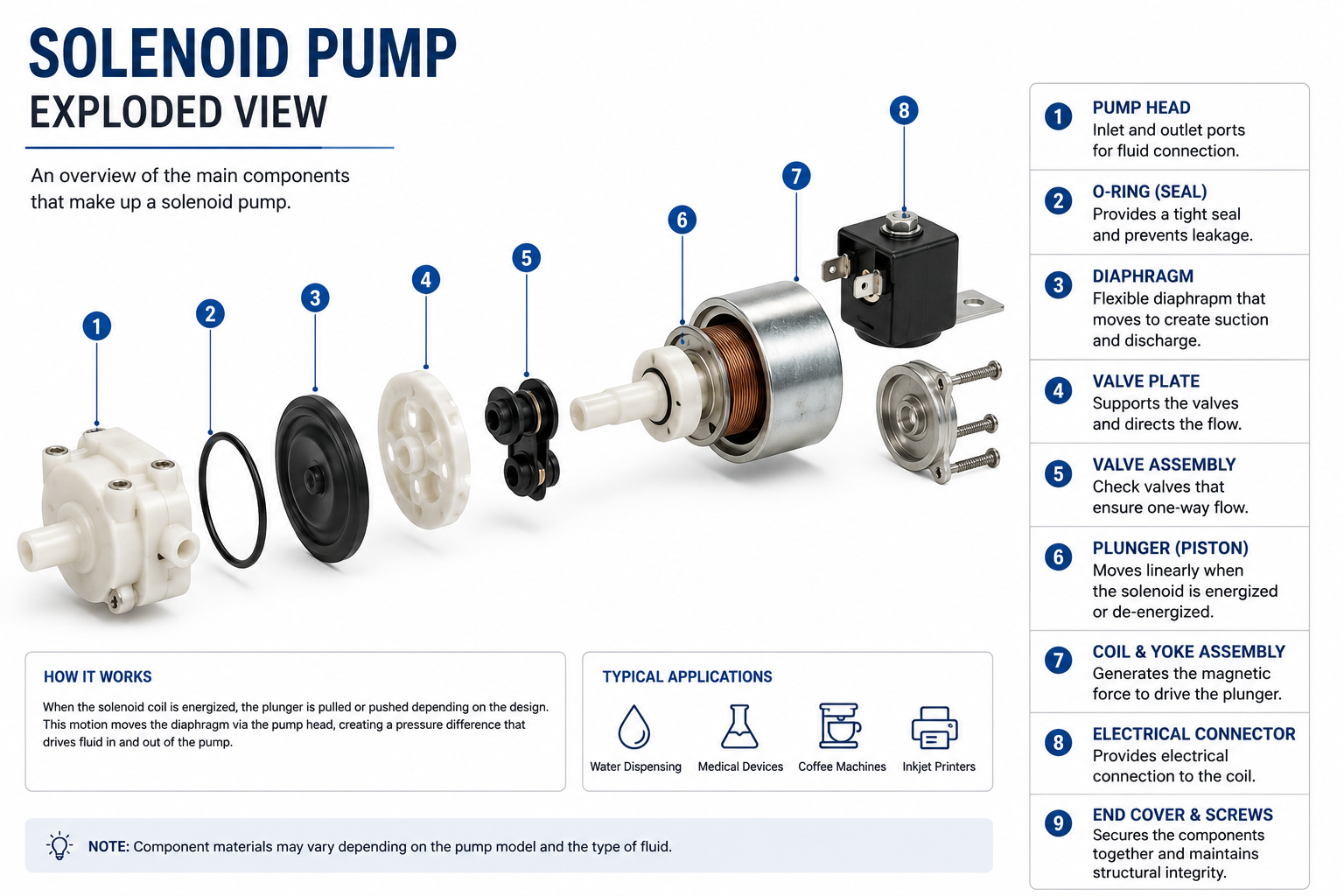
Anatomy of a Dosing Pump
Each component plays a vital role. As an OEM manufacturer of solenoid coils, I've learned that the quality of each part is what separates a pump that lasts for millions of cycles from one that fails prematurely.
The Electromagnetic Engine: Solenoid Coil and Plunger
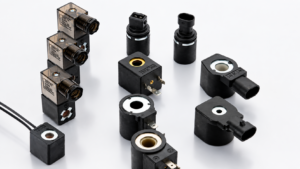
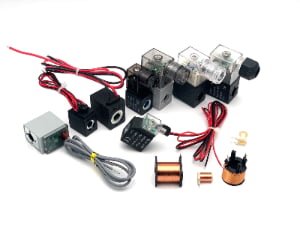
- Solenoid Coil: This is the heart of the pump. It consists of high-purity copper wire precisely wound around a bobbin. When energized, it becomes an electromagnet. The quality of the copper, insulation, and bobbin material (often a heat-resistant thermoplastic like PBT) determines its efficiency, thermal performance, and overall lifespan. At SolenElec, we specialize in customizing these coils to meet specific voltage, power, and duty cycle requirements for our clients.
- Plunger (Armature): This is the ferromagnetic slug that moves in response to the coil's magnetic field. It's typically made from a specific grade of stainless steel that offers both corrosion resistance and excellent magnetic properties. Its mass and shape are carefully engineered to optimize the force and speed of the stroke.
The Fluid Handling System: Valves, Spring, and Housing
- Pump Body (Housing): This component contains the fluid chamber and pathways. Its material is one of the most critical choices in pump selection. For neutral fluids like water, plastics like POM are common. For aggressive chemicals, materials like PP or PVDF are used. For high-pressure applications like coffee machines, brass or stainless steel are required.
- Check Valves (Inlet & Outlet): These are the gatekeepers of the pump. They are simple one-way valves, often a tiny ball or poppet held by a light spring, or a flexible rubber "duckbill" valve. They must open with minimal suction and seal perfectly under pressure to prevent backflow. The material of the seals (e.g., EPDM, FKM/Viton®, NBR) must be chemically compatible with the fluid being pumped.
- Return Spring: This provides the motive force for the discharge stroke. The spring's stiffness (spring rate) is precisely calculated to overcome the system's back-pressure and return the plunger quickly. This is crucial for achieving high operating frequencies and consistent output pressure.
In some designs, a diaphragm is used to separate the plunger from the fluid. This is ideal for hygienic applications or when pumping highly corrosive fluids, as it creates a hermetically sealed fluid path.
Where Are Solenoid Pumps Commonly Used?
You have almost certainly used a device with a solenoid pump today without even realizing it. Their unique ability to dose tiny, accurate amounts of fluid makes them indispensable across a surprisingly wide range of industries. So, where exactly do they shine, and why are they consistently chosen over other pump technologies?
Solenoid pumps are commonly used in applications demanding precise fluid control, such as espresso and coffee machines, medical diagnostic equipment, water treatment systems for chemical dosing, inkjet printers, and professional cleaning and disinfection equipment. Their compact size, reliability, and unparalleled accuracy are the primary reasons for their adoption.
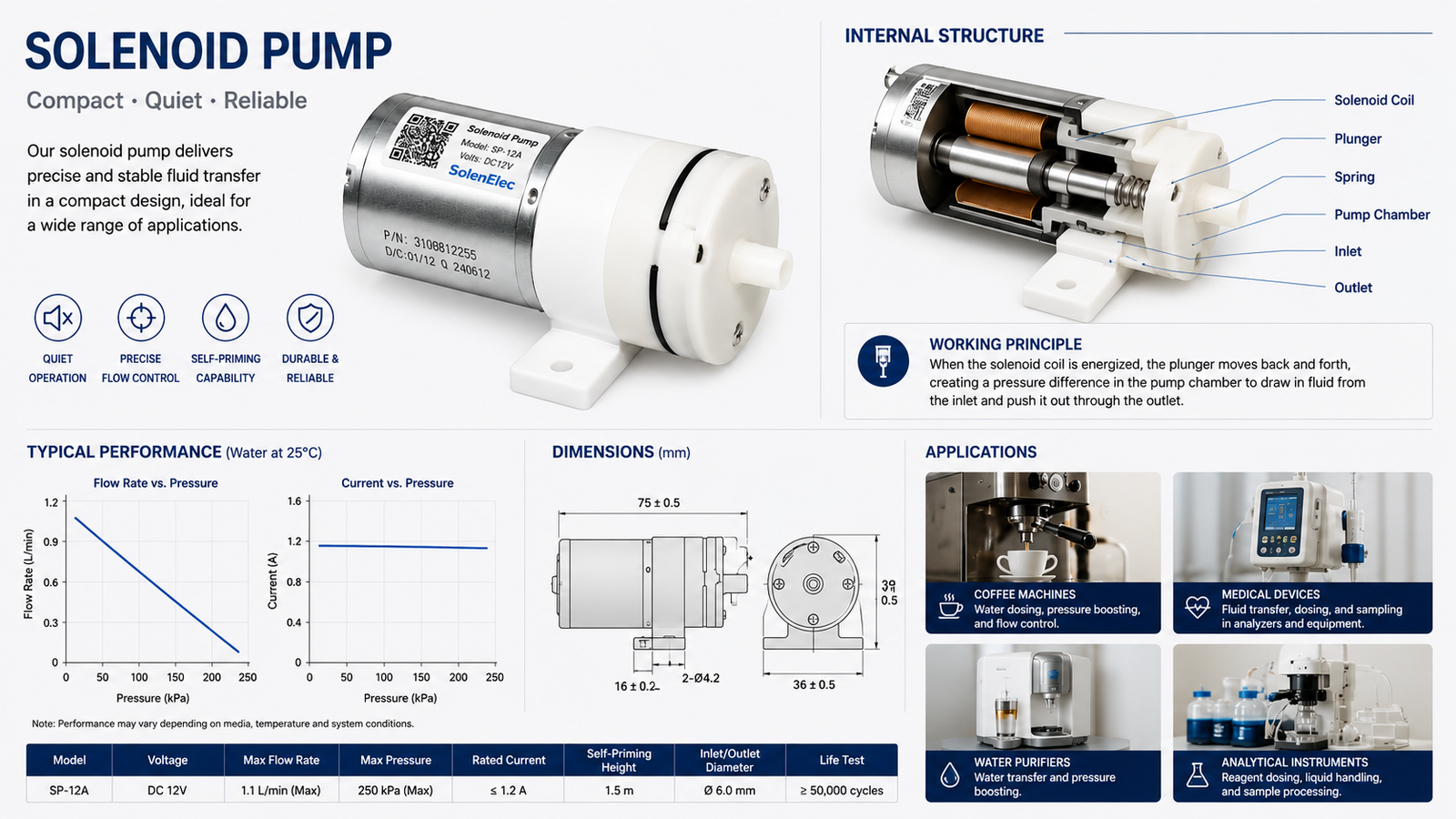
Why These Industries Rely on Solenoid Pumps
Let's explore why these specific industries choose solenoid pumps. The answer is always rooted in the need for control and consistency.
Home Appliances: The Perfect Espresso Shot
For a premium home appliance brand, consistency is everything. When making espresso, you need to force a precise volume of hot water (around 90-95°C9) through finely-ground coffee at very high pressure (typically 9-15 bar10).
- Why a solenoid pump? A centrifugal pump can't generate this pressure in a small form factor, and a gear pump would be too large and expensive. A solenoid pump is compact, generates high pressure in short bursts, and its pulsatile nature allows for advanced techniques like "pre-infusion" (a short, low-pressure pulse to wet the coffee grounds before the main extraction), leading to a better-tasting, more consistent shot of espresso.
Medical & Laboratory Devices: Uncompromising Precision
In medical diagnostics, analyzers mix tiny, specific volumes of patient samples with reagents to perform tests. A few microliters too much or too little can lead to a false diagnosis.11
- Why a solenoid pump? The positive displacement nature of the solenoid pump guarantees that each pulse delivers the exact same micro-volume of fluid, time after time. Its reliability and the ability to use medically-safe materials for the fluid path (like PEEK or stainless steel) make it the only viable choice where accuracy is a matter of health.
Water Treatment & Chemical Dosing: Automated Accuracy
Municipal and industrial water treatment facilities need to inject precise amounts of chlorine, flocculants, or pH-adjusting chemicals12 into their water streams 24/7.
- Why a solenoid pump? A solenoid pump can be connected to a sensor and a controller. The controller can adjust the pump's frequency in real-time based on the sensor's readings. If pH drifts, the controller increases the pump's speed to add more neutralizing agent. This creates a fully automated, closed-loop system that is both accurate and incredibly efficient, minimizing chemical waste.
How Do You Choose the Right Solenoid Pump?
Selecting the wrong solenoid pump can be a costly mistake, leading to system failure, poor product performance, or a drastically shortened lifespan. As a procurement manager or brand engineer, your decision involves balancing performance, cost, and reliability. Let's walk through the key criteria to ensure you specify the perfect pump for your application.
To choose the right solenoid pump, you must systematically evaluate four key factors: 1) Flow Rate and Pressure required by your system, 2) Fluid Compatibility with the pump's wetted materials, 3) Duty Cycle and Frequency of operation, and 4) Environmental and Electrical Conditions like temperature and available voltage.
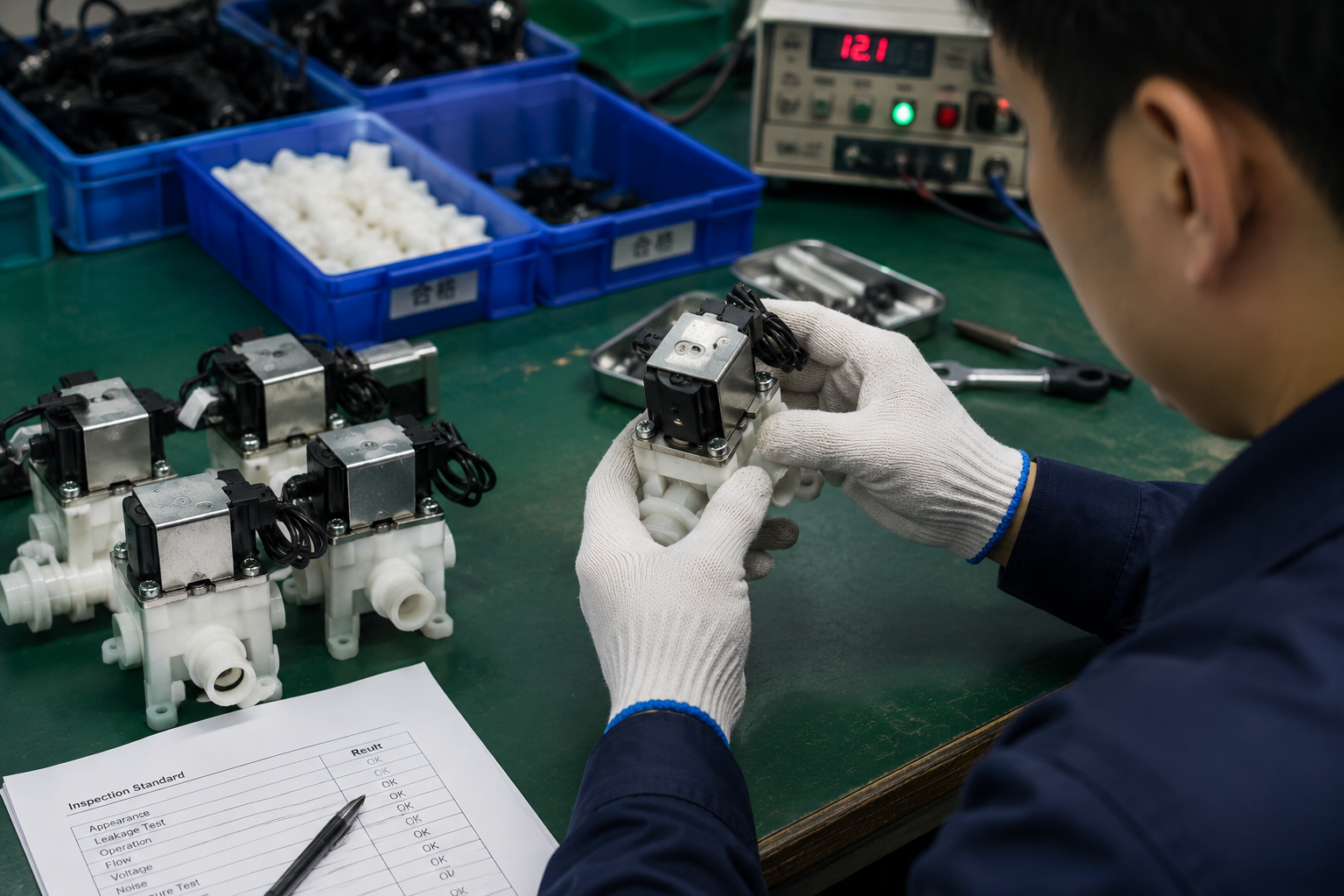
A Checklist for Procurement and Engineering
From my experience working with leading appliance brands, a methodical approach is best. Use this checklist as a guide during the specification and supplier selection process.
Define Your Performance Requirements
- Flow Rate (ml/min or L/hr): What is the maximum and minimum flow rate you need? This will determine the required stroke volume and operating frequency range.
- Pressure (bar or psi): What is the system's back-pressure that the pump must work against? A pump specified for 3 bar will fail if used in a 15-bar espresso machine. The pressure requirement directly influences the required force from the solenoid coil and return spring.
Ensure Material and Fluid Compatibility
- Fluid Composition: What is the exact fluid? Is it water, an acid, a solvent, or an oil?
- Chemical Resistance: The "wetted parts" (pump body, valves, seals) must be chemically inert to the fluid. This is non-negotiable. Using the wrong material will cause seals to swell, plastics to crack, and lead to leaks and catastrophic failure. This is where an experienced OEM partner like SolenElec can add immense value by recommending and sourcing the right materials (e.g., FKM seals for oils, EPDM for water, PVDF body for acids).
Consider the Operational Profile
- Duty Cycle: Will the pump operate continuously (100% duty cycle) or intermittently? A pump not rated for continuous duty will overheat and burn out its coil if run for too long.
- Operating Frequency (Hz): How fast will the pump need to pulse? High-frequency operation creates more wear on the spring and valve seats, requiring more robust components.
Environmental and Electrical Factors
- Voltage & Power: What is your available power source (e.g., 230V AC, 24V DC)? The solenoid coil must be wound specifically for this voltage.
- Ambient Temperature: Will the pump operate in a hot environment, like inside a coffee machine? High ambient temperatures reduce the coil's ability to dissipate its own heat, potentially requiring a higher temperature class of insulation.
Here is a simple table to guide your specification process:
| Parameter | Question to Ask Yourself | Example Specification |
|---|---|---|
| Flow Rate | What is the target flow rate? | 650 ml/min ± 10% |
| Pressure | What is the maximum system back-pressure? | 15 bar |
| Fluid Type | What is the liquid being pumped? | Potable water |
| Fluid Temp. | What is the temperature of the liquid? | 95°C |
| Voltage | What is the supply voltage and type? | 230V AC, 50Hz |
| Duty Cycle | How long will the pump run at a time? | Intermittent, max 1 min on / 1 min off |
| Material Req. | Any specific material needs? | All wetted parts must be food-grade (e.g., NSF certified) |
Frequently Asked Questions
What is the typical lifespan of a solenoid pump?
The lifespan of a high-quality solenoid pump is typically measured in millions of cycles. However, the actual operational life depends heavily on the application, fluid type, operating pressure, and frequency. Using the pump within its specified limits and with compatible fluids is key to maximizing its longevity.
Can a solenoid pump run dry?
Generally, no. Most solenoid pumps rely on the fluid being pumped for lubrication and cooling of the plunger. Running the pump dry for an extended period can cause friction, overheating, and permanent damage to the plunger and seals. Some specialized designs may tolerate short periods of dry running.
Are solenoid pumps noisy?
Solenoid pumps produce a characteristic "clicking" or buzzing sound with each actuation cycle. The noise level depends on the pump's size, operating frequency, pressure, and how it is mounted. The sound can be minimized by using rubber vibration-damping mounts and ensuring the pump is securely fastened.
How do you control the flow rate of a solenoid pump?
The primary method for controlling the flow rate is by adjusting the operating frequency—the number of electrical pulses sent to the pump per second or minute. Since each pulse delivers a fixed volume, doubling the frequency doubles the flow rate. This provides a simple, linear, and highly precise method of control.
Conclusion
To recap, a solenoid pump is a masterpiece of electromechanical efficiency. It works by converting precise electrical pulses into the linear motion of a plunger, enabling it to dose exact volumes of fluid with every stroke. This operating principle distinguishes it from common rotary pumps, making it the ideal choice for applications where precision is paramount, such as in high-end coffee machines, critical medical devices, and automated chemical dosing systems. Understanding its core components and the key selection criteria—flow, pressure, fluid compatibility, and duty cycle—empowers you to specify a solution that enhances your product's performance, reliability, and market reputation.
At SolenElec, we have over 20 years of experience manufacturing the critical core of any high-quality solenoid pump—the solenoid coil itself. If you are a brand or procurement manager seeking a reliable OEM/ODM partner to develop a custom fluid control solution for your appliance, contact our engineering team today. We can help you design a component that performs flawlessly for years to come.
Looking for a Reliable OEM Solenoid Pump Solution?
Choosing the right solenoid pump starts with selecting the right coil, materials, and operating parameters for your application. Our engineering team can help you develop reliable OEM fluid control solutions for coffee machines, medical devices, water treatment systems, and other industrial equipment.
👉 Contact us to discuss your project.
Need a compact pump for precise dosing rather than a generic diaphragm pump?
Send the target flow, pressure, voltage, and medium. We can recommend a standard solenoid pump or customize port, coil, and stroke.
"fabrication of pneumatic water pumping system", https://www.academia.edu/34679735/FABRICATION_OF_PNEUMATIC_WATER_PUMPING_SYSTEM. Engineering reference material classifies solenoid-driven metering pumps as positive-displacement pumps in which an electromagnetic actuator reciprocates a plunger or diaphragm to move fluid. Evidence role: definition; source type: encyclopedia. Supports: A neutral source should define solenoid or solenoid-driven metering pumps as positive-displacement devices using electromagnetic actuation of a plunger or diaphragm.. ↩
"Piston pump", https://en.wikipedia.org/wiki/Piston_pump. Fluid-mechanics teaching sources describe reciprocating positive-displacement pumps as devices that trap a discrete volume during the suction stroke and discharge it during the return stroke. Evidence role: mechanism; source type: education. Supports: A source should explain that reciprocating positive-displacement pumps move discrete volumes through suction and discharge strokes.. Scope note: This supports the operating principle; real delivered volume may vary with valve leakage, compressibility, pressure, and calibration. ↩
"Pump", https://en.wikipedia.org/wiki/Pump. Pump reference sources identify centrifugal pumps as impeller-based rotodynamic pumps and gear pumps as rotary positive-displacement pumps using meshing gears, distinguishing both from linear reciprocating solenoid actuation. Evidence role: definition; source type: encyclopedia. Supports: A source should distinguish rotary centrifugal and gear pump mechanisms from reciprocating solenoid-actuated mechanisms.. ↩
"Centrifugal pump selection and characteristics", https://en.wikipedia.org/wiki/Centrifugal_pump_selection_and_characteristics. Hydraulic engineering sources show centrifugal pump performance with head-flow curves, indicating that delivered flow changes as system head or resistance changes. Evidence role: mechanism; source type: education. Supports: A source should show that centrifugal pump flow depends on head/system resistance, which makes open-loop volumetric dosing less direct than with metering pumps.. Scope note: This contextual evidence supports the dosing limitation in general; specific precision depends on controls, sensors, and the pump installation. ↩
"Peristaltic Pumps - myweb", https://www.myweb.ttu.edu/bren/paper/CH2-Peristaltic%20Pumps.pdf. Biomedical and fluid-handling references describe peristaltic pumps as tube-compression pumps in which the fluid is contained within the tubing and isolated from the mechanical rollers. Evidence role: mechanism; source type: education. Supports: A source should explain that peristaltic pumps move fluid by externally compressing tubing, so the fluid path is confined to the tube.. ↩
"Construction. The Stanadyne pump, shown in Figure 5-62 ...", https://media.defense.gov/2014/Jun/20/2002655917/-1/-1/1/140620-N-ZZ182-6558.pdf. Technical descriptions of solenoid-actuated dosing pumps identify the reciprocating armature or plunger and return spring as central moving elements of the actuator assembly. Evidence role: general_support; source type: institution. Supports: A source should describe the principal moving elements in a solenoid-actuated pump, including a plunger or armature and return spring.. Scope note: This supports the general design description; actual pump designs may include additional moving parts such as diaphragms, valve balls, or poppets. ↩
"Diesel engine", https://en.wikipedia.org/wiki/Diesel_engine. Published technical studies and pump specifications report solenoid-driven pump operation in hertz or strokes per minute, showing that some designs can cycle at frequencies corresponding to multiple strokes per second. Evidence role: statistic; source type: research. Supports: A source should document typical or demonstrated actuation frequencies for solenoid-driven pumps or electromagnetic micro-pumps.. Scope note: This is context-dependent; maximum frequency varies with pump size, stroke volume, fluid properties, valve response, and heat dissipation. ↩
"Internal combustion engine", https://en.wikipedia.org/wiki/Internal_combustion_engine. Fluid-machinery references express reciprocating pump capacity as displacement volume per stroke multiplied by the number of strokes per unit time. Evidence role: mechanism; source type: education. Supports: A source should state that reciprocating pump capacity is a function of displacement per stroke and stroke rate.. Scope note: The formula gives theoretical flow; actual output may require correction for volumetric efficiency, leakage, compressibility, and valve dynamics. ↩
"Coffee", https://en.wikipedia.org/wiki/Coffee. Coffee brewing standards and espresso research commonly place espresso extraction water temperature in the low-90°C range, with recommended ranges overlapping approximately 90-95°C. Evidence role: statistic; source type: institution. Supports: A source should identify the commonly recommended or standardized espresso brewing temperature range near 90-95°C.. Scope note: This supports a typical brewing range; individual machines, recipes, and coffee types may use temperatures outside this interval. ↩
"Espresso", https://en.wikipedia.org/wiki/Espresso. Coffee-industry standards and technical references commonly describe espresso extraction as occurring at approximately 9 bar, while some consumer machines use pumps rated at higher pressures. Evidence role: statistic; source type: institution. Supports: A source should document typical espresso extraction pressure, especially the commonly cited 9 bar standard and higher machine pump ratings.. Scope note: This contextualizes the 9-15 bar range; pump rating pressure is not always the same as actual pressure at the coffee puck. ↩
"Assessing variations in manual pipetting: An under-investigated ...", https://pmc.ncbi.nlm.nih.gov/articles/PMC10569977/. Clinical laboratory studies report that liquid-handling and pipetting errors can materially affect assay measurements, which may compromise diagnostic interpretation. Evidence role: general_support; source type: paper. Supports: A source should show that volumetric errors in clinical laboratory liquid handling can alter assay outcomes or measurement accuracy.. Scope note: This supports the general risk; whether a difference of only a few microliters causes a false diagnosis depends on assay design, sample volume, analyte concentration, and decision thresholds. ↩
"Finalization of Guidance on Incorporation of Water ...", https://www.epa.gov/pesticide-science-and-assessing-pesticide-risks/finalization-guidance-incorporation-water-treatment. Government water-treatment guidance describes the use of disinfectants such as chlorine, coagulants or flocculants, and pH-adjusting chemicals as established steps in drinking-water and process-water treatment. Evidence role: general_support; source type: government. Supports: A source should describe chlorination, coagulation/flocculation, and pH adjustment as standard water-treatment chemical processes.. ↩