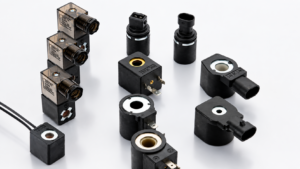

Top 10 DIN Connector Manufacturers for Industrial Automation in 2026: How Engineers Should Evaluate Them
DIN connector manufacturers can look surprisingly similar when buyers compare only catalog dimensions, IP ratings, and prices. However, two connectors that both comply with DIN 43650 Form A can perform very differently after thousands of switching cycles or months of exposure to moisture. We recommend evaluating sealing, contacts, electronics, tolerances, and production consistency before selecting a supplier.
The best DIN connector manufacturers offer more than standard-compliant dimensions. They provide reliable terminal contacts, consistent gasket compression, suitable cable glands, durable housings, verified electronic circuits, and repeatable mass-production quality. Engineers should evaluate the connector and solenoid coil as one electrical and mechanical system instead of purchasing them as unrelated catalog components.
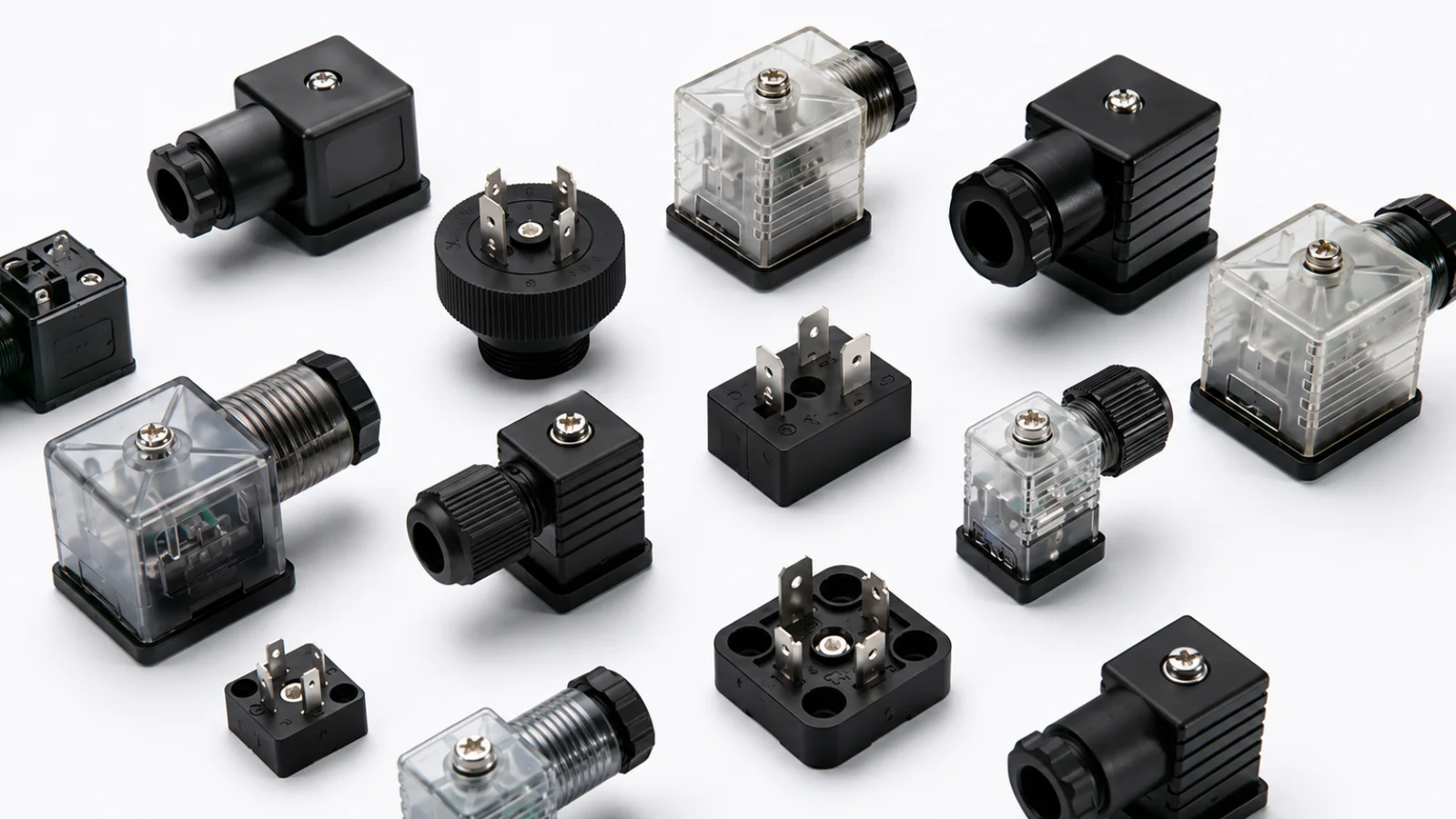
This guide compares ten established suppliers without treating the list as a simple popularity ranking. We focus on what engineers and procurement teams should verify, including DIN forms, circuit options, sealing performance, OEM support, quality control, and long-term supply capability.
If you are matching a connector to a coil rather than comparing brand catalogs, start from the interface:
- Connector / form: How to choose a solenoid valve connector · DIN connector coil selection
- Voltage: What voltage do solenoids use · 12V vs 24V for pneumatic OEMs
- Valve body / application: Coil selection for pneumatic valves
- Replacement fit: Drop-in coil compatibility checklist
- Products: Solenoid valves · Solenoid coil series
What Should Engineers Look for in a DIN Connector Manufacturer?
Catalog specifications make initial screening easy, but they can hide important differences between products. If a buyer treats “DIN compliant” as proof of equal quality, the project may later experience moisture ingress, loose contacts, damaged screws, or incorrect suppression behavior.
We believe engineers should evaluate DIN connector manufacturers in this order: application compatibility, sealing and electrical reliability, manufacturing consistency, circuit options, engineering support, supply stability, and price. DIN compliance is only the entry requirement. It does not prove that two connectors will deliver the same field performance or production consistency.1

DIN compliance does not make every connector equal
The term “DIN connector” often refers to valve connectors based on DIN 43650, now commonly associated with EN 175301-803.2 The standard defines important mating dimensions and arrangements.3 It helps engineers match a connector with a solenoid valve or coil interface.
However, compliance does not make products identical. Two Form A connectors may differ in:
- Gasket design and compression4
- Contact plating and spring pressure5
- Terminal alignment
- Cable gland material and clamping range
- Housing resin and flame resistance
- Central screw strength
- Assembly tolerances
- LED, rectifier, diode, or varistor quality
- Process control during mass production
A DIN connector rarely fails because its catalog specification looks obviously wrong. In our experience, field problems are more often related to sealing, terminal contact, cable entry, assembly consistency, or incorrect circuit selection.
A practical supplier evaluation scorecard
We recommend scoring candidates against measurable requirements rather than broad statements such as “high quality.”
| Evaluation area | What we check | Suggested priority |
|---|---|---|
| Application compatibility | Form, pin spacing, voltage, current, cable direction, operating environment | 20% |
| Sealing reliability | Gasket, gland, cable range, torque, mating surface, assembled IP test | 20% |
| Electrical reliability | Contact material, resistance, terminal retention, circuit design | 15% |
| Manufacturing consistency | Dimensional capability, traceability, inspection, batch control | 15% |
| Circuit options | LED, rectifier, diode, varistor, polarity, AC/DC versions | 10% |
| Engineering support | Drawings, samples, failure analysis, customization | 10% |
| Supply stability | Capacity, lead time, change control, continuity planning | 5% |
| Commercial terms | Price, tooling, MOQ, warranty, payment terms | 5% |
The percentages should change according to the application. For example, a washdown valve assembly should place more weight on sealing. A high-frequency pneumatic machine should give more attention to contact reliability and coil suppression.
We advise buyers not to start with price and evaluate everything else afterward. A low unit price can quickly disappear when the finished machine develops intermittent connections, water ingress, or excessive warranty claims.
Documents and samples we request
We usually recommend requesting the following evidence from DIN connector manufacturers:
- A dimensioned drawing with tolerances
- A bill of materials or controlled material specification
- Contact material and plating information
- Cable gland clamping range
- Recommended assembly torque
- IP test conditions for the assembled product
- Circuit diagrams for illuminated or protected versions
- Temperature and electrical ratings
- Lot traceability information
- Change-control and nonconformance procedures
Certificates such as CE, UL, RoHS, REACH, TÜV, or IEC-related reports should be treated as documents to verify, not as general marketing labels.6 Buyers should confirm the issuing organization, report number, product family, validity, and whether the exact ordered configuration is covered.
Top 10 DIN Connector Manufacturers Compared
A “top ten” list becomes unhelpful when it only repeats company histories and promotional claims. Engineers need to know which product families are available, where each supplier is strong, what customization may be possible, and which technical details still require confirmation.
Our 2026 shortlist includes Belden’s Hirschmann brand, Molex, Murrelektronik, Phoenix Contact, binder, Mencom, Canfield Connector, ATAM, HTP Europe, and LÜTZE. We do not rank them from best to worst because the right supplier depends on the DIN form, circuit, sealing environment, volume, region, and OEM customization requirements.
Product ranges and ownership structures can change. Therefore, procurement teams should confirm all 2026 specifications on the manufacturer’s official website and in the current SKU datasheet. In particular, buyers should verify the exact DIN form, IP rating, cable diameter, circuit voltage, approvals, and minimum order conditions.
Engineering comparison table
The descriptions below summarize commonly marketed product families. An IP rating or circuit option may apply only to certain part numbers and assembly conditions.
| Manufacturer | DIN connector range | Advertised sealing level* | Circuit options* | OEM capability | Typical applications |
|---|---|---|---|---|---|
| Hirschmann / Belden | Form A, B, C families and accessories | Commonly IP65 to IP67 | LED, rectifier, suppression options | Configuration support; custom terms depend on project | Hydraulic and pneumatic valves, process equipment |
| Molex mPm | Form A, B, C valve connectors | Commonly up to IP67 | LED, diode, varistor, rectifier options | Broad configuration range and project support | Factory automation, fluid control, mobile equipment |
| Murrelektronik | Valve plugs, molded cables, Form A/B/C options | Commonly IP65/IP67 | LED and suppression circuits | Strong cable-assembly and system configuration support | Machine building, distributed automation |
| Phoenix Contact | Valve connectors and assembled cabling | Commonly IP65/IP67 | LED and protective circuit variants | Configured cabling and industrial connectivity support | Control cabinets, machinery, valve islands |
| binder | Form A/B/C solenoid valve connectors | Commonly IP65/IP67 | Versions with indicators and protective circuits | Project-based cable and connector configurations | Sensors, actuators, automation equipment |
| Mencom | DIN valve connectors and cordsets | Commonly IP65/IP67 | LED, diode, MOV, rectifier variants | Custom cordsets and North American project support | Packaging, material handling, industrial machinery |
| Canfield Connector | Standard, mini, and micro valve connector families | Commonly IP65/IP67; some specialized options | Indicators, suppression, timers, specialty circuits | Strong specialty and application-specific capability | Pneumatics, hydraulics, process controls |
| ATAM | Form A/B/C connectors and molded solutions | Commonly IP65/IP67 | LED, rectifier, diode and varistor options | Connector and cable customization | Solenoid valves, pressure controls, appliances |
| HTP Europe | Valve connectors and overmolded cable assemblies | Commonly IP65/IP67 | Illuminated and protected circuit options | Custom cable assemblies and molding | Industrial valves, automation, transportation |
| LÜTZE | Valve plugs and preassembled control cables | Commonly IP65/IP67 | LED and suppression variants | Cable assembly and automation project support | Machine tools, factory automation, control systems |
*Buyers must verify ratings and circuit availability at the exact part-number level. Final sealing also depends on assembly, cable dimensions, and the mating component.
1. Hirschmann / Belden
Hirschmann is frequently shortlisted when engineers want an established industrial connector family with broad market recognition. Its valve connector lines are used with hydraulic and pneumatic equipment, process controls, and general industrial automation.
We would consider Hirschmann when a project values documented industrial product families and international sourcing channels. Buyers should still confirm the exact form, pin layout, contact arrangement, circuit diagram, gasket material, and cable gland range. They should also ask whether the quoted product is field-wireable, molded, or supplied as part of a cable assembly.
For OEM programs, we recommend checking lead times, regional stock, product-change notification procedures, and whether the required customization is available at the projected annual volume. Brand recognition does not remove the need for assembly validation.
2. SolenElec
SolenElec’s DIN valve connector portfolio is designed for solenoid coils and industrial fluid-control applications. The range includes common DIN-style configurations, with options such as LED indication, rectification, and surge suppression. Because SolenElec also develops and manufactures solenoid coils, the connector and coil can be evaluated together as one electrical system rather than as two independent components.
We would shortlist SolenElec for OEM projects that require customization, coil-to-connector matching, and engineering support during product development. This can be particularly useful for pneumatic valves, solenoid valves, and other industrial automation applications where connector dimensions, voltage, circuit configuration, sealing, and coil characteristics need to work together.
Buyers should carefully match the connector circuit to the actual solenoid coil and control system. They should verify AC or DC operation, operating voltage, LED configuration, polarity, rectifier or suppression circuit, cable diameter, gasket compression, and final assembled sealing performance. For customized coils or non-standard electrical requirements, we recommend validating the connector and coil together before mass production rather than approving each component independently.
3. Murrelektronik
Murrelektronik focuses strongly on machine connectivity. Its value is not limited to loose valve plugs because its product approach often includes molded cables, connection systems, and automation infrastructure.
We would consider Murrelektronik for machine builders that want standardized cable assemblies and simplified installation. Preassembled products can reduce wiring time and lower the risk of field errors involving cable stripping, gland compression, and terminal torque.
However, buyers still need to confirm mating dimensions and circuit behavior. A molded assembly may improve repeatability, but cable length, jacket material, bend radius, oil resistance, voltage indication, and suppression must match the application. For high-volume OEM projects, procurement teams should ask about custom lengths, labeling, packaging, testing, and supply continuity rather than assuming every catalog product can be modified.
4. Phoenix Contact
Phoenix Contact offers industrial connectivity products across control cabinets, field wiring, and machine automation. Its valve connector options can appeal to buyers who already use the company’s terminal blocks, power supplies, I/O products, or industrial cabling.
We would shortlist Phoenix Contact when a project benefits from sourcing several automation connection products through one established channel. This approach may simplify approved-vendor management and documentation.
Engineers should verify whether the required product is a field-attachable connector or a molded cable assembly. They should also check cable jacket properties, circuit voltage, indicator orientation, protective component type, and environmental rating. If the valve is exposed to coolant, washdown chemicals, vibration, or continuous movement, the team should request application-specific confirmation instead of relying only on the headline IP number.
5. binder
binder is known for circular and industrial connectors, and its portfolio also includes solenoid valve connector configurations. The company may suit equipment manufacturers that need several connection technologies from one specialist supplier.
We would evaluate binder for sensor, actuator, pneumatic, and compact automation projects where connector construction and cable assembly support are important. Buyers should confirm which DIN forms and pin arrangements are currently offered in their market.
The main verification points remain practical. Engineers should review the terminal design, central screw retention, cable outlet, gasket, current rating, and circuit schematic. For molded versions, they should specify cable length tolerance and jacket material. For OEM customization, buyers should ask about tooling ownership, minimum volumes, sample approval, production validation, and engineering-change control.
6. Mencom
Mencom supplies industrial connectivity products and is especially visible in North American machine-building applications. Its valve connector and cordset range can be relevant to packaging machines, material handling systems, and other automated equipment.
We would consider Mencom when buyers need DIN-style valve connectors combined with custom cable lengths, molded cordsets, or application-oriented support. The company’s regional focus may also help manufacturers that need local commercial and technical communication in North America.
Procurement teams should verify the exact form designation because “mini” and “micro” terminology is not always used consistently across the market. They should also check LED voltage, suppression type, cable approvals, conductor size, and environmental compatibility. If the finished machine will be exported, the buyer should confirm that all required documents apply to the final configuration and destination market.
7. Canfield Connector
Canfield Connector is strongly associated with solenoid valve connections and specialized electronic connector functions. Its range can be relevant when a project needs more than a basic plug, such as timers, indicators, surge suppression, or application-specific circuit behavior.
We would shortlist Canfield for pneumatic, hydraulic, and process-control projects that require specialized engineering support. Its products may be especially useful when the connector plays an active role in controlling or protecting the solenoid circuit.
Buyers should not treat these electronic functions as interchangeable. A timer, rectifier, diode, or varistor changes system behavior.7 Engineers should document coil voltage, current, inrush, holding power, switching frequency, polarity, release-time requirement, and controller output. They should then validate the connector and coil together under realistic temperature and duty-cycle conditions.
8. ATAM
ATAM has a long-standing focus on electrical connections for solenoid valves and related industrial devices. Its catalog commonly covers multiple DIN forms, field-wireable designs, molded cables, and electronic options.
We would consider ATAM when a buyer wants a specialist supplier with a broad valve-connection focus. The range can fit fluid control, pneumatic equipment, pressure systems, and selected appliance applications.
Engineers should verify the current dimensional drawings because each form can include different contact spacings, pin arrangements, and circuit layouts. They should also confirm cable gland size and gasket material. For illuminated versions, the team should specify voltage rather than simply requesting “a connector with LED.” OEM buyers should ask about custom cable assemblies, logos, colors, packaging, testing, and batch traceability.
9. HTP Europe
HTP Europe supplies connector and cable-assembly solutions for industrial applications. Its valve connector offering can be useful to OEMs that prefer an overmolded assembly rather than terminating loose connectors during machine assembly.
We would evaluate HTP for projects that need custom cable lengths, molded construction, or integrated cable-and-connector manufacturing. Overmolding can reduce assembly variation, but it does not automatically solve every reliability issue.
Buyers should check cable adhesion, flex performance, conductor specifications, molding material, strain relief, and resistance to oil or cleaning agents. They should also verify the circuit configuration and mating dimensions. For volume production, procurement teams should review mold maintenance, electrical testing, dimensional inspection, marking, lot identification, and the supplier’s process for approving material or component substitutions.
10. LÜTZE
LÜTZE focuses on industrial automation cabling and connectivity. Its valve plug and cable products may fit machine builders that want organized, ready-to-install wiring for actuators and solenoid valves.
We would shortlist LÜTZE when cable performance and automation integration are as important as the connector body. Preassembled solutions may reduce installation time and improve wiring consistency across repeated machine builds.
Engineers should confirm the available DIN forms, cable jacket, conductor cross-section, circuit option, operating temperature, and ingress rating for the specific assembly. They should also review how the cable exits the plug and whether that direction works within the available installation space. OEM teams should ask about custom lengths, labels, packaging, test reports, and long-term availability for machine platforms that may remain in production for many years.
DIN 43650 Form A vs Form B vs Form C: Which Suppliers Offer the Right Range?
Choosing a recognized DIN connector manufacturer does not prevent a dimensional mismatch. Form A, B, and C connectors have different dimensions and contact arrangements, while additional variants and informal terms can create confusion during cross-sourcing.
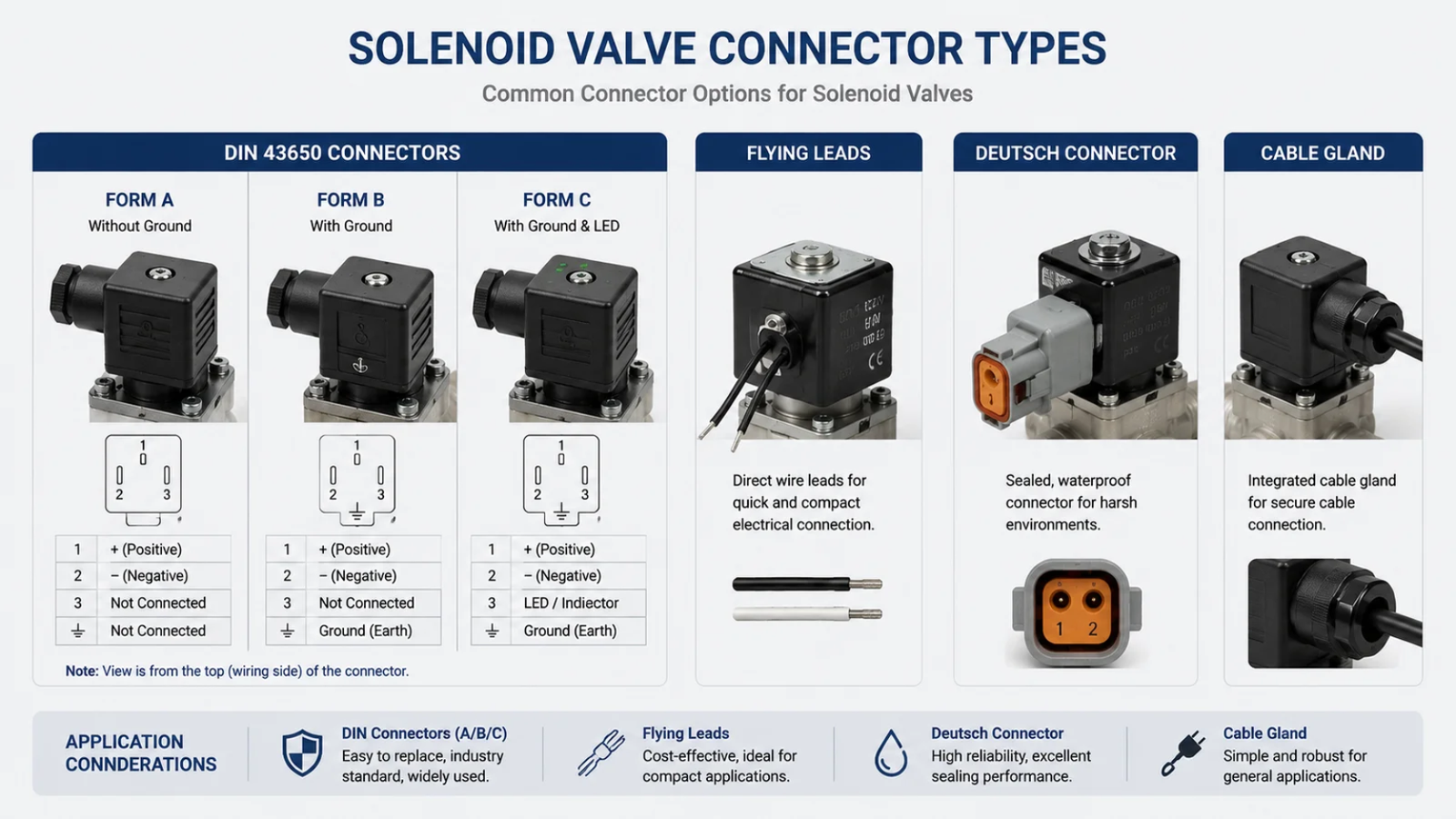
DIN 43650 Form A is generally the largest and is widely used on hydraulic and pneumatic valves.8 Forms B and C are more compact and suit smaller valves or restricted spaces.9 Engineers must confirm the dimensional drawing, contact spacing, pin arrangement, gasket, and mating interface because the form name alone may not identify the complete configuration.
A practical form comparison
The following dimensions are commonly associated with these families, but buyers should use controlled drawings for final approval.
| Form | Common contact spacing | Relative size | Typical use | Main sourcing risk |
|---|---|---|---|---|
| Form A | Approximately 18 mm | Largest | Hydraulic valves, pneumatic valves, industrial solenoids | Assuming every Form A circuit and gasket is identical |
| Form B | Commonly approximately 10 or 11 mm, depending on variant | Medium | Compact valves, pressure switches, automation components | Confusing industrial Form B variants |
| Form C | Commonly approximately 8 or 9.4 mm, depending on variant | Smallest | Miniature valves and space-limited equipment | Selecting by “micro” terminology instead of drawing |
Terms such as mini, micro, ISO, industrial standard, and DIN style can be inconsistent between catalogs. We always recommend comparing the plug drawing directly with the coil or valve interface drawing.
Buyers should check more than contact spacing
A reliable dimensional review should include:
- Center-to-center contact spacing
- Number and position of contacts
- Protective-earth location
- Contact blade dimensions
- Central screw position and thread
- Gasket shape and thickness
- Connector body clearance
- Cable outlet direction
- Maximum housing envelope
- Mating surface flatness
I once reviewed a sample that appeared to fit correctly by hand. The drawing review later revealed that the gasket-support area was too narrow. The plug could be tightened, but gasket compression was uneven. That kind of mismatch may pass a quick functional test and still fail after thermal cycling or vibration.
Which DIN connector manufacturers offer the right range?
Several suppliers in our comparison market products across Form A, B, and C families. However, “full range” should not be assumed to mean that every form is available with every voltage, cable, circuit, or approval.
A buyer may find:
- Form A with LED and varistor options
- Form B with only basic wiring in a particular region
- Form C with limited cable diameters
- Molded versions with different ratings from field-wireable versions
- Rectified versions available only for selected voltages
We recommend creating a part-number matrix before approving a supplier. The matrix should connect each valve or coil model to the exact connector SKU, circuit, cable, gasket, and approved assembly instructions. This step prevents purchasing teams from substituting a visually similar connector during a shortage.
What Matters Beyond the Datasheet When Comparing DIN Connector Suppliers?
Datasheets are necessary, but they normally describe a correctly assembled product under controlled conditions. Real installations introduce cable variation, damaged gaskets, inconsistent torque, surface defects, vibration, heat, contamination, and operator error.
Beyond the datasheet, we evaluate DIN connector suppliers by sealing consistency, contact reliability, gland performance, screw durability, electronic component control, assembly tolerance, temperature resistance, and batch-to-batch repeatability. A good sample is useful, but stable performance across tens of thousands of production units is the more important OEM requirement.10

An IP rating belongs to an assembled system11
In our experience, specifying an IP67 connector does not guarantee an IP67 valve assembly12. The final result depends on:
- Cable outside diameter
- Gland insert and compression
- Cable jacket hardness and roundness
- Gasket condition
- Gasket compression
- Central screw torque
- Mating surface dimensions
- Surface cleanliness
- Cable bending near the gland
- Assembly workmanship
The same connector may seal correctly around a 7 mm cable and poorly around a cable near the lower limit of its stated range. A scratched mating surface or twisted gasket can also create a leakage path.
We recommend performing ingress tests on the complete assembly, using production cables, production coils or valves, specified torque, and representative operators. A qualified laboratory or application engineer should define tests for safety-critical or harsh-environment equipment.
Contact quality can create intermittent failures
Contact reliability involves more than rated current. We review:
- Base contact material
- Plating material and thickness
- Contact pressure
- Terminal retention
- Alignment with mating blades
- Screw terminal durability
- Conductor preparation
- Contact resistance before and after environmental testing
A connector can pass an initial continuity test and later develop resistance because of low contact force, corrosion, vibration, or terminal movement. Increased resistance produces localized heat. The problem may then appear to be a coil failure even though the connection caused the temperature rise.
Electronics must match the solenoid coil
LEDs, rectifiers, diodes, and varistors are not simple check-box features.
| Circuit feature | Main purpose | What engineers must verify |
|---|---|---|
| LED | Visual energized-state indication | AC/DC type, operating voltage, polarity, leakage current |
| Rectifier | Converts AC input to DC for a DC coil | Input voltage, output behavior, heat, coil compatibility |
| Flyback diode | Suppresses DC coil voltage spike | Polarity, slower release time, controller compatibility |
| Varistor/MOV | Limits voltage transients | Clamping voltage, energy rating, switching frequency |
| RC network | Suppresses AC transients | Voltage, frequency, leakage current, thermal behavior |
We believe the connector and solenoid coil should be selected as an electrical system, not as two independent catalog components. A flyback diode can protect a controller output, but it can also slow the valve’s release. A wrongly oriented diode can cause a short circuit. An LED selected for the wrong voltage may fail early or remain too dim to be useful.
Mass-production consistency matters more than a perfect sample
Producing one sample that passes a waterproof test is not unusually difficult. The real manufacturing challenge is keeping terminal position, gasket compression, screw assembly, electronic components, and molded dimensions stable across tens of thousands of units.
For OEM sourcing, we recommend reviewing:
- Incoming material inspection
- Mold and tooling maintenance
- Contact stamping controls
- Plating and material traceability
- Electronic component supplier control
- Assembly error-proofing
- In-process electrical testing
- Final visual and functional inspection
- Lot identification
- Corrective-action and change-control systems
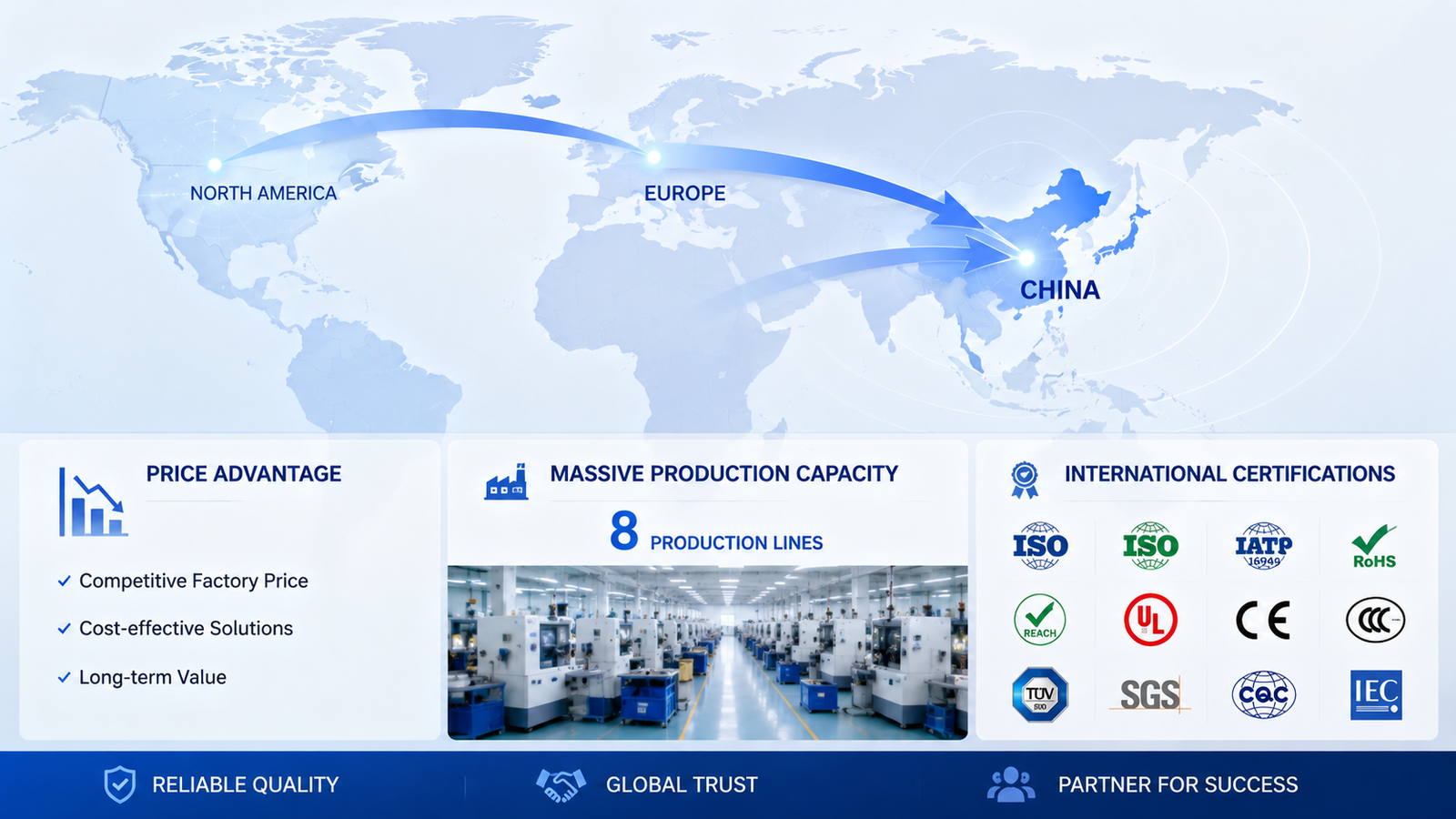
At SolenElec, our own manufacturing perspective comes from more than 20 years of OEM/ODM work with solenoid coils and related assemblies. We use eight production lines, quality-control personnel, and MES-supported traceability. Buyers should still verify any supplier’s audit evidence, certifications, process records, and product-specific test reports independently.
How to Choose the Right DIN Connector Supplier for Industrial Automation?
A supplier may provide a competitive quote and attractive samples but still be unsuitable for a long-term OEM program. Problems usually appear when volumes rise, requirements change, or field failures require fast technical investigation.
To choose the right DIN connector supplier, we first define the complete application and electrical circuit. We then test assembled sealing and electrical performance, audit manufacturing consistency, validate circuit options, assess engineering support, review supply stability, and compare total cost. We approve price only after the supplier has passed the technical and production evaluation.

Step 1: Define the complete application
We start with an application specification rather than a supplier catalog. It should include:
- DIN form and dimensional drawing
- Number and position of contacts
- Coil voltage and tolerance
- AC or DC supply
- Rated and inrush current
- Switching frequency and duty cycle
- Required valve release time
- Ambient and coil temperature
- Cable diameter and jacket material
- Exposure to water, oil, chemicals, or dust
- Vibration and shock conditions
- Required approvals and destination markets
- Expected annual volume and product lifetime
This information prevents suppliers from quoting technically different products under the same general description.
Step 2: Match the circuit with the coil
We ask the connector supplier and coil engineer to review the circuit together. A 24 V DC coil may need an LED and surge suppression, but the suppression method depends on the controller and required valve response.
For example, a diode usually provides strong transient suppression but can increase magnetic decay time. A varistor may allow faster release but clamps at a higher voltage. The engineer must balance output protection, electromagnetic compatibility, response time, heat, and component life.
Application-specific decisions should be reviewed by a qualified electrical engineer. The final circuit should be tested with the actual coil, connector, cable, controller output, and operating duty cycle.
Step 3: Validate assembled samples
We recommend testing more than one carefully prepared sample. The sample plan should represent normal production variation.
Useful validation tests can include:
- Dimensional inspection
- Mating and unmating checks
- Terminal torque and pull tests
- Contact resistance
- Dielectric strength and insulation resistance
- Temperature rise
- Switching endurance
- Thermal cycling
- Vibration
- Cable pull and flex tests
- Ingress protection testing
- Chemical or oil exposure
- Circuit polarity and suppression testing
The test requirements should reflect the finished machine’s risk level. A connector inside a protected cabinet does not need the same validation as a connector installed on outdoor mobile hydraulic equipment.
Step 4: Audit production readiness
Before mass production, we examine whether the factory can reproduce the approved sample. We pay particular attention to tooling, critical dimensions, component substitutions, electronic testing, gasket handling, and operator instructions.
We also ask how the supplier controls changes. A different LED resistor, varistor, plating process, plastic resin, or gasket compound can affect performance even when the commercial part number stays unchanged.
A production approval package may include:
- Approved drawings
- Golden samples
- Critical-to-quality dimensions
- Material specifications
- Circuit diagrams and component lists
- Control plan
- Inspection criteria
- Reliability test results
- Packaging standard
- Change-notification agreement
Step 5: Compare total procurement risk
The lowest quoted connector may not provide the lowest total cost. We consider incoming inspection, assembly time, line stoppages, returns, troubleshooting, warranty repairs, and brand damage.
| Supplier factor | Low-risk evidence | Warning sign |
|---|---|---|
| Technical communication | Clear drawings and direct answers | Marketing claims without engineering detail |
| Sample consistency | Multiple samples perform similarly | One hand-selected sample only |
| Quality control | Traceable records and defined limits | Inspection described only as “100%” |
| Electronics | Full circuit and component information | “LED version” without voltage or polarity |
| Sealing | Assembly conditions documented | IP claim without cable or torque details |
| Change control | Written notification process | Unapproved substitutions are permitted |
| Capacity | Production and contingency plan | Capacity based only on verbal assurance |
| Failure support | Root-cause process and response time | Replacement offered without investigation |
We prefer a supplier that discusses limitations honestly. Clear technical boundaries are usually more valuable than a promise that one product fits every valve, cable, voltage, and environment.
Frequently Asked Questions
Is DIN 43650 the same as EN 175301-803?
DIN 43650 is the older designation commonly used in the market for solenoid valve connectors. EN 175301-803 is the related European standard designation. Suppliers still use both terms, so we recommend checking the exact form, dimensions, contact arrangement, and drawing rather than relying only on the standard name.
Does an IP67 DIN connector guarantee an IP67 solenoid valve assembly?
No. The connector’s rating applies under specified test and assembly conditions. Cable diameter, gland compression, gasket condition, central screw torque, mating-surface quality, and installation workmanship affect the final assembly. We recommend testing the complete valve, coil, connector, and cable combination.
Should I choose a DIN connector with a diode or varistor?
The choice depends on the coil, supply, controller output, switching frequency, and required valve response.
A flyback diode is commonly used with DC coils because it can suppress the voltage spike generated when the coil is switched off. However, it also slows magnetic-field decay and may increase valve release time. Polarity must also be correct.
A varistor provides bidirectional transient suppression and can allow faster release than a conventional flyback diode, but engineers must select an appropriate clamping voltage and energy rating.
We do not recommend choosing the suppression circuit from the connector catalog alone. The coil, connector, suppression component, controller output, and required valve response should be evaluated as one electrical system.
Can I replace one DIN connector brand with another if both are Form A?
Not automatically.
Matching Form A dimensions is only the first step. Engineers should also compare contact arrangement, gasket geometry, cable gland range, housing clearance, rated voltage and current, electronic circuit, polarity, temperature rating, IP test conditions, and applicable approvals.
For OEM projects, we recommend validating the replacement connector on the actual coil or valve rather than approving a cross-reference from catalog dimensions alone.
What usually causes DIN connector failures in the field?
In our experience, many failures are related to the assembled connection rather than the DIN form itself.
Common causes include:
- Incorrect cable diameter for the gland
- Insufficient or uneven gasket compression
- Incorrect central screw torque
- Damaged or contaminated sealing surfaces
- Loose or poorly aligned terminals
- Increased contact resistance
- Moisture or chemical ingress
- Incorrect LED or suppression circuit
- Excessive coil temperature
- Vibration and cable strain
- Inconsistent assembly during mass production
When troubleshooting, we recommend inspecting the connector, cable, gasket, mating interface, coil, and electrical circuit together instead of replacing the connector without identifying the root cause.
What should OEM buyers ask a DIN connector manufacturer before approval?
Before supplier approval, we would ask for the controlled dimensional drawing, material specifications, contact and plating information, cable gland range, recommended assembly torque, circuit diagram, IP test conditions, traceability method, production inspection criteria, and engineering-change procedure.
For high-volume programs, we would also request samples from more than one production lot. A single good prototype does not demonstrate mass-production consistency.
Conclusion
Choosing among DIN connector manufacturers should not begin and end with Form A, B, or C, an IP rating, and a unit price.
Those specifications help engineers create a shortlist. They do not prove that two connectors will deliver the same sealing reliability, electrical contact performance, circuit behavior, assembly consistency, or service life.
For OEM projects, we recommend evaluating suppliers in this order:
- Application and dimensional compatibility
- Sealing and electrical reliability
- Connector and solenoid coil compatibility
- Manufacturing consistency
- Circuit and suppression options
- Engineering and failure-analysis support
- Supply stability and change control
- Total procurement cost
The most important point is to treat the DIN connector, solenoid coil, cable, suppression circuit, and mating valve interface as one system.
A connector that performs well on a laboratory bench can still fail when cable dimensions change, gasket compression varies, coil temperature rises, or production moves from carefully prepared samples to thousands of assembled units.
That is why we believe the right DIN connector supplier is not simply the company with the largest catalog. It is the supplier that can provide the correct interface, prove repeatable production quality, explain the electrical circuit clearly, and support the OEM when real application problems appear.
Need Support With DIN Connectors and Solenoid Coil Integration?
SolenElec works with OEM customers on solenoid coils, DIN connector and coil matching, electromagnetic assemblies, prototyping, testing, and customized production.
If you are evaluating a new DIN connector, replacing an existing supplier, or developing a customized solenoid valve or coil assembly, our engineering team can review the application requirements together with you.
Before recommending a configuration, we prefer to understand the coil voltage, DIN form, cable requirements, operating environment, duty cycle, circuit protection, annual volume, and validation requirements.
Contact SolenElec to discuss your DIN connector and solenoid coil application.
If you are matching a coil to an existing valve or connector, start here:
- DIN connector coil selection
- Coil selection for pneumatic valves
- Drop-in coil compatibility checklist
- Solenoid coil series
"ISO 9000 family", https://en.wikipedia.org/wiki/ISO_9000_family. ISO/IEC guidance describes standards as documents that establish agreed requirements, guidelines, or characteristics; this supports treating DIN compliance as a baseline conformity condition rather than proof of equal field reliability or production capability. Evidence role: expert_consensus; source type: institution. Supports: An institutional source should explain that standards define specified requirements or characteristics, while quality and reliability depend on additional design, manufacturing, and validation controls.. Scope note: This is contextual support for the reasoning, not direct test evidence comparing two DIN connector brands. ↩
"How to Choose the Right DIN Connector Coil for Your ...", https://solenelec.com/how-to-choose-the-right-din-connector-coil-for-your-solenoid-valve/. A neutral technical reference identifies DIN 43650 valve connectors and notes the related EN 175301-803 designation, supporting the terminology used here while not replacing the normative standard text. Evidence role: historical_context; source type: encyclopedia. Supports: A neutral reference should confirm that DIN 43650 valve connectors are commonly associated with EN 175301-803 terminology.. Scope note: An encyclopedia or technical summary can support terminology and historical context, but the official standard should be consulted for controlled dimensions and requirements. ↩
"EN 175301-803:2006 - Rectangular Connectors Flat Contacts IP65", https://standards.iteh.ai/catalog/standards/clc/73ce0bf1-a17a-469e-a92e-a992cd63b8b0/en-175301-803-2006?srsltid=AfmBOooV6M9HS0rgKMQh8A96C90lI0tK9Nlz8ZTHpCnBCkhFEcugDEfK. The EN 175301-803/DIN 43650 standards documentation describes the dimensional and interface requirements for rectangular valve connectors, supporting the statement that the standard governs mating geometry and arrangements. Evidence role: definition; source type: institution. Supports: A standards body or standards catalogue entry should show that the standard covers rectangular valve connector interfaces, dimensions, or contact arrangements.. ↩
"How Material Selection Affects Solenoid Valve Service Life in High ...", https://solenelec.com/how-material-selection-affects-solenoid-valve-service-life-in-high-temperature-oem-applications/. Studies of elastomer gasket sealing show that seal geometry, compression level, and compression-set behavior affect leakage resistance and long-term seal integrity, supporting the article’s emphasis on gasket design and compression. Evidence role: mechanism; source type: paper. Supports: A research source should show that gasket compression, compression set, and seal geometry influence leakage and sealing reliability.. ↩
"Relay", https://en.wikipedia.org/wiki/Relay. Research on electrical contacts shows that plating material and contact normal force affect contact resistance, wear, fretting corrosion, and connection stability, supporting their inclusion as connector reliability factors. Evidence role: mechanism; source type: paper. Supports: A peer-reviewed or technical paper should explain the relationship between plating, normal force, fretting, corrosion, and contact resistance.. ↩
"Type approval", https://en.wikipedia.org/wiki/Type_approval. Official conformity-assessment guidance for CE marking and product certifications emphasizes that compliance depends on applicable documentation, product scope, and verifiable records, supporting the recommendation to check certificates rather than treat marks as generic claims. Evidence role: expert_consensus; source type: government. Supports: Government or certification-body guidance should explain that conformity claims depend on documentation, scope, applicable product, and valid certification records.. Scope note: The cited guidance would support verification principles across compliance regimes; individual marks such as UL, TÜV, RoHS, and REACH have distinct rules and databases. ↩
"Glossary of electrical and electronics engineering", https://en.wikipedia.org/wiki/Glossary_of_electrical_and_electronics_engineering. Electrical-engineering studies of inductive coil suppression show that diode and varistor networks alter transient voltage and current decay after de-energization, supporting the claim that protective or timing electronics in a valve connector can change system behavior. Evidence role: mechanism; source type: paper. Supports: A paper or academic source should explain how diodes, varistors, rectifiers, or timing circuits affect inductive coil current decay, voltage transients, and switching behavior.. Scope note: The mechanism is general to inductive loads; the exact effect depends on coil design, supply voltage, controller output, and the specific suppression circuit. ↩
"Solenoid Coil Selection Guide for Pneumatic Valves - Solenoid ...", https://solenelec.com/solenoid-coil-selection-guide-for-pneumatic-valves/. Technical references for DIN 43650/EN 175301-803 valve connectors list Form A with the larger common contact spacing and describe its use on industrial solenoid valve interfaces, including hydraulic and pneumatic applications. Evidence role: general_support; source type: other. Supports: A technical reference should document Form A dimensions and describe common use with hydraulic or pneumatic solenoid valves.. Scope note: Such references support common practice and relative sizing, but they do not prove that Form A is used in every hydraulic or pneumatic valve design. ↩
"How to Choose the Right Solenoid Valve Connector for Your ...", https://solenelec.com/how-to-choose-the-right-solenoid-valve-connector-for-your-application/. Published technical comparisons of DIN 43650/EN 175301-803 connector forms show that Forms B and C use smaller interface dimensions than Form A, supporting their description as compact alternatives for smaller or space-constrained valve assemblies. Evidence role: general_support; source type: other. Supports: A technical comparison should show that Forms B and C have smaller contact spacing and housing dimensions than Form A.. Scope note: The source would support dimensional context; suitability for a particular restricted-space design still requires checking the actual connector and valve drawings. ↩
"Why Do Some Solenoid Valves Last Longer? Engineering Factors ...", https://solenelec.com/why-do-some-solenoid-valves-last-twice-as-long-a-field-technicians-perspective/. Quality-management standards and statistical process-control literature emphasize controlled production processes, monitoring, and process capability as means of achieving consistent conforming output, supporting the focus on repeatable OEM production performance. Evidence role: general_support; source type: institution. Supports: A quality-management or manufacturing source should support the importance of process control and repeatability for consistent production output.. Scope note: The source supports the general manufacturing principle; it does not prove a specific threshold of tens of thousands of units for DIN connector qualification. ↩
"IP code", https://en.wikipedia.org/wiki/IP_code. IEC 60529 defines IP ratings by standardized tests of an enclosure’s protection against solid objects and water, supporting the point that the rating applies to the tested assembly and conditions. Evidence role: definition; source type: institution. Supports: An IEC or NEMA source should define IP ratings as protection levels determined under specified test conditions for an enclosure or assembled product.. ↩
"How to Choose the Right Solenoid Valve Connector for Your ...", https://solenelec.com/how-to-choose-the-right-solenoid-valve-connector-for-your-application/. Institutional guidance on IEC 60529 IP ratings explains that water-ingress protection is verified under specified assembly and test conditions, supporting the statement that a rated connector alone does not guarantee the same rating for the completed valve assembly. Evidence role: mechanism; source type: institution. Supports: A standards or institutional source should show that IP67 performance depends on the tested assembled configuration, including seals and cable-entry features.. Scope note: The source supports the principle of assembly-dependent ingress protection; it does not test the specific connector, cable, gasket, or valve combinations discussed in the article. ↩