
Top 10 Solenoid Pump Manufacturers in 2026: How Should OEM Engineers Evaluate Them?
Solenoid pump manufacturers can look remarkably similar when an OEM engineer compares only flow, voltage, and pressure. That similarity creates a procurement risk because an excellent prototype does not always lead to stable mass production1. I believe buyers can reduce that risk by evaluating engineering support, process control, testing, documentation, and long-term supply capability.
The right solenoid pump manufacturer is the supplier whose design, engineering support, manufacturing controls, and supply model best fit the application. I do not believe that one manufacturer is universally best. Datasheets help OEM engineers create a shortlist, but prototype capability, production consistency, failure analysis, and lifecycle support usually determine whether a project succeeds.

The following comparison is not a ranking. I use the ten companies as a practical market reference covering appliance pumps, electromagnetic pumps, compact fluid systems, and industrial dosing equipment. Buyers should confirm each supplier’s current product range, certifications, production locations, and OEM policies directly before making a sourcing decision.
What Makes Good Solenoid Pump Manufacturers?
A pump can meet every nominal specification and still create noise, heat, leakage, or assembly problems in the final product. I have seen procurement teams focus heavily on the initial sample while giving too little attention to the process that will produce the next 10,000 units.
A good solenoid pump manufacturer combines application knowledge with repeatable manufacturing. I would look for responsive design support, rapid prototyping, clear design-for-manufacturing feedback, controlled materials, traceable production, application-specific testing, and reliable engineering change management2. The supplier should prove that production units can remain close to the approved sample.
Product Specifications Are Only the Starting Point
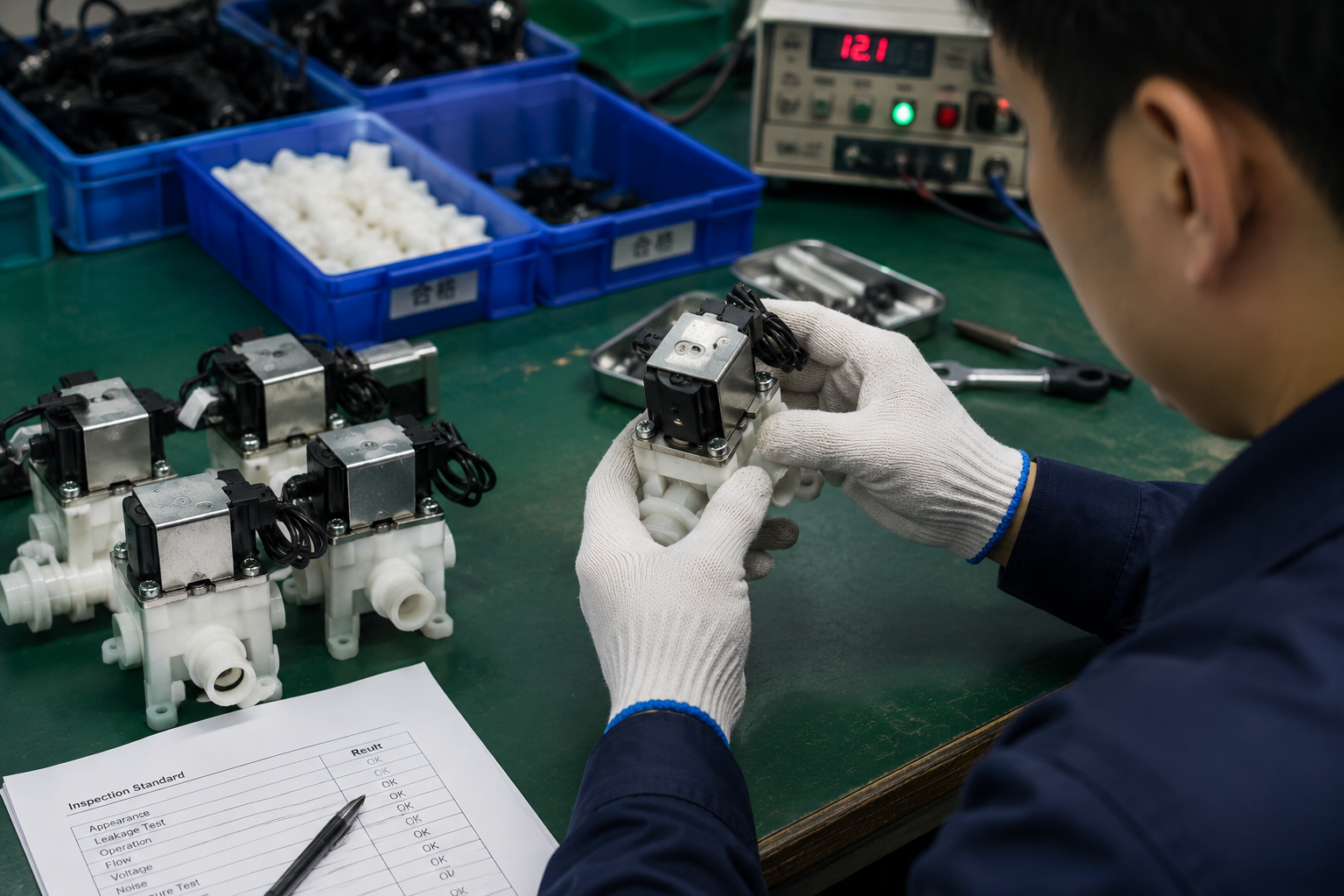
Flow rate, discharge pressure, suction capability, voltage, power, and duty cycle remain essential. However, these numbers describe only a controlled test condition3. They do not automatically show how a pump will perform inside an appliance or industrial assembly.
A buyer should ask how the supplier measured each value:
- What fluid and fluid temperature were used?
- What inlet restriction and outlet back pressure were applied?
- Was the pump tested continuously or intermittently?
- What voltage tolerance was allowed?
- Was flow measured at nominal pressure or at free flow?
- How many samples were tested?
- What were the minimum, average, and maximum results?
- Did the test include hot-start and cold-start conditions?
A published flow rate of 500 millilitres per minute means little without the corresponding pressure, fluid, temperature, and duty cycle.4
Engineering Support Creates the Real Difference
Pump catalogs are becoming more alike. Many solenoid pump manufacturers can offer comparable values for voltage, pressure, flow, and power consumption. I believe the greater difference now lies in engineering execution.
OEM customers are not simply buying a pump. They are buying access to a development process that may include:
- Application requirement review
- Electromagnetic and hydraulic design assessment
- Material selection
- Prototype production
- Design for manufacturing, or DFM
- Reliability and life testing
- Failure analysis
- Engineering change control
- Pilot production support
- Corrective action during mass production
That support becomes especially important when an application involves unusual fluids, limited installation space, strict noise targets, high ambient temperatures, or local compliance requirements.
Production Consistency Matters More Than a Perfect Sample
In one anonymous OEM sourcing project, two suppliers offered pumps with almost identical specifications. Both prototypes met the target flow and pressure. However, one supplier showed noticeable variation in flow and operating noise during pilot production5. The OEM had to adjust its assembly process repeatedly.
The final selection was not based on the better-looking datasheet. The buyer selected the supplier that demonstrated tighter process control and faster engineering support.
I recommend reviewing evidence from multiple production lots, not only hand-selected samples. Useful indicators include:
| Evaluation item | What I would request |
|---|---|
| Flow consistency | Test data across several lots |
| Electrical performance | Current, resistance, insulation, and power distribution |
| Noise | Defined test distance, fixture, environment, and limits |
| Leakage | Test pressure, test medium, duration, and acceptance criteria |
| Temperature rise | Results under the intended duty cycle |
| Life performance | Test conditions and failure criteria |
| Traceability | Lot, material, line, operator, and test records |
| Change control | Written notification and approval procedure |
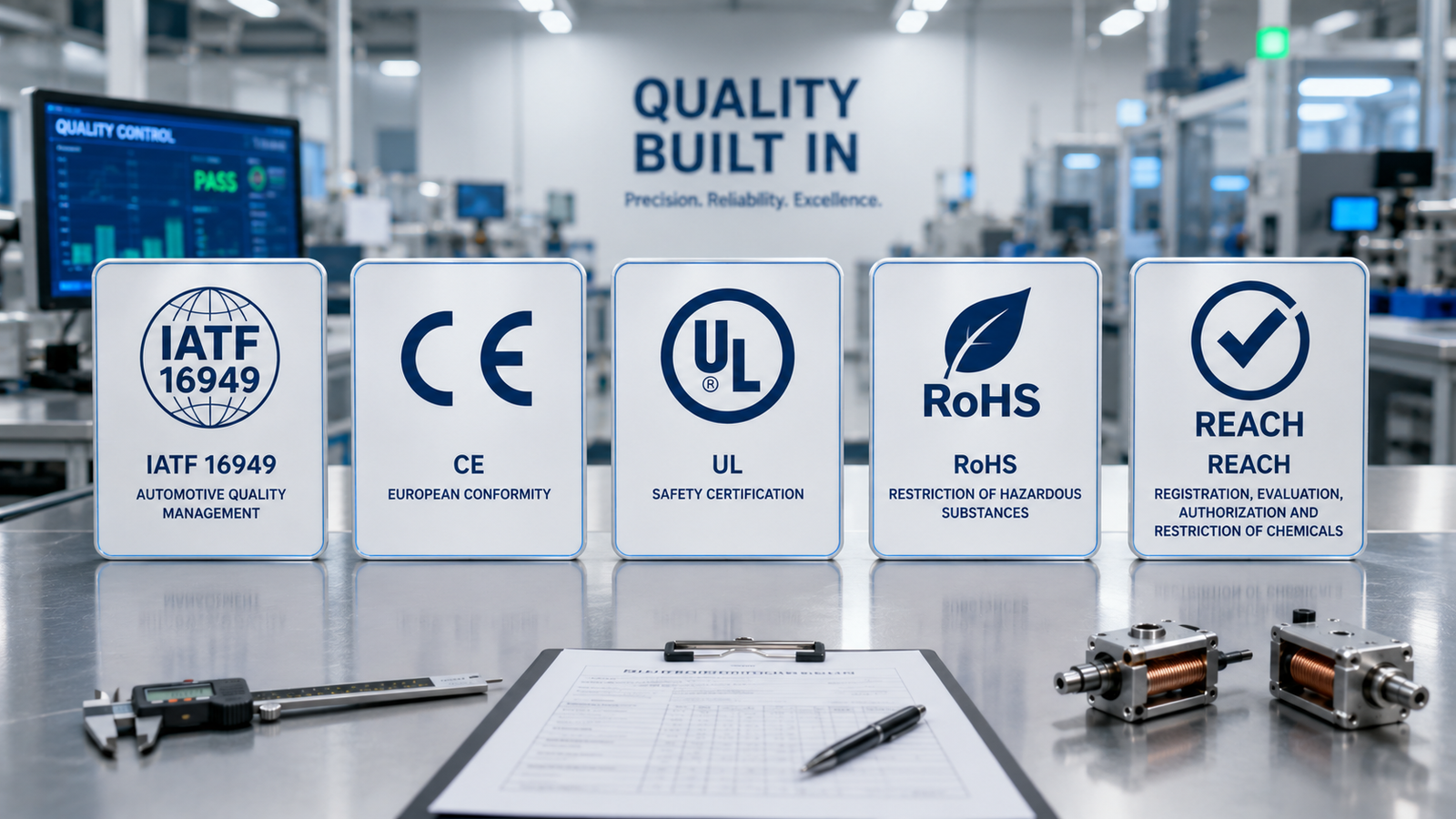
I also treat certifications as documents to verify. A logo on a presentation does not prove that a specific pump, factory, or production line falls within the certificate’s scope.6
Top 10 Solenoid Pump Manufacturers Compared?
A long supplier list can create the illusion of choice without helping an engineer make a decision. Product names also vary across the market. Companies may describe similar technologies as solenoid pumps, vibration pumps, oscillating pumps, electromagnetic pumps, linear pumps, or solenoid-driven dosing pumps.7
I compare the following solenoid pump manufacturers as market references rather than as positions in a league table. Each company serves different applications, volumes, and customization levels. OEM engineers should use this table to build a shortlist and then validate technical fit, production location, support coverage, and current product availability.
| Manufacturer or brand | Product range | OEM capability | Typical applications | Website |
|---|---|---|---|---|
| CEME Group | Vibration pumps, rotary vane pumps, solenoid valves, and fluid-control components | Established industrial and appliance supply capabilities; buyers should confirm project-specific customization | Coffee equipment, steam systems, cleaning equipment, and appliances | ceme.com |
| ULKA | Compact vibration pumps in multiple voltage, pressure, and duty configurations | Commonly used in established appliance platforms; customization should be discussed through the relevant sales channel | Espresso machines, beverage systems, steam appliances, and cleaning equipment | ulkapumps.com |
| SolenElec | Custom solenoid coils, electromagnetic components, and OEM/ODM solenoid assemblies that can support pump actuation projects | In-house design, prototyping, tooling, coil customization, and volume production; buyers should confirm responsibility for the complete pump assembly | Home appliances, pneumatic equipment, automotive components, and custom electromagnetic systems | solenelec.com |
| Fluid-o-Tech | Vibration pumps, rotary vane pumps, gear pumps, and fluid-handling systems | Broad OEM engineering and application support, subject to project and regional arrangements | Beverage equipment, water systems, foodservice equipment, and medical or industrial fluid systems | fluidotech.it |
| Gotec | Electromagnetic pumps and related compact fluid-transfer products | Application-oriented development for appliance and industrial customers | Coffee machines, steam appliances, cooling, condensate handling, and industrial equipment | gotec.ch |
| Nitto Kohki | Linear piston and diaphragm pump technologies, including compact air and fluid solutions | Mature engineering capabilities; buyers should verify whether a specific series supports OEM modification | Medical equipment, environmental systems, laboratory devices, and industrial equipment | nittokohki.com |
| Takasago Fluidic Systems | Compact solenoid pumps, diaphragm pumps, valves, and precision fluid-control products | Strong fit for compact and precision fluidic development; customization depends on platform and volume | Medical devices, analytical instruments, laboratory systems, and ink handling | takasago-fluidics.com |
| Gorman-Rupp Industries | Oscillating pumps, diaphragm pumps, and compact fluid-transfer products | Offers application engineering for selected OEM programs | Beverage systems, printing, medical equipment, water systems, and appliances | gripumps.com |
| ProMinent | Solenoid-driven metering and dosing pumps with control and monitoring options | Strong system integration capability for industrial dosing; not positioned primarily as a small appliance pump supplier | Water treatment, chemical dosing, food processing, and industrial process control | prominent.com |
| SEKO | Solenoid dosing pumps, controllers, and chemical dosing systems | Industrial project support and configurable dosing solutions | Water treatment, hygiene, agriculture, chemical dosing, and process equipment | seko.com |
Why This Table Is Not a Ranking
I have intentionally avoided labels such as “best,” “number one,” or “market leader.” Those claims rarely help an OEM team because the requirements for a coffee machine pump differ sharply from those for a chemical dosing system or diagnostic instrument.
The table also includes different electromagnetic pump categories. That distinction matters:
- Vibration pumps often suit beverage and steam appliances.
- Compact solenoid diaphragm pumps can suit precision liquid transfer.
- Linear piston pumps frequently appear in air, vacuum, and medical systems.
- Solenoid dosing pumps focus on controlled chemical injection.
- Custom electromagnetic assemblies may support an OEM developing its own pump architecture.
I recommend confirming whether a supplier manufactures the complete pump, supplies only the electromagnetic actuator or coil, or integrates purchased subcomponents. Each model can work, but the OEM must understand who controls design validation, materials, testing, and warranty responsibility.
My view is simple: there is no universally best manufacturer. There is only the manufacturer that best fits the application, quality target, development process, and supply strategy.
What Should OEM Engineers Compare Beyond Product Specifications?
Datasheets make supplier screening efficient, but they can make two fundamentally different factories appear equal. If a sourcing team stops at voltage, flow, pressure, and price, it may overlook the capabilities that control field performance and warranty exposure.
I recommend comparing solenoid pump manufacturers through engineering, manufacturing, quality, and commercial criteria. The most important areas include prototype speed, design review quality, customized testing, response time, process consistency, change control, documentation, capacity planning, and supply continuity. These factors reveal how a supplier will behave after nomination.
Application Engineering
A capable supplier should ask detailed questions before recommending a model. I become cautious when a manufacturer selects a pump based only on a target flow rate.
The supplier should review:
- Fluid type and viscosity
- Fluid temperature range
- Ambient temperature and humidity
- Required inlet and outlet pressure
- Suction height
- Duty cycle and operating frequency
- Voltage tolerance
- Available installation space
- Mounting orientation
- Noise and vibration targets
- Expected service life
- Regulatory market
- Contact-material restrictions
The supplier should also identify foreseeable failure modes. For example, scale buildup may affect a coffee-machine pump, while aggressive chemicals may damage seals in a dosing application8.
Prototype and DFM Capability
Fast samples are useful, but prototype quality depends on how closely the sample represents future production. I ask whether the prototype uses the intended wire, plastic, seal, spring, core material, winding process, and tooling concept.
A strong DFM review should cover:
- Tolerance feasibility: Can the factory hold the proposed dimensions at volume?
- Assembly access: Can the pump be installed without damaging connectors or tubing?
- Thermal management: Can heat escape under the actual enclosure conditions?
- Electrical integration: Are voltage tolerance, inrush behavior, insulation, and protection suitable?
- Noise transfer: Will the mounting method amplify vibration?
- Testing access: Can critical characteristics be checked on the production line?
Manufacturing and Quality Control
OEM engineers should compare the manufacturing process behind the approved drawing. Key questions include:
- Which processes are automated?
- Which operations depend on manual adjustment?
- How are winding turns, wire tension, and resistance controlled?
- How are injection-molding parameters recorded?
- How does the factory prevent mixed materials?
- Which characteristics receive 100% testing?
- Which characteristics use statistical sampling?
- How are nonconforming units isolated?
- Can the supplier trace a failure back to its production lot?
At SolenElec, our supplied business context includes eight production lines, MES-supported traceability, incoming material inspection, automated molding and assembly processes, and 100% outgoing inspection combined with sampling methods. However, I would still advise buyers to audit these controls, review actual records, and verify whether each claimed certification covers the relevant factory and product scope.
Total Lifecycle Cost
The lowest unit price can become the most expensive choice when it creates assembly delays or field failures.9 I recommend comparing the total lifecycle cost rather than the quoted pump price alone.
| Cost category | Possible hidden cost |
|---|---|
| Development | Repeated prototype revisions |
| Tooling | Unclear ownership or maintenance charges |
| Assembly | Extra brackets, dampers, or calibration |
| Quality | Incoming inspection and sorting |
| Field performance | Returns, service calls, and brand damage |
| Logistics | Air freight caused by unstable lead times |
| Engineering changes | Requalification and documentation updates |
| End of life | Unplanned redesign after component discontinuation |
Datasheets help an OEM shortlist suppliers. Engineering capability determines whether the project succeeds.
What Are the Common Mistakes When Choosing a Solenoid Pump Supplier?
Procurement teams often work under pressure to reduce cost and shorten development time. That pressure can encourage quick comparisons based on a few measurable values. The resulting shortlist may look logical, but it can hide major technical and supply risks.
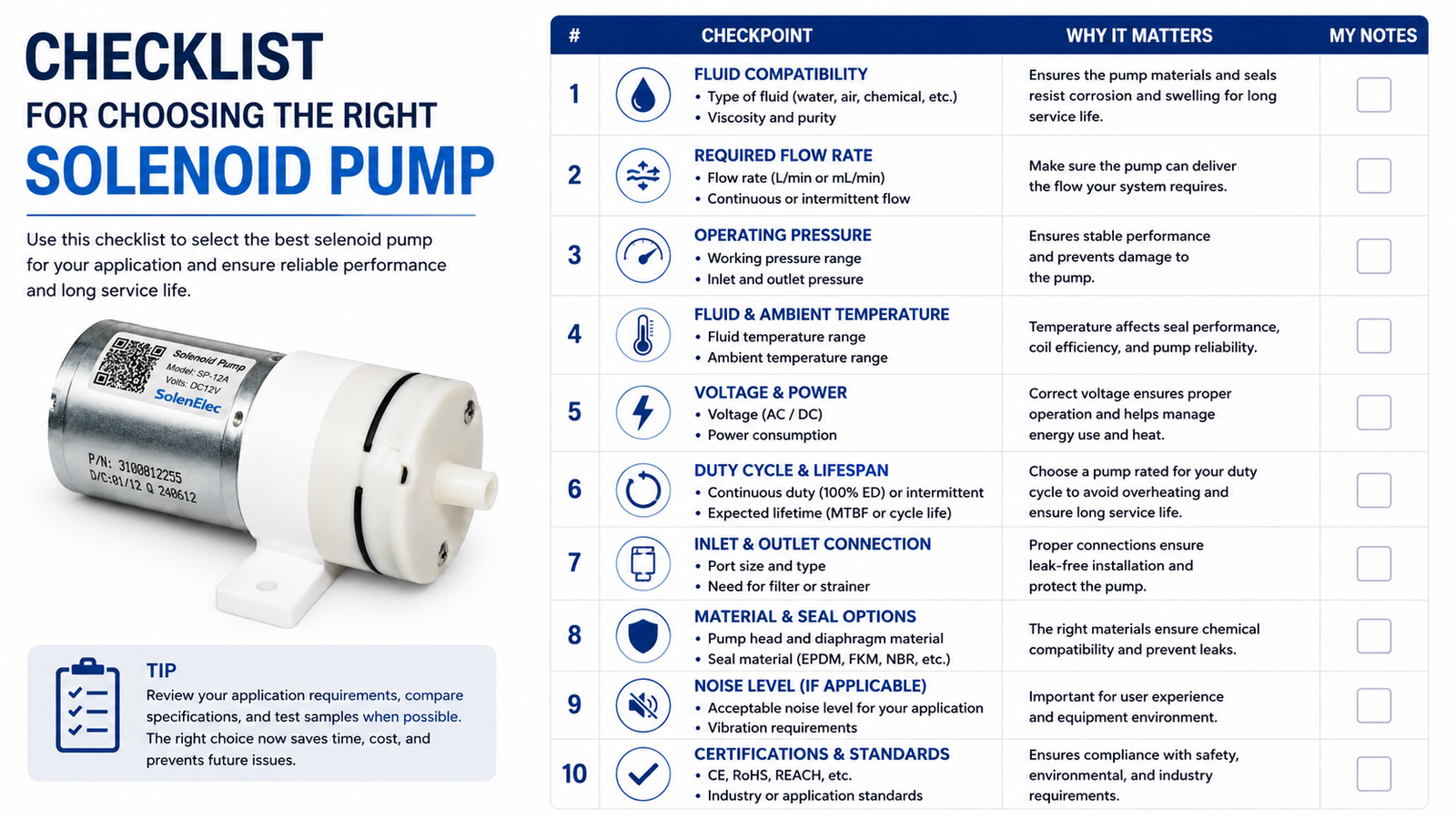
The most common mistakes include choosing by price alone, accepting an ideal sample as proof of production capability, comparing data measured under different conditions, failing to verify compliance documents, overlooking change control, and ignoring communication quality. I would address these issues before approving tooling or placing a production order.
Mistake 1: Treating Catalog Values as Directly Comparable
Two manufacturers may publish the same flow and pressure, but they may use different test conditions. One value may represent a typical result, while another may represent a guaranteed minimum.
I ask suppliers to test shortlisted pumps under one agreed protocol. The protocol should define:
- Test fluid
- Fluid temperature
- Supply voltage
- Back pressure
- Inlet conditions
- Operating duration
- Duty cycle
- Measurement equipment
- Sample quantity
- Pass and fail limits
This approach creates comparable evidence instead of relying on catalog language.
Mistake 2: Approving the Supplier After One Excellent Sample
Some samples receive special engineering attention. Production units must pass through normal material purchasing, shift changes, equipment maintenance, and operator variation.
I prefer a staged approval:
- Initial engineering samples
- Revised design samples
- Tooling samples
- Pilot production units
- Multiple-lot validation
- Controlled production ramp-up
The OEM should record critical-to-quality characteristics at each stage. A golden sample can support inspection, but it should not replace an approved drawing and measurable acceptance criteria.
Mistake 3: Focusing Only on Purchase Price
A low quotation may exclude tooling maintenance, special testing, packaging, compliance work, or engineering changes. It may also rely on a material that provides less thermal or chemical resistance.
I ask for a quotation breakdown that identifies:
- Pump and component cost
- Tooling cost and ownership
- Minimum order quantity
- Test charges
- Packaging
- Freight terms
- Payment terms
- Forecast commitments
- Engineering change charges
- Warranty and claim handling
Mistake 4: Failing to Verify Certifications
Buyers should request current certificates and supporting test reports instead of relying on website claims. They should check:
- Certificate holder
- Factory address
- Product or process scope
- Standard and revision
- Issue and expiry dates
- Certification body
- Model numbers covered
- Any exclusions or conditions
Standards such as CE, UL, CB, RoHS, REACH, TÜV-related schemes, IEC requirements, ISO 9001, or automotive quality systems do not all mean the same thing. A qualified compliance professional should determine which requirements apply to the finished product and sales market.
Mistake 5: Ignoring Response Speed and Documentation
Slow communication during sourcing often becomes slower communication during a quality incident. I evaluate how quickly the supplier provides drawings, test results, corrective actions, and change notices.
A professional supplier should be able to support documents such as:
- Technical drawings
- Material declarations
- Inspection standards
- Control plans
- Process flow charts
- Failure mode and effects analysis
- Test reports
- Traceability records
- Corrective action reports
- Engineering change notices
How Should You Choose the Right Solenoid Pump Supplier for an OEM Project?
A large number of potential suppliers can make the sourcing process feel more secure. In practice, too many loosely screened candidates consume engineering time and delay meaningful testing. I prefer a structured funnel that removes unsuitable suppliers early and validates the remaining candidates with consistent evidence.
I would choose among solenoid pump manufacturers in a fixed order: application fit, engineering support, prototype capability, manufacturing consistency, supply stability, and total lifecycle cost. Product specifications still matter, but they should open the evaluation rather than close it. The final decision should reflect both technical evidence and production readiness.

Our Procurement Principle
If we were sourcing a solenoid pump for a new OEM project, we would evaluate suppliers in this order:
- Application fit
- Engineering support
- Prototype capability
- Manufacturing consistency
- Supply stability
- Total lifecycle cost
Our view is that product specifications should be the starting point, not the final decision. The suppliers that create the most value help solve engineering problems throughout development and mass production. They do not rely only on a long catalog or a low quotation.
Step 1: Create an Application Requirement Specification
I would define the operating conditions before contacting suppliers. The requirement should separate mandatory limits from preferred targets.
A practical specification can include:
| Category | Example requirement |
|---|---|
| Electrical | Nominal voltage, tolerance, power, insulation class |
| Hydraulic | Flow range, pressure, suction capability |
| Environment | Ambient and fluid temperature |
| Operation | Duty cycle, starts per hour, expected life |
| Mechanical | Envelope, mounting, connectors, tubing |
| Acoustic | Sound pressure and vibration limits |
| Materials | Fluid-contact restrictions and declarations |
| Compliance | Target countries and applicable requirements |
| Quality | PPM target, traceability, inspection method |
| Supply | Annual volume, ramp plan, and service expectations |
Step 2: Send a Structured Request for Information
I would ask each supplier the same questions. Standardized questions make responses easier to compare.
The request should cover:
- Relevant product platforms
- Similar OEM experience
- Engineering team availability
- Prototype lead time
- Custom tooling capability
- Testing equipment
- Capacity and utilization
- Quality management systems
- Traceability method
- Subsupplier management
- Business continuity planning
- Typical corrective action time
- Engineering change procedure
Step 3: Score the Shortlist
A weighted scorecard makes internal decisions more transparent. The weighting should reflect the project rather than a generic purchasing rule.
| Criterion | Suggested weight |
|---|---|
| Application fit | 25% |
| Engineering support | 20% |
| Manufacturing consistency | 20% |
| Prototype capability | 10% |
| Quality and documentation | 10% |
| Supply stability | 10% |
| Commercial terms | 5% |
A safety-critical or highly regulated application may require greater weighting for quality and compliance. A fast-moving consumer appliance project may place more weight on capacity, cost, and ramp speed.
Step 4: Validate With Production-Like Samples
I recommend testing samples in the actual product whenever possible. A bench test cannot fully reproduce enclosure temperature, tubing resonance, mounting vibration, supply voltage variation, or system back pressure.10
The validation plan should include:
- Minimum and maximum voltage
- Cold and hot starts
- Expected fluid range
- Maximum back pressure
- Abnormal inlet conditions
- Noise inside the final assembly
- Thermal rise in the enclosure
- Repeated start-stop operation
- Accelerated life testing
- Post-test inspection
Step 5: Audit Before Nomination
A remote document review can support early screening, but it may not show actual process discipline. A qualified OEM quality engineer or third-party auditor should verify production controls for the intended model.
The audit should follow the physical production flow from incoming material to outgoing inspection. I would compare written procedures with actual operator behavior and system records. I would also confirm which processes are outsourced and how the supplier controls those partners.
Frequently Asked Questions
Is there one best solenoid pump manufacturer?
No. I do not believe one supplier is best for every application. A compact beverage pump, precision medical pump, and industrial chemical dosing pump require different materials, controls, and engineering expertise. The best choice is the supplier that fits the application, production volume, quality requirements, and support model.
What specifications should I compare first?
I would begin with flow, pressure, suction capability, voltage, power, duty cycle, temperature limits, media compatibility, expected life, noise, and installation dimensions. Buyers should also compare the test conditions behind each value because similar catalog figures may not represent equivalent performance.
How many samples should an OEM test?
One or two samples can support early feasibility work, but they cannot demonstrate production consistency. I recommend testing samples from pilot production and multiple manufacturing lots. The appropriate quantity depends on project risk, annual volume, application criticality, and the statistical confidence required by the OEM’s quality team.
Should I choose a complete pump manufacturer or a custom solenoid specialist?
The choice depends on the OEM’s design responsibility. A complete pump supplier may reduce integration work. A custom solenoid specialist may offer greater flexibility when the OEM controls the hydraulic design or needs a unique electromagnetic actuator. Buyers should define responsibility for validation, compliance, testing, and warranty clearly.
How should I verify a supplier’s compliance claims?
I would request current certificates, test reports, material declarations, covered model numbers, factory addresses, and standard revisions. A qualified compliance professional should review whether those documents apply to the specific pump and finished product. Buyers should not assume that a company-level certificate automatically covers every product.
Conclusion
The comparison of solenoid pump manufacturers should never end with a datasheet or price table. I recommend starting with application fit and then examining engineering support, prototype development, design review, manufacturing consistency, custom testing, documentation, response speed, and supply stability. The right supplier is not the company with the longest catalog. It is the company that can support the project from concept through stable mass production.
If you are developing a custom electromagnetic pump or solenoid assembly, Contact SolenElec to discuss your application requirements, prototype needs, coil design, testing plan, and OEM/ODM production expectations.
"A state-of-the-art survey of methodologies for representing ...", https://nvlpubs.nist.gov/nistpubs/Legacy/IR/nistir5391.pdf. Manufacturing quality literature treats prototype approval and production validation as distinct activities because process variation, material variation, and operating conditions can affect output after scale-up. Evidence role: general_support; source type: research. Supports: Manufacturing quality research or guidance should support that production consistency depends on controlled processes and cannot be inferred from a single successful prototype.. Scope note: This would provide general manufacturing support rather than direct evidence about solenoid pumps specifically. ↩
"Why Do Some Solenoid Valves Last Longer? Engineering Factors ...", https://solenelec.com/why-do-some-solenoid-valves-last-twice-as-long-a-field-technicians-perspective/. Quality-management standards such as ISO 9001 require control of production, documented information, traceability where applicable, and management of changes, supporting the article’s use of these factors as supplier-evaluation criteria. Evidence role: expert_consensus; source type: institution. Supports: A quality-management standard or professional quality source should support the relevance of material control, traceability, testing, and change management to manufacturing reliability.. Scope note: Such standards support the management-system rationale but do not prove that any particular pump supplier applies these controls effectively. ↩
"Hydraulic machinery", https://en.wikipedia.org/wiki/Hydraulic_machinery. Pump performance standards define measured quantities such as flow and pressure in relation to specified test conditions, supporting the point that catalog values should not be interpreted independently of the test setup. Evidence role: mechanism; source type: institution. Supports: A pump-testing standard or engineering source should show that reported pump performance values depend on defined conditions such as pressure, fluid properties, and operating setup.. Scope note: Many pump standards address broader pump categories and may not be written specifically for miniature solenoid pumps. ↩
"pump characteristics and", https://classes.engineering.wustl.edu/2009/fall/che473/handouts/PumpingMain.pdf. Engineering references on pump performance describe flow as a function of system pressure and fluid properties, supporting the article’s statement that a nominal flow rate is incomplete without the associated test conditions. Evidence role: mechanism; source type: education. Supports: An engineering education source should explain that pump flow is affected by system resistance, fluid properties, and operating conditions.. Scope note: The source would establish the general hydraulic principle rather than verify the numerical example of 500 millilitres per minute. ↩
"Parker Solenoid Valve Alternatives for Espresso Machines", https://solenelec.com/parker-solenoid-valve-alternatives-for-espresso-machines-what-do-oems-really-evaluate-beyond-the-datasheet/. Manufacturing validation guidance treats pilot production as a means of evaluating whether normal production processes can consistently meet requirements, which contextualizes why flow or noise variation may appear after prototype approval. Evidence role: general_support; source type: research. Supports: A manufacturing source should support that pilot production is used to observe process variation and validate whether production conditions can reproduce intended performance.. Scope note: This supports the general production-validation logic and does not independently verify the anonymous sourcing project. ↩
"Product certification", https://en.wikipedia.org/wiki/Product_certification. Accreditation and certification guidance describes certificates as scope-limited documents, supporting the article’s warning that a logo alone does not establish coverage for a particular product, factory, or production line. Evidence role: expert_consensus; source type: institution. Supports: An accreditation or certification source should support that certificates have defined scopes and should be verified against products, sites, and standards.. Scope note: The source would explain certification practice generally and would not assess any specific certificate shown by a supplier. ↩
"Why Is a Solenoid Pump Noisy? Causes and Design Fixes for OEM ...", https://solenelec.com/why-is-a-solenoid-pump-noisy-causes-and-design-fixes-for-oem-applications/. Technical references describe multiple pump designs that use electromagnetic or solenoid actuation, providing context for the article’s observation that related products may appear under different market names. Evidence role: definition; source type: encyclopedia. Supports: A technical encyclopedia or neutral reference should define these pump categories and show that related electromagnetic actuation concepts are described using several terms.. Scope note: A general reference may document the terminology but may not prove how each individual manufacturer labels its products. ↩
"How to Choose the Right Solenoid Pump for Coffee Machines: OEM ...", https://solenelec.com/how-to-choose-the-right-solenoid-pump-for-coffee-machines-oem-buyers-guide/. Engineering and materials references explain that mineral scale can form in water-handling equipment and that elastomer seals are susceptible to degradation when exposed to incompatible chemicals, supporting these examples of application-specific pump failure modes. Evidence role: mechanism; source type: education. Supports: Sources should support that hard-water scale can accumulate in heated water systems and that seal materials must be chemically compatible with process fluids.. Scope note: The evidence would support the mechanisms generally rather than document failures in a specific coffee machine or dosing installation. ↩
"Supply chain management", https://en.wikipedia.org/wiki/Supply_chain_management. Cost-of-quality and total-cost-of-ownership frameworks include prevention, appraisal, failure, warranty, and operational costs, supporting the article’s statement that the lowest unit price may not minimize lifecycle cost. Evidence role: general_support; source type: research. Supports: A cost-of-quality or procurement source should support that purchase price alone can underestimate costs associated with defects, rework, warranty, and delays.. Scope note: The source would support the economic principle generally and would not calculate costs for a specific solenoid pump project. ↩
"Integration and Test > Accelerated Life Testing - S3VI - NASA", https://s3vi.ndc.nasa.gov/ssri-kb/topics/38/. Reliability and systems-engineering guidance emphasizes testing under representative operating environments and interfaces, supporting the article’s claim that isolated bench tests may not capture enclosure, vibration, voltage, and back-pressure effects. Evidence role: general_support; source type: government. Supports: A reliability or systems-engineering source should support that validation should consider the actual operating environment and system interactions, not only isolated bench conditions.. Scope note: The source would provide general validation principles rather than a solenoid-pump-specific test protocol. ↩