

Parker Solenoid Valve Alternatives for Espresso Machines: What Do OEMs Really Evaluate Beyond the Datasheet?
Parker solenoid valve alternatives can appear equivalent when buyers compare dimensions, voltage, pressure, and port layout. However, a valve that passes today’s bench test can still create leaks, inconsistent brewing, or service problems years later. We believe OEMs need to evaluate lifecycle reliability, manufacturing consistency, and supplier accountability before approving a replacement.
A credible Parker alternative for an espresso machine must do more than match a Parker valve’s basic specifications. It must demonstrate stable performance across production batches, resist heat, scale, moisture, and corrosion, support practical maintenance, and come from a supplier capable of maintaining quality, documentation, spare parts, and technical support throughout the machine’s service life.
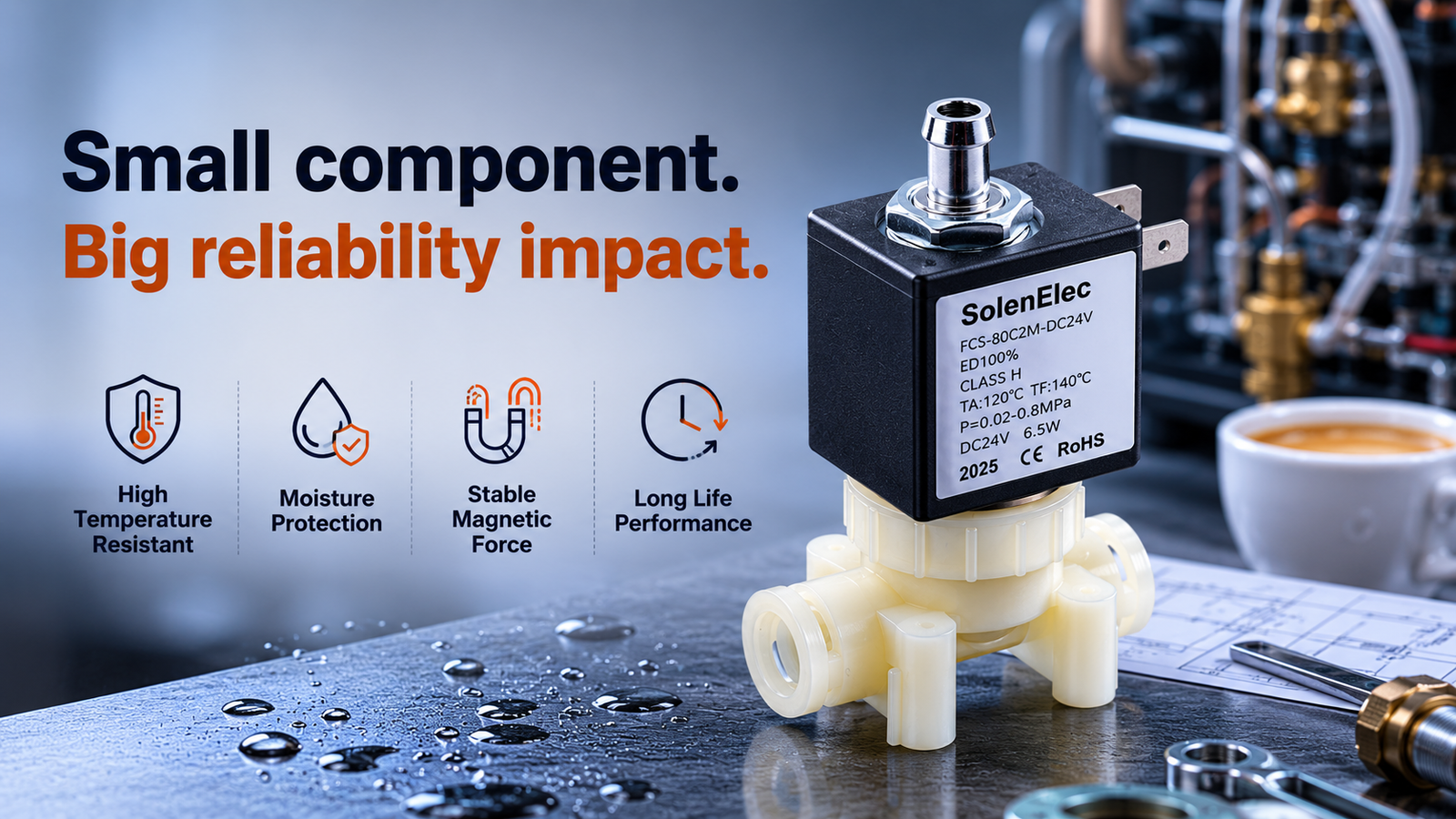
We purchased and analyzed a Parker 3-way valve to better understand the engineering priorities behind successful espresso machine designs. We did not approach the project as an exercise in copying geometry. Instead, we studied how compact integration, maintenance access, magnetic stability, material selection, and manufacturability work together over a long product lifecycle.
Parker is a trademark of its respective owner. We refer to Parker only for technical evaluation and supplier-comparison purposes. We recommend that every OEM complete application-specific engineering validation before approving any alternative valve.
Why Do Espresso Machine OEMs Look Beyond Parker Solenoid Valves?
Espresso machine OEMs rarely consider a second source because an established valve suddenly stops working. They usually face pressure from rising costs, long lead times, regional supply risk, limited customization, or new machine requirements. A poor second-source decision, however, can turn a purchasing improvement into years of warranty and service problems.
OEMs look beyond Parker solenoid valves to reduce supply concentration, improve commercial flexibility, obtain application-specific customization, and secure better regional support. However, the objective should not be to find a dimensionally similar valve. The objective should be to qualify a supplier that can assume comparable responsibility for reliability, continuity, documentation, and field support.

Second sourcing is usually a risk decision
We believe that Parker’s greatest competitive advantage is not one technical feature. Its real advantage is decades of proven field performance that reduce uncertainty for OEMs.
A purchasing team can compare quoted prices within an afternoon. An engineering team cannot establish ten years of operating history within the same period. That difference explains why established suppliers retain their position even when another valve looks similar on paper.
In our discussions around OEM projects, we often see procurement teams balance five objectives:
- Supply continuity: The OEM wants protection against shortages, allocation, and excessive lead times.
- Commercial leverage: The OEM wants a healthier negotiating position without sacrificing quality.
- Customization: The OEM may need a different connector, coil voltage, mounting arrangement, seal, or flow characteristic.
- Regional support: The OEM may need faster communication and shorter logistics routes.
- Lifecycle availability: The OEM wants valves, coils, and service parts to remain available for installed machines.
These objectives are reasonable. However, we think buyers should distinguish between price diversification and risk diversification. A lower-cost supplier does not reduce risk if its batch control is weak or its engineering records are incomplete.
OEMs are buying more than a valve
In our view, an espresso machine manufacturer buys an operating system around the component. That system includes:
- Operating history
- Maintenance experience
- Technical support
- Spare-part availability
- Supply continuity
- Change-control discipline
- Traceable quality records
The most important question is not, “Can this valve pass today’s bench test?”
The better question is:
Will this valve still perform consistently after five years in cafés?
A commercial machine can face frequent thermal cycling, variable water chemistry, scale accumulation, cleaning chemicals, vibration, moisture, and repeated switching. Field technicians also need to diagnose and replace components quickly. A small design or material difference can therefore affect both machine uptime and service cost.
We advise buyers to create a clear second-source strategy before requesting quotations. The strategy should define whether the alternative will serve as an emergency backup, a regional source, a cost-reduction source, or a fully interchangeable production source. Each role requires a different level of testing, documentation, capacity, and inventory planning.
What Really Matters Beyond the Datasheet for Parker Solenoid Valve Alternatives?
A datasheet gives engineers a necessary starting point, but it does not show every source of field failure. Two valves can share the same envelope, voltage, nominal pressure, and connection size while behaving differently after thermal aging, scale exposure, repeated cycling, or normal production variation.
OEMs should evaluate magnetic margin, seal behavior, wetted materials, thermal performance, scale sensitivity, corrosion resistance, manufacturing capability, batch consistency, traceability, and maintenance access. We consider these factors more important than nominal dimensional equivalence because they determine whether Parker solenoid valve alternatives remain stable in real machines rather than only under controlled laboratory conditions.

Geometry is only the visible layer
We believe reproducing geometry is relatively straightforward. Reproducing long-term consistency is the real engineering challenge.
When we analyzed a Parker 3-way valve, we focused on the engineering priorities behind the design rather than simply recording dimensions. We observed several areas that deserve close attention:
- Compact integration within a crowded machine
- Practical access for installation and maintenance
- A stable magnetic circuit
- Appropriate material selection
- Designs that support repeatable manufacturing
- Interfaces that reduce assembly variation
- A structure that technicians can understand and service
A dimensional scan cannot fully explain why a valve remains reliable. The supplier must also understand the relationships among the coil, plunger, spring, guide tube, seals, valve seat, flow path, and surrounding machine conditions.
Magnetic performance needs operating margin
A coil can actuate successfully at nominal voltage during an initial test but still have insufficient margin at elevated temperature or reduced supply voltage. Copper winding resistance rises as temperature increases1, which changes current and magnetic force. Component tolerances can further reduce the available actuation margin.
We suggest that OEM engineers evaluate at least the following conditions:
| Evaluation area | Basic datasheet check | More useful OEM question |
|---|---|---|
| Voltage | Rated voltage matches | Does the valve actuate at voltage limits when hot? |
| Power | Nominal wattage matches | Is coil temperature stable inside the actual machine? |
| Pressure | Rated pressure appears adequate | Does the valve switch reliably at worst-case differential pressure? |
| Flow | Nominal flow is acceptable | Does flow remain stable after scale and lifecycle testing? |
| Insulation | Insulation class is listed | Has the complete coil system been validated under heat and humidity? |
| Leakage | Initial leakage passes | Does leakage remain controlled after cycling and contamination exposure? |
| Dimensions | Envelope fits | Do interfaces, tolerances, and service access remain compatible? |
The OEM should define acceptable limits from the actual machine design. A valve supplier should not choose universal limits without understanding the application.
Water quality changes the failure mechanism
Commercial espresso machines do not operate with one globally consistent water condition. Mineral content, filtration practices, chloride levels, cleaning routines, and service intervals vary by region and café.2
Scale can restrict movement, alter sealing surfaces, or reduce flow.3 Corrosion can affect wetted components and moving interfaces.4 Fine particles can settle around seats or guides. Cleaning chemicals can also interact with elastomers and plastics.5
For this reason, we advise buyers to request a wetted-material declaration and review it with a qualified materials or compliance professional. The review should consider:
- Potable-water requirements in the destination market
- Maximum water and steam temperatures
- Cleaning and descaling chemicals
- Seal compatibility
- Dezincification or corrosion risk where applicable
- Restricted-substance requirements
- Taste and odor considerations
- Local food-contact or drinking-water rules
A certificate logo alone does not answer these questions. Buyers should verify the certificate holder, product scope, standard edition, validity period, and model coverage directly with the issuing body when possible.
What Do We Believe OEM Engineers Should Test Before Switching Suppliers?
A short functional test can confirm that a sample opens and closes, but it cannot prove production readiness. OEM engineers need a validation plan that combines application testing, accelerated endurance, environmental exposure, dimensional studies, and production-lot comparisons. Otherwise, a successful prototype can create false confidence.
Before switching suppliers, we believe OEMs should test valves in the real machine, across expected voltage, pressure, temperature, and water conditions. They should also compare multiple production lots, measure leakage and actuation margin before and after endurance testing, verify material documentation, and audit the supplier’s process control, traceability, and change-management systems.
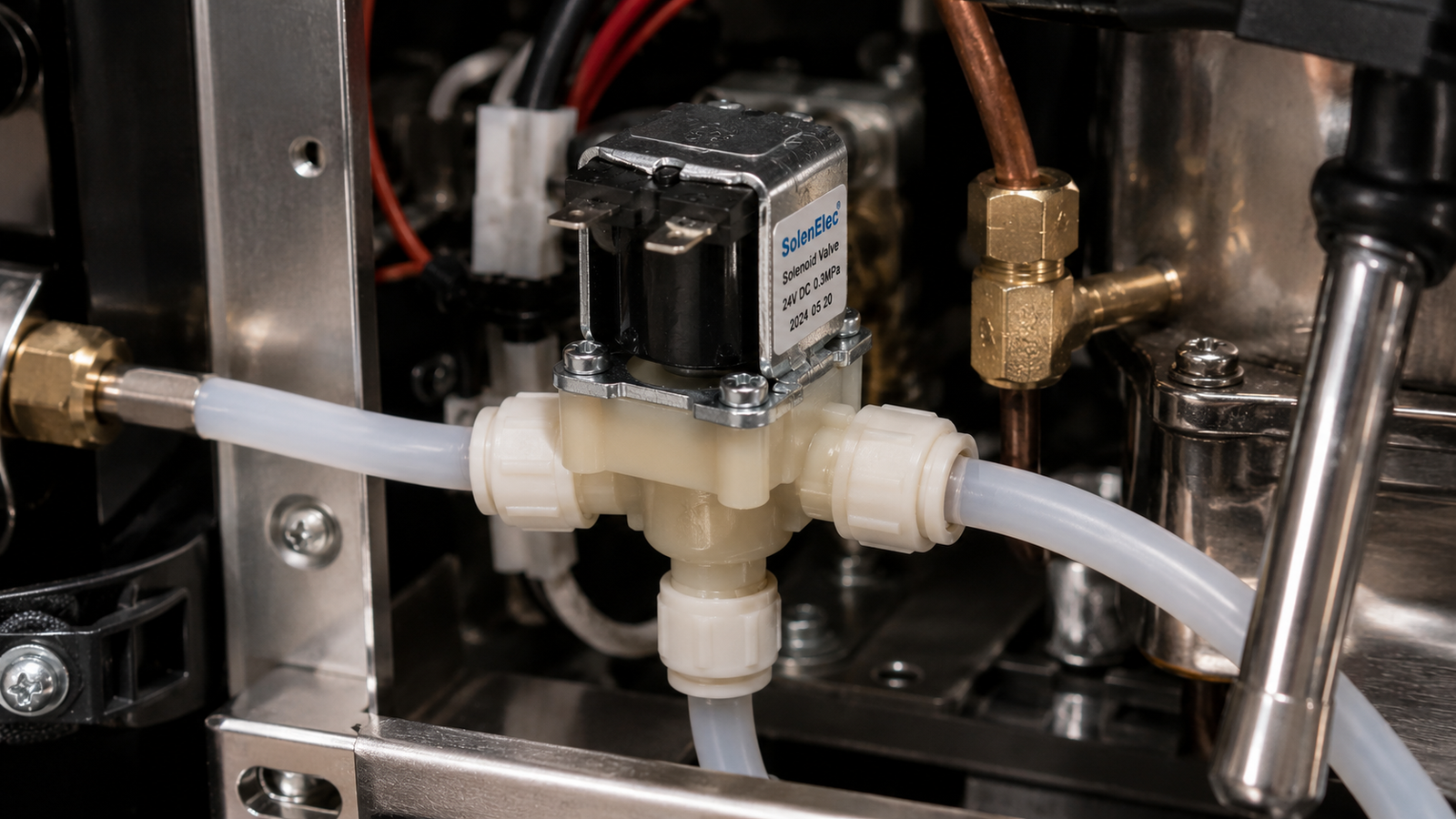
Start with an application risk assessment
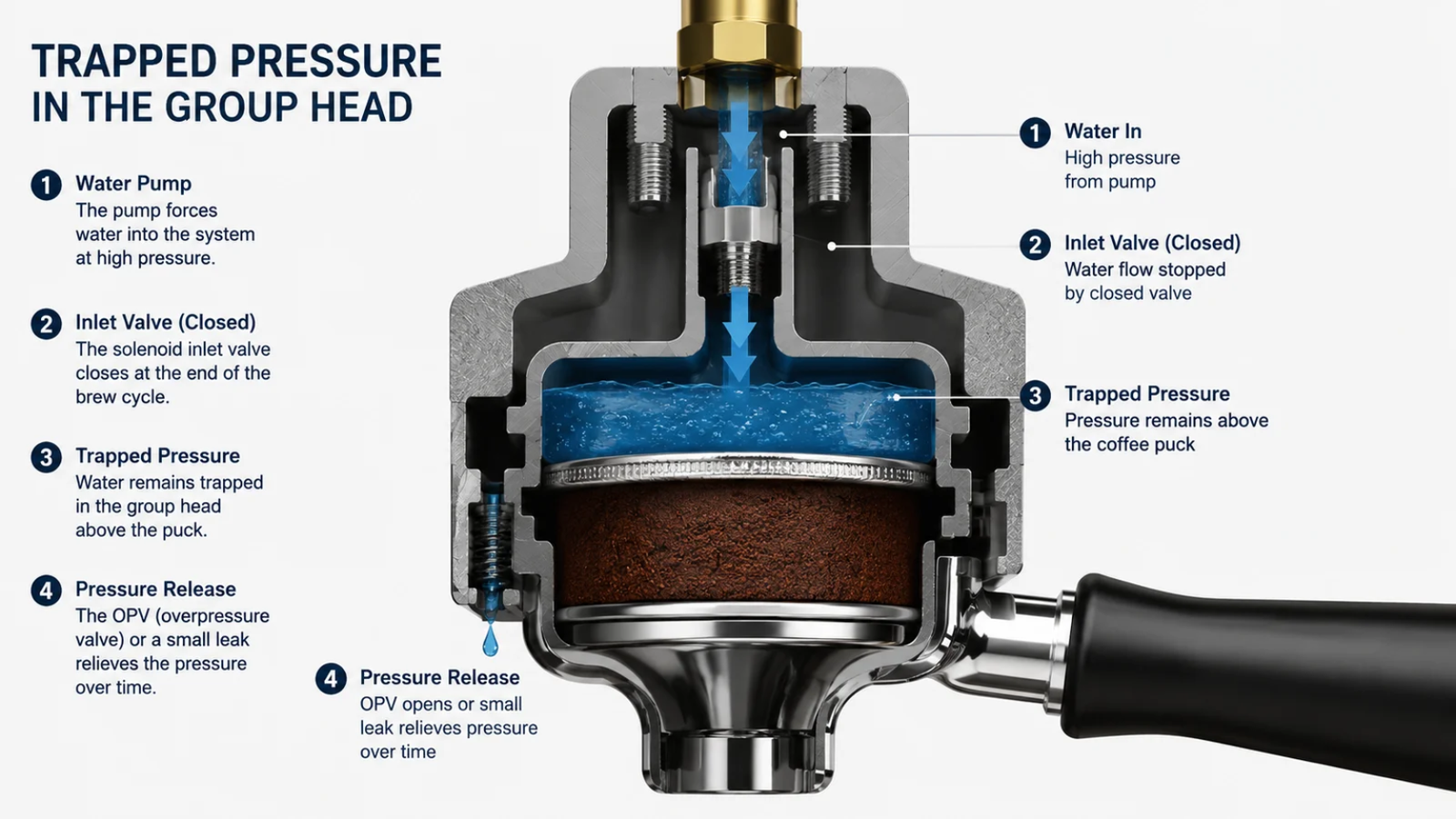
We would begin by documenting the valve’s exact function. A 3-way valve used to control brewing and release pressure has different risks from a fill valve or a steam-related valve. The validation team should understand what happens if the component fails open, fails closed, leaks internally, leaks externally, or switches slowly.
A useful risk review should cover:
- Safety consequences
- Brewing consistency
- Pressure-release behavior
- Water leakage
- Coil overheating
- Machine downtime
- Technician access
- Warranty cost
- Brand reputation
The OEM can use a design or process failure mode and effects analysis, commonly called DFMEA or PFMEA, to rank these risks.6 The method should guide test severity rather than become a paperwork exercise.
Test beyond nominal conditions
We recommend that the OEM create a test matrix around actual design limits. The values should come from the machine’s electrical, hydraulic, and thermal architecture.
| Test category | Suggested evaluation |
|---|---|
| Functional baseline | Opening, closing, flow, leakage, response, sound, and pressure release |
| Voltage tolerance | Actuation at specified low and high voltage limits |
| Thermal behavior | Coil temperature rise inside the most thermally demanding machine configuration |
| Pressure range | Switching and sealing at minimum and maximum differential pressure |
| Endurance | Repeated cycling under representative load, temperature, and fluid conditions |
| Scale exposure | Testing with controlled mineral conditions relevant to target markets |
| Chemical compatibility | Exposure to approved cleaning and descaling procedures |
| Corrosion resistance | Review and testing based on materials, environment, and regional water |
| Environmental exposure | Humidity, storage, transport, and thermal cycling where applicable |
| Service evaluation | Removal, replacement, connector access, and technician error risks |
We do not believe that one universal cycle count can prove suitability for every espresso machine.7 A high-use commercial platform and a light-duty machine have different operating profiles. The OEM should translate expected daily cycles, duty patterns, and intended service life into a justified validation target. The test should also include pauses, heat soak, and realistic pressure conditions rather than rapid unloaded cycling alone.
Compare multiple lots, not hand-picked samples
From our manufacturing experience, consistency between production batches is often more difficult—and more valuable—than excellent performance in a single prototype.
A supplier can carefully build ten engineering samples. The more revealing question is whether normal production can hold critical parameters over many months.
We recommend evaluating samples from at least three independently produced lots during supplier qualification when project timing allows. The engineering team should examine:
- Critical dimensions and tolerances
- Coil resistance distribution
- Insulation and dielectric performance
- Actuation voltage or current margin
- Leakage distribution
- Flow variation
- Plunger movement
- Spring characteristics
- Seal and plastic lot traceability
- Visual and assembly defects
The OEM should agree on critical-to-quality characteristics and measurement methods before production approval. The supplier should also present process capability data where the measurement system and sample size support a meaningful conclusion.8
At SolenElec, we use automated processes, controlled production, outgoing inspection, ISO 9001-based sampling practices, and MES-supported traceability within our manufacturing system. However, we still encourage buyers to verify factory controls through audits, records, trial orders, and independent application testing. We regard certificates and system descriptions as evidence to examine, not substitutes for engineering validation.
What Are the Common Mistakes When Comparing Solenoid Valve Suppliers?
Supplier comparisons often become too dependent on unit price, sample performance, certification lists, and matching dimensions. These criteria are easy to place in a spreadsheet, but they can hide more important differences. Weak assumptions during sourcing can later appear as leakage, unstable actuation, delayed deliveries, or difficult field repairs.
The most common mistakes include comparing only nominal specifications, approving one prototype lot, ignoring water chemistry and thermal conditions, accepting certificates without verification, overlooking change control, and calculating only purchase price. OEMs should compare total lifecycle risk, manufacturing consistency, technical support, spare-part strategy, and the supplier’s ability to manage deviations transparently.
Mistake 1: Treating interchangeability as dimensional equivalence
A valve can fit the same space and still differ in flow behavior, response time, pressure release, connector retention, thermal performance, or service access. Small tolerance differences can also affect tube alignment, seals, brackets, and nearby components.
We advise OEMs to define interchangeability at four levels:
- Mechanical: Envelope, ports, threads, brackets, and interfaces fit.
- Electrical: Voltage, power, connector, insulation, and control compatibility match.
- Functional: Flow, leakage, actuation, pressure release, and duty behavior meet requirements.
- Lifecycle: Endurance, maintenance, availability, and batch consistency support the machine platform.
A candidate should not receive “drop-in replacement” status until it passes all relevant levels.
Mistake 2: Believing one excellent sample represents production
Prototype teams can select ideal materials, adjust tooling, and inspect every part closely. Normal production introduces more variation.9 Different material lots, winding heads, molds, operators, and assembly stations can shift performance.
We ask buyers to examine the supplier’s control plan, not only its sample. The review should include:
- Incoming material inspection
- Approved material and sub-supplier lists
- Winding parameter control
- Injection-molding control
- Assembly poka-yoke or error prevention
- In-process testing
- Final inspection
- Nonconformance handling
- Calibration records
- Lot traceability
- Engineering change approval
Mistake 3: Accepting certification claims at face value
A supplier may state compliance with CE, UL, RoHS, REACH, TÜV, CB, IEC, or an ISO management standard. However, these references do not all mean the same thing. Some apply to products, some apply to materials or substances, and others apply to management systems or specific tested configurations.10
We recommend that procurement teams request the underlying documents. They should verify:
- The exact legal entity and manufacturing site
- The covered model or product family
- The applicable standard and edition
- Any conditions or limitations
- The issuing laboratory or certification body
- The certificate’s current status
- Whether customization changes the approved configuration
SolenElec works with international compliance requirements, but we believe each customer must confirm which documents apply to its final machine and destination markets. Qualified compliance professionals should review application-specific obligations.
Mistake 4: Comparing price instead of total cost
The valve’s purchase price represents only one part of its commercial impact.11 A lower-cost valve can become expensive when it causes technician visits, machine downtime, expedited freight, additional inventory, or brand damage.
| Cost area | Often visible during sourcing? | Potential lifecycle effect |
|---|---|---|
| Unit price | Yes | Immediate material cost |
| Validation | Sometimes | Engineering time and test equipment |
| Assembly variation | Often missed | Rework and line stoppage |
| Warranty claims | Delayed | Parts, labor, logistics, and customer dissatisfaction |
| Field service | Delayed | Technician time and machine downtime |
| Supply interruption | Underestimated | Expediting, redesign, and lost production |
| Spare parts | Underestimated | Service continuity over the machine lifecycle |
We therefore prefer a total cost of ownership comparison. That analysis does not automatically favor the highest-priced supplier. It favors the supplier that provides the strongest combination of cost, evidence, consistency, and accountability.
How Should OEMs Choose the Right Valve Partner for Long-Term OEM Projects?
A long-term valve project requires more than a responsive salesperson and an attractive sample. OEMs need a partner that can convert application requirements into controlled production, communicate technical risks, preserve records, manage changes, and support the machine after launch. Without these capabilities, early savings can disappear quickly.
OEMs should choose a valve partner by evaluating engineering depth, manufacturing control, traceability, capacity, compliance documentation, change management, service support, and financial supply continuity. We believe a credible Parker alternative must demonstrate that it can repeatedly manufacture the approved design and accept responsibility throughout development, mass production, and aftermarket support.

We look for evidence of engineering ownership
A capable supplier should ask detailed questions before recommending a design. If a supplier quotes immediately without discussing the machine, we see that behavior as a warning sign.
The supplier should ask about:
- Valve function and hydraulic circuit
- Working fluid and water quality
- Normal and maximum temperatures
- Pressure and differential pressure
- Voltage tolerance and control method
- Duty cycle and switching frequency
- Installation position
- Available space and nearby heat sources
- Connector and wiring requirements
- Target markets and compliance requirements
- Expected annual volume
- Intended machine service life
- Maintenance and spare-part strategy
These questions show that the supplier understands the difference between selling a component and supporting an application.
Manufacturing systems must support repeatability
At SolenElec, our perspective comes from more than 20 years of OEM and ODM solenoid and coil manufacturing. We operate eight production lines and support customized projects with in-house engineering, coil design, material selection, tooling, winding, and precision injection-molding capabilities.
Our experience has taught us that a stable design can still fail commercially if the process is unstable. We therefore focus on incoming material control, production controls, testing, outgoing inspection, and MES-supported traceability.
However, we encourage OEMs to inspect these systems rather than rely on our description. A serious supplier evaluation should include:
- A technical capability review
- A manufacturing-process audit
- A quality-system and document review
- A controlled pilot build
- Multi-lot validation
- Capacity and contingency planning
- A change-control agreement
- A production-part approval process where appropriate
Change control protects the approved performance
A supplier may change copper wire, elastomers, plastics, machining sources, tooling, lubricants, or assembly processes for practical reasons. Even a seemingly minor change can influence thermal behavior, chemical resistance, leakage, or magnetic performance.12
We recommend that the commercial agreement define which changes require written OEM approval. The agreement should also define notification periods, validation responsibilities, last-time-buy options, and record-retention requirements.
Long-term support should be measurable
We believe buyers should convert general promises into measurable commitments. A supplier scorecard can include:
- On-time delivery
- Lot acceptance rate
- Corrective-action response time
- Engineering response time
- Traceability completeness
- Unapproved change incidents
- Capacity utilization
- Lead-time stability
- Spare-part availability
- Annual cost-improvement activity
The supplier should also provide a realistic continuity plan. That plan can cover critical tooling, alternative equipment, safety stock, key sub-suppliers, utility interruption, and disaster recovery.
A credible alternative does not need to claim that it has “copied Parker.” In fact, we would avoid that statement. We believe the correct approach is to understand the engineering priorities of proven espresso machine valves and then develop a controlled solution around the OEM’s actual requirements.
Frequently Asked Questions
Can an alternative valve be a direct drop-in replacement for a Parker valve?
An alternative may be mechanically interchangeable, but the OEM must also verify electrical compatibility, flow, leakage, pressure-release behavior, thermal performance, endurance, maintenance access, and compliance. We would not call a valve a direct replacement based only on its dimensions, port pattern, coil voltage, or initial bench performance.
How long should an OEM test an espresso machine solenoid valve?
The correct duration depends on the machine’s duty cycle, expected service life, operating temperature, pressure, water quality, and failure consequences. We recommend a justified lifecycle test rather than one universal cycle count. The OEM should combine endurance testing with heat, pressure, scale, contamination, and multi-lot evaluation.
Which materials are best for espresso machine valves?
No single material combination suits every machine. The OEM should select metals, plastics, elastomers, and insulation systems according to temperature, pressure, water chemistry, cleaning chemicals, food-contact obligations, and expected life. A qualified materials or compliance professional should review the complete wetted-material system.
Should procurement approve a supplier based on certificates?
No. Certificates can support supplier qualification, but buyers should verify their scope, validity, covered models, manufacturing entity, and issuing body. The OEM should also audit process controls and conduct product testing. A quality-management certificate does not prove that a particular valve is suitable for a specific espresso machine.
What is the biggest risk when changing valve suppliers?
We consider hidden production variation the biggest risk. A prototype may perform well while later batches show different resistance, actuation margin, leakage, flow, or material behavior. Multi-lot testing, traceability, process audits, critical-characteristic controls, and formal change management help reduce this risk.
Conclusion
Parker solenoid valve alternatives should not be selected as simple geometric substitutes. We believe OEMs are buying operating history, maintenance knowledge, technical support, spare-part availability, and supply continuity along with the valve itself. Parker’s strength comes largely from proven field confidence, and a new supplier must earn similar trust through evidence.
At SolenElec, we focus on repeatable manufacturing, engineering customization, traceability, and lifecycle thinking. If your team is evaluating an espresso machine valve or coil second source, contact us to discuss your application requirements, validation plan, and supplier qualification process.
"Solenoid", https://en.wikipedia.org/wiki/Solenoid. An electrical engineering reference on conductor temperature coefficients supports that copper resistance increases with temperature, which can reduce current in a fixed-voltage coil; the source establishes the electrical mechanism rather than testing the specific valve discussed here. Evidence role: mechanism; source type: education. Supports: Copper conductors have a positive temperature coefficient of resistance, so coil current can decrease as temperature rises under a fixed voltage.. Scope note: Contextual support for the mechanism, not direct validation of a Parker or alternative espresso-machine valve. ↩
"Variation in Tap Water Mineral Content in the United Kingdom - PMC", https://pmc.ncbi.nlm.nih.gov/articles/PMC9457372/. WHO guidance on drinking-water quality documents that constituents such as hardness minerals and chloride vary among water supplies and can be relevant to scaling, taste, and corrosion; this supports treating water chemistry as a site-dependent variable, although it does not address café cleaning routines directly. Evidence role: general_support; source type: institution. Supports: Drinking-water hardness, mineral content, and chloride levels vary by source and geography and can influence scaling or corrosion concerns.. Scope note: Supports regional water-chemistry variation, but not the café-specific service-interval claim. ↩
"How Does a 3-Way Solenoid Valve Perform in Real Café Conditions ...", https://solenelec.com/how-does-a-3-way-solenoid-valve-perform-in-real-cafe-conditions-why-do-lab-tests-lie/. Research on mineral scaling in water systems shows that calcium carbonate deposits can accumulate on wetted surfaces and restrict flow paths; this supports the stated valve-failure mechanism by analogy, though the cited work may not test espresso-machine solenoid valves specifically. Evidence role: mechanism; source type: paper. Supports: Calcium carbonate or mineral scale deposition can reduce hydraulic passage area and interfere with moving or sealing surfaces in water-handling components.. Scope note: Mechanistic support for scale effects in water systems, not direct proof for the exact valve geometry. ↩
"Galvanic corrosion", https://en.wikipedia.org/wiki/Galvanic_corrosion. Corrosion-engineering literature describes how aqueous corrosion, including chloride-influenced attack, can degrade wetted metallic surfaces and impair component function; this supports corrosion as a plausible valve risk, although material-specific behavior depends on the alloy and water chemistry. Evidence role: mechanism; source type: research. Supports: Corrosion can damage wetted metallic surfaces and affect the function of valve seats, guides, and moving interfaces.. Scope note: Contextual mechanism; alloy and application details must be verified separately. ↩
"Natural rubber", https://en.wikipedia.org/wiki/Natural_rubber. Polymer-compatibility research documents that elastomers and plastics may experience swelling, embrittlement, or chemical degradation after exposure to incompatible liquids; this supports the need to review cleaning and descaling chemicals, while compatibility remains material- and formulation-specific. Evidence role: mechanism; source type: paper. Supports: Elastomers and plastics can swell, harden, crack, or otherwise degrade when exposed to incompatible chemicals.. Scope note: General polymer mechanism, not a compatibility verdict for any specific seal compound. ↩
"Failure mode and effects analysis", https://en.wikipedia.org/wiki/Failure_mode_and_effects_analysis. Institutional guidance on Failure Mode and Effects Analysis describes FMEA as a systematic method for identifying potential failure modes, evaluating their effects, and prioritizing risk-reduction actions; this supports the use of DFMEA or PFMEA in supplier qualification, although industry-specific scoring rules may differ. Evidence role: definition; source type: institution. Supports: FMEA methods are used to identify potential failure modes and assess their effects so that risks can be prioritized for action.. Scope note: Defines and contextualizes FMEA; it does not prescribe a valve-specific test plan. ↩
"Why Do Some Solenoid Valves Last Longer? Engineering Factors ...", https://solenelec.com/why-do-some-solenoid-valves-last-twice-as-long-a-field-technicians-perspective/. Reliability-engineering sources on life testing and accelerated testing emphasize that test conditions and duration should be derived from expected use stresses and duty profiles; this supports the article’s rejection of a universal cycle count, though it does not establish a specific espresso-machine cycle target. Evidence role: expert_consensus; source type: research. Supports: Reliability or endurance testing is typically designed around expected use conditions, stresses, duty cycles, and target life rather than a universal cycle number.. Scope note: Supports the validation principle, not a numerical acceptance criterion. ↩
"6.1.6. What is Process Capability? - Information Technology Laboratory", https://www.itl.nist.gov/div898/handbook/pmc/section1/pmc16.htm. NIST guidance on process capability and measurement quality indicates that capability estimates depend on valid measurements and adequate process data; this supports requiring measurement-system and sample-size justification, while exact thresholds depend on the selected method and industry standard. Evidence role: expert_consensus; source type: government. Supports: Capability indices and process conclusions depend on reliable measurement systems and sufficient data.. Scope note: Supports the statistical principle, not a specific sample-size rule for solenoid valves. ↩
"Why Do Some Solenoid Valves Last Longer? Engineering Factors ...", https://solenelec.com/why-do-some-solenoid-valves-last-twice-as-long-a-field-technicians-perspective/. NIST engineering-statistics guidance explains that manufacturing processes exhibit measurable variation and that process-control methods are used to monitor and manage it; this supports the concern that prototype samples may not represent normal production, although it does not evaluate solenoid-valve factories specifically. Evidence role: general_support; source type: government. Supports: Manufacturing processes exhibit variation across parts and lots, requiring statistical monitoring and process control.. Scope note: General manufacturing-quality support, not valve-specific evidence. ↩
"CE-Kennzeichnung", https://de.wikipedia.org/wiki/CE-Kennzeichnung. European Commission and ISO materials distinguish product conformity requirements, substance restrictions, and management-system certification, supporting the article’s claim that compliance references differ in scope; the sources explain regulatory categories rather than assessing any supplier’s certificate. Evidence role: definition; source type: government. Supports: Regulatory marks, substance rules, product certifications, and management-system standards have different scopes and should not be treated as interchangeable.. Scope note: Scope clarification only; certificate validity must be checked case by case. ↩
"Life Cycle Cost (LCC) | www.waru.edu", https://www.waru.edu/acquipedia-article/life-cycle-cost-lcc. Government lifecycle-cost guidance defines cost evaluation as including acquisition and downstream operating or maintenance costs, supporting the article’s point that purchase price is only one part of commercial impact; the guidance is general procurement methodology rather than a solenoid-valve cost study. Evidence role: definition; source type: government. Supports: Lifecycle cost or total cost of ownership includes acquisition, maintenance, operation, downtime, logistics, and other costs beyond purchase price.. Scope note: General TCO framework, not quantified evidence for espresso machines. ↩
"Engineering change order", https://en.wikipedia.org/wiki/Engineering_change_order. Quality-management and configuration-control standards require organizations to review and control changes that may affect product conformity, supporting the article’s warning that material or process changes can alter performance; the standards establish the control principle rather than proving a specific thermal, leakage, or magnetic failure. Evidence role: expert_consensus; source type: institution. Supports: Quality-management and configuration-control standards require control of changes because changes can affect product conformity and performance.. Scope note: Supports the need for change control generally, not the effect of a named change. ↩