How Automotive-Grade Solenoid Coils Improve System Reliability?
Your premium product is failing, hurting your brand's reputation. You hear "automotive-grade" might be the solution, but is the higher cost justified? The answer is not a simple yes.
An automotive-grade coil improves reliability by withstanding extreme temperatures, vibration, and moisture. However, for most non-automotive applications, the real benefit comes from an IATF 16949-certified supplier whose manufacturing processes provide superior consistency and lower defect rates1 without the over-engineered, high-cost component.
I’ve had this exact conversation with procurement managers at top European brands for over 20 years. They see a spike in warranty claims on a new appliance and want a quick fix. They ask if they need an expensive automotive-grade coil for their new premium coffee machine. My answer often surprises them. As an OEM partner from an IATF 16949-certified manufacturer, I tell them the secret isn't always in the part itself, but in the discipline of the process that made it. The lessons we’ve learned from the brutal demands of the automotive world can transform reliability for any industry, and I want to show you how.
What Makes a Solenoid Coil "Automotive-Grade"? Key Engineering Standards?
You hear the term "automotive-grade," but what does that really mean? Without clear definitions, it's just marketing talk that can trick you into paying for features you don't need.
An automotive-grade solenoid coil is defined by its compliance with strict quality standards like IATF 16949. This means it is engineered for extreme temperature ranges (-40°C to 150°C)2, high vibration, and a long life under harsh conditions that far exceed typical commercial requirements.
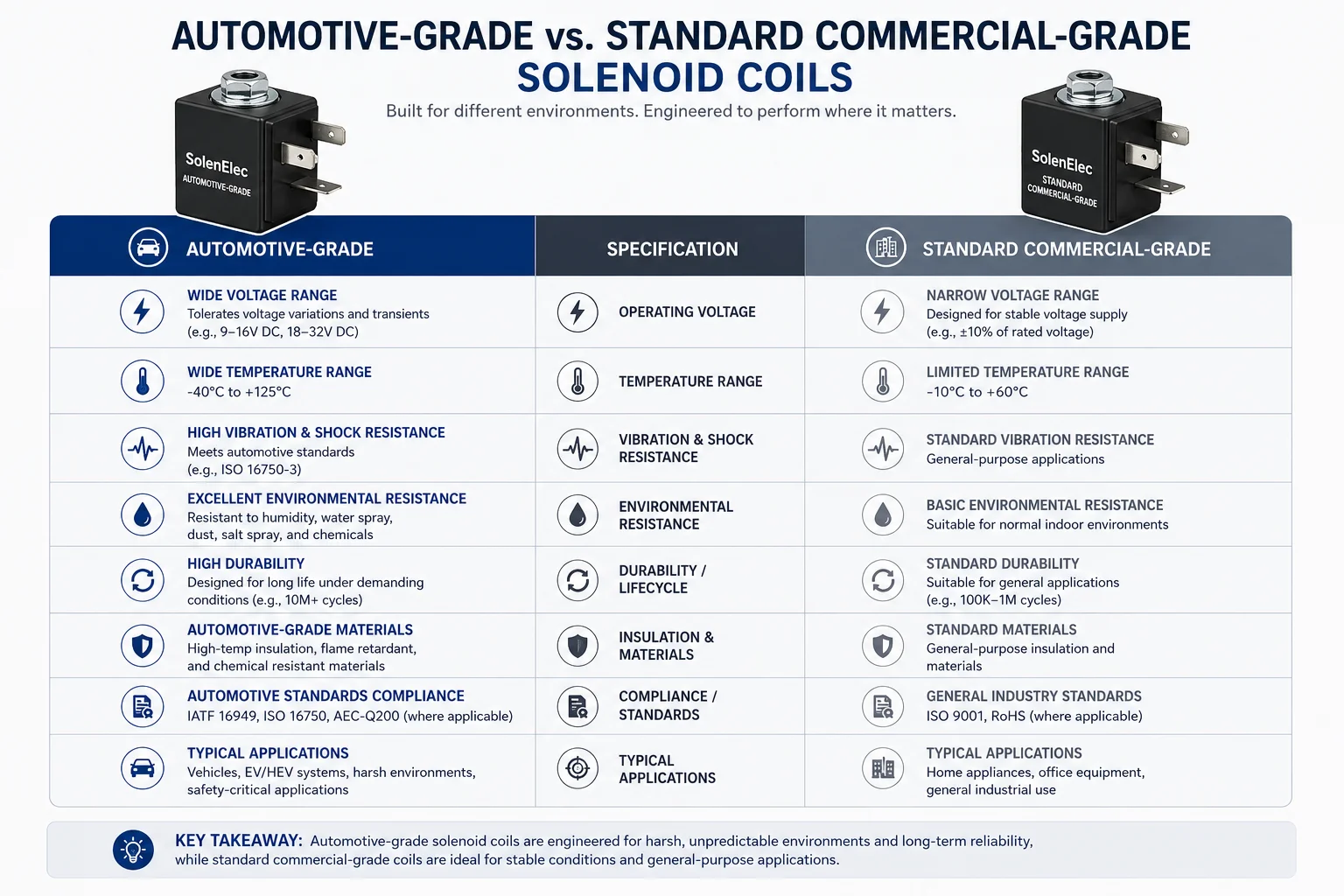
At our company, we are IATF 16949 certified. This isn't just a certificate we hang on the wall; it’s a completely different philosophy of manufacturing. It forces a level of precision, traceability, and process control that is worlds apart from standard manufacturing. To put it in perspective, let’s look at what these parts are designed to handle.
| Parameter | Automotive-Grade | Standard Commercial Grade |
|---|---|---|
| Operating Temperature | -40°C to 150°C | 0°C to 85°C |
| Vibration Resistance | 10-15G | < 2G |
| Target Lifespan | 15+ years / 300k+ cycles | 5-10 years / 50k cycles |
| Target Failure Rate | < 1 PPM (Parts Per Million) | 100+ PPM |
The numbers speak for themselves. A part in a car's engine bay must work perfectly whether you're starting it in the arctic cold or sitting in traffic on a scorching day. It has to endure constant vibration from the engine and bumps in the road for over a decade. A home appliance simply does not face these same extremes. The real takeaway is not that you should put a car part in your coffee machine. The secret is that an IATF 16949 certified supplier applies this rigorous process discipline—like using MES for part-level traceability and automated optical inspection—to all our production lines. You get the benefit of automotive reliability without paying for a part that’s built for a war zone.
Thermal Management in Extreme Environments: How Automotive Coils Prevent Heat Failure?
Your product operates in a hot space, and coil failures are a worry. A single overheating event can cause a system shutdown and lead to expensive warranty claims for your brand.
Automotive coils prevent heat failure through superior materials and design. They use high-temperature wire insulation, heat-resistant plastics, and advanced thermal modeling to ensure stable performance from -40°C to over 150°C. This prevents material degradation and ensures long-term reliability in harsh environments.
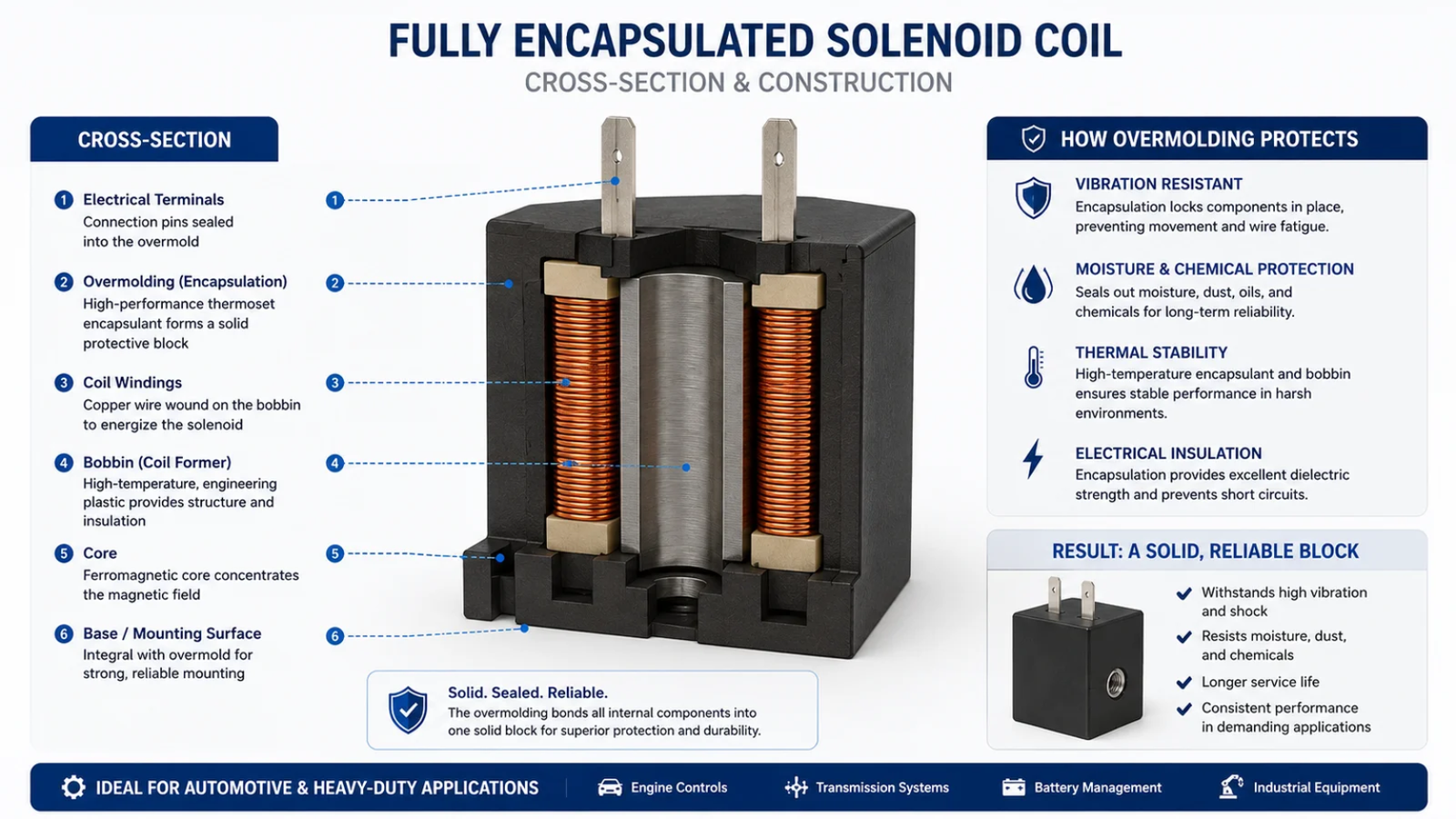
I was talking with a brand manager for a line of high-end commercial ovens. They were having issues with solenoid valves failing when installed too close to the oven cavity. The heat was simply too much for their standard coils. This is a classic thermal management problem. Automotive engineering solves this with a multi-layered approach.
Advanced Materials
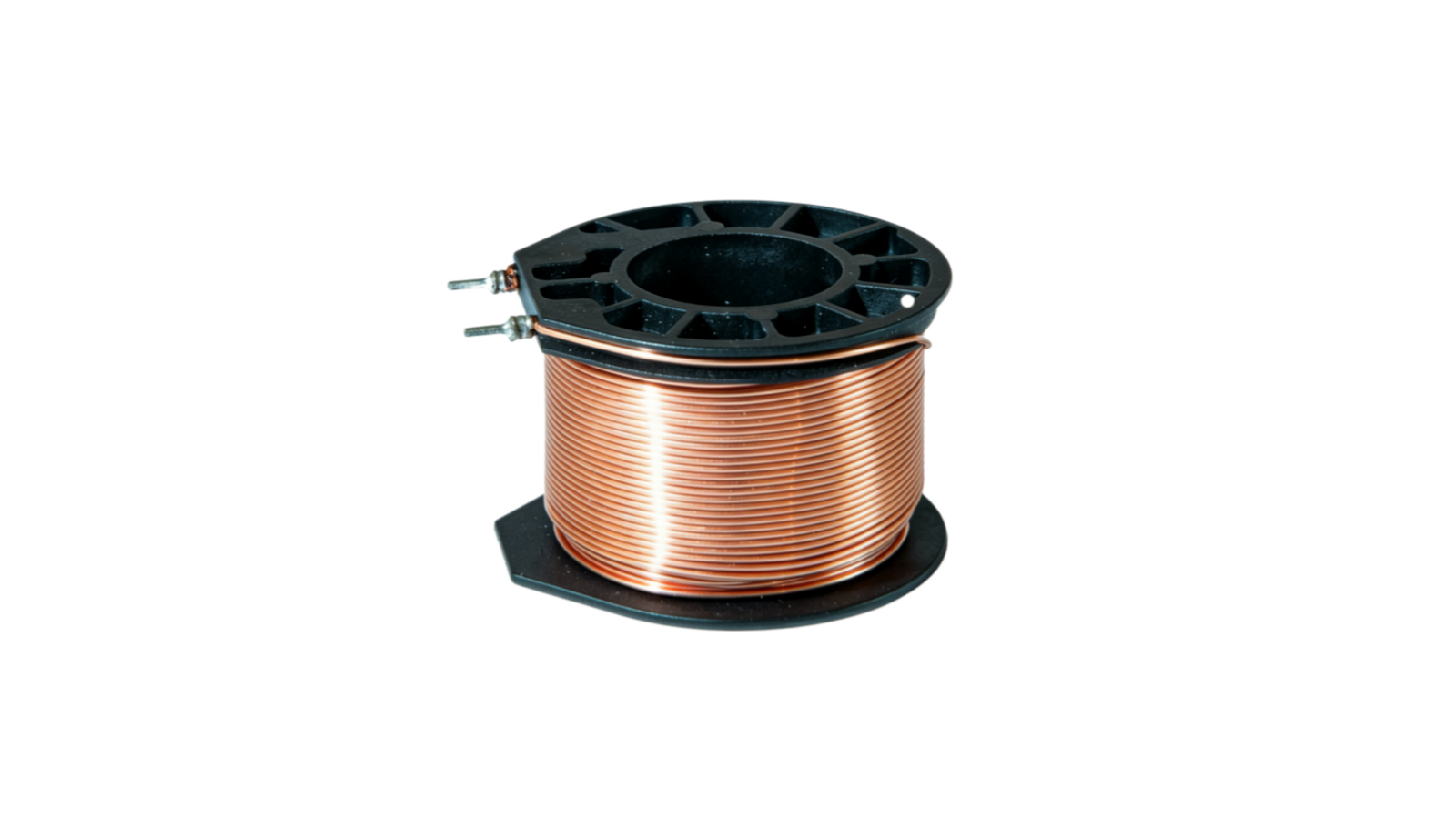
First, we look at the magnet wire itself. A standard coil might use Class F insulation, which is rated for 155°C3. For an automotive part, we often start with Class H (180°C) or even Class N (200°C) insulation4. This provides a huge safety margin. Next is the bobbin, the plastic frame the wire is wound on. We can't use standard nylon or PBT. We must use high-performance polymers like PPS or PEEK, which maintain their structural integrity and don't outgas at very high temperatures5.
Smart Design
The materials are only half the story. The coil’s design is also critical for dissipating heat. The encapsulation material used in the final overmolding step must not only protect the coil but also efficiently conduct heat away from the windings. We use thermal modeling software during the design phase to simulate how the coil will perform under load and identify potential hot spots6 before we ever make a physical part. This level of analysis, driven by automotive requirements, means we can build a coil that will remain stable and reliable for years, even when things get hot.
Vibration Resistance and Durability: Overcoming the Hardest On-Road Challenges?
Your equipment is subject to constant shaking, shipping impacts, or operational movement. This vibration can cause tiny internal wires to break, leading to frustrating, intermittent failures that are hard to diagnose.
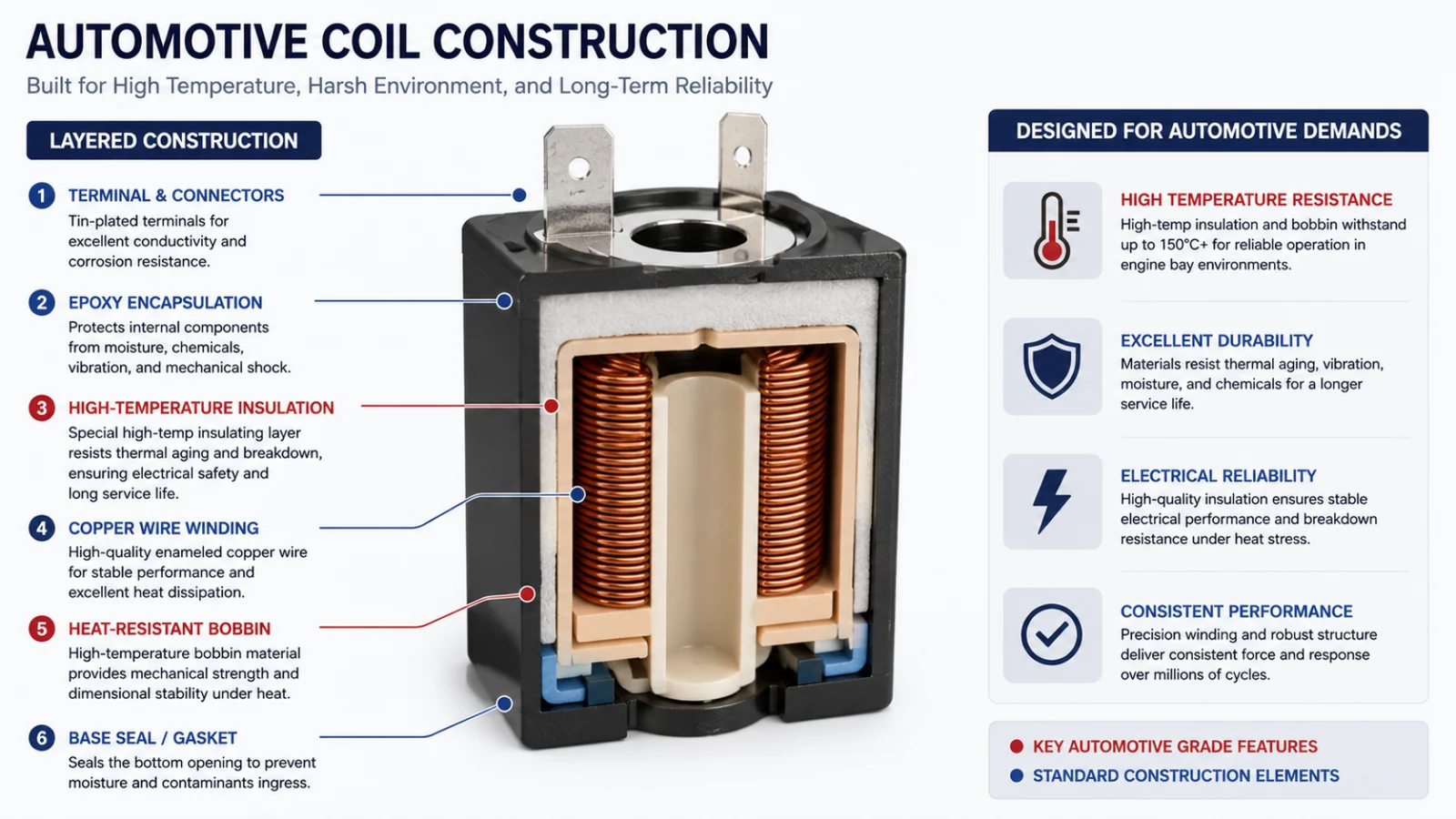
Automotive coils overcome vibration using robust internal connections, secure terminal designs, and full epoxy or plastic encapsulation7. This creates a solid, single-piece component that can withstand forces over 10G8, preventing internal wire fatigue and ensuring electrical integrity through the roughest conditions.
Think about a solenoid valve that controls the air brakes on a commercial truck. It will experience constant, high-frequency vibration for millions of miles. A failure is not just an inconvenience; it's a catastrophic safety issue. So, how do we build a small electrical component to survive that? It comes down to two key areas.
Internal Construction
The weakest point in any coil is where the ultra-fine magnet wire is connected to the much larger external terminals. Under vibration, this connection point can fatigue and break9. In our automotive-grade processes, we use specialized welding techniques and add specific strain relief features in the bobbin design. This protects that fragile connection from any stress. It's a microscopic detail that makes a world of difference in long-term durability.
Monolithic Encapsulation
Second, we turn the coil into a solid block. We don’t just dip the coil in a coating. We use high-pressure injection overmolding to fill every single microscopic gap inside and around the coil windings with a high-strength polymer. This process, when controlled correctly, ensures there are no air voids. It creates a monolithic part where nothing can move, shake, or rub against anything else. Now, does your washing machine vibrate as much as a semi-truck? Of course not. But because our manufacturing lines are built on these IATF 16949 principles, the standard coils we produce have stronger terminals and more robust encapsulation than our competitors. You get the benefit of that durability, a direct result of our automotive process discipline.
IP Ratings and Moisture Protection: Preventing Corrosion in Automotive Valves?
Your product operates in a damp, humid, or wet environment. Even a small amount of moisture can get inside components, leading to corrosion and electrical shorts that cause premature failure.
To prevent corrosion, automotive coils are designed to meet high Ingress Protection (IP) ratings, often IP67 or IP6K9K. This is achieved with sealed connectors and precision overmolding that creates a fully sealed unit, making it impervious to water, salt spray, and cleaning chemicals.
I once worked with a client who manufactured professional irrigation systems. Their valves, which sit outdoors, were failing. It wasn't rain that was killing them; it was the morning dew. Over months and years, that tiny amount of moisture was enough to cause corrosion on the coil terminals. The solution was a lesson learned from the automotive industry: total sealing.
Let's quickly talk about IP ratings. An IP67 rating means the part is dust-tight and can be fully submerged in 1 meter of water for 30 minutes without leaking10. It's very robust. But in automotive, we often have to meet IP6K9K. This is a German standard that means the part can withstand high-pressure, high-temperature water jets from every angle. Think about an engine bay being power-washed. The electronics have to survive.
We achieve this level of sealing through two critical process controls. First, the interface with the electrical connector must be perfect. We often design the coil and its mating connector as a system to ensure a perfect seal. Second, our automated injection overmolding process is precisely controlled. We monitor pressure, temperature, and flow to ensure the plastic bonds perfectly to the metal terminals, leaving no path for moisture to get in. For the procurement manager of a premium appliance, like a built-in coffee machine where a water leak is a disaster, specifying a coil with a verified IP67 rating, born from automotive design discipline, is a very smart and protective investment.
Evaluating Lifespan and Failure Rates: The ROI of Upgrading to Automotive-Grade Solenoids?
You need to justify the higher cost of a premium component to your management. Without a clear Return on Investment (ROI), it's just an added expense that eats into your product's profit margin.
The ROI of upgrading comes from drastically reducing the total "Cost of Failure." While a better coil may cost 30% more, preventing even one high-consequence failure—which includes service calls, brand damage, and secondary property damage—can deliver a 10x or even 100x return.
This is the most important conversation I have with purchasing managers. It all comes down to a simple calculation, but one that many companies don't fully complete. Let's run the numbers on two different scenarios.
Scenario A: A $50 countertop coffee maker.
- The standard coil costs $1.00.
- The real-world failure rate is about 1,000 PPM (0.1%), which is typical for standard components.
- The Cost of Failure is maybe $25 (cost of the product for a warranty replacement).
- For every 10,000 units sold, your failure cost is 10 failures * $25 = $250.
Scenario B: A $3,000 built-in espresso machine.
- The Cost of Failure here is not $25. It's a $500 service call for a technician, plus potential water damage to a $10,000 custom kitchen cabinet. The real cost is easily $1,500, plus immense damage to your premium brand's reputation.
- If you use the same $1.00 coil, your failure cost per 10,000 units is 10 failures * $1,500 = $15,000.
- Now, what if you use a coil from our IATF 16949-certified line? It might cost $1.30. But its failure rate is closer to 10 PPM. Your failure cost is now 0.1 failures * $1,500 = $150.
You spent an extra $3,000 on better coils (30 cents x 10,000 units) to save almost $15,000 in direct failure costs. That is a massive ROI. This is why I empower managers to ask their engineering teams these questions:
- What is our true, all-in Cost of Failure for this product?
- What is our target PPM failure rate for this component?
- Can we hit our reliability goal by partnering with an IATF 16949-certified supplier who applies stricter process controls, instead of specifying a full, over-engineered automotive part?
Conclusion
Choosing the right coil is not about simply buying the most expensive part. It's about understanding risk and partnering with a supplier whose process discipline guarantees reliability, protecting your brand and bottom line.
"IATF 16949 - Wikipedia", https://en.wikipedia.org/wiki/IATF_16949. IATF 16949 is described as an automotive quality-management standard focused on defect prevention, reduction of variation and waste, and continual improvement across the supply chain. Evidence role: general_support; source type: institution. Supports: IATF 16949 emphasizes defect prevention, variation reduction, process control, and continual improvement in automotive production.. Scope note: The standard supports the mechanism for improved consistency, but it does not by itself prove that every certified supplier will achieve lower defect rates in every product category. ↩
"[PDF] An Overview Of NASA Automotive Component Reliability Studies", https://nepp.nasa.gov/files/28172/NEPP-CP-2016-Sampson-Pres-MRQW-TN29817.pdf. Automotive environmental and component-qualification standards specify severe operating-temperature categories for vehicle electrical equipment, commonly including subzero operation and high-temperature under-hood conditions. Evidence role: definition; source type: institution. Supports: Automotive electrical and electronic components are often qualified against environmental temperature ranges that include severe low and high temperatures.. Scope note: The source would contextualize the temperature range as an automotive qualification environment, not prove that every solenoid coil labeled automotive-grade is rated to exactly -40°C to 150°C. ↩
"Insulation system - Wikipedia", https://en.wikipedia.org/wiki/Insulation_system. Electrical insulation thermal-class tables identify Class F insulation with a maximum temperature class of 155°C. Evidence role: definition; source type: institution. Supports: Class F insulation corresponds to a 155°C thermal classification.. ↩
"Insulation system - Wikipedia", https://en.wikipedia.org/wiki/Insulation_system. Standard electrical-insulation thermal classifications list Class H at 180°C and Class N at 200°C. Evidence role: definition; source type: institution. Supports: Class H and Class N insulation correspond to 180°C and 200°C thermal classes.. ↩
"Outgassing Database", https://etd.gsfc.nasa.gov/capabilities/outgassing-database/. Materials-science references describe PPS and PEEK as high-performance thermoplastics with elevated service-temperature capability and strong thermal and dimensional stability. Evidence role: general_support; source type: research. Supports: PPS and PEEK are high-performance engineering polymers with high thermal stability and good dimensional performance compared with commodity plastics.. Scope note: The source would support the general material-property claim, while actual outgassing and structural performance depend on grade, fillers, processing, and test conditions. ↩
"Method to reduce non-specific tissue heating of small animals in ...", https://pmc.ncbi.nlm.nih.gov/articles/PMC3991111/. Engineering studies of electromagnetic coils use electrothermal or finite-element models to estimate temperature rise and identify localized hot spots under operating loads. Evidence role: mechanism; source type: paper. Supports: Electrothermal or finite-element modeling is used to estimate coil temperature rise and locate thermal hot spots during design.. Scope note: The source would support the modeling method generally, not verify the specific software, workflow, or validation practices of the manufacturer described in the article. ↩
"PCB Potting Explained: Protection Against Moisture, Vibration ...", https://www.sierraassembly.com/blog/what-is-pcb-potting--how-it-protects-circuits-against-moisture-vibration-and-corrosion/. Electronics-reliability references describe potting and encapsulation as methods for providing mechanical support and environmental protection against vibration, moisture, and contaminants. Evidence role: mechanism; source type: research. Supports: Potting, encapsulation, and overmolding can mechanically support electronic assemblies and reduce exposure to moisture or contaminants.. Scope note: The source would support the protective mechanism, but actual performance depends on material selection, process control, void content, adhesion, and thermal stresses. ↩
"ISO 16750 Part 3 Road Vehicle Testing - Mechanical Loads", https://keystonecompliance.com/iso-16750-3/. Automotive vibration-test standards for vehicle electrical equipment define mechanical-load profiles using acceleration levels, frequency ranges, and mounting conditions to evaluate component durability. Evidence role: general_support; source type: institution. Supports: Automotive electrical components are tested under specified vibration and mechanical-load profiles that can include multi-g acceleration levels.. Scope note: The source would support the existence of demanding automotive vibration qualification, but the exact 10G threshold may vary by vehicle location, standard edition, and customer specification. ↩
"Reliability issues of lead-free solder joints in electronic devices", https://pmc.ncbi.nlm.nih.gov/articles/PMC6735330/. Reliability studies of electronic interconnects show that vibration loading can produce fatigue cracking or fracture at mechanically stressed connection points. Evidence role: mechanism; source type: paper. Supports: Mechanical vibration can induce fatigue damage in electrical interconnects, especially at stress-concentration points.. Scope note: The source would support the general fatigue mechanism; the exact vulnerability of a particular solenoid connection depends on its geometry, materials, and strain relief. ↩
"IP code - Wikipedia", https://en.wikipedia.org/wiki/IP_code. IEC 60529 ingress-protection definitions identify IP6X as dust-tight protection and IPX7 as protection against temporary immersion under specified depth and duration conditions. Evidence role: definition; source type: institution. Supports: IP67 denotes complete dust protection and protection against temporary immersion under defined conditions.. Scope note: The common 1-meter, 30-minute formulation reflects typical IEC 60529 test conditions, but exact test details may depend on product size and standard interpretation. ↩