How to Choose a Solenoid for High Temperature Applications?
Your standard solenoid just failed in a hot environment, causing a costly product recall. This is a frustrating problem. You need to select parts that can withstand the heat.
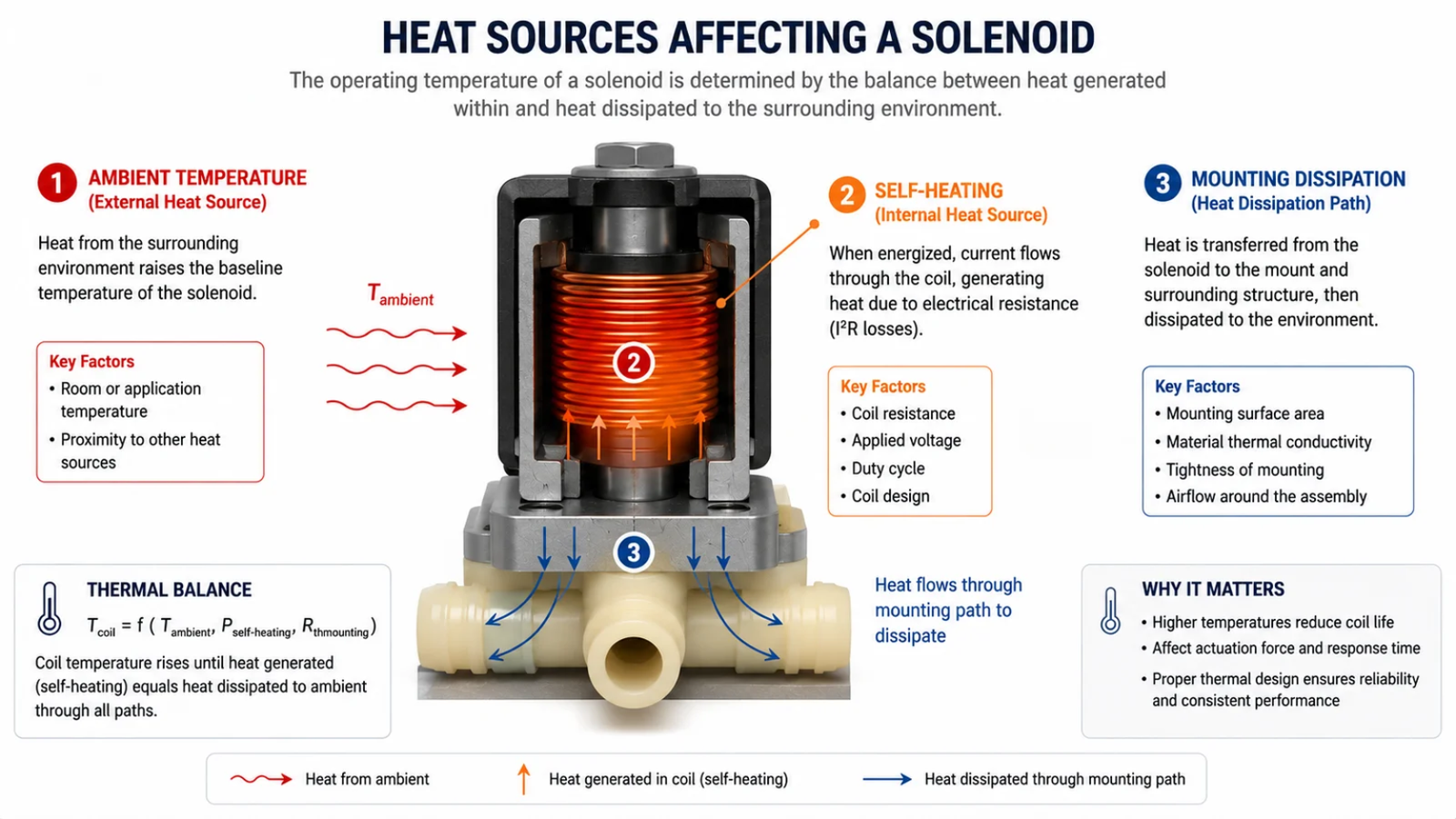
Choosing the right high-temperature solenoid requires a full risk analysis. You must evaluate the ambient temperature, self-heating from the duty cycle, heat dissipation from mounting, and required operational life1. This ensures you balance performance with total cost, preventing premature failure and protecting your brand.
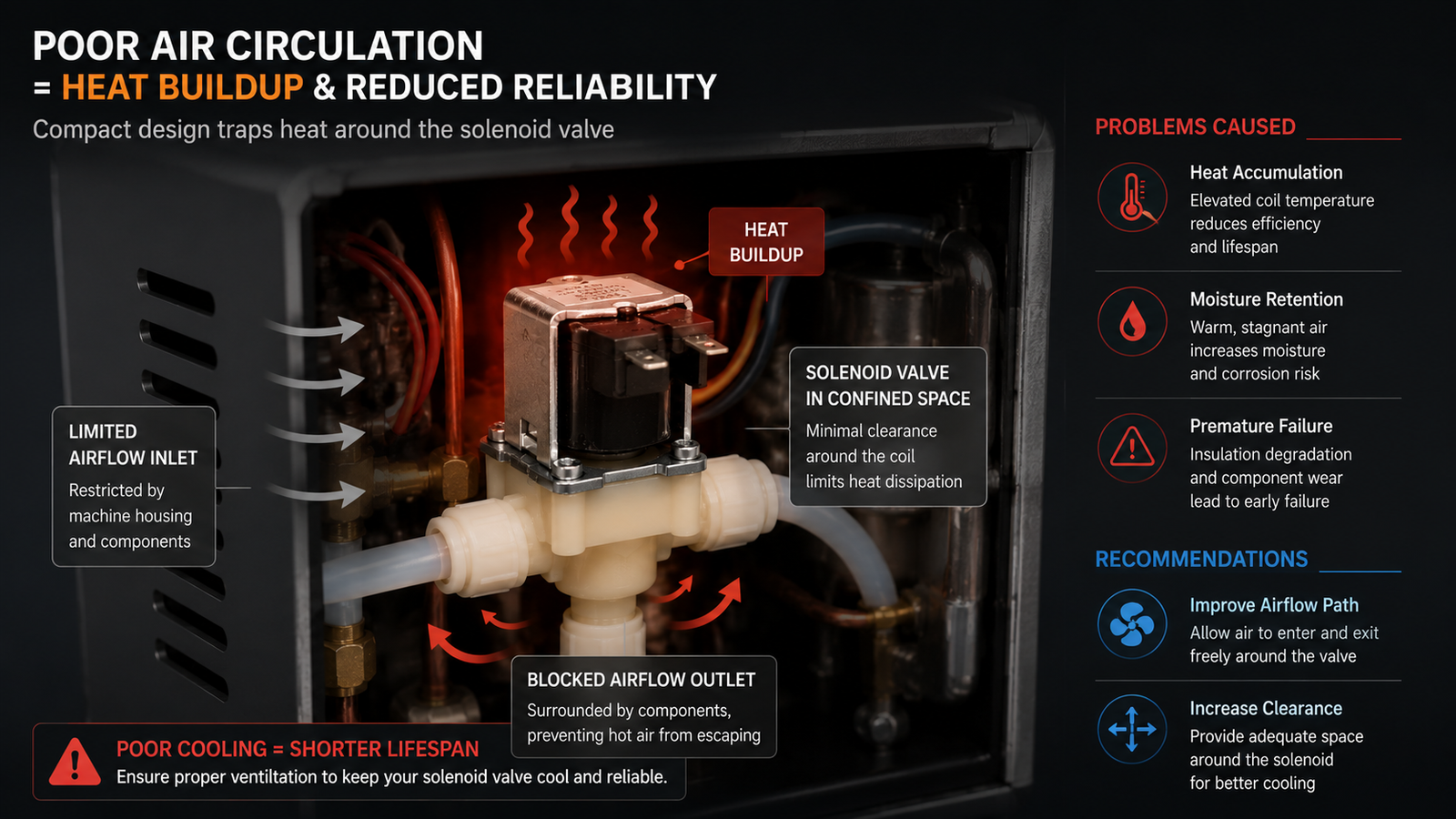
Over my 20 years of working with global appliance brands, I've seen this issue repeatedly. A procurement manager or engineer selects a solenoid based on a single temperature rating on a spec sheet, and it fails in the field. The problem is that the spec sheet doesn't tell the whole story. The real challenge is managing thermal stress over time, not just surviving a peak temperature. To make a reliable choice, you need to ask deeper questions and understand the factors that truly impact performance in your specific application. This is how you move from simply buying a part to making a smart investment in your product's reliability.
What Are the Key Technical Factors to Consider When Selecting a High-Temperature Solenoid?
You picked a solenoid with a 180°C rating for a 120°C application, but it still failed. This is a common and expensive frustration. You need to look beyond the datasheet.
The key factors are not just ambient temperature. You must consider the heat the solenoid generates itself (self-heating), how well its mounting dissipates heat, and the duration of heat exposure. Ignoring these leads to premature failure even when the spec seems right.
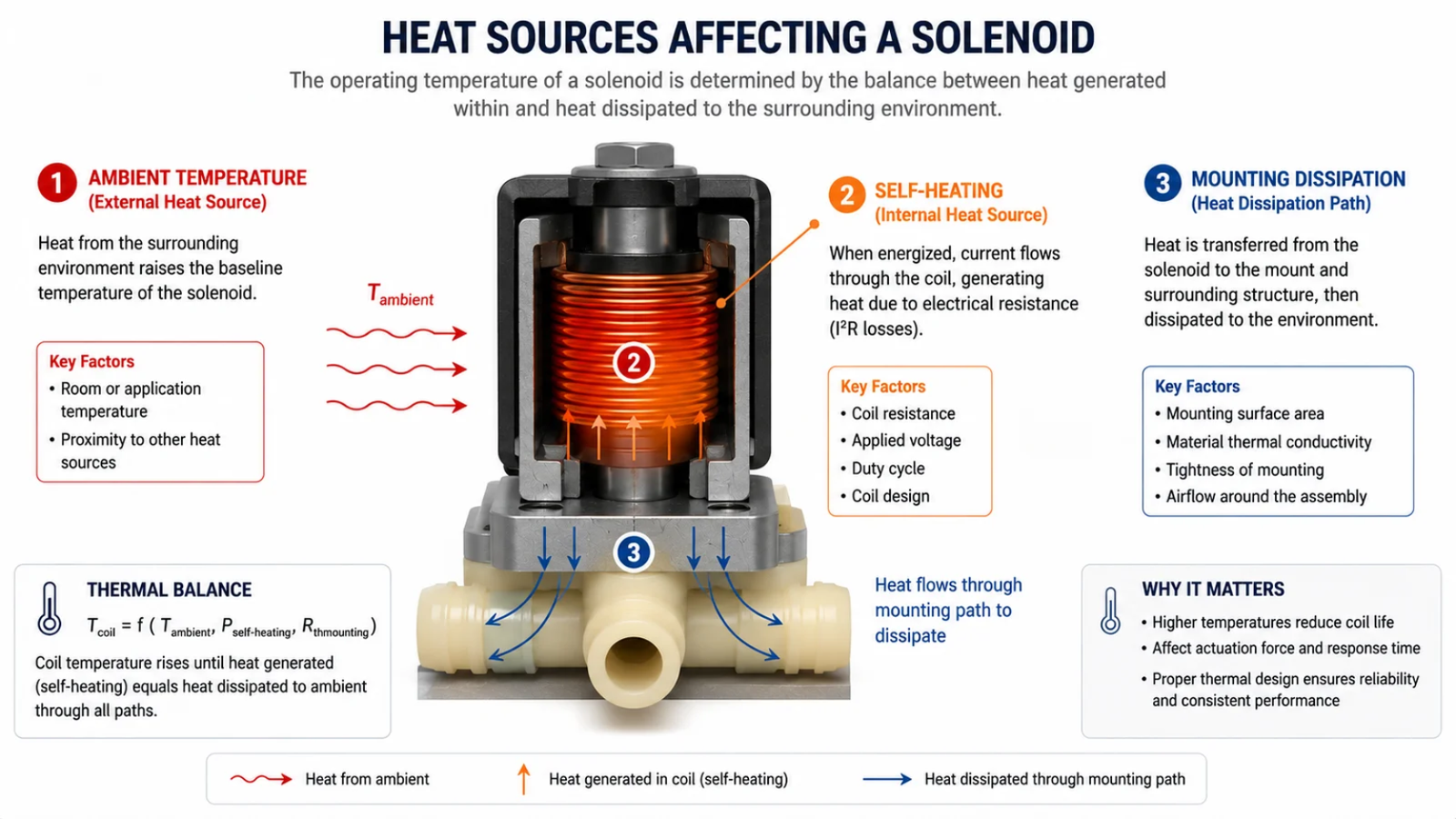
When we help a client spec a new solenoid, the first thing we do is deconstruct the term "high temperature." A single number on a spec sheet is misleading. The real-world operating temperature is a combination of several factors. We've seen 180°C rated solenoids fail in 120°C environments because of a high duty cycle or poor mounting that trapped heat.
The total thermal stress on the solenoid is what matters. You need to consider four variables:
Key Thermal Stress Variables
| Factor | Description | Why It Matters |
|---|---|---|
| Ambient Temperature | The temperature of the environment surrounding the solenoid. | This is the baseline heat the solenoid must endure before it's even turned on. |
| Self-Heating | Heat generated by the coil when electricity passes through it, influenced by duty cycle. | A 100% duty cycle generates continuous heat, while a 10% duty cycle allows time for cooling.2 |
| Heat Dissipation | How effectively heat is removed from the solenoid, determined by its mounting. | A solenoid mounted on a metal bracket will dissipate heat better than one enclosed in plastic.3 |
| Exposure Duration | How long the solenoid is subjected to the combined heat load. | Materials degrade over time. A short burst of high heat is different from continuous operation for years. |
Focusing only on ambient temperature is a frequent mistake. A procurement manager sees "180°C" and thinks it's safe for their 150°C oven. But they haven't accounted for the extra 40°C of self-heating from continuous operation. This oversight often leads to a spike in warranty claims 12 to 18 months after product launch.
How Do You Choose the Right Insulation Class (Class H vs. Class N) for Extreme Heat?
You see "Class H" and "Class N" on spec sheets, but it is not clear which one you need. Choosing wrong can cause unexpected failures or make you overspend on parts.
Insulation classes like H (180°C) and N (200°C)4 are just lab-tested temperature limits. To choose correctly, you must ask the supplier for the validated operational life of the solenoid at your specific operating temperature and duty cycle. This is the true measure of performance.
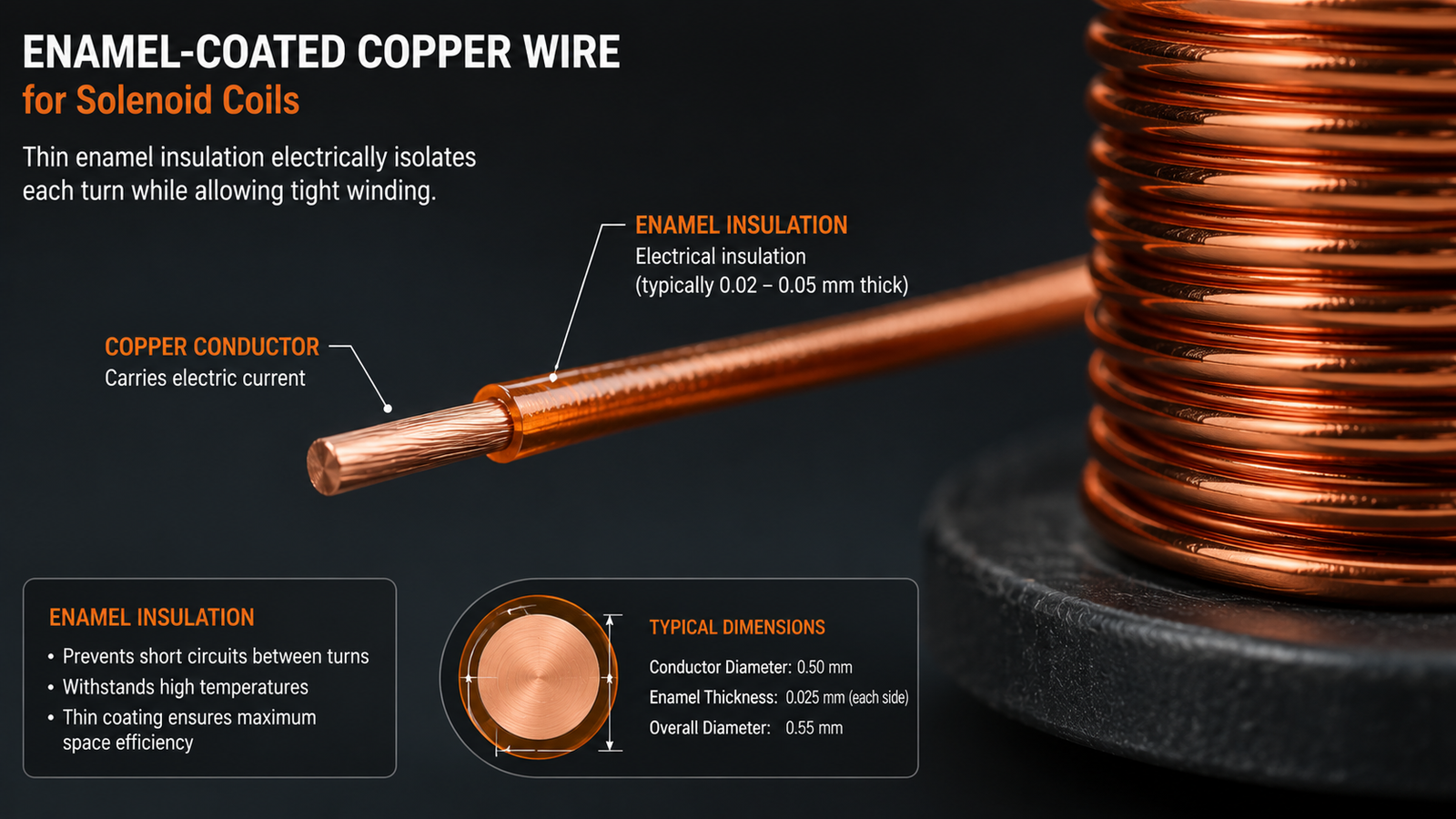
A common question I get from procurement managers is, "Is Class N always better than Class H since it has a higher temperature rating?" The answer is no. A temperature class is a starting point, not a guarantee of performance in your application. These ratings are determined under specific laboratory conditions that may not match your product's environment.5
The real goal is to ensure the solenoid's insulation system survives for the intended life of your appliance. A higher class letter does not automatically mean longer life.6 A well-designed Class H solenoid from a reliable manufacturer could easily outperform a poorly made Class N part. The choice is a business decision that balances cost, risk, and long-term reliability.
Comparing Insulation Classes in Practice
| Aspect | Class H (180°C) | Class N (200°C) | Key Question for Your Supplier |
|---|---|---|---|
| Typical Use Case | Industrial ovens, steam appliances, automotive applications. | Extreme heat environments like aerospace or specialized industrial equipment. | "What is the validated life of this part at X°C with a Y% duty cycle?" |
| Cost | More common and generally more cost-effective. | Uses more exotic materials, leading to a higher price point. | "Can you provide thermal aging data to justify the higher cost of Class N for my application?" |
| Material Stability | Based on robust and well-understood polymer systems. | Materials are more specialized and can have different mechanical properties. | "How does the bobbin and encapsulation material perform alongside the Class N wire enamel?" |
Often, a Class H system is more than sufficient and provides the best balance of performance and cost. We've seen teams specify Class N for a 160°C application, thinking it provides a safety margin. But they end up paying a 30% premium for performance they don't need, which could have been better invested in other components.
Why Do Standard Solenoids Fail in Hot Applications, and How Do High-Temp Designs Prevent It?
Your standard solenoids are failing in your new hot appliance prototype. This causes project delays and budget overruns. The reason is often the slow degradation of internal materials.
Standard solenoids fail because their materials, like the bobbin plastic and wire insulation, soften and degrade under sustained heat.7 This leads to electrical shorts or mechanical failure. High-temp designs use superior materials that resist this thermal aging, ensuring long-term reliability.
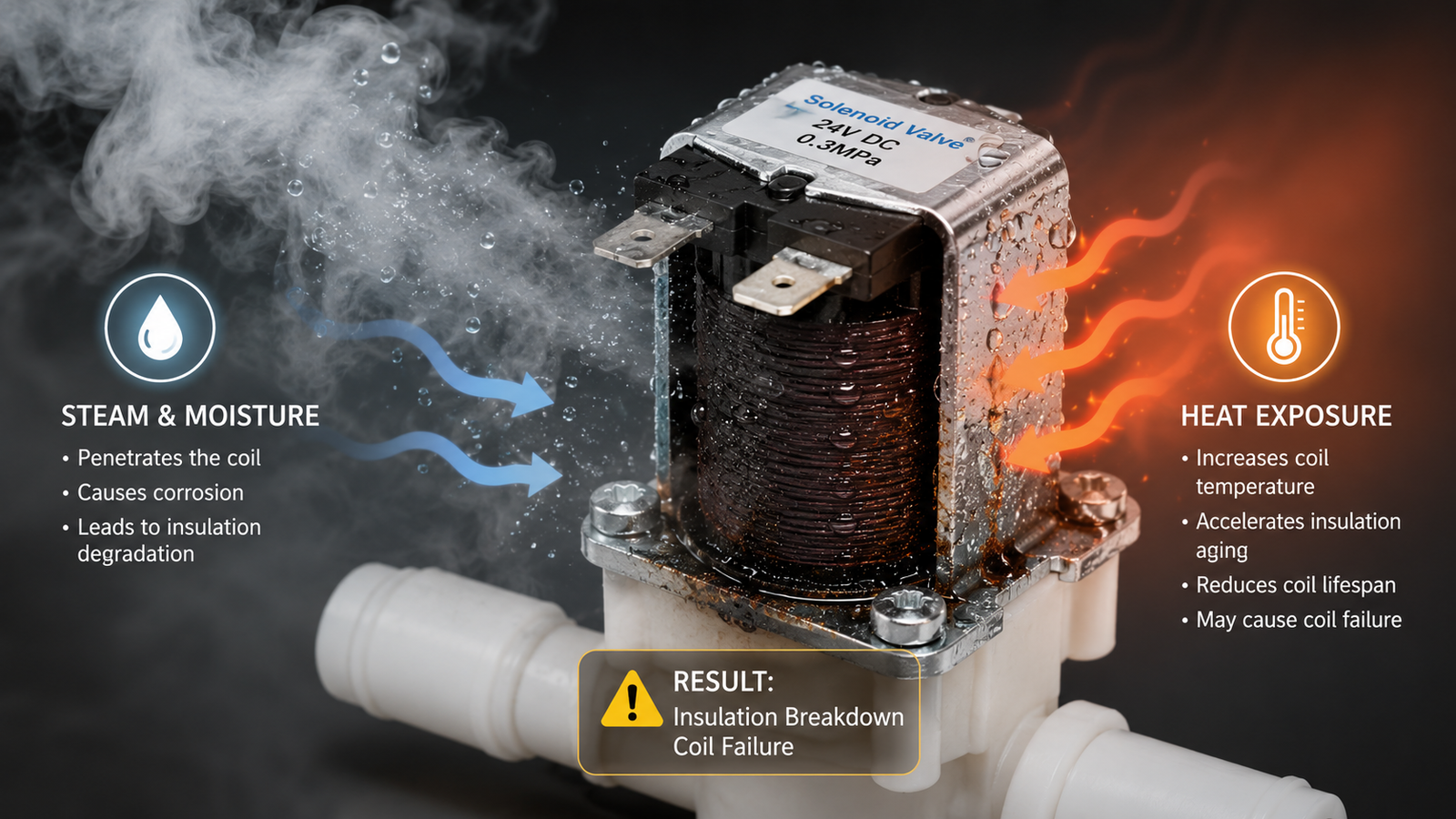
From analyzing after-sales data from dozens of appliance brands, the real culprit in heat-related failures is almost always material breakdown over time. It is not a sudden event. It is a slow, predictable process of thermal aging. A standard solenoid might work perfectly for the first 100 hours in a test lab, but it will fail after 1,000 hours in a customer's home.
High-temperature designs prevent this by upgrading the core components that are vulnerable to heat. This is not just about the wire. It's about the entire system working together. Choosing these materials is a business decision. A cheaper bobbin might save you 10 cents per unit, but if it leads to a 2% increase in warranty claims on a million units, the total cost is catastrophic for your brand.
Common Failure Points and High-Temp Solutions
| Component | Standard Material & Failure Mode | High-Temperature Material & Solution |
|---|---|---|
| Bobbin | Material: Standard Nylon (PA66) <br> Failure: Softens and deforms, causing the coil winding to loosen and fail mechanically. | Material: PEEK or LCP <br> Solution: These materials maintain their structural integrity at high temperatures, keeping the coil secure. |
| Wire Insulation | Material: Standard Polyurethane Enamel <br> Failure: Becomes brittle and cracks, leading to shorts between windings and electrical failure. | Material: Modified Polyester-imide Enamel <br> Solution: This enamel is more flexible and resilient, resisting cracking even after thousands of hours of thermal cycling. |
| Encapsulation | Material: Standard Epoxy <br> Failure: Can crack or separate from the coil, allowing moisture ingress and corrosion. | Material: High-Temperature Thermoset Plastic <br> Solution: Provides a robust, sealed housing that protects the coil from both heat and environmental factors. |
This is why we treat material selection as a critical part of risk management. It directly impacts the total cost of ownership (TCO) and protects brand reputation.
Which Seal Materials (Viton, PTFE, or Silicone) Perform Best Under Severe Thermal Stress?
A leaking valve in a hot water dispenser or steam oven is a major safety and reliability issue. This can damage the appliance and your brand's reputation. The seal material is the weak link.
For severe heat and pressure, Viton (FKM) and PTFE offer the best performance.8 Viton provides excellent temperature range and flexibility, while PTFE excels at the highest temperatures but is rigid. Silicone is generally not suitable for dynamic, high-pressure hot applications.9
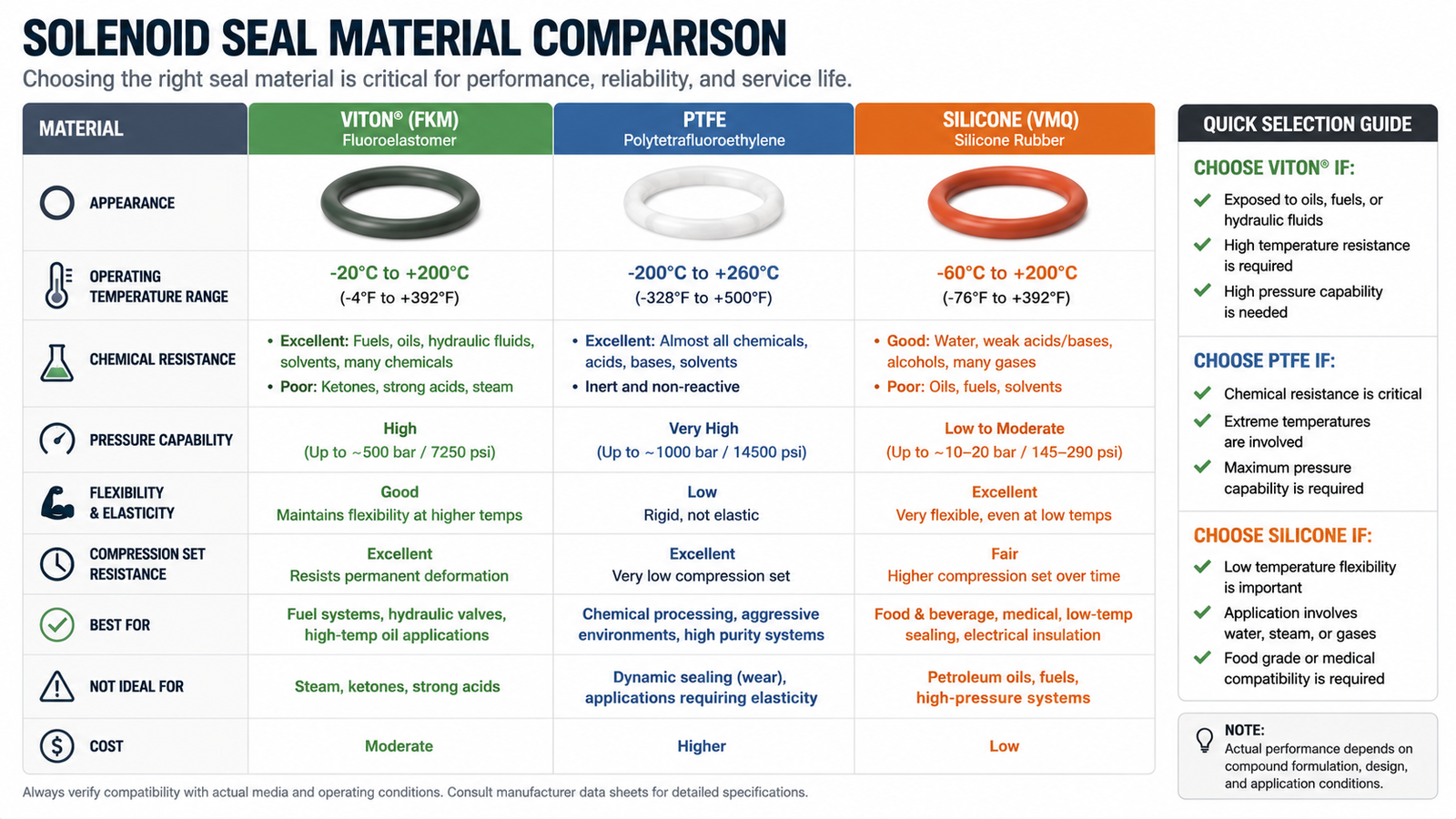
When a solenoid valve is used to control hot water, steam, or air, the seal's performance is just as important as the coil's. A common mistake I see is focusing entirely on the solenoid's electrical rating and treating the seal as an afterthought. From our experience, seal failure is a leading cause of warranty claims for fluid control applications in home appliances. The choice of seal material is not just a technical detail; it is a critical decision that impacts product safety and longevity.
Different materials have significant trade-offs in performance, longevity, and cost. Understanding these trade-offs is key to making a reliable choice for your specific application.
Seal Material Performance Comparison
| Material | Max Continuous Temp. | Pros | Cons | Best For... |
|---|---|---|---|---|
| Viton® (FKM) | ~200°C | Excellent heat and chemical resistance, good for pressure. | Higher cost, can swell with certain fluids. | Steam valves, hot water dispensers, commercial coffee machines. |
| PTFE (Teflon®) | ~260°C | Highest temperature resistance, extremely low friction. | Rigid and not elastic, harder to create a perfect seal in some designs. | High-temperature static seals, dry heat applications like industrial ovens. |
| Silicone (VMQ) | ~230°C | Very flexible, excellent for a wide temperature range. | Poor tear resistance, not suitable for high-pressure dynamic seals. | Low-pressure applications, static seals where flexibility is key. |
| EPDM10 | ~150°C | Excellent for water and steam, good value. | Poor resistance to oils and solvents. | Standard hot water appliances where temperatures stay below 150°C. |
For a European coffee machine brand we work with, switching from EPDM to a custom Viton seal for their steam valve reduced in-field leakage incidents by over 90%. The upfront cost was slightly higher, but the reduction in warranty costs and brand damage delivered a massive return on investment.
When Should You Source a Custom-Engineered High-Temperature Solenoid Over an Off-the-Shelf Model?
You cannot find an off-the-shelf solenoid that meets the unique heat and space requirements of your new appliance. Trying to force a standard part to work is risky and could lead to failure.
You should choose a custom solenoid when your application has unique thermal challenges, tight space constraints, or a specific life cycle target that standard parts cannot meet. A custom solution is a form of risk management that ensures reliability and protects your long-term brand reputation.

The decision between a standard part and a custom solution often comes down to one question: Does an off-the-shelf product truly meet all the performance and reliability requirements of your specific application? In my experience advising design engineers, the answer is often no, especially in competitive markets where performance and design are key differentiators.
For example, the needs of a mass-market drip coffee maker are very different from a high-end commercial steam oven.
- The Coffee Maker: This is a high-volume, cost-sensitive product. It needs a reliable solenoid for intermittent use (a few minutes a day). Heat exposure is intense but brief. Here, a modified off-the-shelf solenoid, perhaps with an upgraded bobbin material, might be the perfect balance of cost and performance.
- The Commercial Steam Oven: This is a lower-volume, high-reliability product. It runs continuously for hours at high temperatures. Failure is not an option. For this application, a fully custom-engineered solenoid is often the only way to guarantee performance over a 10-year lifespan. This might involve a unique form factor for better heat dissipation, a specialized wire and insulation system, and integrated connectors.
Sourcing a custom solenoid is not about adding cost; it's about buying down risk. When we develop a custom coil for a client, we are not just building a component. We are engineering a solution to a specific business problem, whether it's hitting a 10-year service life or fitting into a compact design. This investment ensures the solenoid performs reliably, protecting the end-user and, most importantly, the manufacturer's brand.
Conclusion
Choosing a high-temp solenoid is about managing thermal risk. Look beyond specs to balance materials, application environment, and total cost of ownership for long-term reliability and brand protection.
"[PDF] Reliability and life study of hydraulic solenoid valve. Part 2", https://www.eng.auburn.edu/~choeson/Publication/1132_2009_Reliability%20and%20life%20study%20of%20hydraulic%20solenoid%20valve-Part%202%20_S.%20V.%20Angadi,%20R.%20L.%20Jackson.pdf. A thermal-analysis source on electromagnetic coils supports that solenoid operating temperature is determined by ambient temperature, internally generated Joule heat, duty cycle, heat-transfer paths, and allowable material temperature limits. Evidence role: mechanism; source type: paper. Supports: A technical source should explain that coil temperature depends on ambient conditions, electrical losses, duty cycle, thermal paths, and allowable insulation life.. Scope note: This would support the engineering mechanism generally; it may not validate the exact risk framework or any specific solenoid model discussed in the article. ↩
"Duty cycle - Wikipedia", https://en.wikipedia.org/wiki/Duty_cycle. Educational material on duty cycle and electrical heating supports that continuous energization produces sustained resistive heating, whereas intermittent operation lowers average heat input and permits cooling between cycles. Evidence role: mechanism; source type: education. Supports: A source should define duty cycle and show that average power and heat generation increase as the energized fraction of time increases.. Scope note: This evidence would support the general physics of coil heating, not the exact temperature rise of any specific solenoid. ↩
"[PDF] Untitled", https://www.energy.gov/documents/engineering-toolbox-2015-soil-and-rock-bulking-or-swell-factors. Reference data on material thermal conductivity supports that metals typically provide much higher conductive heat-transfer paths than plastics, making metal mounts more effective for dissipating heat from an attached component. Evidence role: mechanism; source type: education. Supports: A source should provide thermal conductivity comparisons showing that common metals conduct heat far better than common plastics.. Scope note: The actual dissipation in a solenoid assembly also depends on geometry, contact resistance, airflow, and enclosure design. ↩
"Insulation system - Wikipedia", https://en.wikipedia.org/wiki/Insulation_system. Electrical-insulation thermal-class references based on IEC or NEMA classifications identify Class H with a 180°C temperature index and Class N with a 200°C temperature index. Evidence role: definition; source type: institution. Supports: A standards-based or institutional source should define thermal classes for electrical insulation and list Class H as 180°C and Class N as 200°C.. Scope note: The class rating defines a standardized thermal index for an insulation system; it does not by itself prove service life in a particular appliance design. ↩
"[PDF] PV Standards and Long Term Thermal Aging (LTTA)", https://www.nist.gov/document/pv-standards-and-long-term-thermal-aging-ltta-christopher-flueckigerpdf. Standards for electrical-insulation thermal endurance describe temperature indices as results of controlled aging and evaluation procedures, supporting the distinction between standardized ratings and actual application environments. Evidence role: expert_consensus; source type: institution. Supports: A standards or testing source should explain that insulation thermal indices are derived from controlled thermal-aging evaluations, not from every possible field condition.. Scope note: This supports the general caution about ratings; it does not show that any particular Class H or Class N solenoid will fail in a given appliance. ↩
"[PDF] SEC Equipment Aging, Subject: M38773 Revision 6.", https://www.nrc.gov/docs/ML1211/ML12116A323.pdf. Thermal-aging literature for electrical insulation systems supports that service life depends on time-temperature exposure and system construction, so a higher thermal class alone is not a sufficient predictor of longer life in use. Evidence role: mechanism; source type: paper. Supports: A source should explain thermal aging and life-temperature relationships for electrical insulation systems.. Scope note: The evidence would be general to insulation systems and may not compare specific commercial Class H and Class N solenoids. ↩
"Degradation Monitoring of Insulation Systems Used in Low-Voltage ...", https://pmc.ncbi.nlm.nih.gov/articles/PMC7374401/. Research on polymer and electrical-insulation thermal aging supports that sustained elevated temperature can reduce mechanical integrity and dielectric performance, creating conditions for coil deformation, insulation cracking, or electrical shorts. Evidence role: mechanism; source type: paper. Supports: A source should describe thermal aging of polymer insulation and structural plastics, including embrittlement, softening, and loss of dielectric or mechanical properties.. Scope note: This supports the failure mechanism broadly; it does not quantify failure probability for the specific solenoids in the article. ↩
"Compare FKM and FFKM Materials", https://www.gtweed.com/materials/fkm-vs-ffkm/. Seal-material handbooks and compatibility references support that FKM elastomers and PTFE fluoropolymers are widely used where elevated temperature and chemical resistance are required. Evidence role: expert_consensus; source type: institution. Supports: A source should compare temperature and chemical resistance properties of FKM and PTFE with other common sealing materials.. Scope note: The phrase 'best performance' is application-dependent; pressure, motion, fluid chemistry, compression set, and seal geometry can change the optimal material. ↩
"[PDF] Elastomer Characteristics", https://www.nrc.gov/docs/ML0720/ML072040257.pdf. Elastomer seal handbooks commonly note that silicone offers broad-temperature flexibility but relatively poor tear and abrasion resistance, which limits its suitability in demanding dynamic sealing applications. Evidence role: expert_consensus; source type: institution. Supports: A source should document silicone's sealing strengths and limitations, especially tear strength, abrasion resistance, and dynamic-seal suitability.. Scope note: This supports a general design caution; specially formulated silicone compounds or low-stress designs may perform adequately in some dynamic hot applications. ↩
"EPDM rubber - Newby Rubber Inc.", https://newbyrubber.com/resources/ethylene-propylene-diene-rubber/. Elastomer compatibility references support that EPDM is commonly used with water and steam service while showing poor compatibility with petroleum oils and many hydrocarbon solvents. Evidence role: general_support; source type: institution. Supports: A source should confirm EPDM's compatibility with water or steam and its limitations with petroleum oils and solvents.. Scope note: Temperature limits and compatibility depend on compound formulation, exposure duration, pressure, and the exact fluid mixture. ↩