Common Solenoid Pump Problems and Solutions
Your new appliance is failing and customers are complaining about strange noises or leaks. You thought you bought a quality component, but now your brand's reputation is at risk.
The most common solenoid pump problems—noise, pressure loss, leaks, and total failure—often come from selecting a pump that is not suited for the specific application's temperature, fluid type, or duty cycle.1 The root cause is usually a mismatch, not poor quality.
I’ve been working in this factory for over 20 years, dealing directly with engineers and purchasing managers from major European brands. I've seen the same mistakes happen over and over. A small choice made to save a few cents at the design stage ends up costing thousands in warranty claims and damages a brand's good name. The real solution isn't about learning how to fix a broken pump; it's about learning how to choose the right one so it never breaks in the first place. This guide is based on two decades of seeing what works and what leads to disaster.
Why Is My Solenoid Pump Not Working at All?
Your device is completely dead and the pump will not start. You suspect a faulty part, which could delay your entire production timeline and lead to missed deadlines.
A non-working solenoid pump is often due to an electrical issue, like a burnt solenoid coil from incorrect voltage, or a mechanical jam from debris. This is usually caused by specifying the wrong parameters for your target market or application during the selection process.
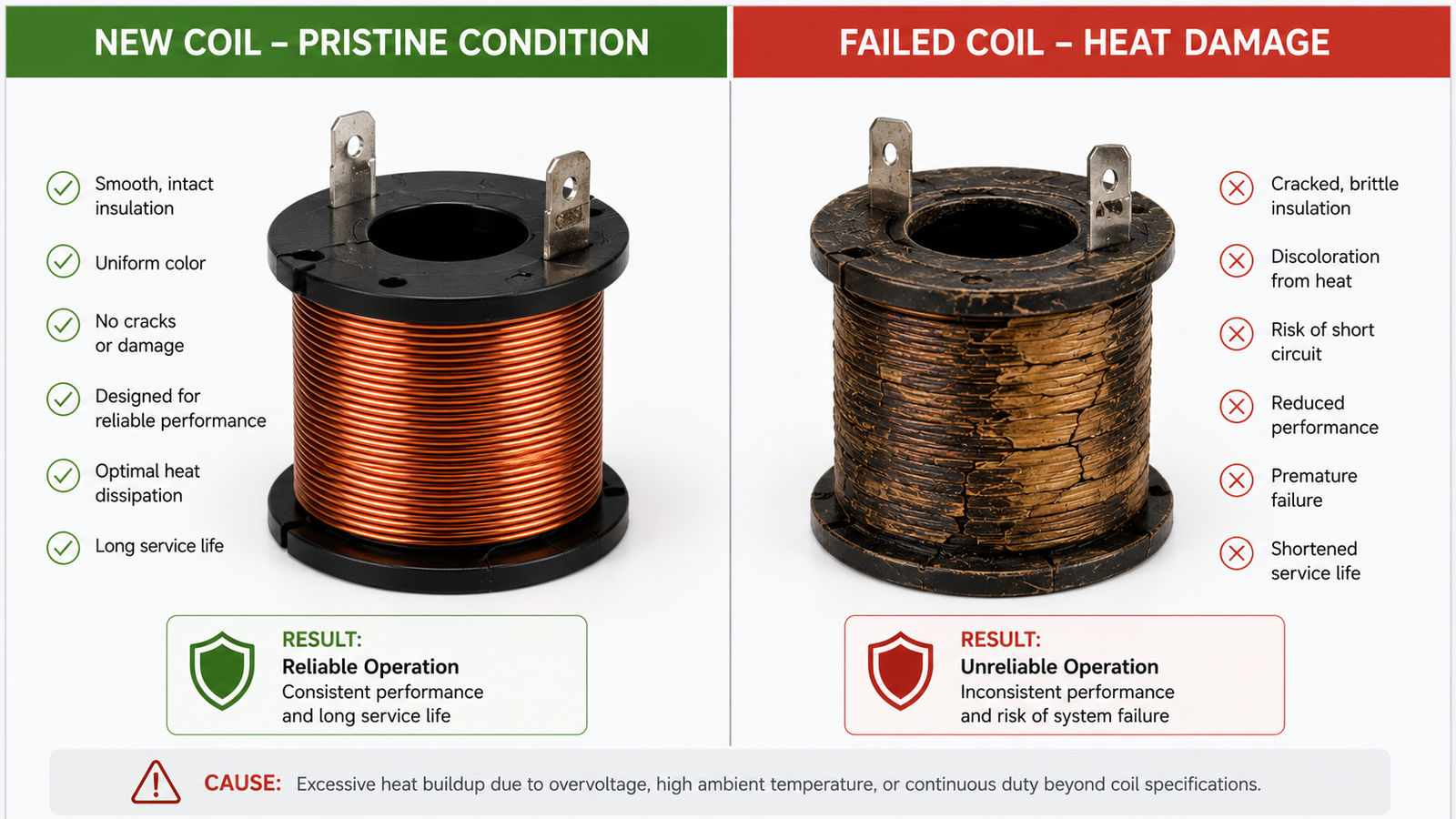
I remember a client who was rushing a product to the European market. Their design used a 110V/60Hz coil because that’s what they tested in their lab. They sent the order without double-checking. When the finished appliances were plugged into Europe's 230V/50Hz outlets2, the coils burned out almost instantly. This wasn’t a quality failure; it was a simple, but very expensive, oversight. The pump didn't fail; the specification did. Similarly, a pump can jam if the wrong materials are chosen. If you use a pump designed for pure water in a coffee machine where fine grounds might get into the system, it’s only a matter of time before it clogs up.
Understanding the Mismatch
The pump is rarely the "problem" on its own. It becomes a problem when it's put in an environment it wasn't built for. The key is to match the pump to the system, not the other way around.
| Cause of Failure | The Wrong Choice Made During Selection | The Right Question to Ask Your Supplier |
|---|---|---|
| Burnt Coil | Specified incorrect voltage or frequency for the target market. | "What are the standard voltage and frequency requirements for the region this product will be sold in?" |
| Mechanical Jam | Chose a pump not rated for the fluid's viscosity or potential for debris. | "My fluid has these properties and may contain small particles. Is this pump's design and material robust enough?" |
| Overheating Failure | Used an intermittent-duty pump in a continuous-use application.3 | "My product will run for [X minutes/hours] at a time. Do I need a continuous or intermittent duty pump?" |
Why Does a Solenoid Pump Lose Pressure?
Your steam iron produces weak steam, or your coffee machine's brew is watery. The pump is running, but it feels like it has lost all its power and effectiveness.
A solenoid pump loses pressure because of internal wear or deformation of its components.4 This is often because the materials, like plastics or seals, were not designed to handle the application's operating temperature or the fluid’s chemical properties.
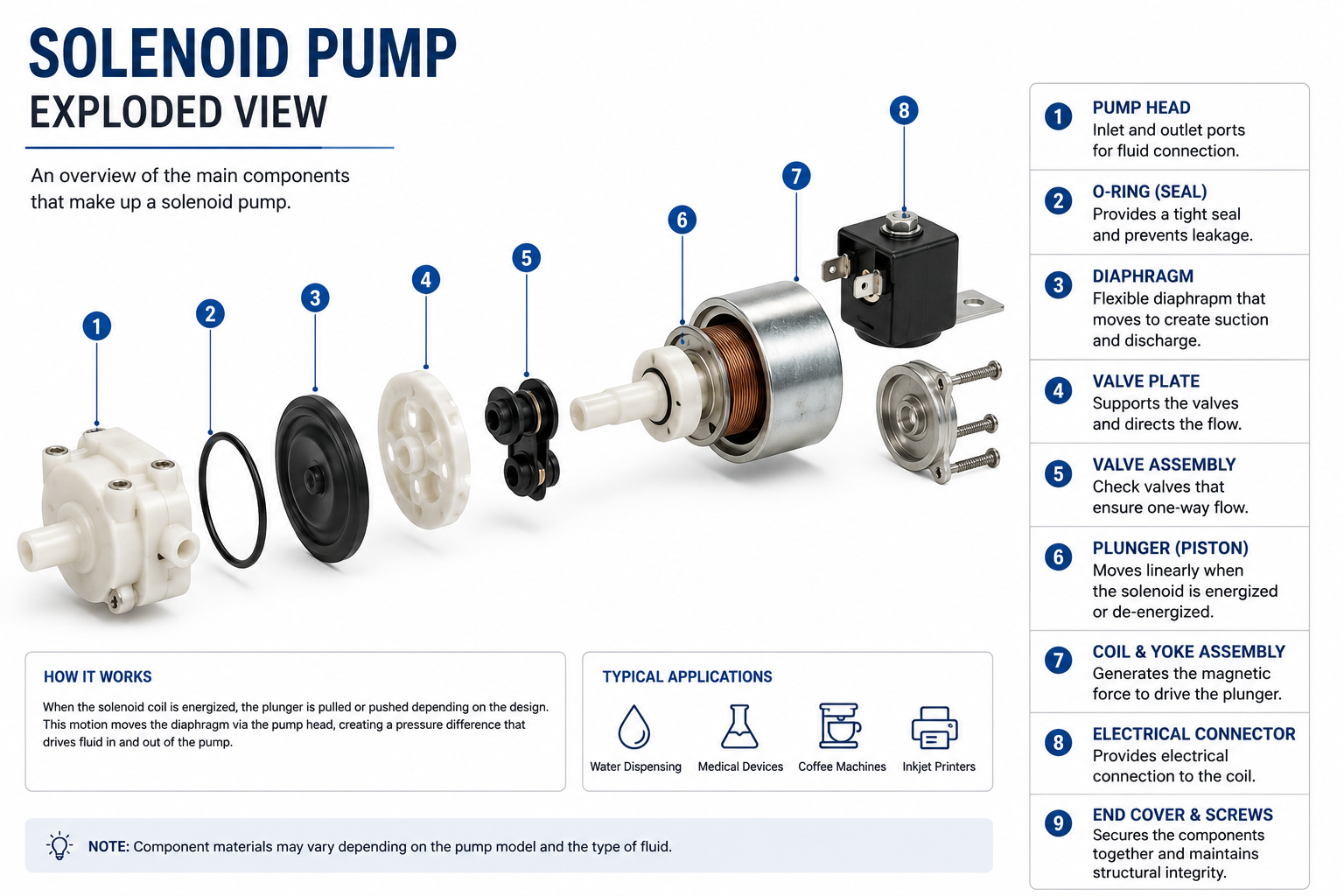
We once had a customer developing a new steam cleaner. They were very focused on cost. They chose a pump that met their pressure requirements perfectly on the spec sheet and worked great in short lab tests. However, they overlooked one detail. Their steam cleaner was designed for long cleaning sessions. After 15-20 minutes of continuous operation, the high temperature of the steam caused the pump’s internal plastic components to soften slightly. This tiny deformation was enough to create a small internal leak, causing a significant drop in pressure. The pump wasn't "bad." It was simply the wrong pump for a high-temperature, long-duration application.
Looking Beyond the Spec Sheet
A spec sheet gives you a snapshot, not the whole story. Pressure and flow ratings are often measured under ideal lab conditions. Real-world performance is what matters.
The Temperature Trap
Many standard plastics used in general-purpose pumps will begin to lose their structural integrity at temperatures above 80°C.5 For any steam or hot water application, you must ask about the long-term heat resistance of the materials. Using a pump with glass-filled nylon or other high-performance polymers might add a small amount to the unit cost, but it prevents catastrophic failure in the field.
The "Good Enough" Fallacy
Choosing a pump that just barely meets your pressure requirement is a risky strategy. You need to consider the entire system. Is there a long tube run? Are there sharp bends? These factors increase resistance and require a pump with a bit more power to maintain consistent pressure over the product's lifetime. Always ask your supplier for the pump's performance curve, not just a single number.
Why Is My Solenoid Pump Making Noise?
Customers complain that your new, high-end appliance sounds loud and cheap. The constant buzzing or rattling from the solenoid pump is ruining the user experience and generating bad reviews.
A noisy solenoid pump is often a sign of a mismatch with the system. Common causes include vibration from incorrect flow (cavitation), a knocking sound from pressure shock (water hammer), or simply using a pump not designed for a quiet home environment.
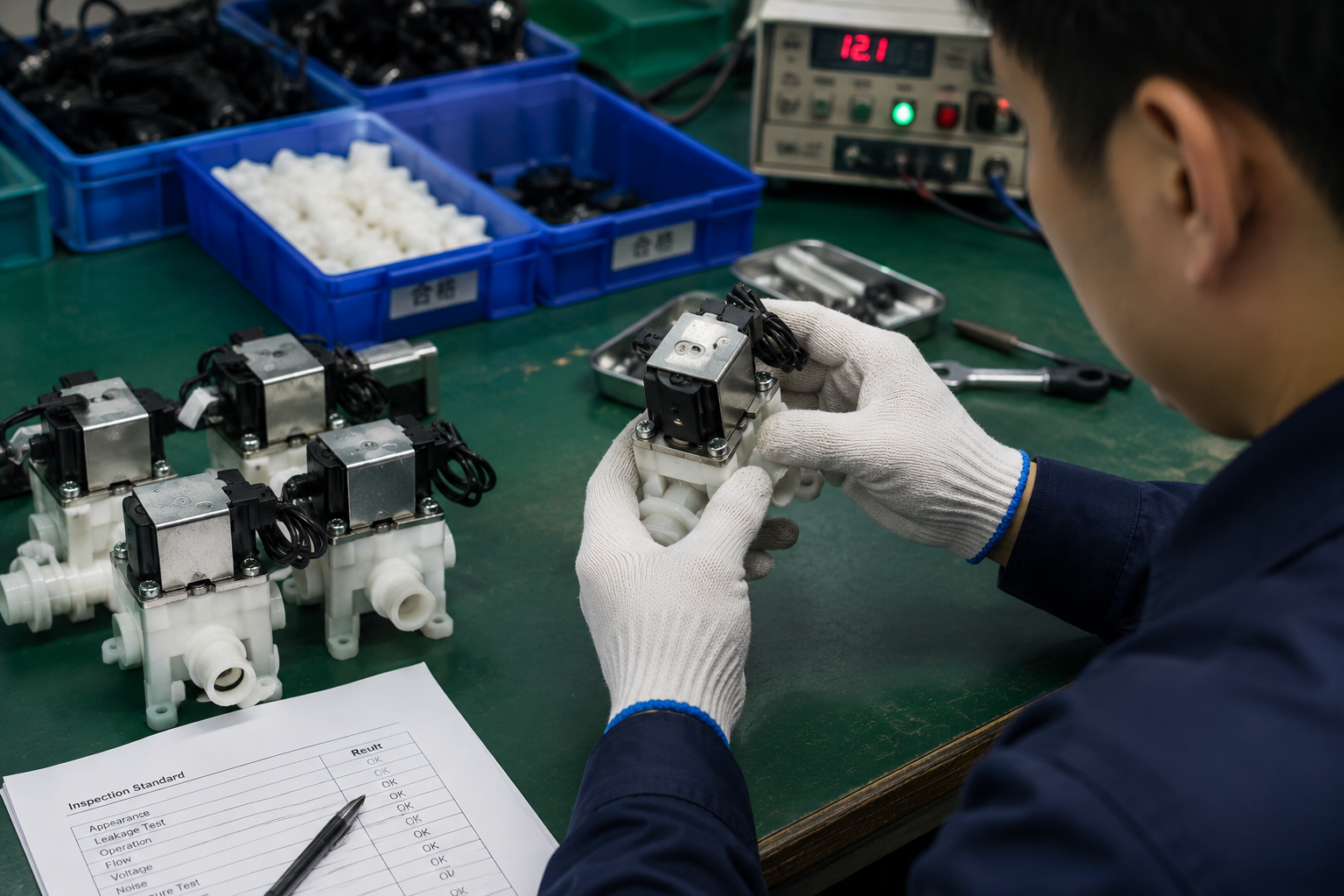
I’ll never forget a project with a manufacturer of luxury coffee machines. Their whole brand was built on a premium experience. They chose a pump that was technically excellent—powerful and efficient. It made a great cup of coffee. But in a quiet kitchen, it was distractingly loud. We worked with them and proposed a different model. This second pump was slightly less powerful and cost a bit more because it had special internal dampening components and a fine-tuned armature. For their brand, this was the right choice. They didn’t need the most powerful pump; they needed the quietest pump that could do the job. The noise wasn’t a defect; it was a characteristic. They had simply chosen the wrong characteristic for their product.
Noise Is a Feature, Not a Bug
In many applications, especially home appliances, the noise level is just as important as the pressure or flow rate. A pump that is perfectly acceptable in an industrial setting can be a product-killer in a consumer device.
| Noise Source | Common Cause (Wrong Choice) | The Right Question to Ask Your Supplier |
|---|---|---|
| Loud Buzzing/Humming | Mismatched AC frequency (e.g., 50Hz pump on 60Hz supply), or the pump is rigidly mounted to a panel that amplifies vibration. | "What is the decibel (dB) rating of this pump, and do you have recommendations for mounting it to minimize noise?" |
| Knocking/Banging | Water hammer caused by the valve closing too quickly in a rigid pipe system.6 | "My system uses these types of pipes. Do you recommend a pump with soft-shifting features to prevent water hammer?" |
| Rattling/Grinding | Cavitation caused by insufficient water supply to the pump inlet, making it run partially dry.7 | "What are the inlet pressure and flow requirements for this pump to operate quietly and avoid cavitation?" |
Why Does a Solenoid Pump Leak?
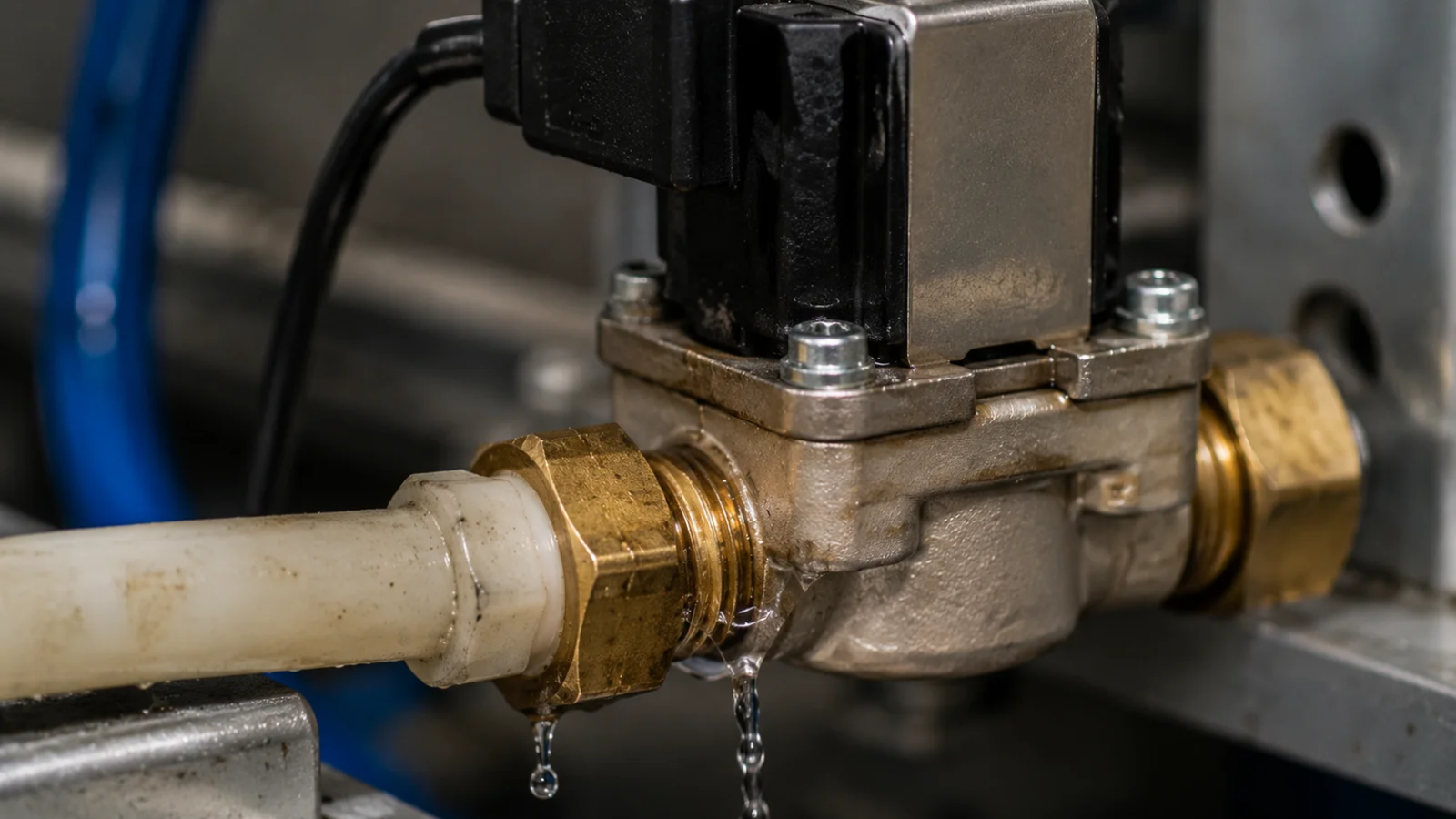
You're dealing with warranty claims that include photos of water damage inside a customer's appliance. The source is a small, but destructive, leak from the solenoid pump's seals.
Solenoid pumps leak when their seals degrade. This is almost always a material compatibility issue. The seal material was not chosen to withstand the chemical composition or the operating temperature of the fluid, causing it to become brittle, shrink, or swell.
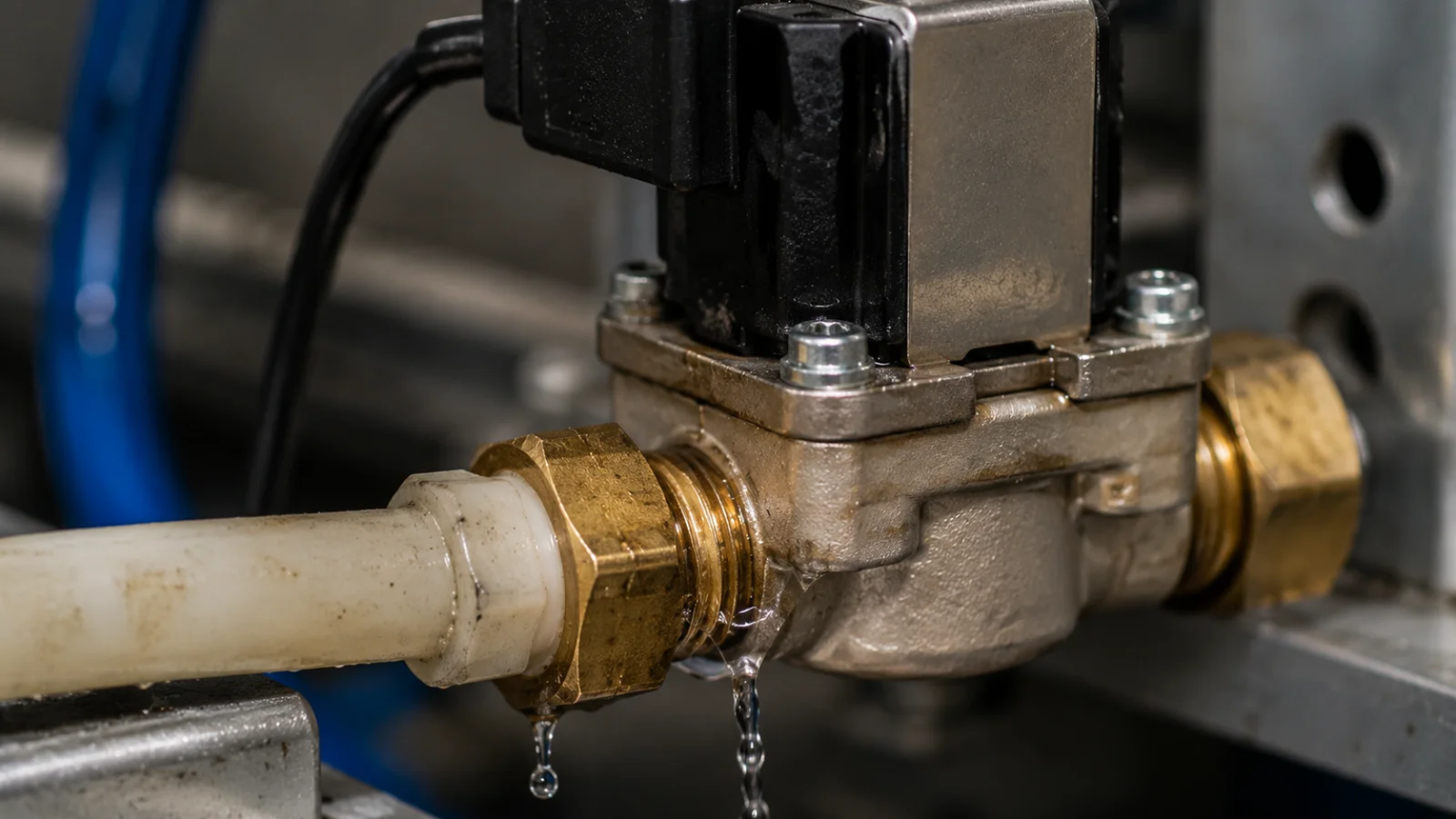
This is a problem I see all the time, especially with appliances that use cleaning agents or descalers. A purchasing manager looks at a spec sheet, sees "rubber seal," and assumes all rubber is the same. It is not. We had a client making a device that used a mild cleaning fluid. They chose a pump with a standard NBR (Nitrile) seal because it was the most common and cost-effective option. The pump worked perfectly with water. But the cleaning fluid, over several months, slowly broke down the NBR material, causing it to harden and crack. Leaks started appearing about six months after the product launched. They had to issue a recall. The solution was simple: use a pump with an EPDM seal, which is resistant to those chemicals. The price difference was less than a dollar.
The Devil is in the Details
The fluid inside your product is a critical detail. You cannot over-communicate this to your supplier. "Water" is not enough information.
Material Science 101 for Buyers
You don't need to be a chemist, but you need to know that different seals are for different jobs.
- NBR: Good for oils and general use with water, but poor with ozone and certain chemicals.8
- EPDM: Excellent for hot water, steam, and many acids/alkalis, but not for oils.9
- FKM (Viton): Excellent for a very wide range of chemicals and high temperatures, but often more expensive.
When you contact a supplier, don't just say your medium is "water." You must specify, "tap water at 90°C" or "water mixed with XYZ cleaning agent." This information is not optional; it is essential for choosing a pump that will not leak.
How to Prevent Solenoid Pump Failure?
You're tired of reacting to problems and managing angry customers. You want to be proactive, stop failures before they happen, and find a partner who helps you manage risk.
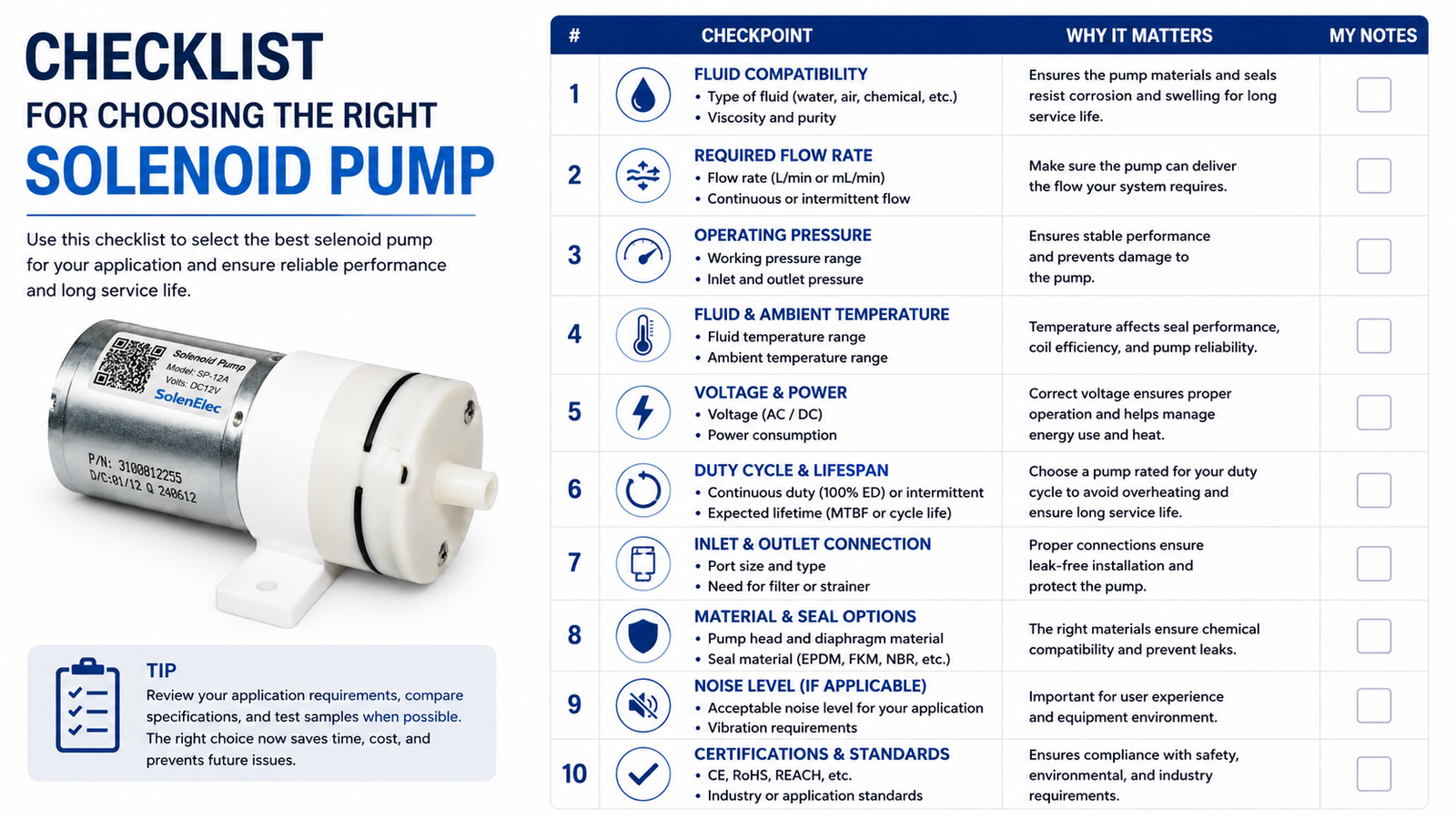
Preventing pump failure isn't about finding the "best" pump; it's about a collaborative selection process. You must give your supplier a complete picture of your application, including fluid, temperature, duty cycle, noise requirements, and target market.
The smartest procurement managers I work with don't start by asking me for my cheapest pump. They start by telling me about their product. They'll say, "We are building a steam mop for the German market. It needs to run for 30 minutes straight, be relatively quiet, and last for at least 500 hours of use." That is the beginning of a successful partnership. They are not buying a part; they are solving a problem. My job as a supplier is to use my experience to help them find the most reliable, lowest-risk solution for that specific problem. The goal is to move from a transactional relationship ("sell me this part number") to a consultative one ("help me choose the right part"). This approach doesn't just prevent failures; it builds better products and stronger brands.
Your Pre-Flight Checklist for Pump Selection
Before you send out your next Request for Quotation (RFQ), make sure you have the answers to these questions. Sharing this information with your supplier is the single most effective way to prevent future problems.
- Fluid: Exactly what is it? (e.g., Deionized water, tap water with chlorine, coffee, cleaning solution with pH 5).
- Temperature: What are the minimum, maximum, and typical operating temperatures?
- Pressure & Flow: What are your required output specifications at the point of use?
- Duty Cycle: Will it run continuously or intermittently? If intermittent, what is the on-time and off-time in seconds or minutes?
- Environment & Noise: Where will the device be used? Is it a quiet home or a noisy workshop? Is there a decibel limit?
- Market & Voltage: Where in the world will this product be sold? (e.g., Europe 230V/50Hz, North America 120V/60Hz).
- Expected Lifetime: How many hours of operation or number of cycles should the pump last?
Conclusion
Stop trying to fix broken pumps after they fail. Start by choosing the right one from the very beginning. Your brand's reputation depends on these small, critical choices.
Need Help Choosing the Right Solenoid Pump?
Most solenoid pump failures are not caused by poor product quality—they result from selecting a pump that doesn't match the application's operating conditions.
Whether you're developing coffee machines, steam appliances, medical equipment, or industrial dosing systems, our engineering team can help you choose or customize the right solution.
👉 Contact us to discuss your application requirements.
"Hydrogen embrittlement - Wikipedia", https://en.wikipedia.org/wiki/Hydrogen_embrittlement. A general engineering overview of pumps notes that misapplication—such as choosing materials incompatible with the fluid, operating at unsuitable temperatures, or specifying an inappropriate duty cycle—is a common root cause of pump failures, independent of manufacturing quality. Evidence role: expert_consensus; source type: encyclopedia. Supports: That improper pump selection with respect to fluid chemistry, operating temperature, and duty cycle is a common cause of failures across pump types.. Scope note: The source addresses pumps broadly rather than solenoid pumps specifically, so the support is contextual. ↩
"Mains electricity by country", https://en.wikipedia.org/wiki/Mains_electricity_by_country. An encyclopedia entry on mains electricity by country documents that most of Europe standardizes on 230 V at 50 Hz. Evidence role: definition; source type: encyclopedia. Supports: That the standard mains supply in most European countries is 230 volts at 50 hertz.. ↩
"Thermocouple - Wikipedia", https://en.wikipedia.org/wiki/Thermocouple. Reference material on solenoids and duty cycle notes that intermittent-duty coils are not designed for continuous energization, and prolonged use can cause overheating and failure. Evidence role: mechanism; source type: encyclopedia. Supports: That solenoids and similar coils are assigned duty-cycle ratings, and continuous energization beyond rating leads to excess heat and failure.. Scope note: The source typically discusses solenoids in general rather than pump-specific products. ↩
"Volumetric efficiency in motor-driven two-dimensional piston ...", https://pmc.ncbi.nlm.nih.gov/articles/PMC11584680/. Educational resources on pump performance explain that increased internal clearances from wear or material deformation elevate internal leakage, which decreases volumetric efficiency and output pressure. Evidence role: mechanism; source type: education. Supports: That wear-induced clearances or material deformation in positive-displacement pumps increase internal leakage, reducing delivered pressure and flow.. Scope note: Sources typically describe pump principles generally and do not isolate solenoid pumps specifically. ↩
"Acrylonitrile butadiene styrene", https://en.wikipedia.org/wiki/Acrylonitrile_butadiene_styrene. Materials references indicate that common thermoplastics (e.g., ABS, PP, some nylons) have heat deflection/softening temperatures near or below the boiling point of water, and elevated temperatures promote creep and loss of dimensional stability. Evidence role: mechanism; source type: encyclopedia. Supports: That many common thermoplastics have heat deflection or softening temperatures in the 70–100°C range and exhibit reduced mechanical stability as temperature approaches these limits.. Scope note: Exact temperatures vary by polymer grade, reinforcement, and load; the 80°C figure should be understood as an approximate threshold. ↩
"Hydraulic shock", https://en.wikipedia.org/wiki/Hydraulic_shock. An encyclopedia article on water hammer explains that sudden valve closure in rigid piping creates pressure transients that manifest as banging or knocking noises. Evidence role: definition; source type: encyclopedia. Supports: That water hammer is a pressure surge resulting from sudden changes in flow, such as rapid valve closure, often causing audible knocking.. ↩
"Net positive suction head - Wikipedia", https://en.wikipedia.org/wiki/Net_positive_suction_head. Reference material on pump cavitation describes how insufficient inlet pressure or flow causes vapor bubble formation and collapse, resulting in rattling or grinding noises and vibration. Evidence role: mechanism; source type: encyclopedia. Supports: That inadequate inlet pressure/flow (insufficient NPSH) leads to cavitation, which produces distinctive noise and vibration.. Scope note: The discussion pertains to pumps generally rather than solenoid vibratory pumps in particular. ↩
"Ozone cracking - Wikipedia", https://en.wikipedia.org/wiki/Ozone_cracking. An encyclopedia entry on nitrile rubber states that it is highly resistant to oils and fuels but has poor ozone and weathering resistance. Evidence role: definition; source type: encyclopedia. Supports: That nitrile rubber exhibits good oil resistance but poor resistance to ozone and weathering.. Scope note: Specific compatibility with particular chemicals can vary by formulation; the source provides general properties. ↩
"EPDM rubber - Wikipedia", https://en.wikipedia.org/wiki/EPDM_rubber. Reference material on EPDM notes strong resistance to hot water and steam as well as many acids and alkalis, alongside poor resistance to oils and hydrocarbons. Evidence role: definition; source type: encyclopedia. Supports: That EPDM rubber has good resistance to hot water/steam and many acids/alkalis, but poor resistance to oils and hydrocarbons.. Scope note: Exact resistance depends on compound formulation and service conditions. ↩