
Why IATF 16949 Matters for Solenoid Coil Manufacturing?
Struggling with inconsistent solenoid coils that lead to product failures? This damages your brand reputation and inflates warranty costs, eating into your profits and creating headaches you don't need.
Choosing a supplier with IATF 16949 certification1 is the solution. This standard guarantees a manufacturing process focused on defect prevention, continuous improvement, and robust traceability, bringing automotive-grade reliability to your home appliance components and reducing your long-term business risks.
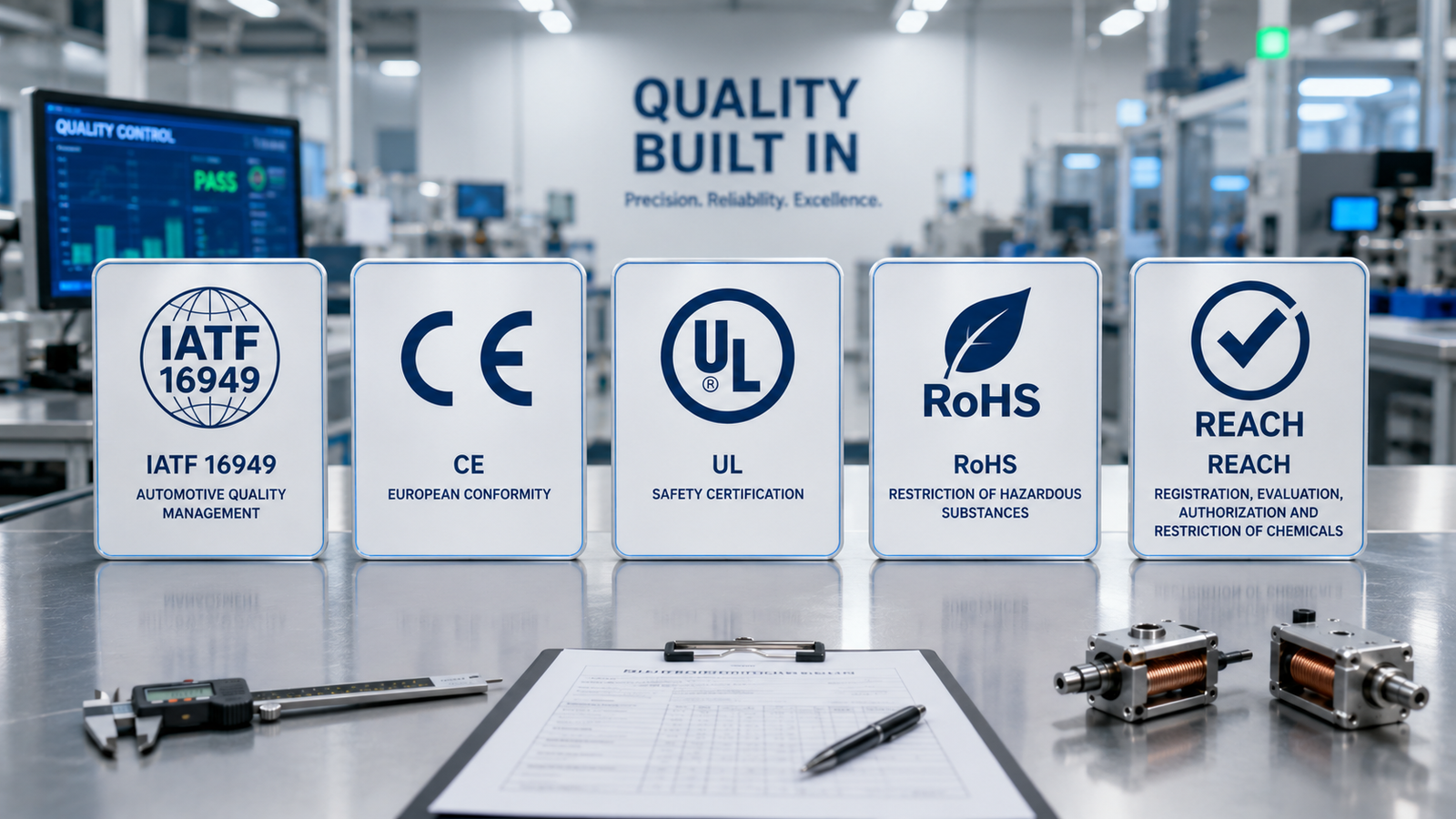
I've talked to hundreds of procurement managers over my 20 years in this industry. A common theme I see is the focus on unit price. But when a brand manager from a major European appliance company came to me after a massive field failure from another supplier, the conversation changed. He wasn't asking about price anymore. He was asking about process. He wanted to know how we could guarantee that this would never happen with our coils. The answer lies in a standard that many in the home appliance world overlook. It's not just about a certificate on the wall; it’s a completely different way of thinking about quality. This is why I believe understanding IATF 16949 is critical for any buyer who cares about long-term stability and brand reputation.
What Is IATF 16949 and Why Is It Mandatory for Automotive Solenoid Coils?
You see "IATF 16949 certified" on a supplier's website, but you're not sure what it means for your home appliances. Ignoring it could mean choosing a riskier, less reliable partner.
IATF 16949 is the global quality management standard for the automotive industry. It's mandatory because it demands extreme defect prevention and process control to ensure the safety and long-term reliability required in vehicles, where component failure is not an option.

Many people think IATF 16949 is just a more complicated version of ISO 9001, but that misses the point. ISO 9001 confirms you have a quality system in place. IATF 16949 confirms that your system is actively working to prevent defects and reduce variation in every single part you make. Think about a solenoid coil in a car's transmission system. It has to perform perfectly for over 10 years, through extreme heat, cold, and constant vibration. The standard was created to ensure that level of reliability.
When we decided to get IATF 16949 certified at SolenElec, it wasn't because we planned to enter the automotive market. We did it because we wanted to bring that same level of process discipline to the solenoid coils we make for our home appliance clients. A washing machine or coffee maker might not face the same conditions as a car, but your customers still expect it to work reliably for years. Applying automotive-grade standards is how we deliver that.
| Aspect | Typical Quality Check | IATF 16949 Approach |
|---|---|---|
| Defect Handling | Find and fix at final inspection | Prevent defects from ever happening |
| Process Control | Follow the documented instructions | Continuously monitor and reduce variation |
| Risk Management | React to failures when they occur | Proactively identify and mitigate risks upfront |
| Supplier Role | Simply fulfill the purchase order | Act as a partner in your product's quality |
How Does IATF 16949 Certification Reduce Defect Rates in Coil Winding?
A single bad batch of solenoid coils arrives and halts your entire production line. This costs you valuable time, money, and can even damage your relationship with distributors waiting for products.
IATF 16949 dramatically reduces defects by forcing a shift from final inspection to in-process control2. It mandates real-time monitoring to catch tiny deviations during the coil winding process itself, preventing an entire batch from becoming faulty.

The process of winding a solenoid coil involves thousands of turns of fine copper wire. A small change in wire tension, an incorrect turn count, or a micro-crack in the insulation can lead to a failure3 months or years down the line. A non-certified factory might wind 10,000 coils and then test a sample of 100 at the end. If the sample passes, they ship the whole batch. But what about the other 9,900 coils?
Our IATF 16949 system doesn't allow for that kind of guesswork. Every one of our eight production lines is equipped with sensors that monitor critical parameters like winding tension and turn count in real time for every single coil. This data is fed directly into our Manufacturing Execution System (MES). If the tension on a machine drifts by even a tiny fraction, an alarm alerts the operator immediately. The process is stopped, corrected, and only a handful of parts are affected, not the entire batch. I remember a case where our MES flagged a minor temperature fluctuation in the injection molding material. We stopped the line, adjusted the process, and only had to quarantine 50 units. A less rigorous system would have shipped the entire batch of 5,000, likely leading to cracking issues for the customer months later. This is the difference between catching a problem and preventing one.
What Core Tools (APQP, PPAP, FMEA) Do Solenoid Manufacturers Use Under IATF 16949?
You hear acronyms like APQP, FMEA, and PPAP4 from suppliers. You nod along, but secretly wonder if they are just buzzwords or if they actually deliver any real value to you.
These are not buzzwords; they are the structured tools we use to guarantee quality. APQP plans for success, FMEA proactively identifies risks before production, and PPAP proves that our manufacturing process is stable and capable of meeting your specs consistently.

Let me break these down in terms of what they mean for you, the buyer. These tools are a core part of the IATF 16949 framework, and they transform the supplier relationship from a simple transaction to a true partnership.
APQP (Advanced Product Quality Planning): Think of this as the master blueprint for your project. Before we even make a single prototype of your custom coil, we use APQP to map out every single step. This includes design verification, material selection, tooling creation, and packaging. It ensures that we both agree on the definition of success and have a clear plan to get there, eliminating surprises during launch.
FMEA (Failure Mode and Effects Analysis): This is our structured "what-if" process. My engineering team and I sit down and brainstorm everything that could possibly go wrong. What if the copper wire has a hidden flaw from our supplier? What if the bobbin material is slightly out of spec? We then rank these potential failures by severity and likelihood, and build specific controls into our process to prevent them. For you, this means we've already done the worrying and problem-solving upfront.
PPAP (Production Part Approval Process): This is the final exam before we start mass production. We run parts on the actual production line, measure them, and give you a comprehensive report. This PPAP submission is not a promise; it's documented proof, with real data, that our process is capable and stable. It gives you the confidence to approve the part, knowing it can be made to your specifications over and over again.
| Tool | What It Is | Why It Matters to You (the Buyer) |
|---|---|---|
| APQP | A shared project plan for quality | Ensures a smooth, predictable product launch with no surprises. |
| FMEA | A proactive risk assessment | We find and solve potential problems before they ever reach you. |
| PPAP | A process validation data package | Gives you hard evidence that we can make your part correctly, every time. |
How Does an IATF 16949 Supply Chain Prevent Field Failures and Recalls?
A product recall due to one small, faulty component is every brand manager's worst nightmare. The financial costs and damage to your brand's reputation can be immense and long-lasting5.
An IATF 16949 system prevents recalls through mandatory end-to-end traceability and strict sub-supplier management6. We can trace every raw material in every coil back to its origin, allowing us to contain issues before they become widespread field failures.
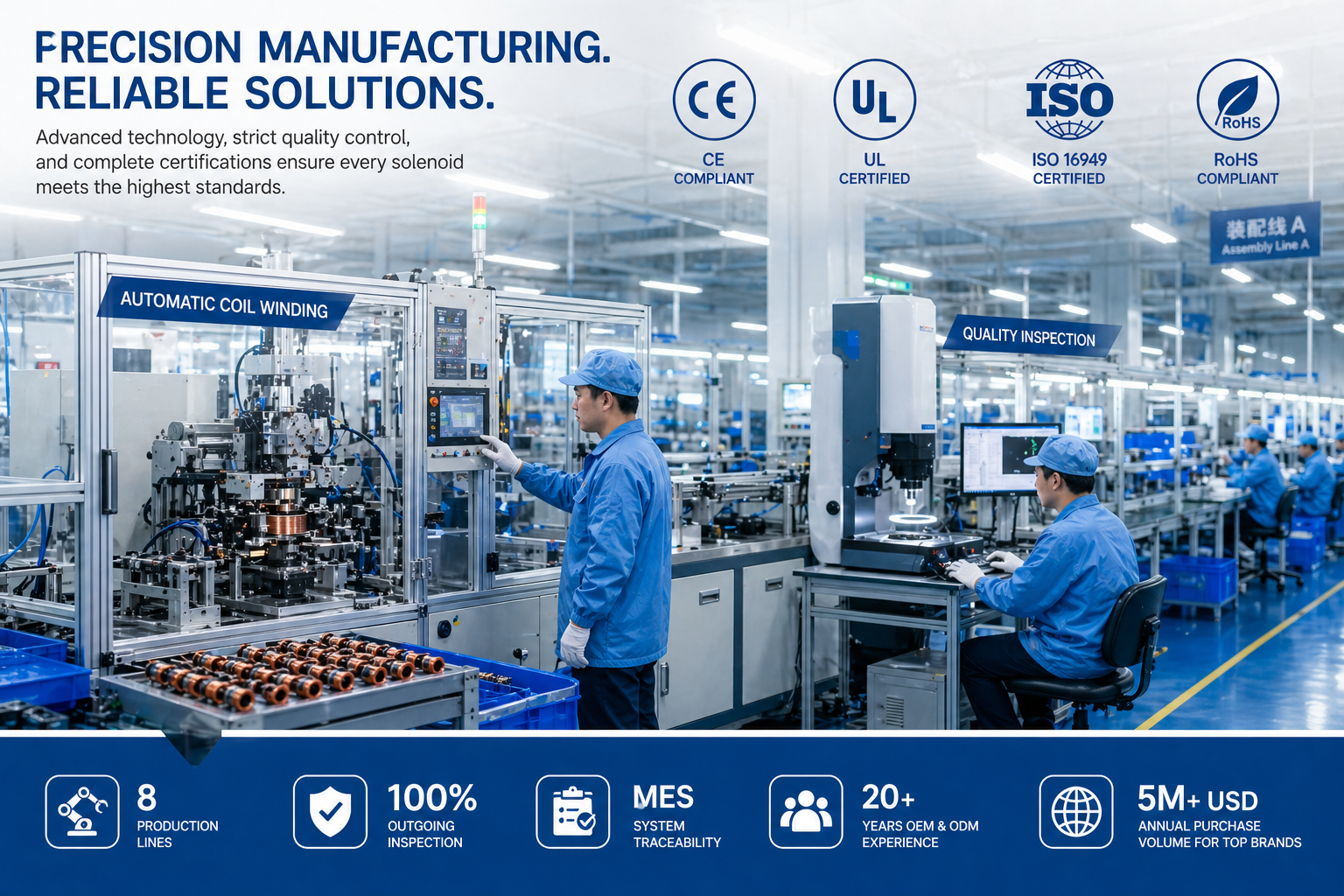
The IATF 16949 standard requires us to apply the same level of rigor to our suppliers as we apply to ourselves. We can't just buy the cheapest copper wire or plastic resin on the market. We are required to audit our key suppliers, verify their quality controls, and demand certificates of conformity for every batch of material they send us. This is the first line of defense.
The second, and perhaps most powerful, line of defense is our traceability system. Our MES system links every single solenoid coil we produce to a specific production run, machine, operator, and date. More importantly, it links it to the exact batches of raw materials used—the specific lot of copper wire, the specific batch of plastic for the bobbin.
Imagine this scenario: a year after launch, a few of your coffee makers are failing in the field due to a faulty solenoid coil. You give us the serial numbers from the failed units. Within minutes, I can use our MES to trace those specific coils back to their production date. I can see that they were all made in the same week and used copper wire from Batch #A582 from our supplier. We can immediately quarantine any remaining stock made with that same batch. We can also provide you a list of every other product we shipped to you containing coils from that batch. This allows you to contain the problem to a few hundred units instead of recalling tens of thousands. That is how you turn a potential catastrophe into a manageable quality issue.
What Is the ROI of Partnering with an IATF 16949 Certified Solenoid Manufacturer?
You know that IATF 16949 certified suppliers often have a slightly higher unit price. Your boss wants you to cut costs, making it a difficult choice to justify the premium.
The ROI comes from a dramatically lower total cost of ownership. You save money on fewer warranty claims, zero production line stops, no recall expenses, and less time spent managing supplier issues. It's an investment that protects your brand's reputation.

It’s true that a coil from an IATF 16949 certified facility might cost a few cents more than one from a standard factory. But focusing only on the unit price is a classic mistake. As a procurement or brand manager, your goal is to manage total cost and risk, not just the price on an invoice. The "cheaper" supplier often comes with a mountain of hidden costs that you end up paying for later.
Let's look at the real costs. There are the internal costs of your team having to inspect every batch of incoming parts because you can't trust the supplier's quality. There are the huge costs of stopping your assembly line because a batch of coils was out of spec. Then there are the external costs: processing warranty claims, shipping replacement parts, and paying for technician visits. Finally, there's the cost you can't even measure: the damage to your brand from negative reviews and a loss of customer trust.
Partnering with an IATF 16949 certified manufacturer like us is an investment in predictability. You are buying peace of mind. The small premium you pay upfront is your insurance against these much larger, unpredictable costs down the road.
| Cost Factor | "Cheaper" Non-Certified Supplier | IATF 16949 Certified Partner |
|---|---|---|
| Unit Price | Low | Slightly Higher |
| Internal Quality Costs | High (Line stoppages, inspection) | Very Low |
| Warranty & Recall Risk | High and Unpredictable | Minimal and Contained |
| Brand Reputation Risk | High | Low |
| Total Cost of Ownership | Unpredictable & Potentially Massive | Predictable & Lower Overall |
Ultimately, you are not just buying a solenoid coil. You are buying a reliable component that will perform flawlessly inside your product for years, protecting the brand you have worked so hard to build.
Conclusion
IATF 16949 isn't just an automotive standard. For home appliance brands, it’s a strategic framework for manufacturing excellence that reduces risk, lowers total costs, and secures your brand’s reputation.
"IATF 16949 - Wikipedia", https://en.wikipedia.org/wiki/IATF_16949. The International Automotive Task Force describes IATF 16949 as an automotive quality-management standard built on ISO 9001 with additional requirements for defect prevention, continual improvement, and reduction of variation and waste; this supports the process-focus claim but does not prove that any individual certified supplier will eliminate defects. Evidence role: definition; source type: institution. Supports: IATF 16949 specifies automotive quality-management requirements emphasizing defect prevention, continual improvement, variation reduction, and supply-chain controls.. Scope note: Certification supports the existence of a compliant management system, not a guarantee of defect-free output. ↩
"[PDF] NIST.SP.800-53r5.pdf", https://nvlpubs.nist.gov/nistpubs/SpecialPublications/NIST.SP.800-53r5.pdf. Quality-engineering guidance, including statistical process control references, explains that monitoring process variation during production can detect abnormal conditions earlier than end-of-line inspection; this supports the article’s process-control rationale but does not by itself quantify the effect of IATF 16949 certification. Evidence role: mechanism; source type: government. Supports: Quality-management and statistical process control literature emphasizes controlling processes during production to prevent or detect variation earlier than final inspection alone.. Scope note: The support is general quality-engineering evidence, not direct proof of defect reduction in the named factory. ↩
"Effect of Winding Tension on Electrical Behaviors of a No-Insulation ...", https://pmc.ncbi.nlm.nih.gov/articles/PMC7453491/. Research on wound-coil manufacturing and magnet-wire insulation reliability shows that winding parameters and insulation defects can influence coil electrical characteristics and failure modes; this supports the mechanism, though the timing of field failure depends on operating conditions and component design. Evidence role: mechanism; source type: paper. Supports: Manufacturing variation and insulation damage in wound coils can affect electrical performance and reliability, including resistance, inductance, short circuits, and insulation breakdown.. Scope note: The support is mechanistic and may not directly quantify failure rates for the article’s specific solenoid coils. ↩
"Quality Core Tools Training in Tennessee | APQP, FMEA, SPC", https://tmep.cis.tennessee.edu/quality-core-tools. Automotive Industry Action Group core-tool materials define APQP as structured quality planning, FMEA as systematic failure-risk analysis, and PPAP as production-part approval evidence, supporting the article’s explanation of these tools in an IATF 16949 context. Evidence role: definition; source type: institution. Supports: APQP, FMEA, and PPAP are recognized automotive quality-planning, risk-analysis, and production-part approval methods associated with IATF 16949 implementation.. Scope note: The source defines and contextualizes the tools but does not prove that a specific supplier applies them effectively. ↩
"[PDF] Brand Reputation and Product Recall - Scholar Commons", https://scholarcommons.sc.edu/cgi/viewcontent.cgi?article=1454&context=etd. Academic studies of product recalls report that recalls can reduce firm value, increase direct remediation costs, and harm consumer perceptions of the affected brand; this supports the article’s risk framing, although impacts vary by industry, recall severity, and company response. Evidence role: statistic; source type: paper. Supports: Empirical research links product recalls to financial losses, adverse market reactions, and reputational effects for firms.. Scope note: The support is general across product recalls and may not quantify costs for home-appliance solenoid failures specifically. ↩
"IATF 16949:2016 Clause 8.5.2.1 Identification and traceability", https://preteshbiswas.com/2023/08/01/iatf-169492016-clause-8-5-2-1-identification-and-traceability/. IATF 16949 implementation guidance describes requirements for control of externally provided products and services, supplier development, and product traceability, supporting the article’s claim that certified systems emphasize sub-supplier management and traceable production records. Evidence role: general_support; source type: institution. Supports: IATF 16949 includes requirements related to product identification, traceability, supplier control, and supplier quality development in automotive supply chains.. Scope note: The source supports the presence of requirements, not the completeness or speed of any individual company’s traceability system. ↩