
What is a Car Solenoid? How This Tiny Component Powers Your Vehicle’s Vital Systems
Your brand's reputation hinges on reliability, yet a tiny component can cause massive recalls. The car solenoid, often overlooked, poses a significant risk if not sourced with extreme care.
A car solenoid is an electromagnetic component that acts as a switch or valve1 in systems like the starter, transmission, and fuel lines. For procurement managers, its true definition is a critical risk point where manufacturing consistency, guaranteed by IATF 16949 certification2, is essential for vehicle reliability.

As a partner to automotive brands for over 20 years, I've seen how sourcing decisions on seemingly simple parts can have huge consequences. The question isn't just "What is a car solenoid?" but "How can I guarantee every single solenoid I purchase meets the extreme demands of the automotive world?" The answer lies less in the component's textbook definition and more in the supplier's manufacturing discipline. A failure here doesn’t just mean a faulty part; it means warranty claims, brand damage, and potential safety issues. Let's look at this from a risk management perspective.
How Does a Car Solenoid Work, and What Does That Mean for Automotive Reliability?
You see a simple component, but a slight deviation in its function can cause catastrophic system failure. Understanding the core mechanism is the first step to managing its associated risks.
A car solenoid works by converting electrical energy into linear motion3. When an electric current passes through its copper coil, it generates a magnetic field that moves a metal plunger, either opening a valve or closing an electrical circuit. This simple action powers countless vehicle functions.

From a manufacturing standpoint, this "simple action" is incredibly complex to replicate millions of times with zero deviation. Every part of the process is a potential point of failure if not rigorously controlled. As an IATF 16949 certified manufacturer, we view every component through the lens of risk and process control.
The Science of Failure Prevention
The physics are straightforward, but the manufacturing execution is what separates a reliable component from a liability. Here’s how we break it down:
- The Coil: This is the heart of the solenoid. The purity of the copper wire and the consistency of the winding determine the strength of the magnetic field and the amount of heat generated. Inconsistent winding tension can create hotspots, leading to premature coil burnout.4 An IATF 16949 quality system mandates strict controls on incoming materials and automated winding processes to ensure every coil performs identically.
- The Plunger: This is the moving part. Its movement must be fast and precise. The material selection is critical for wear resistance, and the manufacturing tolerances are measured in microns. Any contamination during assembly can cause the plunger to stick, leading to a system that's either stuck open or closed.
A common issue we help clients troubleshoot is a solenoid that fails field tests despite meeting an RFQ's specs. The problem is often a mismatch between the spec and the real-world application, a classic example of which is the duty cycle.
| Duty Cycle Mismatch | Application Requirement | Consequence of Using Incorrect Solenoid |
|---|---|---|
| Intermittent | Starter Solenoid (On for seconds) | A continuous-duty solenoid would be over-engineered and costly. |
| Continuous | Transmission Solenoid (On for hours) | An intermittent-duty solenoid would quickly overheat and burn out. |
This is why our first question is never "What are the specs?" but "What is the application and environment?" Understanding this prevents predictable failures.
What Are the Different Types of Automotive Solenoids, and Why Can't You Treat Them All the Same?
Thinking all solenoids are the same is a costly mistake that can compromise vehicle systems. Each application has wildly different demands, and the risks of misapplication are enormous.
Common automotive solenoids include starter, transmission, fuel injector, and Variable Valve Timing (VVT) solenoids. Each type has unique requirements for power, speed, heat resistance, and operational life, making application-specific engineering and sourcing absolutely critical for reliability.
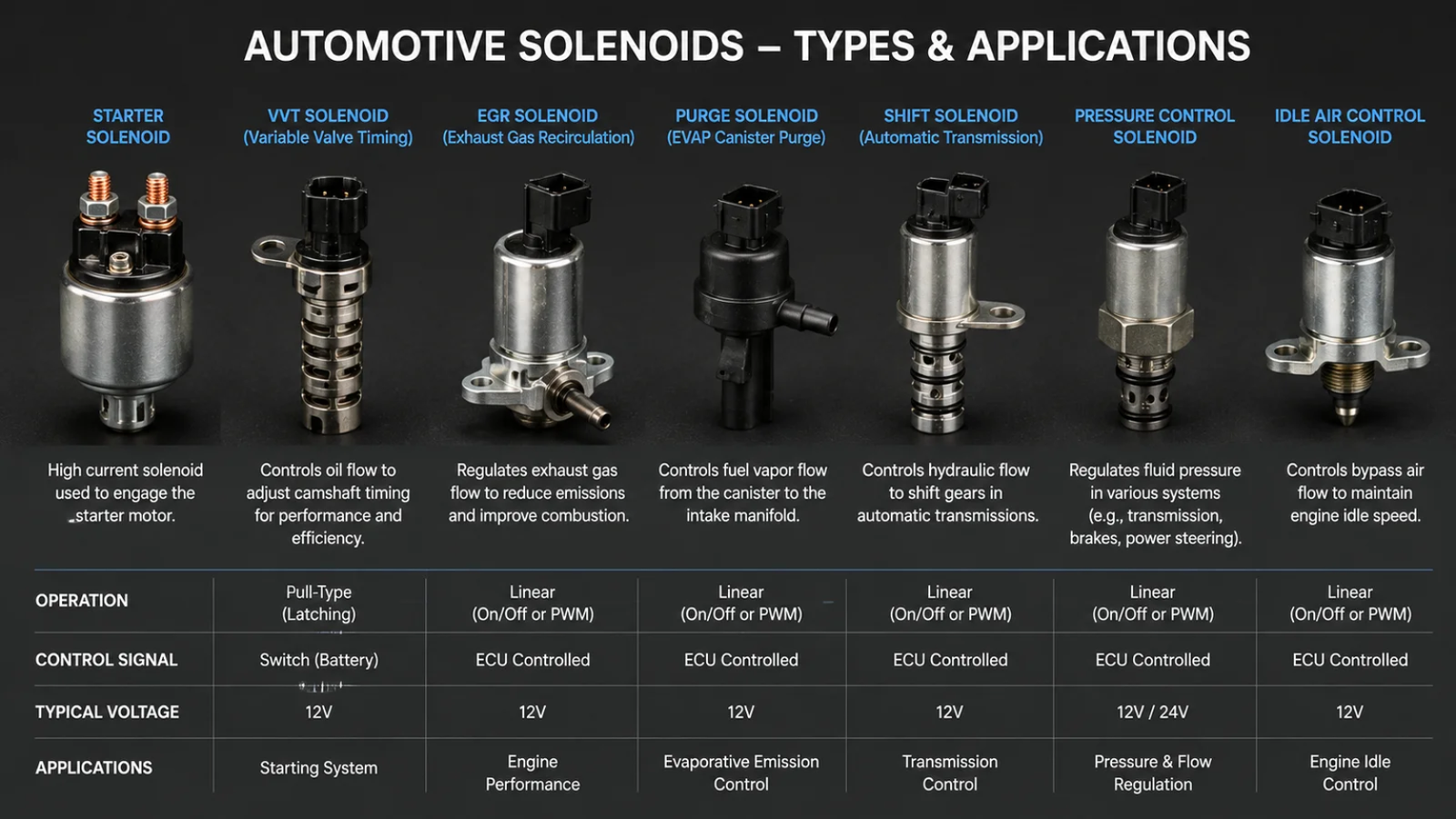
In my experience, the most significant supply chain risks arise when a component is treated like a commodity. A "solenoid" is not a single part; it's a category. Sourcing a VVT solenoid, which operates in hot engine oil5, from a supplier who specializes in simple door lock solenoids is a recipe for disaster. The supplier must demonstrate deep expertise not just in solenoids, but in the specific automotive system it will serve. This is a core principle of the IATF 16949 standard—context and application risk are paramount.
A Risk Matrix for Procurement
For a procurement manager, knowing the different types is less about technical trivia and more about understanding the different risk profiles. Let’s compare a few to illustrate the point.
| Solenoid Type | Key Function | Primary Challenge | Manufacturing Focus |
|---|---|---|---|
| Starter Solenoid | High-current switch to engage the starter motor. | Massive electrical load for a short duration. | Robust contacts and high-purity copper windings. |
| Transmission Solenoid | Precision valve controlling hydraulic fluid flow for gear changes. | Continuous operation, high precision, and fluid immersion. | Extreme lifecycle testing, chemical-resistant materials, clean-room assembly. |
| VVT Solenoid | Controls engine oil flow to adjust valve timing. | High temperatures, oil contamination, and precise response. | Thermal shock resistance, high-temperature polymers, and filtration. |
| Fuel Injector Solenoid | Ultra-fast valve controlling fuel delivery. | Microsecond response times and extreme precision over billions of cycles.6 | Sub-micron tolerances, specialized materials, and automated precision assembly. |
As you can see, the manufacturing capabilities required for a fuel injector are vastly different from those for a starter solenoid. When we partner with an OEM, we develop a specific Process FMEA (Failure Mode and Effects Analysis) for each unique part number. This is a requirement under IATF 16949 and it’s how we ensure that the unique risks of each solenoid type are systematically neutralized before the first part is even produced.
What Are the Symptoms of a Bad Car Solenoid, and How Do They Trace Back to Manufacturing?
A clicking sound might seem like a simple mechanical failure. But for a brand manager or quality engineer, it's a potential recall that points directly back to a process failure in manufacturing.
Common symptoms include a clicking noise without the engine starting (starter solenoid)7, erratic gear shifting (transmission solenoid), or poor engine performance (VVT or fuel solenoid). These field failures often trace back to manufacturing inconsistencies, material defects, or incorrect component selection—risks that are systematically mitigated by a certified IATF 16949 quality system.

I don't provide car repair advice. My job is to prevent the failure from ever happening. When a client reports a field failure, our IATF 16949 certified process requires us to perform a root cause analysis. This isn't about blaming a worker; it's about finding the weakness in the system that allowed the defect to occur. Over 20 years, I’ve learned that almost all "random" field failures are predictable symptoms of uncontrolled manufacturing processes. The symptoms you see in the field are the final, costly result of a problem that began on the factory floor.
From Symptom to Root Cause: A Quality Manager's View
Let's connect common field symptoms to their manufacturing root causes. This is how a quality-focused supplier thinks about preventing problems, not just reacting to them.
-
Symptom: The infamous "click, click, click" with no engine crank.
- Field Diagnosis: Bad starter solenoid.
- Manufacturing Root Cause: Most likely, the coil generated a weak magnetic field, insufficient to fully engage the plunger. This can be caused by inconsistent copper wire diameter or variations in winding tension.
- IATF 16949 Control: Our system mandates 100% electronic testing of coil resistance on the production line and strict audits of our copper suppliers. Every spool of wire is traceable.
-
Symptom: Rough or delayed automatic gear shifting.
- Field Diagnosis: Failing transmission solenoid.
- Manufacturing Root Cause: A sticky or slow-moving plunger. This is often caused by microscopic burrs on the plunger shaft or contamination from the assembly environment8 that causes drag when heated by transmission fluid.
- IATF 16949 Control: We use automated optical inspection (AOI) to detect surface imperfections and perform assembly in a controlled, positive-pressure environment to eliminate airborne contaminants. Full traceability via our MES system allows us to isolate any batch if a problem is ever detected.
This systematic approach is the only way to build confidence when you are shipping millions of components that will be buried deep inside a vehicle for the next decade.
Starter vs. Transmission Solenoid: Why Are These Two Components So Different?
They both use electromagnetism and the word "solenoid" is in their name, but their functions are worlds apart. Confusing their requirements is a critical error for any automotive purchasing team.
A starter solenoid is a brute-force, high-current switch designed for short, powerful bursts of work. A transmission solenoid is a high-precision, continuous-duty hydraulic valve built for endurance and finesse. Their operational demands and failure modes are completely different.

I often get RFQs from potential clients that list generic "solenoid" specifications. This is a major red flag. It tells me that the procurement team may not fully appreciate the application-specific risks. One of my first tasks is to educate them on why a starter solenoid supplier is not automatically qualified to produce a transmission solenoid, and vice-versa. The expertise doesn't lie in winding coils; it lies in mastering the entire system of design, materials, and process control for a specific, hostile automotive environment.
A Procurement Guide to Their Differences
Understanding these differences is key to making an informed sourcing decision and mitigating risk. Here is how I explain it to our OEM partners:
| Feature | Starter Solenoid | Transmission Solenoid | Procurement Implication |
|---|---|---|---|
| Function | Electrical Switch (On/Off) | Proportional Hydraulic Valve (Modulating) | Requires entirely different testing equipment and quality control parameters. |
| Duty Cycle | Intermittent (seconds) | Continuous (hours) | The material for the coil bobbin and housing must have superior, long-term heat dissipation properties. |
| Environment | Engine bay (air, heat, vibration) | Inside transmission (hot hydraulic fluid) | Materials must be certified for chemical compatibility to prevent swelling, cracking, or degradation. |
| Lifecycle | ~200,000 starts9 | Hundreds of millions of cycles10 | Demands different approaches to material fatigue testing and validation. |
| Failure Impact | Vehicle won't start. | Erratic shifting, limp mode, potential transmission damage. | Both are severe, but a transmission failure often leads to higher warranty costs. |
When you are qualifying a supplier, you must ask for their experience and quality data related to the specific application. Ask to see their lifecycle test data for continuous-duty solenoids operating in hot oil, not just their standard electrical test reports. This is how you move from buying a part to sourcing a reliable solution.
How Can You Ensure Long-Term Solenoid Reliability in Your Vehicles?
You can't "maintain" a sealed solenoid after it's installed, but you can prevent failures from ever happening. The secret to long-term reliability is locked in during the initial sourcing and manufacturing stages.
True solenoid reliability is not about maintenance; it is engineered from the start. It is achieved by partnering with an IATF 16949 certified manufacturer who can prove process control, full material traceability, and consistent quality, thereby extending component life and minimizing field failures.

In the automotive industry, hope is not a strategy. You cannot hope that your supplier will send you good parts. You need a system that guarantees it. For decades, my work has been focused on building and refining these systems. The goal is to make quality so consistent that it becomes boringly predictable. For a procurement or quality manager at a global automotive brand, "boring" is the best news you can get from a supplier. Predictability means reliability, and reliability builds brand value. Here’s how you achieve it.
The Procurement Strategy for Zero-Defect Sourcing
Forget "maintenance tips." Here are the strategic pillars for ensuring the solenoids in your vehicles last.
-
Source a System, Not a Part Number: The most important shift is to stop buying a "solenoid" and start sourcing a "solution for transmission fluid control" or a "solution for starter motor engagement." This forces your supplier to demonstrate that they understand the entire automotive system, its stresses, and its failure modes. A supplier who only talks about their coil winding specs doesn't understand your real-world risk.
-
Make IATF 16949 Certification a Non-Negotiable Prerequisite: This is the global quality standard for the automotive industry.11 It's not just a certificate on the wall. It's a fundamental commitment to a culture of risk management. It legally requires us to maintain Control Plans, FMEAs, and complete traceability for every single component.12 If a defect is found, I can use our MES traceability system to identify every part from the same batch, the same machine, and the same raw material lot within minutes. This capability is essential for managing risk in a global supply chain.
-
Audit the Process, Not Just the Part: A perfect sample batch is easy to make. What you need to know is whether the millionth part will be identical to the first. During a supplier audit, ask to see their process controls. Ask them to demonstrate traceability. How do they control the viscosity of the plastic for the injection molding process? How do they verify the purity of their incoming copper wire? A strong, IATF 16949-certified partner will welcome these questions. A weak one will give you excuses.
Ultimately, extending the life of your vehicle's solenoids has very little to do with the vehicle itself and everything to do with the rigor and discipline of the manufacturing partner you choose.
Conclusion
A car solenoid is more than just a part; it's a promise of reliability. Ensuring that promise requires a manufacturing partner with a robust, certified quality system like IATF 16949.
"Solenoid (engineering) - Wikipedia", https://en.wikipedia.org/wiki/Solenoid_(engineering). Sources in electrical and automotive engineering define a solenoid as a type of electromagnet that converts electrical energy into linear motion, commonly used to actuate a switch or a valve in various vehicle systems. Evidence role: definition; source type: encyclopedia. Supports: The source should define a solenoid as an electromechanical device that uses an electromagnet to produce linear motion, often used as a switch or valve.. ↩
"IATF 16949 - Wikipedia", https://en.wikipedia.org/wiki/IATF_16949. The IATF 16949 standard specifies the quality management system requirements for the automotive industry, with a focus on developing a process-oriented system that provides for continual improvement, defect prevention, and the reduction of variation and waste. Evidence role: definition; source type: institution. Supports: The source should describe IATF 16949 as the international quality management system standard for the automotive industry, focused on defect prevention, risk mitigation, and the reduction of variation and waste in the supply chain.. Scope note: The standard provides a framework for quality management and risk mitigation; it does not in itself 'guarantee' that no defects will occur, but rather that robust processes are in place to minimize their likelihood and manage them when they do. ↩
"Solenoid (engineering) - Wikipedia", https://en.wikipedia.org/wiki/Solenoid_(engineering). Physics principles state that a solenoid operates by passing an electric current through a coil of wire, which generates a magnetic field that pulls a movable plunger (or core) along the coil's axis, thereby converting electrical energy into mechanical linear motion. Evidence role: mechanism; source type: encyclopedia. Supports: The source should explain that when current flows through the coil of a solenoid, it creates a uniform magnetic field that exerts a force on a ferromagnetic plunger, causing it to move linearly.. ↩
"[PDF] A SYSTEMS APPROACH TO REDUCING WINDING DEFECTS AT ...", https://openresearch.okstate.edu/server/api/core/bitstreams/c5d493ad-ad07-4f43-b034-adf7dfba2346/content. Studies on the reliability of electromagnetic coils confirm that manufacturing defects, such as inconsistent winding tension, can alter the local current density and thermal dissipation, leading to the formation of hotspots that can cause the wire's insulation to break down and result in coil burnout. Evidence role: mechanism; source type: paper. Supports: The source should discuss failure analysis of electromagnetic coils, noting that variations in winding density or tension can lead to non-uniform current distribution and thermal resistance, creating localized "hotspots" that accelerate insulation degradation and cause premature failure.. ↩
"Variable valve timing - Wikipedia", https://en.wikipedia.org/wiki/Variable_valve_timing. Automotive engineering resources explain that Variable Valve Timing (VVT) systems typically use an oil control solenoid to regulate the flow of pressurized engine oil to cam phasers, requiring the solenoid to function while immersed in hot, and potentially contaminated, motor oil. Evidence role: general_support; source type: education. Supports: The source should explain that Variable Valve Timing (VVT) systems use oil control valves (solenoids) to direct pressurized engine oil to actuators that change the camshaft timing, meaning these solenoids are submerged in and must operate reliably within hot engine oil.. ↩
"Gasoline direct injection - Wikipedia", https://en.wikipedia.org/wiki/Gasoline_direct_injection. Technical papers on modern gasoline direct injection (GDI) systems document the performance requirements for fuel injectors, which include actuation response times measured in microseconds and durability testing that simulates billions of cycles to ensure performance over the vehicle's lifespan. Evidence role: statistic; source type: paper. Supports: The source should provide technical specifications for modern fuel injectors, particularly solenoid-based ones, indicating response times (opening/closing times) in the microsecond range and durability requirements rated for the lifetime of the vehicle, which translates to billions of cycles.. Scope note: Specific performance varies between injector types (e.g., solenoid vs. piezo) and application, but the general order of magnitude for response time and required durability is supported. ↩
"Signs of a Bad Starter Relay or Struggling Solenoid - Hogan & Sons", https://www.hoganandsonsinc.com/blog/signs-of-a-bad-starter-relay-or-struggling-solenoid. Automotive diagnostic guides list a distinct clicking sound without engine cranking as a primary symptom of a faulty starter solenoid. This occurs when the solenoid's electromagnet successfully moves the plunger but the high-current contacts fail to close or pass sufficient current to the starter motor. Evidence role: case_reference; source type: other. Supports: The source should identify a rapid clicking sound as a classic symptom of a failing starter solenoid, explaining that the solenoid is engaging but lacks the power or has worn contacts to pass the high current needed to turn the starter motor.. ↩
"Reliability and life study of hydraulic solenoid valve. Part 2", https://www.eng.auburn.edu/~choeson/Publication/1132_2009_Reliability%20and%20life%20study%20of%20hydraulic%20solenoid%20valve-Part%202%20_S.%20V.%20Angadi,%20R.%20L.%20Jackson.pdf. Failure analysis studies of hydraulic components, including transmission solenoids, identify particulate contamination and manufacturing imperfections such as microscopic burrs on moving parts as primary causes of stiction, where the valve plunger fails to move freely, leading to erratic operation. Evidence role: mechanism; source type: paper. Supports: The source should discuss the failure modes of hydraulic solenoids, noting that 'stiction' (static friction) can be caused by particulate contamination or surface imperfections (like burrs from machining) on the plunger or valve body, which impede smooth movement.. ↩
"Stop and Restart Effects on Modern Vehicle Starting System ...", https://publications.anl.gov/anlpubs/2015/05/115925.pdf. Automotive engineering design and validation standards for starter motors and solenoids often specify a target lifecycle of over 150,000 start cycles to ensure durability for the expected life of the vehicle. Evidence role: statistic; source type: education. Supports: The source should provide typical design life or validation testing requirements for automotive starter systems, indicating a target number of start cycles in the range of 150,000 to 250,000.. Scope note: The exact number can vary based on vehicle type (e.g., standard vs. start-stop vehicle) and manufacturer specifications, but 200,000 is a representative figure for design life targets. ↩
"Long-Term Durability of Transcatheter Heart Valves - PubMed", https://pubmed.ncbi.nlm.nih.gov/31575516/. Durability analysis for automatic transmission components shows that control solenoids, which may actuate multiple times during a single drive, are designed and tested to withstand hundreds of millions of operational cycles to ensure reliability over the vehicle's service life. Evidence role: statistic; source type: paper. Supports: The source should discuss the durability requirements for continuously-acting components in an automatic transmission, explaining that solenoids may cycle multiple times per gear shift, leading to a cumulative lifecycle requirement in the hundreds of millions or even billions of cycles over the vehicle's lifetime.. ↩
"International Automotive Task Force - Wikipedia", https://en.wikipedia.org/wiki/International_Automotive_Task_Force. The International Automotive Task Force (IATF), the body that oversees the standard, defines IATF 16949 as the global technical specification and quality management standard for the automotive industry. Evidence role: definition; source type: institution. Supports: The source, ideally the International Automotive Task Force (IATF) itself, should state that IATF 16949, in conjunction with ISO 9001, defines the fundamental quality management system requirements for automotive production and service parts organizations.. ↩
"[PDF] IATF 16949 - Customer Specific Requirements", https://www.iatfglobaloversight.org/wp/wp-content/uploads/2019/05/IATF-16949-GM-CSR-May-2019-_V4.pdf. The IATF 16949 standard explicitly requires certified organizations to implement core quality tools, including the use of Failure Mode and Effects Analysis (FMEA) for risk management, the development of Control Plans for all stages of production, and the establishment of a traceability system that can identify product down to the raw material lot. Evidence role: general_support; source type: institution. Supports: The source should reference the specific clauses within the IATF 16949 standard that mandate the use of risk analysis (like FMEA), the development of Control Plans, and the implementation of a robust traceability system.. Scope note: The term 'legally requires' is contextual; the standard is a contractual requirement for doing business with most automotive OEMs, rather than a government law. ↩