
What Defines High Performance Linear Solenoids? A Complete Guide to Power, Speed, and Durability
Struggling with complex solenoid spec sheets? Choosing the wrong component can lead to product failures and high warranty costs, but understanding the key trade-offs makes the decision simple.
"High performance" in a linear solenoid isn't about a single top specification. It is the optimal balance of force, speed, and durability1 tailored precisely to your application. The best solenoid is the one that reliably does its specific job for the longest time.

As a procurement manager, you are constantly balancing cost, quality, and risk. When it comes to a component like a solenoid, the spec sheet can feel like a list of compromises. A supplier might show you a solenoid with massive force, but they might not mention it runs hot and has a short life. Another might be incredibly fast, but too weak for your needs. The truth I've learned from over 20 years of helping European appliance brands is that the concept of a single "best" solenoid is a myth. The real goal is finding the smartest trade-offs for your specific product. This is how you move from just buying a part to making a strategic sourcing decision that protects your brand and your bottom line. Let's break down what those trade-offs really look like.
High Force vs. High Speed: How Do You Select the Right Linear Solenoid for Your Appliance?
Your design needs both powerful actuation and quick response. But choosing one often means sacrificing the other, complicating your selection. The key is to prioritize based on the appliance's primary function.
For high force, you need more coil windings and power, which can slow response time and generate more heat. For high speed, a lighter plunger and optimized magnetic circuit are key, but this reduces available force. The choice depends entirely on the application's core requirement.

When we get a request for a "high-force, high-speed" solenoid, my first question is always: "Which one is more important?" The physics are straightforward. Force is generated by the magnetic field, which is a function of the coil's windings and the current. More windings or more current equals more force. However, more windings add weight and electrical inductance, slowing down the solenoid2. A heavier plunger also takes more time to accelerate. On the other hand, a high-speed solenoid is designed for minimum mass and rapid magnetic field buildup. It has a light plunger and a coil optimized for quick energization, but this design simply cannot generate the same magnetic flux as a high-force model.
Application Determines Priority
Let's look at two common home appliance examples.
- Smart Door Lock: The primary need is high force. The solenoid must engage a heavy bolt and hold it securely. It only operates a few times a day. Speed is secondary.
- Espresso Machine Valve: The primary need is high speed. The solenoid must open and close very quickly, often multiple times, to precisely control water flow for a perfect shot. The force required is relatively low.
Making the Right Choice
As a purchasing manager, your job is to communicate the application's priority to your supplier.
| Factor | Smart Door Lock | Espresso Machine Valve |
|---|---|---|
| Primary Need | High Force | High Speed |
| Solenoid Choice | Larger coil, stronger magnetic path | Lighter plunger, optimized coil |
| The Trade-Off | Slower actuation, higher power draw | Lower force output |
| Key Question for Supplier | "What is the holding force at the required stroke?" | "What is the response time (pull-in and drop-out)?" |
Don't just ask for peak force. Ask for the force-speed curve to see how the solenoid behaves through its entire stroke. A good supplier can help you interpret this data in the context of your specific appliance.
What Key Design Factors Ensure a Long-Life Linear Solenoid?
Your solenoids are failing prematurely in the field. This damages your brand's reputation for quality and drives up warranty costs. The solution is to focus on material quality and construction details.
A long-life solenoid depends on superior materials and precision manufacturing. This includes high-purity copper wire, heat-resistant bobbins, durable plunger coatings, and low-friction bushings. These components prevent overheating and mechanical wear, the two main causes of failure3.

Many procurement managers focus on the big three specs: force, stroke, and duty cycle. But I've seen countless field failures that had nothing to do with those numbers. The problem was a component made with substandard materials that couldn't handle the stress of real-world use. A solenoid's lifespan is determined by its ability to manage heat and friction over millions of cycles. This is purely a function of the quality of its internal components. A supplier that saves a few cents on the bobbin material or the plunger coating is passing a huge reliability risk on to you.
Material Selection is Everything
The "invisible" parts of a solenoid are what determine its durability. When we build solenoids for top European brands, the discussion always includes a deep dive into materials.
- Coil Wire: We use high-purity copper wire. Lower-purity wire has higher resistance, which means it generates more heat for the same amount of force. Excess heat is the number one enemy of a solenoid's life, as it degrades insulation and leads to electrical shorts.4
- Bobbin: The bobbin holds the copper coil. A cheap bobbin made from standard plastic will deform under heat. We use engineering plastics like PA66 or PBT, often with glass fiber reinforcement5, which maintain their shape and insulating properties even at high operating temperatures.
The Unsung Heroes: Coatings and Bushings
Friction is the second great enemy of solenoid life.
| Component | Standard Quality | High-Durability Quality | Impact on Lifespan |
|---|---|---|---|
| Plunger Coating | None or simple plating | PTFE (Teflon) or specialized low-friction coating6 | Reduces friction, prevents sticking, ensures smooth travel for millions of cycles. |
| Bushing | Simple plastic or low-grade metal | Oil-impregnated bronze or high-performance polymer7 | Provides a smooth, self-lubricating guide for the plunger, drastically reducing wear. |
Asking a potential supplier "What is your plunger coating?" or "What material do you use for your bushings?" can tell you more about their commitment to quality than any marketing brochure.
How Do Duty Cycle and Heat Affect Solenoid Performance and Lifespan?
Your solenoid works fine on the test bench but overheats and loses force in the final product. This can lead to intermittent failures that are difficult to diagnose and frustrate customers. The key is to correctly specify the duty cycle.
Duty cycle is the percentage of time a solenoid can be safely energized without overheating. A 100% duty cycle solenoid can stay on forever but has less force. A 10% duty cycle model is powerful but will burn out if left on too long.8

Heat is the byproduct of a solenoid's work. Every time you run current through the coil to generate a magnetic field, you also generate heat. Duty cycle is simply a rating that tells you how to manage that heat. I often talk to clients who have chosen a solenoid with the right force, but it fails because they underestimated the "on-time" in their application. They might have tested it in an open-air lab, but inside a compact appliance casing with no airflow, the solenoid overheats and fails.
What Duty Cycle Really Means
The calculation is simple: *Duty Cycle % = (On Time / (On Time + Off Time)) 100**. A solenoid rated for a 25% duty cycle can be energized for 1 minute as long as it has 3 minutes to cool down afterward. Trying to run it for 2 minutes straight will cause it to overheat, lose force, and eventually fail.
| Duty Cycle | Force Output | Heat Generation | Typical Application Example |
|---|---|---|---|
| 10% | Very High | High (in short bursts) | An electronic cabinet latch release |
| 25% | High | Medium | A sorting machine diverter gate |
| 50% | Medium | Low-Medium | A frequently used water valve |
| 100% | Low | Low (Continuous) | A holding mechanism or safety lock |
Thermal Management is a System Problem
The solenoid's specified duty cycle is rated at a standard ambient temperature (usually 20°C)9. If you place that solenoid next to a hot motor inside an appliance, its effective duty cycle will be much lower. As a procurement manager, you should not only provide your supplier with the required on/off timing but also the expected ambient temperature inside your product. A good supplier can then recommend a solenoid with the correct thermal properties or suggest solutions like adding a heat sink to ensure long-term reliability.
When Do You Need a Custom OEM Solenoid for Your Appliance?
Off-the-shelf solenoids don't quite fit your design or performance needs. Trying to force a standard part to work can compromise your product's reliability and add assembly costs. This is when you should consider a custom solution.
You need a custom OEM solenoid when standard options fail to meet your specific force, stroke length, size, mounting, or connector requirements. Customization ensures optimal performance and seamless integration, reducing long-term risks for your product and brand.

A common question we hear from brand managers is, "Isn't a custom part too expensive?" The initial unit cost might be slightly higher than a generic, mass-produced part. However, the total cost of ownership is often much lower. A custom solenoid is designed for your application. This means no awkward brackets, no extra wiring adapters, no performance compromises. It drops right into your assembly line and works perfectly from day one. This reduces labor costs, simplifies your supply chain, and, most importantly, eliminates a potential point of failure.
Beyond Standard Specs: The Power of Customization
Working with an OEM/ODM partner opens up possibilities that go far beyond what you can find in a catalog.
- Mechanical Fit: We can design custom mounting plates, plunger end-fittings (clevis, push-pin, etc.), and overall housing dimensions to match your exact mechanical constraints.
- Electrical Integration: We can add specific connectors, wire lengths, and sheathing right at the factory, eliminating a step on your assembly line.
- Performance Tuning: We can adjust the coil winding and magnetic path to shape the force curve, giving you maximum force exactly where you need it in the stroke.
- Material Selection: Need a solenoid for a high-humidity environment like a dishwasher? We can use water-resistant coatings, stainless steel components, and sealed coil assemblies.
The Value of an OEM Partnership
Choosing a custom manufacturer is about more than just the part; it's about the partnership. A true OEM partner acts as an extension of your engineering team. For example, our manufacturing process is certified to the IATF 16949 standard. While this is an automotive quality system, we apply that same rigor to every solenoid we build for our home appliance partners. This means we have a culture of zero-defect thinking, full process control, and complete traceability. It's a guarantee that the custom solenoid we design for you will be produced with the highest level of consistency and quality, batch after batch.
What Testing and Certifications Ensure Solenoid Reliability?
A supplier claims their solenoids are reliable and high-quality. But without objective proof, it's just a claim. The only way to be sure is to look for specific testing protocols and internationally recognized certifications.
Safety and compliance are proven by certifications like UL, CE, and RoHS. Performance and reliability are verified through rigorous internal tests, such as life cycle, thermal, and vibration testing. A quality management system like ISO 9001 or IATF 16949 guarantees production consistency.
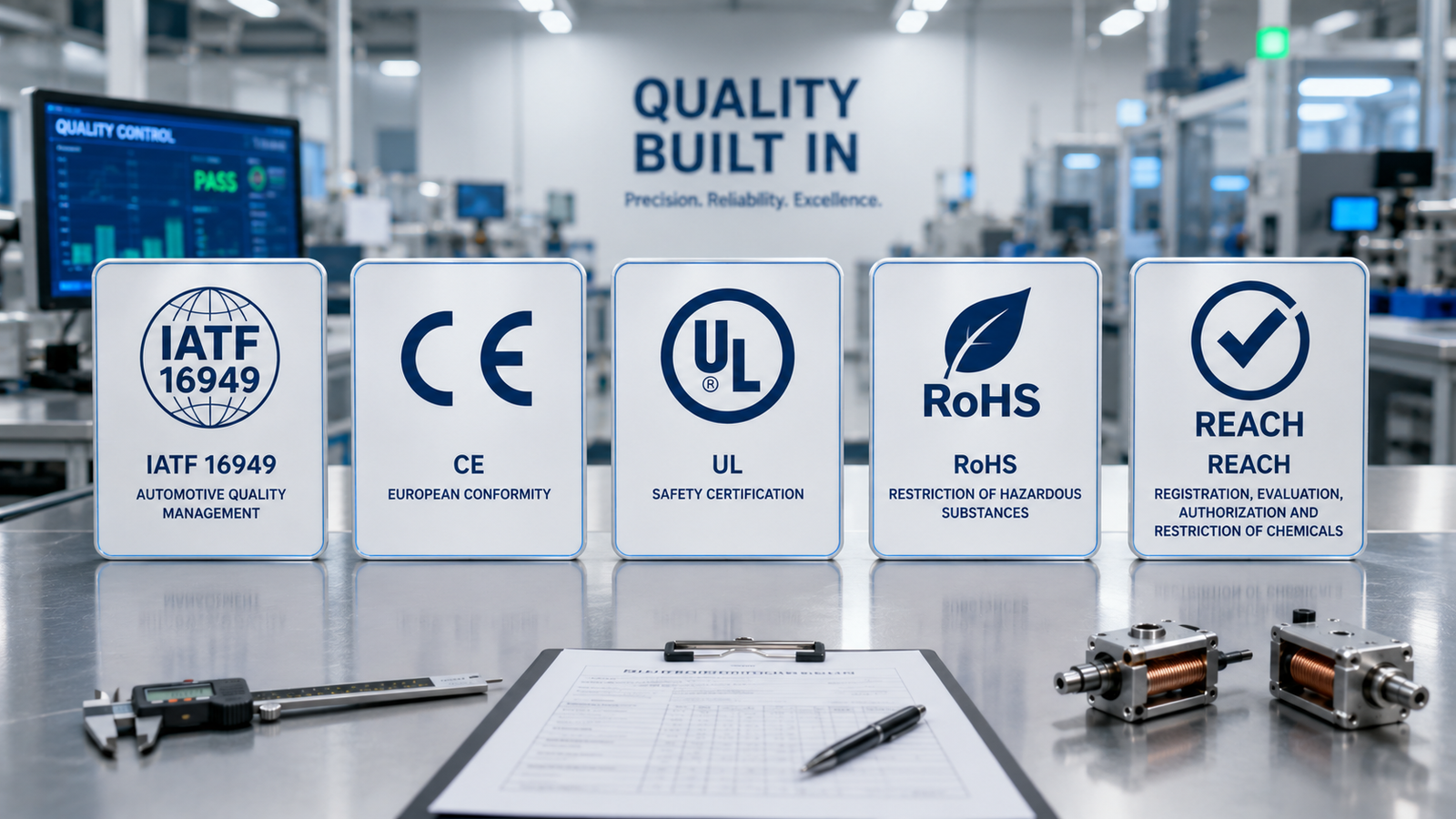
When I speak with procurement managers, I always tell them to separate marketing claims from verifiable proof. Any factory can say they make "durable" products. But can they show you the data? Can they prove their processes are stable and their materials are safe? Certifications and a transparent testing process are the only way to manage your risk effectively. They are your insurance policy against sourcing a component that could lead to a product recall.
Decoding the Alphabet Soup of Certifications
These aren't just logos on a box; they are critical risk management tools.
- Safety (UL, CE, TUV): These certify that the solenoid is electrically safe and won't cause fires or electric shocks10. For any consumer-facing appliance, these are non-negotiable.
- Material Compliance (RoHS, REACH): These certify that the product is free from hazardous substances like lead and cadmium. This is a legal requirement for selling products in Europe and other regions.11
Beyond Compliance: Proving Durability
While certifications cover safety, they don't tell you if the solenoid will last. That's where a supplier's internal quality control and testing come in.
- Life Cycle Testing: We use automated testers that run a solenoid for millions of cycles to simulate years of use in just a few weeks. This helps us validate new designs and ensure our production parts meet lifespan targets.
- Environmental Testing: Solenoids are subjected to thermal shock chambers (going from extreme hot to cold), salt spray tests (for corrosion resistance), and vibration tables to ensure they can survive the harsh conditions inside an appliance.
- Process Control (ISO 9001 / IATF 16949): These certifications show that the factory has a robust quality management system. At SolenElec, we also use a Manufacturing Execution System (MES). This means every single solenoid has a digital record, tracing it back to the material batch, machine, and operator. If a problem ever arises, we can pinpoint the cause instantly. This level of traceability is the ultimate safety net for your brand.
Conclusion
Ultimately, high performance is not a spec; it's a result. It comes from matching the right solenoid trade-offs to your application and partnering with a supplier who proves quality through data.
"A framework for electromechanical actuator design", https://repositories.lib.utexas.edu/items/e777e211-0ee2-49ff-b4ef-791c7def25c3. Engineering design guides for electromechanical actuators confirm that key performance indicators such as force, actuation speed, and operational life (durability) are interdependent and present fundamental trade-offs that must be optimized for any given application. Evidence role: general_support; source type: education. Supports: The claim that force, speed, and durability are the principal and often competing characteristics that must be balanced in solenoid design.. ↩
"RL Time Constant | Harvard Natural Sciences Lecture Demonstrations", https://sciencedemonstrations.fas.harvard.edu/presentations/rl-time-constant. A solenoid coil acts as an inductor in an RL circuit. The circuit's time constant (τ = L/R) determines how quickly the current reaches its steady state. A higher inductance (L), resulting from more coil windings, increases this time constant, thereby slowing the rate at which the magnetic field builds and the plunger actuates. Evidence role: mechanism; source type: paper. Supports: The claim that increased inductance from more coil windings slows a solenoid's operation.. ↩
"Reliability and life study of hydraulic solenoid valve. Part 2", https://www.eng.auburn.edu/~choeson/Publication/1132_2009_Reliability%20and%20life%20study%20of%20hydraulic%20solenoid%20valve-Part%202%20_S.%20V.%20Angadi,%20R.%20L.%20Jackson.pdf. Failure mode and effects analysis (FMEA) studies on electromechanical components frequently identify thermal degradation of coil insulation due to overheating and mechanical wear of moving parts (plunger and guide) as the two dominant causes of failure in linear solenoids. Evidence role: expert_consensus; source type: research. Supports: The claim that heat and wear are the primary failure mechanisms for solenoids.. ↩
"A study of expected lifetime of XLPE insulation cables working at ...", https://pmc.ncbi.nlm.nih.gov/articles/PMC7002785/. The lifespan of electrical insulation materials used in solenoid coils is inversely related to operating temperature, often modeled by the Arrhenius equation. High temperatures accelerate the chemical degradation of the polymer, making it brittle and causing cracks that compromise its dielectric strength, leading to turn-to-turn shorts and eventual coil failure. Evidence role: mechanism; source type: paper. Supports: The claim that heat degrades insulation, causing shorts and limiting solenoid life.. ↩
"Thermal Degradation of Glass Fibre-Reinforced Polyamide 6 ... - PMC", https://pmc.ncbi.nlm.nih.gov/articles/PMC11859150/. Material property databases show that glass-fiber-reinforced engineering plastics like Polyamide 66 (PA66-GF) and Polybutylene terephthalate (PBT-GF) exhibit high heat deflection temperatures and excellent dimensional stability, making them suitable for components like solenoid bobbins that must maintain structural and electrical integrity at elevated operating temperatures. Evidence role: general_support; source type: education. Supports: The claim that glass-reinforced PA66 and PBT are suitable for high-temperature applications like solenoid bobbins.. ↩
"[PDF] Friction Coefficients for Stainless Steel (PTFE) Teflon Bearings", https://wisconsindot.gov/documents2/research/WisDOT-WHRP-project-0092-08-13-final-report.pdf. Polytetrafluoroethylene (PTFE) is known for having one of the lowest coefficients of friction of any solid, typically in the range of 0.05 to 0.10. This property makes it an effective coating for reducing both static and dynamic friction on moving parts like a solenoid plunger, preventing stick-slip phenomena and reducing wear. Evidence role: statistic; source type: encyclopedia. Supports: The claim that PTFE is a low-friction coating suitable for reducing friction on a solenoid plunger.. ↩
"Benefits of AeroDoors' Oil-Impregnated Bronze Rollers", https://hangardoors.aero/oil-impregnated-bronze-rollers/. Oil-impregnated bronze bearings are produced through powder metallurgy, creating a porous structure that is filled with lubricating oil. During operation, a thin film of oil is released onto the bearing surface through capillary action and heat, providing continuous lubrication that reduces friction and wear on the guided component, such as a solenoid plunger. Evidence role: mechanism; source type: education. Supports: The claim that oil-impregnated bronze provides self-lubrication.. ↩
"Duty Cycles Explained - Magnet-Schultz of America", https://magnet-schultzamerica.com/resources/blog/duty-cycles-explained/. Solenoid design balances thermal and magnetic performance. Intermittent-duty (e.g., 10%) solenoids use coils with lower resistance to allow higher current, generating a stronger magnetic field and more force, but must be de-energized to dissipate heat. Continuous-duty (100%) solenoids use higher-resistance coils to limit current and heat, permitting constant operation but at a reduced force level. Evidence role: definition; source type: education. Supports: The claim that lower duty cycle ratings allow for higher force, and vice versa.. ↩
"[PDF] Qualification tests of solenoid valves by environ exposure to ...", https://www.nrc.gov/docs/ML1807/ML18078A980.pdf. Industry standards and best practices for testing electromechanical components specify that performance characteristics, including duty cycle, are measured under controlled conditions. This typically includes a standard ambient temperature, often 20°C or 25°C, as thermal performance is highly dependent on the surrounding temperature. Evidence role: general_support; source type: institution. Supports: The claim that solenoid duty cycles are rated at a standard ambient temperature.. Scope note: The exact standard temperature can vary slightly between different standards bodies and manufacturers. ↩
"Electrical - Overview | Occupational Safety and Health Administration", http://www.osha.gov/electrical. The CE marking, when applied to electrical equipment, indicates conformity with relevant EU legislation, such as the Low Voltage Directive (LVD), which ensures protection against risks like electric shock and fire. Similarly, the UL mark from Underwriters Laboratories certifies that a product meets established safety standards in North America. Evidence role: definition; source type: government. Supports: The claim that UL and CE marks certify electrical safety.. ↩
"RoHS - Wikipedia", https://en.wikipedia.org/wiki/RoHS. The European Union's Directive on the Restriction of Hazardous Substances in Electrical and Electronic Equipment (RoHS) makes it a legal requirement for most electrical and electronic products sold on the EU market to be free of specified levels of certain materials, including lead, mercury, and cadmium. Evidence role: historical_context; source type: government. Supports: The claim that RoHS is a legal requirement in the EU.. ↩