How to Choose the Perfect Water Solenoid Valve Coil for Your System?
Choosing the wrong water valve coil can lead to product failures and brand damage. You need a coil that performs reliably, but selecting the right one can feel complex.
The "perfect" coil is a myth. The right coil is one that precisely matches your application's specific needs for voltage, duty cycle, environment, and materials. It's about conducting a risk assessment to ensure long-term reliability and protect your brand, not just matching a spec sheet.

After more than 20 years of helping leading appliance brands select coils, I've seen how easy it is to overlook a critical detail. A simple spec sheet doesn't tell the whole story. The real work is in asking the right questions to uncover the hidden risks in your application. This guide will walk you through the exact questions I ask my clients. It will help you move from simply buying a component to making a strategic sourcing decision that protects your product's performance and your company's reputation. Let's break down the key parameters together.
AC vs. DC Voltage: How to Choose the Correct Power Supply for Your Water Valve Coil?
Choosing the wrong voltage type can cause your valve to buzz, overheat, or fail completely. This small mistake can compromise the reliability and user experience of your entire product.
Choose a DC coil for applications that need quiet, energy-efficient operation, like in-home appliances. Use an AC coil for industrial settings where a slight hum is acceptable and higher inrush current isn't an issue. Always match the coil's voltage rating to your system's power supply.
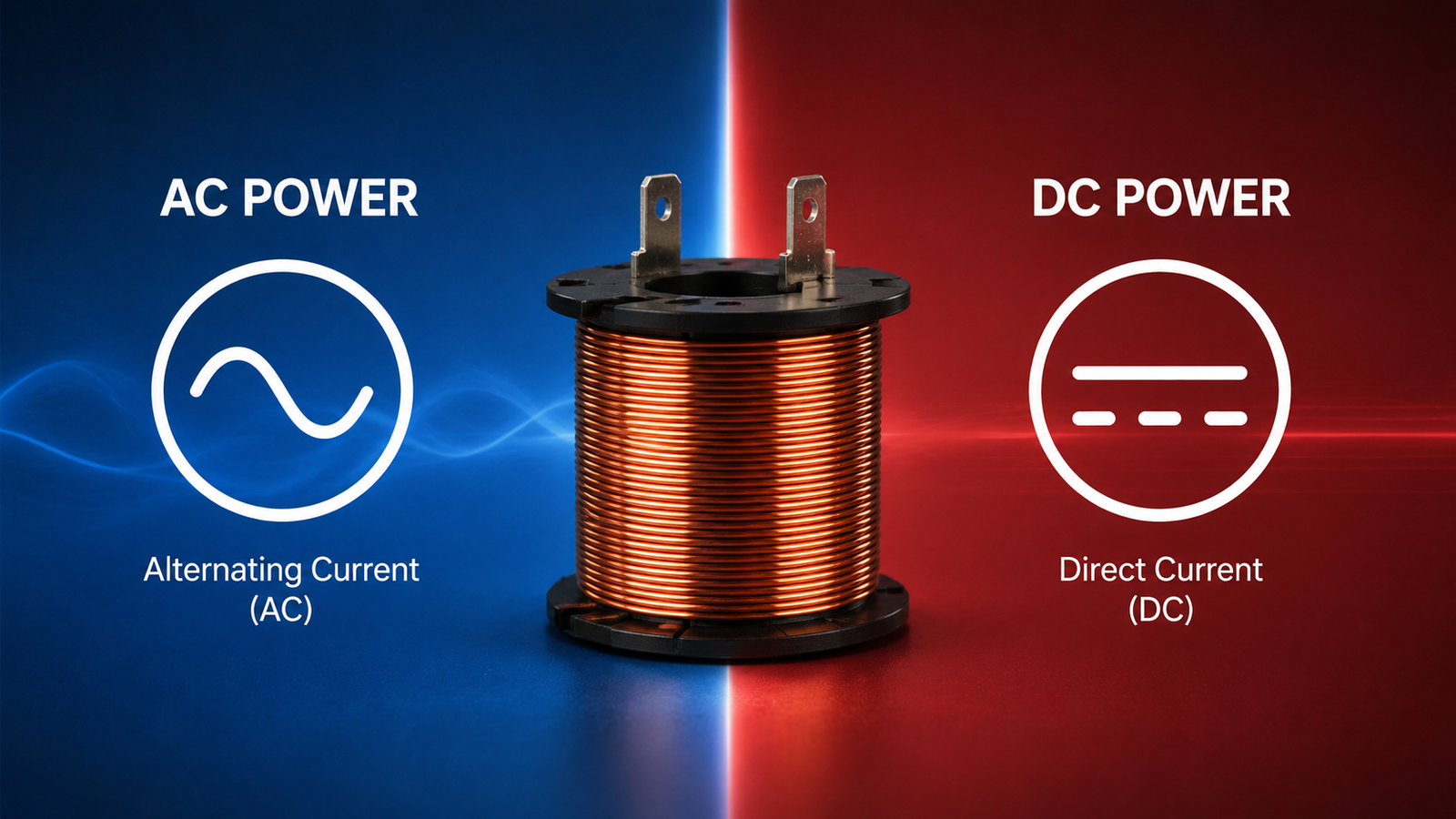
The decision between AC and DC power goes beyond just matching the voltage number. It directly impacts your product's performance, cost, and a user's experience. Overlooking this can lead to frustrating and costly field failures. In my experience, the choice often comes down to the specific environment where the product will be used.
The Case for DC Coils
DC coils are the standard for most modern consumer appliances. Think of water purifiers, smart faucets, or high-end coffee machines. The primary reason is that they operate silently. There is no 50/60 Hz hum that you often get with AC power.1 They are also more energy-efficient, holding the valve open with minimal power draw. This is critical for battery-powered devices or for appliances where energy consumption is a key selling point.
Understanding AC Coil Behavior
AC coils, on the other hand, are often found in more industrial or commercial applications. They have a high inrush current to actuate the valve, followed by a lower holding current.2 While generally robust, they can produce an audible buzz. Mismatches here are dangerous. If you connect a DC coil to an AC supply, it will likely overheat and burn out quickly.3 An AC coil on a DC supply may not generate enough force to open the valve reliably.4
| Feature | AC Coil | DC Coil |
|---|---|---|
| Noise | Can produce a 50/60 Hz hum | Silent operation |
| Efficiency | Less efficient, generates heat | More efficient, lower holding power |
| Inrush Current | High | Low / None |
| Best For | Industrial, commercial systems | Consumer appliances, quiet environments |
IP65 vs. IP67 Waterproof Ratings: Which Insulation Class Do You Need for Wet Environments?
Water getting inside your coil is a recipe for disaster. It can cause short circuits, corrosion, and complete system failure, creating a significant safety hazard and warranty nightmare.
Use an IP65-rated coil for devices that will be splashed or sprayed with water, like a coffee maker. Choose an IP67-rated coil for applications that may be temporarily submerged or operate in very damp conditions, such as an outdoor irrigation valve.
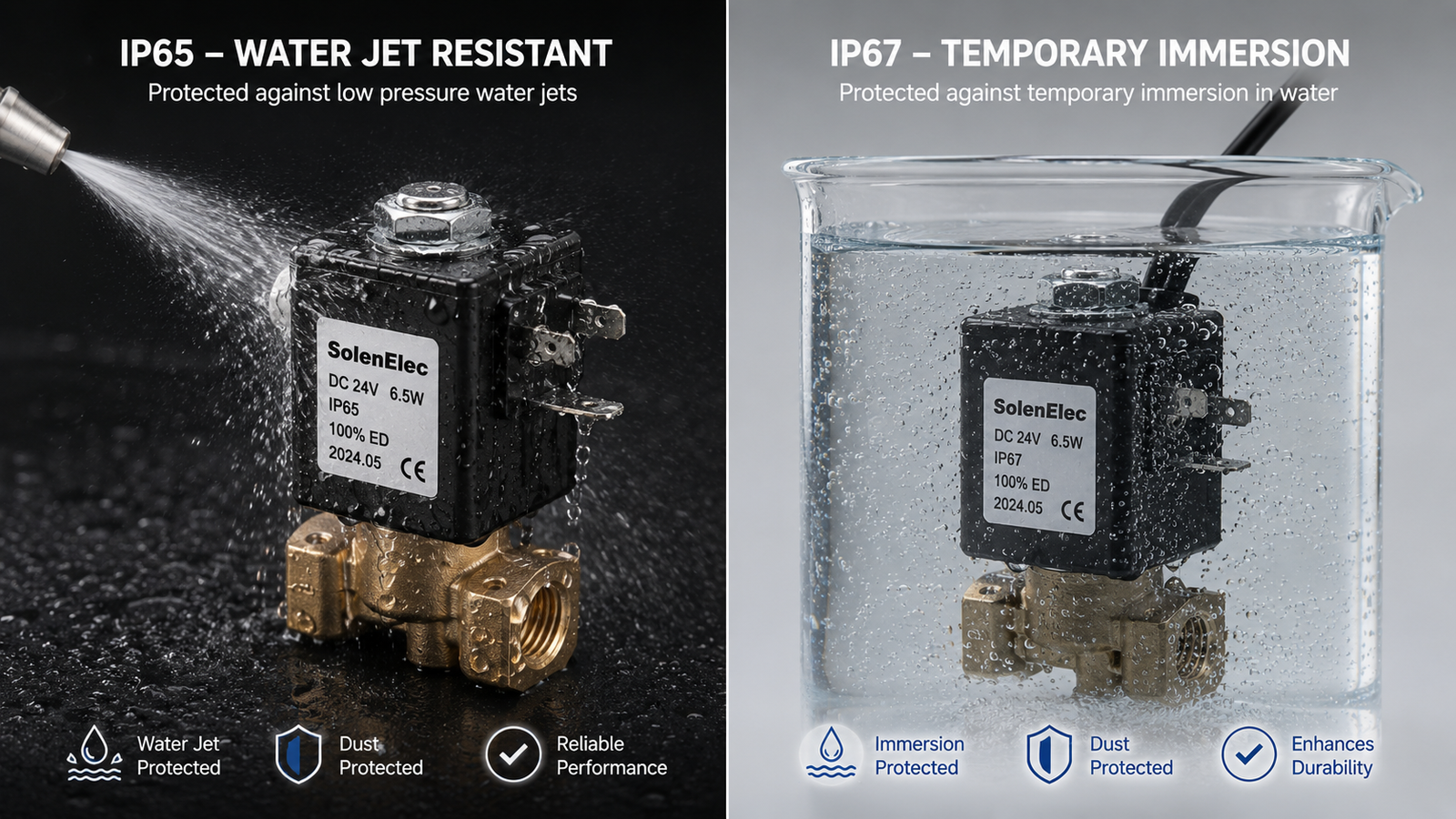
The IP (Ingress Protection) rating is one of the most critical specs for a water valve coil, yet it's often chosen based on cost rather than application risk. The difference between IP65 and IP67 seems small on a spec sheet, but in the real world, it's the difference between a reliable product and a mass failure.
When is IP65 Enough?
An IP65 rating means the coil is protected against water jets from any angle.5 This is perfectly suitable for many home appliances. For example, a dishwasher or a washing machine coil is located inside a cabinet. It might get splashed during maintenance, but it will never be submerged. In these controlled environments, specifying an IP65 coil is a sound engineering and cost-effective decision. There is no need to over-engineer the component.
Making the Jump to IP67
An IP67 rating certifies that the coil can be submerged in up to 1 meter of water for 30 minutes without damage.6 This is non-negotiable for any component exposed to the elements or harsh conditions. I worked with a client developing a smart irrigation system. They initially considered an IP65 coil to reduce costs. I asked them, "What happens when a sprinkler head creates a puddle around the valve box?" The risk of submersion was real. Choosing IP67 was a small upfront investment that prevented thousands of potential field failures from rain and flooding, protecting their brand's reputation for durability.
Continuous Duty Cycles: Selecting a Water Valve Coil That Won't Overheat?
Using a coil designed for short bursts in a continuous application is a guaranteed failure. The coil will overheat, its insulation will melt, and the valve will stop working.
A 100% duty cycle coil is for continuous operation, like in a water chiller. An intermittent duty cycle coil is for short bursts of power, like in an automated faucet. Using an intermittent coil continuously will cause it to overheat and fail.7 Always specify your required duty cycle.
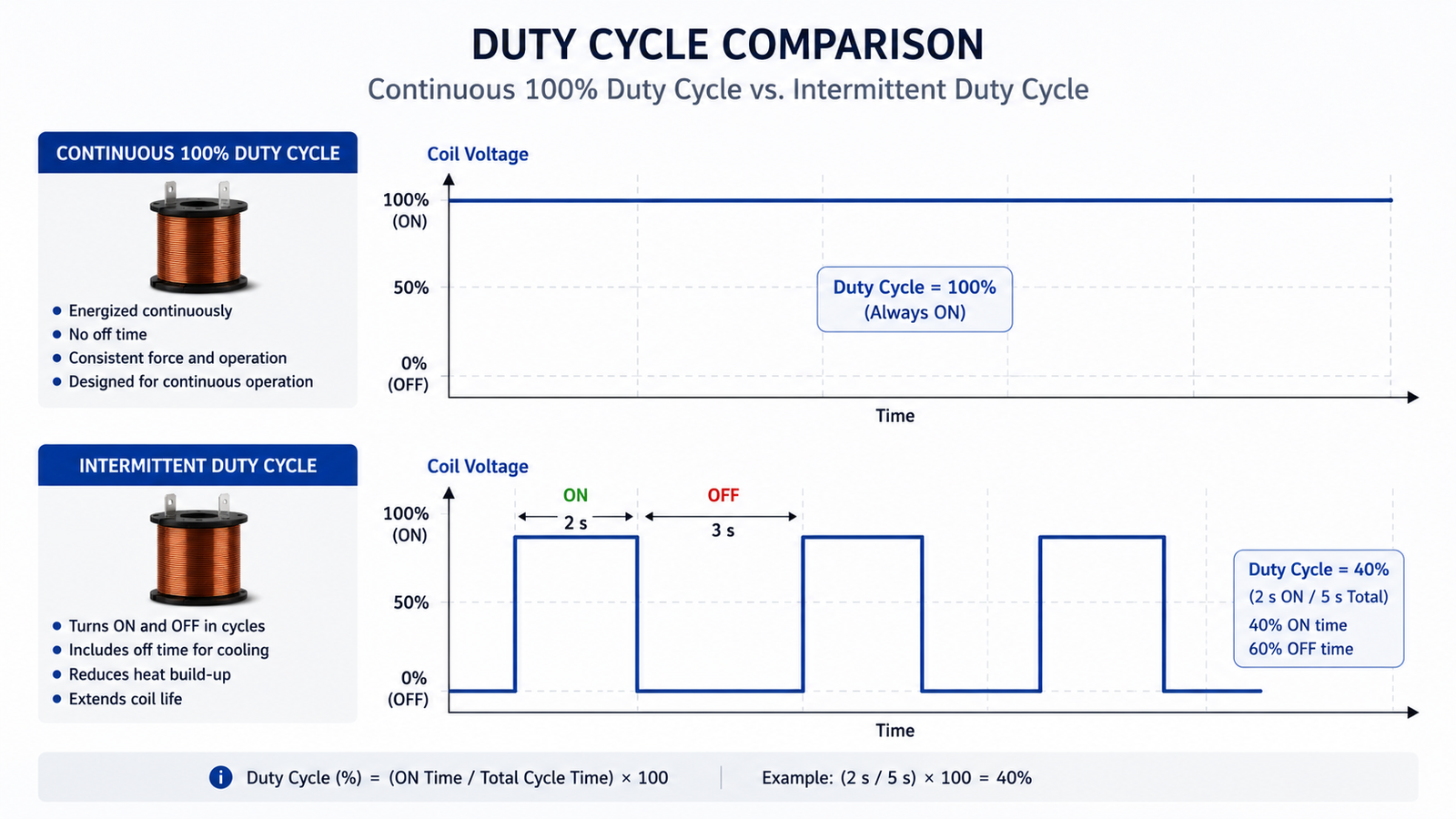
"We need a 24V DC coil." This is one of the most common requests I get from procurement managers. My first question is always: "For how long and how often?" The duty cycle is arguably the single most important parameter for ensuring the long-term reliability of a coil, and it's the one most often overlooked.
The 100% Duty Cycle Misconception
Many buyers assume that if a coil is powered, it should be able to stay powered indefinitely. But physics gets in the way. A continuously powered coil generates heat.8 A coil rated for 100% duty cycle is specifically designed to dissipate that heat effectively, using more copper wire or a more robust construction.9 It's built to stay on forever. A water purifier or a reverse osmosis system that runs for hours needs a 100% duty cycle coil. Using anything less is planning for failure.
Calculating Your Application's Duty Cycle
An intermittent duty coil is designed for applications where it is powered on for a short period and then has a longer period to cool down. Think of a smart faucet or an ice maker. The coil might be on for 30 seconds and then off for several minutes. These coils can be made smaller and more cost-effective because they don't need to manage constant heat buildup. The danger comes from using one in the wrong application. I've seen cases where a coil designed for a 25% duty cycle was used in a 100% duty application. It worked perfectly in testing, but in the field, the coils started failing from overheating after a few months. Always define your 'on' time and 'off' time to select the correct, reliable coil.
How to Match Valve Coil Dimensions: Measuring Inside Diameter (ID) and Height for a Perfect Fit?
A coil with the wrong dimensions is completely useless. It either won't fit on the valve stem or won't fit inside the housing, causing production delays and sourcing headaches.
Use digital calipers for a precise measurement of the coil's inside diameter (ID) and overall height. The ID must fit snugly over the valve's plunger tube, and the height must allow the enclosure to close properly. Providing these dimensions ensures a perfect physical fit.
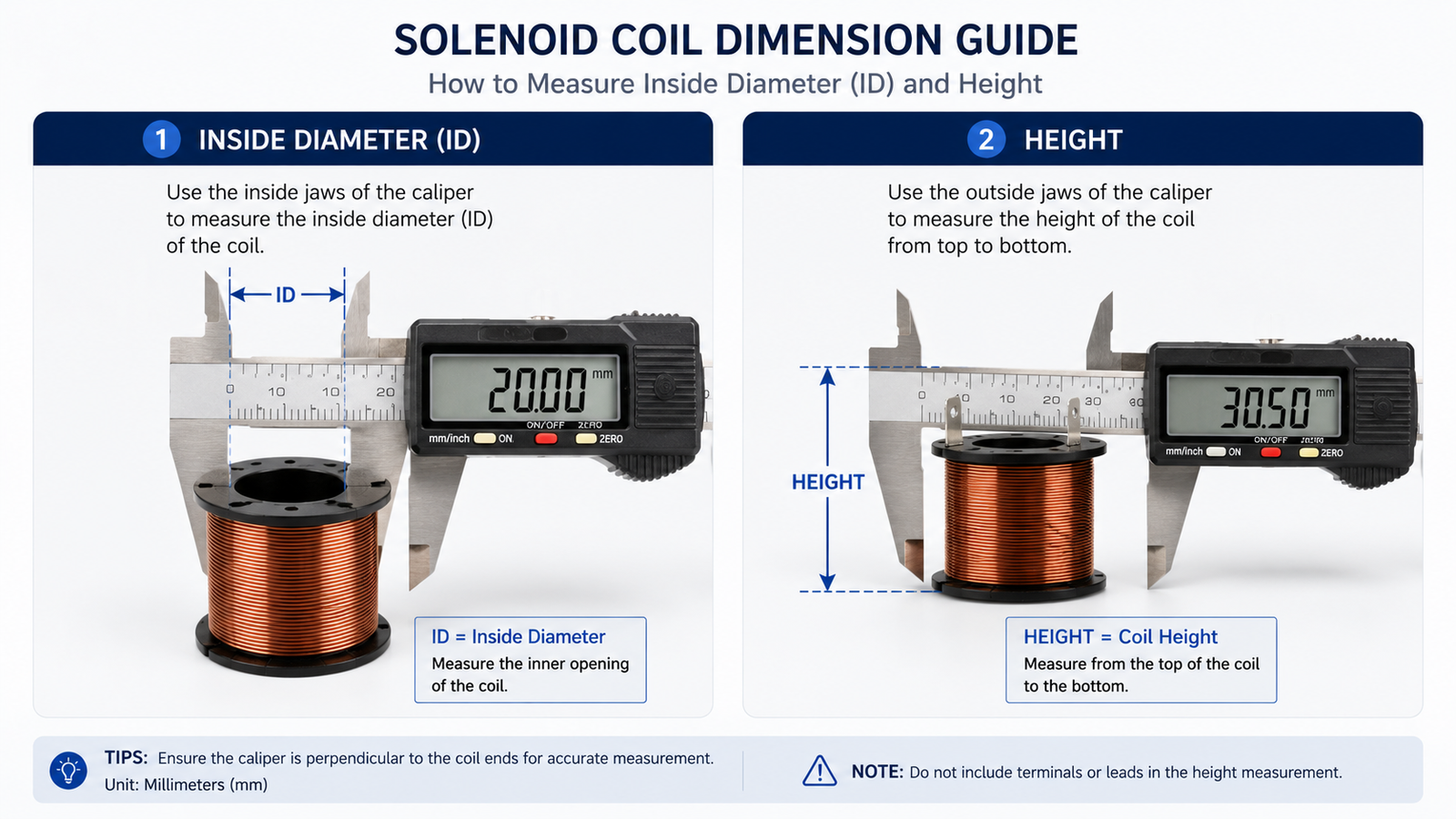
While electrical specifications are critical, they mean nothing if the coil doesn't physically fit your valve assembly. This seems basic, but it’s a frequent source of error that can bring a production line to a halt. When you're sourcing a replacement coil or qualifying a new supplier, getting the physical dimensions right is the first step.
Why Precision Matters for ID
The Inside Diameter (ID) is the most critical dimension. It’s the hole in the center of the coil that slides over the valve’s plunger tube (or "stem"). This fit needs to be just right. If the ID is too small, it obviously won't go on. If the ID is too large, the coil will be loose. This can cause two problems. First, the magnetic field might not be perfectly centered, leading to inefficient or weak actuation of the valve.10 Second, the coil can vibrate against the stem during operation, creating noise and potentially wearing down the encapsulation over time. A photo with a ruler is a good start, but for an order of 100,000 units, I need a measurement from a digital caliper.
Getting the Height and Connector Right
The coil's height is the next critical measurement. It must be short enough to fit within the valve's housing or any covering. A coil that is even a few millimeters too tall can prevent the assembly from being sealed correctly, compromising its IP rating and overall integrity. Finally, don't forget the electrical connection. Is it a DIN connector? Flying leads? Make sure the new coil's connector type and position match the old one to avoid any rewiring or assembly issues. Providing a technical drawing or a physical sample is the best way to eliminate all ambiguity.
Water Valve Coil Selection Guide: Material Compatibility for Hot Water vs. Cold Water Applications?
Using a standard coil in a high-temperature or chemically aggressive environment will cause the materials to fail. The plastic will crack, the insulation will degrade, and the coil will short out.
For cold water, standard PA66 nylon encapsulation and F-class wire often work well. For hot water or steam, such as in coffee makers, you must use high-performance materials like PPS plastic and H-class (180°C) magnet wire to prevent failure.
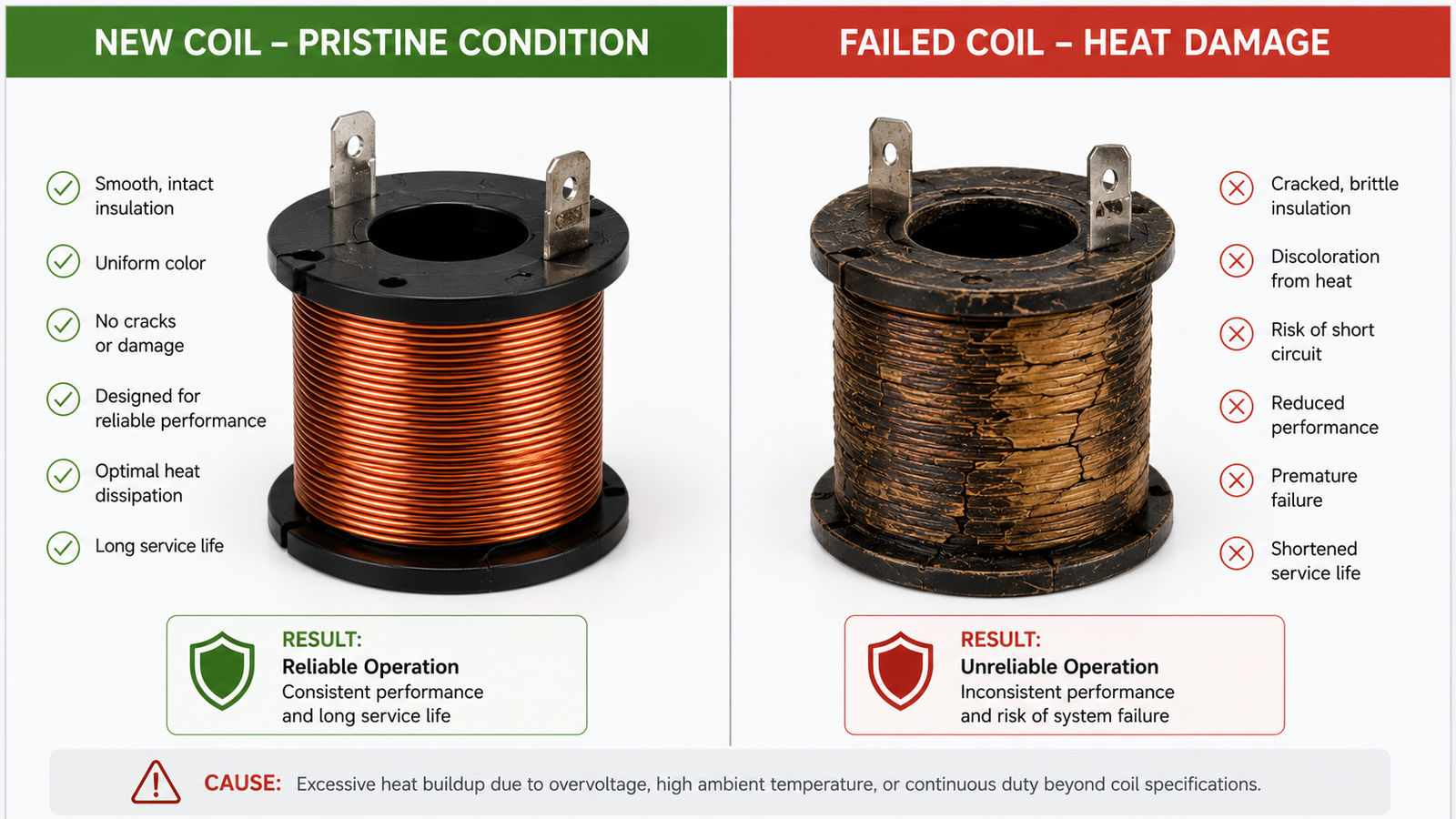
The water in your application is not just water. Its temperature and chemical makeup dictate the materials we must use to build your coil. A request for a "water valve coil" is incomplete. I need to know if it's for 95°C water in a premium coffee machine or for cold water mixed with detergents in an industrial dishwasher. The answer determines the choice of plastic, magnet wire, and varnish, which in turn determines the coil's reliability and lifespan.
High-Temperature Applications
We worked with a manufacturer of high-end European coffee machines. Their new model used a steam wand that exposed the valve coil to bursts of 140°C steam. A standard coil with PA66 nylon encapsulation would become brittle and crack within months under these conditions. The solution was to upgrade the entire material system. We used a high-performance thermoplastic called PPS for the encapsulation, which can handle continuous temperatures up to 200°C.11 We also used H-class (180°C) rated magnet wire instead of the standard F-class (155°C).12 This robust construction ensured the coil could withstand the thermal stress for the product's entire lifecycle.
Chemical and Environmental Resistance
For other applications, the challenge isn't just heat. An industrial dishwasher uses hot water mixed with corrosive detergents. Here, the primary concern is the chemical resistance of the encapsulation material. For an outdoor irrigation system, the coil must resist not only water (requiring a high IP rating) but also UV degradation from sunlight and a wide operating temperature range from freezing winters to hot summers.
| Application | Key Challenge(s) | Recommended Encapsulation | Recommended Wire Class |
|---|---|---|---|
| Home Water Filter | Cold water, continuous duty | PA66 Nylon | Class F (155°C) |
| Premium Coffee Maker | Hot water/steam (95°C-140°C) | PPS | Class H (180°C) |
| Industrial Dishwasher | Hot water + detergents, humidity | Chemically Resistant Epoxy | Class H (180°C) |
| Outdoor Irrigation | Water immersion, UV, temp cycling | UV-Resistant Epoxy/PPS | Class F (155°C) |
Conclusion
Choosing the right coil is a process of matching specific parameters to your application's risks. This ensures reliability, protects your brand, and avoids costly failures in the long run.
"AC Solenoid buzzing badly : r/AskElectronics - Reddit", https://www.reddit.com/r/AskElectronics/comments/1c7kn6y/ac_solenoid_buzzing_badly/. An engineering reference on electromagnets explains that alternating-current excitation can produce audible vibration at line-related frequencies, whereas direct-current excitation is steady; this supports the AC-hum comparison, although actual sound depends on mechanical mounting, shading rings, and coil construction. Evidence role: mechanism; source type: education. Supports: An engineering or educational source should explain that AC excitation produces periodic magnetic-force variation at line frequency, which can create audible vibration, while steady DC excitation does not create the same line-frequency force ripple.. Scope note: This is contextual mechanism support rather than proof that every AC coil in the article's product category will be audibly noisy. ↩
"[PDF] ElectroMagnetic Actuator Basics Chapter 4", http://commons.princeton.edu/motorcycledesign/wp-content/uploads/sites/70/2018/07/solenoid.pdf. A solenoid-actuator engineering reference describes AC solenoids as drawing higher current while the armature gap is open and lower current after closure increases inductance; this supports the stated inrush and holding-current behavior, although magnitudes vary by coil geometry and supply conditions. Evidence role: mechanism; source type: education. Supports: A source should describe how AC solenoid impedance changes as the armature closes, producing higher initial current and lower holding current.. Scope note: The source would support the general mechanism, not the exact current levels for any particular water valve coil. ↩
"How long will solenoid valve coil overheat ? : r/AskEngineers - Reddit", https://www.reddit.com/r/AskEngineers/comments/1atkkuf/how_long_will_solenoid_valve_coil_overheat/. An electrical-engineering reference on solenoid coil ratings states that coils must be matched to their rated voltage and current type because incorrect supply conditions can cause excessive heating or failure; this supports the warning, although the failure rate and time-to-failure depend on the coil resistance, voltage, and protection circuitry. Evidence role: mechanism; source type: education. Supports: A source should explain that solenoid coils are designed for specific supply types and that applying the wrong waveform or voltage can produce excessive current, heating, or malfunction.. Scope note: The support is general to solenoid coils and may not directly test the exact water valve coil described. ↩
"Solenoid Coil - Choosing AC or DC | Tameson.com", https://tameson.com/pages/choosing-an-ac-or-dc-coil-for-a-solenoid-valve. A technical reference on solenoid actuators notes that coil force, current, and heating are tied to the coil's rated supply conditions; this supports the claim that an AC/DC mismatch can cause unreliable valve operation, although the specific outcome can be overheating, non-actuation, or both depending on the coil design. Evidence role: mechanism; source type: education. Supports: A source should support that solenoid force and thermal behavior depend on coil design and rated supply, and that wrong supply type can lead to unreliable actuation.. Scope note: The source would provide mechanism-level support rather than a universal prediction for all AC coils on DC supplies. ↩
"IP code - Wikipedia", https://en.wikipedia.org/wiki/IP_code. IEC 60529 defines IP code water-protection levels, including level 5 as protection against water jets from any direction under specified test conditions; this supports the IP65 description, although the rating does not by itself guarantee durability under prolonged immersion or chemical exposure. Evidence role: definition; source type: institution. Supports: A standards or standards-summary source should define the second digit 5 in IP65 as protection against water jets from any direction under specified test conditions.. Scope note: The standard defines laboratory ingress tests, not full product lifetime reliability. ↩
"IP code - Wikipedia", https://en.wikipedia.org/wiki/IP_code. IEC 60529 defines IP67 as dust-tight protection combined with temporary immersion protection, commonly specified as immersion up to 1 m for 30 minutes under test conditions; this supports the article's rating explanation, although it does not prove resistance to repeated flooding, pressure washing, or chemically contaminated water. Evidence role: definition; source type: institution. Supports: A standards source should state that IP67 covers dust-tight protection plus temporary immersion in water under defined depth and duration conditions.. Scope note: The rating is a standardized test classification, not a comprehensive environmental durability guarantee. ↩
"Causes and remedies of solenoid overheating analysis", https://www.drsolenoid.com/news/causes-and-remedies-of-solenoid-overheating-analysis/. A technical reference on solenoid duty cycles explains that intermittent-duty coils are intended to cool between energization periods and may overheat if operated continuously; this supports the failure warning, although actual failure timing depends on ambient temperature, enclosure, voltage tolerance, and thermal protection. Evidence role: expert_consensus; source type: education. Supports: A neutral technical source should state that intermittent-duty coils require off-time for cooling and can exceed temperature limits if energized continuously.. Scope note: The source would support the general engineering risk, not a guaranteed failure time for every coil. ↩
"Joule heating - Wikipedia", https://en.wikipedia.org/wiki/Joule_heating. A physics reference on Joule heating states that current flowing through a resistive conductor dissipates electrical power as heat, proportional to I²R; this supports the statement that an energized coil generates heat, although actual coil temperature also depends on cooling, encapsulation, and ambient conditions. Evidence role: mechanism; source type: education. Supports: A physics or electrical engineering source should explain Joule heating, where current through resistance dissipates power as heat.. Scope note: The mechanism is direct, but it does not quantify temperatures for any specific coil. ↩
"Why Is Your Solenoid Coil Burning Out? A Troubleshooting Guide to ...", https://solenelec.com/why-is-your-solenoid-coil-burning-out-a-troubleshooting-guide-to-preventing-failure/. A solenoid-design reference defines continuous duty as operation at rated voltage for an indefinite period without exceeding allowable temperature rise; this supports the need for thermal design in 100% duty-cycle coils, although the source may not specify that every design uses more copper rather than other cooling or material choices. Evidence role: definition; source type: education. Supports: A source should define continuous duty or 100% duty cycle for solenoids and relate it to allowable steady-state temperature rise.. Scope note: The support is strongest for the continuous-duty definition and thermal requirement, while the exact construction method is design-dependent. ↩
"[PDF] ElectroMagnetic Actuator Basics Chapter 4", http://commons.princeton.edu/motorcycledesign/wp-content/uploads/sites/70/2018/07/solenoid.pdf. Research on solenoid actuator magnetic circuits shows that actuator force depends on magnetic geometry, air gap, and plunger alignment; this supports the statement that poor coil centering can weaken actuation, although the magnitude of the effect must be evaluated for the specific valve geometry. Evidence role: mechanism; source type: paper. Supports: A paper or university source should explain that solenoid force depends on magnetic circuit geometry, air gap, and alignment of the plunger and coil.. Scope note: The support is mechanistic and may not directly quantify the tolerance limits for this article's example coils. ↩
"[PDF] Polyphenylene Sulfide (PPS) - DIC's Global", https://www.dic-global.com/pdf/products/catalog/dic_pps_property_en.pdf. A polymer reference describes polyphenylene sulfide as a high-temperature engineering thermoplastic with continuous-use temperature ratings in the vicinity of 200°C; this supports the material-selection claim, although exact service temperature depends on grade, fillers, load, exposure time, and chemical environment. Evidence role: definition; source type: encyclopedia. Supports: A polymer reference should identify PPS as a high-temperature engineering thermoplastic with continuous-use temperature near or above 200°C.. Scope note: The cited property would apply to PPS material generally, not necessarily to every molded coil encapsulation formulation. ↩
"Insulation system - Wikipedia", https://en.wikipedia.org/wiki/Insulation_system. Electrical insulation standards such as IEC 60085 classify insulation systems by thermal class, including Class F at 155°C and Class H at 180°C; this supports the stated magnet-wire ratings, although an individual coil's allowable operating temperature also depends on its complete insulation system and temperature rise test. Evidence role: definition; source type: institution. Supports: A standards source should define thermal classes for electrical insulation systems, including Class F at 155°C and Class H at 180°C.. Scope note: The standard supports the class definitions, not the full validated operating limit of a finished valve coil. ↩