Why Does a Solenoid Coil Burn Out? Causes, Diagnosis & Prevention
Solenoid coil burning out is a frustrating failure because the visible damage often appears to point to one simple answer: replace the coil. Yet a replacement coil can fail again if the actual problem is incorrect voltage, a sticking armature, excessive heat, unsuitable duty conditions, or environmental exposure. I recommend treating the burned coil as evidence, not automatically as the root cause.
A solenoid coil burns out when its winding insulation is damaged by excessive electrical, thermal, mechanical, or environmental stress.1 In many cases, the burnt coil is the final symptom rather than the original root cause. To prevent repeat failure, maintenance and OEM teams should verify the supply voltage, armature movement, duty profile, installed temperature, contamination, and coil manufacturing consistency before fitting another coil.

I have seen teams replace a failed coil several times because the valve would not actuate. In some cases, the coil was genuinely defective. In others, the new coil was being installed into the same harmful operating conditions. The following process helps separate a coil failure from a system failure.
What Does a Burnt Solenoid Coil Look Like?
A non-operating valve can create immediate downtime, and the coil is often the most visible component. That can lead to a quick replacement decision. However, a failed actuation event does not always mean the coil itself has burned out, so I recommend confirming the electrical condition before assigning blame.
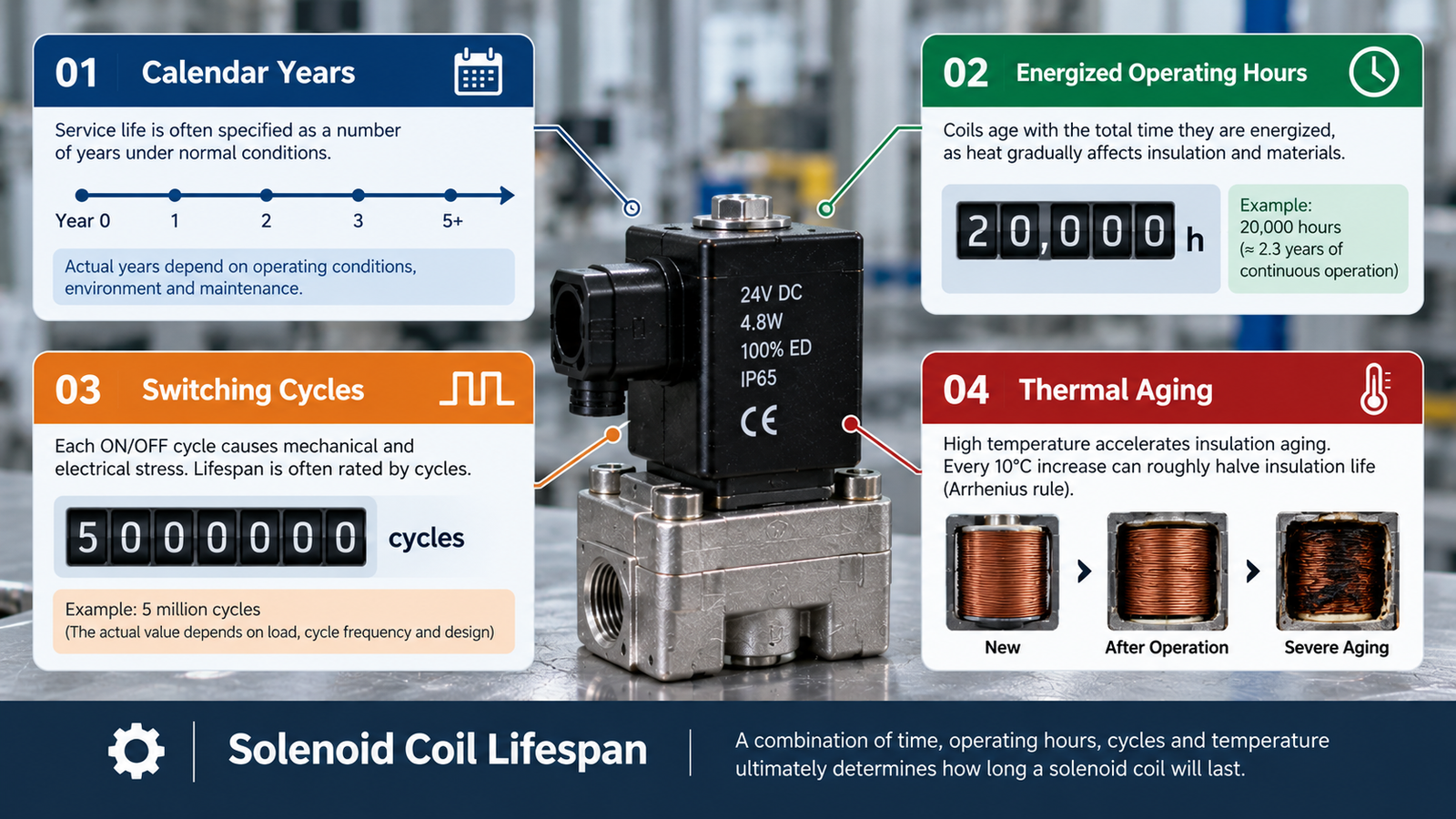
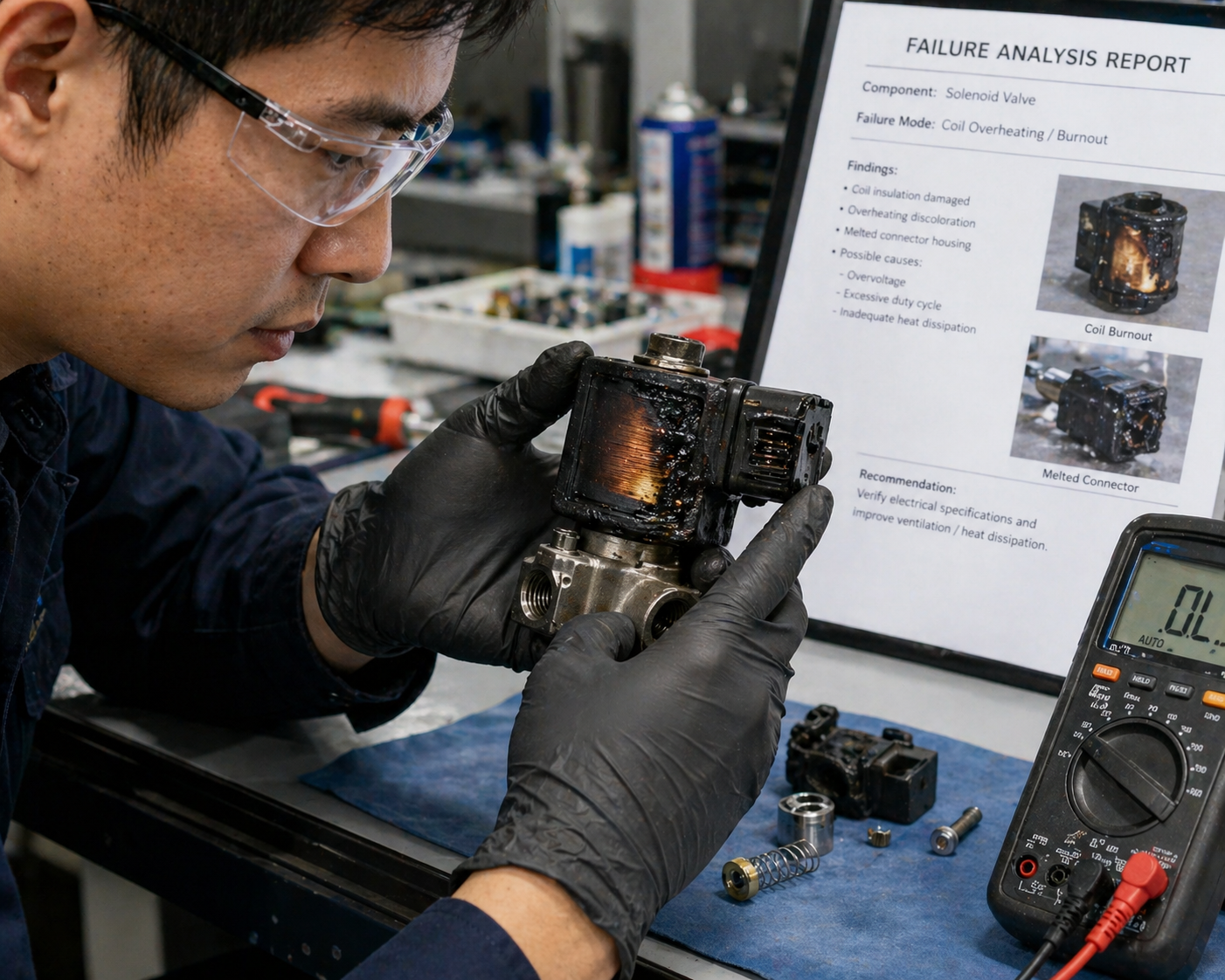
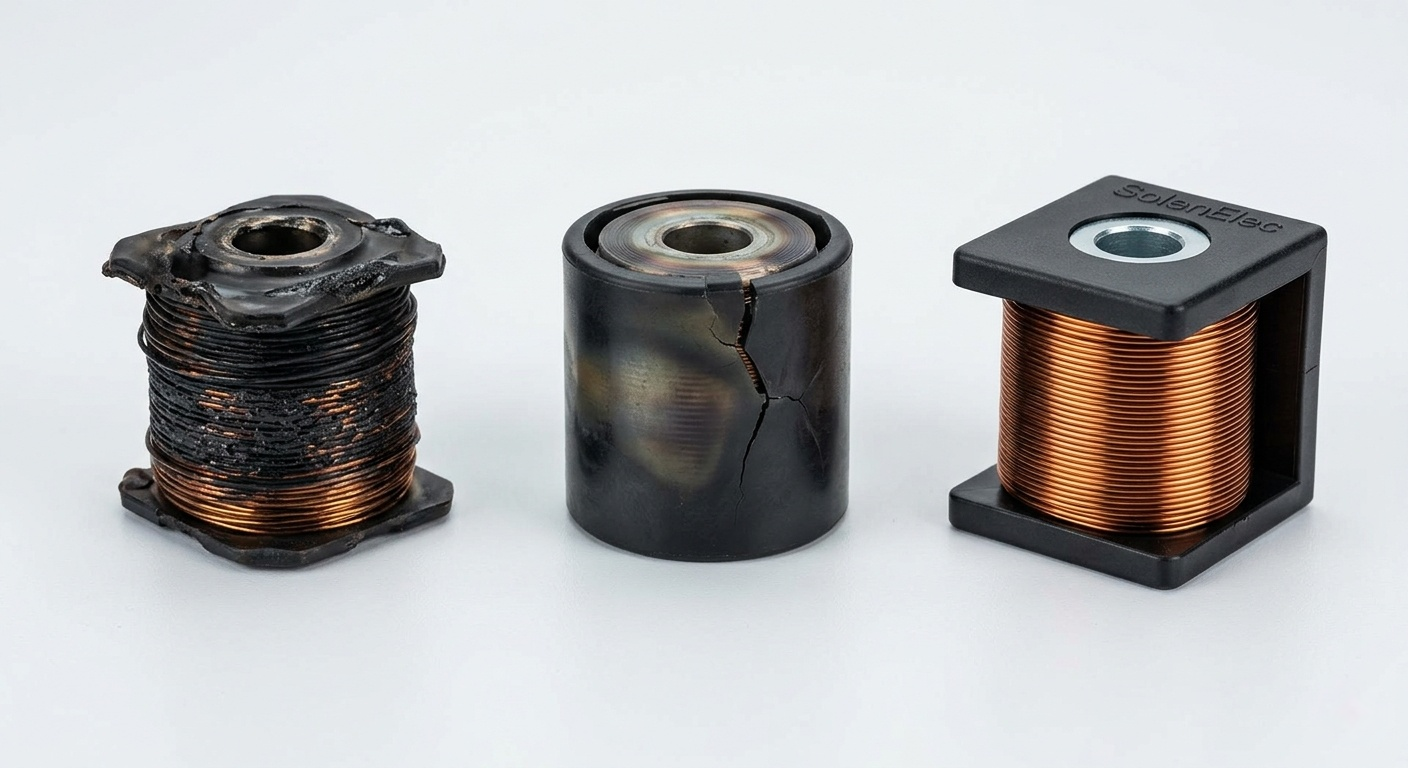
A burnt solenoid coil may show a burning smell, discoloration, melted encapsulation, deformation, an open circuit, abnormal resistance, or repeated fuse and protection trips.2 However, a solenoid valve that does not move may also have a stuck plunger, contamination, wiring damage, incorrect voltage, or an excessive mechanical load.
Confirm the Symptom Before Replacing the Part
The most common visual signs of a burnt solenoid coil include:
- A sharp burnt varnish or plastic smell
- Darkened, brown, or blackened coil housing
- Melted connector bodies, bobbins, or encapsulation material
- Cracked potting compound or deformed plastic
- An open-circuit measurement across the coil terminals
- Resistance that differs substantially from a known-good coil at a comparable temperature
- A coil that no longer energizes despite a verified supply
- Corrosion, moisture marks, or fluid ingress near the connector
Still, I would not use appearance alone as proof. A coil can look normal but have internal insulation damage. Conversely, an externally darkened coil may have been exposed to surrounding heat rather than failing from its own winding condition.
A Non-Moving Valve Is Not Always a Burnt Coil
When a solenoid valve does not actuate, I first separate the electrical coil condition from the mechanical valve condition. Possible non-coil causes include:
| Observed symptom | Possible non-coil explanation |
|---|---|
| Coil energizes but valve does not move | Stuck armature, contamination, pressure imbalance, incorrect spring load |
| No voltage at the coil | Broken wire, damaged connector, controller failure, fuse issue |
| Coil hums loudly | Incomplete armature seating, AC supply issue, mechanical air gap |
| Coil is hot but still functional | Long ON time, high ambient temperature, hot valve body |
| New coil fails quickly | Root cause remains in the machine or electrical system |
A valve that does not actuate does not automatically mean the coil is burnt.
I recommend confirming continuity, resistance, terminal voltage, and plunger movement before ordering a replacement. That small amount of diagnosis can prevent a repeated solenoid coil burnout event and reduce unnecessary spare-part use.
What Causes Solenoid Coil Burning Out?
Solenoid coil burnout rarely has one universal cause. A coil fails when its insulation system experiences stress beyond the design margin for enough time. The important question is not simply, “What damaged the coil?” I ask, “What operating condition created the damage?”
The main causes of solenoid coil burning out are incorrect voltage, incomplete armature seating in conventional AC solenoids, excessive energization time, insufficient cooling, high installed temperature, electrical transients, environmental ingress, and manufacturing or insulation defects. Each cause produces heat or insulation stress through a different physical mechanism.

Incorrect Supply Voltage
Voltage should be checked at the coil terminals under real operating conditions, not only on the power-supply nameplate.
With overvoltage, the mechanism is direct:
Voltage increases → electrical input and heat increase → winding temperature rises → insulation ages faster.3
Overvoltage does not always destroy a coil instantly. In many applications, it causes gradual thermal overstress. The coil may run apparently normally for weeks or months before insulation weakens and fails.
Undervoltage requires more careful interpretation. I do not recommend saying that low voltage makes every solenoid overheat. For a conventional AC solenoid, low voltage can prevent the armature from pulling in fully.4 If the armature remains open, the coil can stay in an abnormal high-current condition and overheat.
That specific AC inrush and holding-current mechanism should not be generalized to DC solenoids. DC coils have different current behavior and should be evaluated according to their own electrical and thermal design.
Buyers should verify:
- Rated voltage on the coil label
- AC or DC supply type
- Voltage tolerance
- Actual terminal voltage during pull-in
- Voltage after the machine reaches its normal operating temperature
- Connector, cable, and control-circuit voltage drop
For related selection guidance, see our solenoid coil voltage selection guide.
AC Armature Does Not Fully Seat
This is one of the most important causes of repeated failure in a conventional AC solenoid.
When the coil is energized, the armature should pull in and reduce the magnetic air gap. As the armature seats, the inductance changes and current falls toward its normal holding condition.5 If dirt, scale, corrosion, misalignment, an incorrect spring, or mechanical obstruction prevents full seating, the AC coil may continue operating at abnormally high current.
The failure path can be:
Mechanical sticking → incomplete armature seating → abnormal AC current → overheating → insulation damage → solenoid coil burning out.
This is why a mechanical problem can appear later as an electrical burnout problem. I have found that replacing the coil without checking armature travel often only delays the next failure.
Excessive Duty Cycle or Continuous Energization
A coil designed for intermittent operation needs enough OFF time to release stored heat.6 If that coil is energized longer than intended, or used continuously, heat accumulates in the winding and surrounding materials.
The thermal chain is straightforward:
Excessive ON time → inadequate heat dissipation → higher winding temperature → reduced insulation life → possible burnout.
Duty evaluation should include more than a percentage such as 25%, 50%, or 100% ED. I recommend recording:
- Maximum continuous ON time
- Minimum OFF time
- Number of cycles per hour
- Continuous hold periods
- Ambient temperature during operation
- Valve-body temperature
A 50% duty coil may work in one machine and overheat in another if the cycle timing, installation temperature, or airflow changes. For more detail, see continuous-duty vs. intermittent-duty solenoids.
Rapid Cycling and Insufficient Cooling
Rapid switching is not automatically harmful. The real issue is whether the actual operating sequence allows enough cooling for that particular coil design.
I avoid broad statements such as “DC coils can always cycle faster than AC coils.” The thermal result depends on:
- Coil power consumption
- ON and OFF duration
- Coil mass and thermal path
- Encapsulation design
- Valve-body heat transfer
- Ambient conditions
- Enclosure ventilation
- Actual cycle frequency
High switching frequency becomes a thermal problem when the operating sequence does not provide enough cooling for the specific coil design.7
A production speed increase can therefore trigger a solenoid coil burnout issue even when the voltage and valve design have not changed.
High Ambient or Valve-Body Temperature
Many troubleshooting guides focus only on coil self-heating. In real equipment, the installed temperature matters just as much.
I use this practical model:
Actual coil temperature = coil self-heating + surrounding thermal environment.8
External heat can come from a hot valve body, heated process media, steam, nearby heaters, enclosed cabinets, poor airflow, or adjacent components. A coil that works well on a bench at 20–25°C can behave very differently when mounted on a hot valve in an enclosed appliance.
Electrical Transients and Switching Surges
Electrical transients are not the first explanation for every failure. However, they can be a possible source of repeated insulation stress in some control systems.9
Repeated switching surges may affect:
- Winding insulation
- Terminal connections
- Connector assemblies
- Integrated electronics, where applicable
- Adjacent control components
I recommend reviewing the supply architecture, shared inductive loads, switching device, and suppression method. Depending on the system, suitable protection may include a flyback diode, TVS device, RC snubber, or another engineered solution.
A single suppression method is not suitable for every application. AC/DC supply type, required response time, release time, and control-circuit requirements all affect the decision.
Moisture, Oil, Chemicals, and Contamination
Environmental exposure can cause both electrical and mechanical problems.
From an electrical and material perspective, moisture, oil, detergents, chemicals, and corrosion can affect insulation, terminals, connectors, cable entries, and encapsulation. Water does not simply “cause a short circuit” in every case. The damage may develop gradually through corrosion, insulation breakdown, or degraded seals.10
From a mechanical perspective, contamination can restrict armature movement. In an AC solenoid, that restriction can then create the incomplete-seating condition that raises current and heat.
Manufacturing or Insulation Defects
Manufacturing consistency also matters, especially in OEM applications with large production volumes. Possible coil-level defects include:
- Magnet-wire damage
- Incorrect winding tension
- Terminal damage
- Poor welding or soldering
- Insulation damage during assembly
- Encapsulation voids or cracks
- Resistance inconsistency
- Material mismatch
- Inadequate process control
Two coils with the same nominal voltage, resistance, wire, and dimensions can still show different field reliability if manufacturing consistency is different.11
At SolenElec, I would expect a supplier evaluation to include documented incoming-material controls, winding and connection process controls, electrical testing, outgoing inspection, and traceability. Buyers should verify relevant test records and compliance documents for the actual product configuration rather than relying only on general claims.
Why Does the Same Solenoid Coil Keep Burning Out?
Repeated replacement creates cost, downtime, warranty exposure, and frustration. The temptation is to order a “more powerful” or “higher-temperature” coil. That approach can miss the real failure mechanism and may simply extend the time until the next failure.
When the same solenoid coil keeps burning out, the correct response is to stop replacing coils blindly and investigate the system. Multiple replacement coils may indicate voltage, armature, duty, heat, contamination, or transient issues, while failures limited to one production batch may indicate a manufacturing consistency issue.
Use Failure Timing as Diagnostic Evidence
I consider failure timing to be highly valuable information. Teams should not ask only, “What failed?” They should also ask:
When does it fail, and what changed before the failures started?
The pattern often points toward the most likely direction of investigation.
| Failure pattern | First priority checks | Likely direction |
|---|---|---|
| Multiple different replacement coils fail | Voltage, duty, temperature, armature seating | System conditions |
| Only one production batch fails | Resistance distribution, terminals, winding, encapsulation | Manufacturing consistency |
| Failures occur after machine becomes hot | Ambient, valve-body temperature, enclosure, duty | Thermal overload |
| AC coil burns after valve starts sticking | Armature travel, air gap, contamination, spring/load | Mechanical issue causing electrical overheating |
| Failure begins after production speed rises | ON/OFF timing, switching frequency, cooling time | Thermal accumulation |
| Moisture or corrosion is visible | Connector, cable entry, sealing, fluid exposure | Environmental ingress |
| New coil fails again quickly | All installed operating conditions | Root cause not removed |
Avoid Simple Conclusions
Repeated burnout does not prove that the system is at fault. A batch problem can happen. For example, if one lot shows a wide resistance distribution, damaged terminals, inconsistent encapsulation, or unusual insulation failures, the supplier’s production controls deserve attention.
However, if coils from different batches or suppliers fail in the same location, I would first investigate the machine. In that situation, the common factor is often the electrical supply, valve mechanism, thermal environment, or operating cycle.
A useful root-cause tree is:
-
Did different replacement coils fail?
- Yes: prioritize system conditions.
- No: compare affected and unaffected production lots.
-
Did failure begin after a process or design change?
- Check machine speed, valve pressure, control settings, enclosure design, or supply changes.
-
Does the failure occur only when hot?
- Measure installed temperatures and hot-state voltage.
-
Is the failed coil AC?
- Check whether the armature fully seats under actual load.
-
Does failure coincide with moisture, cleaning, or chemical exposure?
- Review connector sealing, encapsulation, cable routing, and material compatibility.
This approach turns solenoid coil burning out from a spare-parts problem into an engineering investigation.
How Do You Diagnose Solenoid Coil Burning Out?
A coil failure can be difficult to diagnose if teams only measure resistance after the event. The best diagnosis combines electrical checks, mechanical inspection, thermal measurements, and a review of how the machine actually operates.
To diagnose solenoid coil burning out, first confirm the coil rating and safe isolation, then measure terminal voltage under load, compare resistance at a known temperature, inspect armature movement, record the real duty cycle, check installed temperature, inspect for contamination, and investigate transients when other causes are excluded.
Step 1: Disconnect Power and Confirm the Coil Rating
I begin with safe isolation according to the equipment’s applicable procedures. Then I confirm:
- Rated voltage
- AC or DC designation
- Power rating
- Duty rating
- Connector and wiring configuration
- Part number and revision, if available
A qualified technician should perform electrical measurements and application-specific assessment.
Step 2: Measure Actual Terminal Voltage
Do not rely only on the nominal supply voltage. Measure the voltage at the coil terminals under real operating conditions.
Where relevant, record:
- Voltage during pull-in
- Voltage after the machine has warmed up
- Voltage during simultaneous operation of other loads
- Voltage at the end of a long cable run
- Voltage during peak production operation
This can reveal supply variation, connector resistance, control-device voltage drop, or overloaded wiring.
Step 3: Check Coil Resistance and Continuity
Resistance testing can identify an open winding or a major abnormality. Compare the reading with a known-good coil or the manufacturer’s documented specification.
However, I always note the measurement temperature. Copper resistance rises as temperature rises.12 A hot coil should not be compared directly with a cold reference value without allowing for temperature.
Step 4: Check Armature and Mechanical Movement
For conventional AC solenoids, this step is critical. Inspect whether the plunger or armature:
- Moves freely
- Fully seats
- Has visible dirt, scale, or corrosion
- Is blocked by valve contamination
- Has correct alignment
- Works with the intended spring and load
- Maintains an acceptable magnetic air gap
A coil cannot reliably compensate for a mechanical problem that prevents proper armature travel.
Step 5: Record the Real Duty Profile
I ask operators for actual machine data rather than nominal assumptions:
- Maximum ON time
- Minimum OFF time
- Switching frequency
- Continuous hold periods
- Changes in production rate
- Differences between normal and peak operation
Step 6: Check Installed Temperature
Measure the coil surface, valve body, and nearby ambient air if practical. I also inspect enclosure airflow and nearby heat sources. The key question is whether the coil still has sufficient thermal margin after the machine reaches steady operating temperature.
Step 7: Inspect Environmental Exposure
Check connectors, seals, cable entries, encapsulation, and valve internals for moisture, oil, detergent, chemical residue, corrosion, or fluid ingress. Also inspect for contamination that could interfere with armature movement.
Step 8: Investigate Transients When Needed
If voltage, duty, temperature, and mechanics all appear correct but insulation failures continue, I would investigate switching architecture, shared inductive loads, suppression components, and transient events. This is often a later-stage check, not the default first assumption.
How Can You Prevent Solenoid Coil Burning Out?
Prevention becomes more reliable when it matches the specific root cause. A higher insulation class or larger coil may help in a carefully engineered redesign, but it cannot correct a stuck AC armature, the wrong voltage, or an unrealistic duty profile.
The best way to prevent solenoid coil burning out is to match coil voltage and duty to real operating conditions, ensure full armature travel, design with thermal margin, select materials for the environment, apply appropriate suppression, control manufacturing consistency, and validate performance after the system reaches its hot operating state.
Match Voltage to the Real Electrical System
Verify AC/DC type, nominal voltage, tolerance, terminal voltage under load, and connector losses. A coil label alone is not enough if the installed circuit does not deliver the intended voltage.
Match Duty to the Actual Machine Cycle
Select for maximum ON time, minimum OFF time, switching frequency, and installed temperature. I do not assume that 100% ED is always the best choice. The correct selection depends on the machine’s operating profile and thermal design.
Ensure Full Armature Travel
This is especially important for conventional AC solenoids. Dirt, poor alignment, incorrect valve geometry, or an unsuitable spring can create incomplete seating. A more heat-resistant coil may hide the issue temporarily, but it does not remove the harmful mechanical condition.
Design With Thermal Margin
A robust evaluation includes:
- Ambient temperature
- Valve-body temperature
- Media temperature
- Coil self-heating
- Enclosure volume
- Airflow
- Nearby heat-producing components
- Peak operating cycle
Bench testing at room temperature is useful, but it is not enough for final validation.
Select Materials for the Actual Environment
The correct environmental design may involve encapsulation, connector selection, bobbin material, lead-wire insulation, seals, and chemical compatibility. I recommend looking beyond a single IP rating and considering the actual exposure to steam, moisture, oil, detergents, vibration, and process fluids.
Apply Appropriate Transient Protection
Choose suppression based on the control circuit and response requirements. A diode, TVS, or RC snubber can be appropriate in certain designs, but each option affects release behavior and circuit operation differently.
Control Manufacturing Consistency
For OEM sourcing, buyers should assess:
- Resistance consistency between units
- Winding-process control
- Terminal connection quality
- Insulation handling
- Encapsulation integrity
- Incoming-material inspection
- Electrical inspection records
- Lot traceability
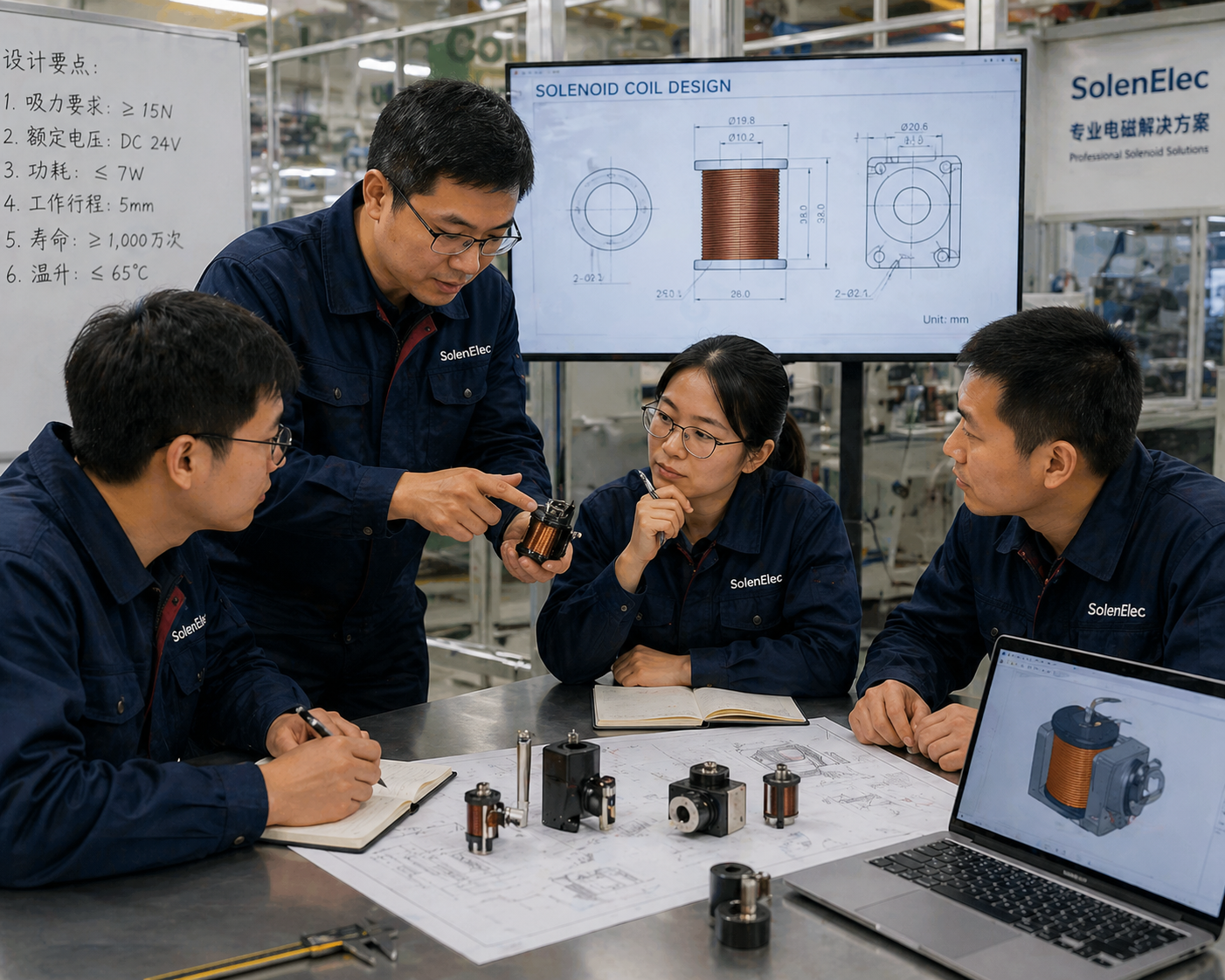
At SolenElec, our manufacturing context includes controlled coil winding, precision molding and assembly, MES-based traceability, and outgoing inspection. I still recommend that buyers validate the specific coil in their own valve and machine conditions, because a compliant coil design must also suit the final application.
Validate at Hot State
The final acceptance question should not be merely, “Does the new coil work?”
The more useful question is:
Does the coil still have adequate thermal and magnetic margin after reaching the real operating condition?
That test should include the real valve, voltage, load, production cycle, enclosure, and temperature.
Frequently Asked Questions
Can a burnt solenoid coil be repaired?
A burnt solenoid coil is usually replaced rather than repaired, especially in production equipment. Rewinding may be possible for some specialist applications, but the underlying failure cause should be identified first. Installing a replacement without checking voltage, duty, heat, and mechanics can lead to repeat failure.
Can low voltage cause a solenoid coil to burn out?
Low voltage can contribute to overheating in a conventional AC solenoid if it prevents the armature from fully seating. The resulting open air gap can keep AC current abnormally high. This mechanism should not be assumed for all DC solenoids, which require separate evaluation.
How do I test a burnt solenoid coil?
A qualified technician can check continuity, coil resistance, and terminal voltage under operating conditions. They should also inspect the armature, valve contamination, duty cycle, installed temperature, wiring, and connector condition. Resistance readings should be interpreted with temperature in mind.
Why does my solenoid valve coil get hot?
Some coil heating is normal during energization. Excessive heat may result from overvoltage, excessive ON time, rapid cycling, poor cooling, high ambient temperature, a hot valve body, incomplete AC armature seating, or an unsuitable coil design for the application.
Does a higher-temperature insulation class prevent coil burnout?
A higher insulation class can improve thermal tolerance, but it does not correct root causes such as incorrect voltage, a stuck armature, wrong duty cycle, high valve-body temperature, or contamination. The complete electrical, mechanical, and thermal system still needs evaluation.
Conclusion
When solenoid coil burning out occurs, especially after repeated replacements, I do not recommend starting with a “more powerful” or “higher-temperature” coil. The better approach is to identify whether the electrical supply, armature movement, duty profile, installed temperature, environment, or manufacturing consistency is creating the failure. The most reliable prevention strategy treats the coil, magnetic circuit, valve mechanism, electrical supply, and thermal environment as one system. For an OEM burnout investigation, share the coil voltage, AC/DC supply, resistance, ON/OFF profile, ambient and valve temperature, armature geometry, and failure symptoms with SolenElec so we can identify where the root-cause review should begin.
"Initial Motor Winding Insulation Lifetime Experimental ...", https://ntrs.nasa.gov/api/citations/20240007451/downloads/Winding%20Lifetime%20Testing%20V4.pdf. Electrical-insulation aging literature describes winding failure as a consequence of thermal, electrical, mechanical, and environmental stresses acting on the insulation system, supporting the article’s framing of coil burnout as insulation damage rather than merely visible charring. Evidence role: definition; source type: paper. Supports: A source should support that failure of magnet-wire or winding insulation can result from combined thermal, electrical, mechanical, and environmental stresses.. Scope note: The source may discuss electrical windings generally rather than solenoid coils specifically. ↩
"Troubleshooting the most typical winding problems of three ...", https://electrical-engineering-portal.com/troubleshooting-winding-problems-three-phase-electric-motors. Educational material on electrical winding failures identifies open circuits, abnormal resistance, and heat-damaged insulation or encapsulation as typical indicators of winding deterioration, providing general support for the listed diagnostic signs. Evidence role: general_support; source type: education. Supports: A source should support common observable and measurable indicators of coil or winding insulation failure, including open circuits and heat-related damage.. Scope note: The evidence is likely to support winding failures broadly and may not enumerate every symptom listed for solenoid coils. ↩
"Investigating Aging Characteristics of Oil-Immersed Power ...", https://pmc.ncbi.nlm.nih.gov/articles/PMC10647747/. Studies of electrical-insulation thermal aging and Joule heating show that increased winding losses raise temperature and that higher operating temperature accelerates insulation degradation, supporting the stated overvoltage-to-aging mechanism. Evidence role: mechanism; source type: paper. Supports: A source should support that increased electrical loading raises winding temperature and that elevated temperature accelerates insulation aging.. Scope note: The source may not establish a precise burnout threshold for the specific solenoid design. ↩
"Electromagnets", https://www.magnet-schultz.com/en/electromagnets. Electromagnetic-actuator references explain that an AC solenoid requires sufficient applied voltage to generate the magnetic force needed for pull-in, supporting the claim that undervoltage can leave the armature unseated. Evidence role: mechanism; source type: education. Supports: A source should explain that AC solenoids require sufficient voltage or magnetomotive force to close the magnetic gap and seat the armature.. Scope note: The support is mechanism-based and does not mean every low-voltage event will burn out every AC solenoid. ↩
"Coil Inductance Model Based Solenoid on–off Valve Spool ...", https://pmc.ncbi.nlm.nih.gov/articles/PMC6308575/. References on AC solenoid operation describe high inrush current with an open magnetic gap and reduced holding current after armature closure increases inductance, supporting the article’s explanation of current reduction after seating. Evidence role: mechanism; source type: education. Supports: A source should support the relationship between magnetic air gap, inductance, and the difference between AC solenoid inrush and holding current.. Scope note: The mechanism applies primarily to conventional AC solenoids and should not be generalized to all DC actuator designs. ↩
"Dynamic thermal management under variable operating ...", https://pmc.ncbi.nlm.nih.gov/articles/PMC12929589/. Engineering duty-cycle references define intermittent duty as operation with rest intervals that allow temperature recovery, supporting the statement that an intermittent coil requires adequate off-time to dissipate stored heat. Evidence role: definition; source type: institution. Supports: A source should define intermittent duty or duty cycle in terms of operating periods, rest periods, and thermal limits.. Scope note: The source will typically define the principle; the required off-time remains specific to the coil design and installation. ↩
"Simulation study on modified coil configuration used for shrink ...", https://pmc.ncbi.nlm.nih.gov/articles/PMC10358703/. Thermal models for electromagnetic coils show that temperature rise depends on losses, duty cycle, thermal capacitance, and heat dissipation, supporting the claim that high switching frequency becomes harmful when cooling time is insufficient. Evidence role: mechanism; source type: paper. Supports: A source should support that temperature rise depends on power dissipation, duty cycle, thermal mass, and heat-transfer conditions rather than frequency alone.. Scope note: The source may provide a general thermal model rather than failure data for the exact solenoid described. ↩
"Measurement and Modeling of Self-Heating in SO1 NMOSFET's", https://nanoheat.stanford.edu/wp-content/uploads/1994/09/A11.pdf. Heat-transfer and electrical-equipment thermal-design texts treat component temperature as the result of internal power dissipation and external boundary conditions such as ambient temperature, airflow, and mounting, supporting the article’s installed-temperature model. Evidence role: mechanism; source type: education. Supports: A source should support that component temperature is determined by internally generated heat plus heat exchange with ambient surroundings and mounting conditions.. Scope note: The equation is a simplified troubleshooting expression rather than a complete thermal-resistance network. ↩
"Optimized Insulation Design of Power Transformer Windings ...", https://scholarworks.wmich.edu/cgi/viewcontent.cgi?article=4751&context=dissertations. Power-quality and insulation-coordination references describe switching transients as short-duration overvoltages capable of stressing insulation systems, supporting the article’s identification of transients as a possible repeated-stress mechanism. Evidence role: mechanism; source type: institution. Supports: A source should support that switching surges or transient overvoltages can stress insulation systems and connected components.. Scope note: Such references establish plausibility, not that transients caused a specific field burnout without measurements. ↩
"Degradation of Polymer Materials in the Environment and Its ...", https://pmc.ncbi.nlm.nih.gov/articles/PMC11478708/. Materials and electrical-reliability studies report that moisture and contaminants can promote corrosion and reduce insulation resistance over time, supporting the claim that environmental damage may develop gradually rather than only as an immediate short circuit. Evidence role: mechanism; source type: paper. Supports: A source should support that moisture, contaminants, or chemicals can degrade electrical insulation, contacts, seals, or connectors over time.. Scope note: The evidence is contextual and does not identify the specific contaminant or degradation rate for any one solenoid installation. ↩
"Statistical Process Monitoring for Autocorrelated Data", https://www.nist.gov/programs-projects/statistical-process-monitoring-autocorrelated-data. Reliability-engineering and statistical-process-control literature links manufacturing variation and process control to differences in product reliability, supporting the article’s claim that nominally identical coils may perform differently in the field when production consistency differs. Evidence role: general_support; source type: research. Supports: A source should support that manufacturing variation and process control influence product reliability beyond nominal design specifications.. Scope note: The support is general to manufactured electrical components and does not prove a defect in any particular coil batch. ↩
"Temperature Coefficient of Resistance", http://hyperphysics.phy-astr.gsu.edu/hbase/electric/restmp.html. Reference data for copper list a positive temperature coefficient of resistance, supporting the article’s warning that resistance readings from a hot coil should not be compared directly with cold reference values. Evidence role: definition; source type: government. Supports: A source should support that copper’s electrical resistance increases with temperature and provide or describe its positive temperature coefficient.. ↩