How Does a Water Valve Coil Work in a Dishwasher?
Your dishwashers are failing, and warranty claims are hurting your brand's reputation. The problem might be a tiny, overlooked component. Understanding its true function is your first step to a solution.
A dishwasher water valve coil works by using an electrical current to create a magnetic field. This field moves a metal plunger inside the valve, opening a path for water to enter the machine.1 The reliability of this simple action depends entirely on the quality of its materials and manufacturing.
You might think the physics are simple, and they are. But for a procurement manager, the important question isn't how it works, but why it fails. The real story is in the details that separate a coil that lasts for a decade from one that causes field failures in a year. Let's look beyond the basic principle and explore what truly defines a reliable water valve coil. This knowledge is key to protecting your brand and your bottom line.
What Is the Function of a Dishwasher Water Valve Coil?
Are you getting reports of inconsistent cleaning results or water fill errors? A faulty coil could be the cause, creating small performance issues that lead to big customer complaints.
The coil's main function is to act as a fast, reliable electromechanical switch. It receives a signal from the dishwasher's main control board and instantly opens the water inlet valve.2 This must happen with perfect timing, every single time, to ensure the correct amount of water is used.
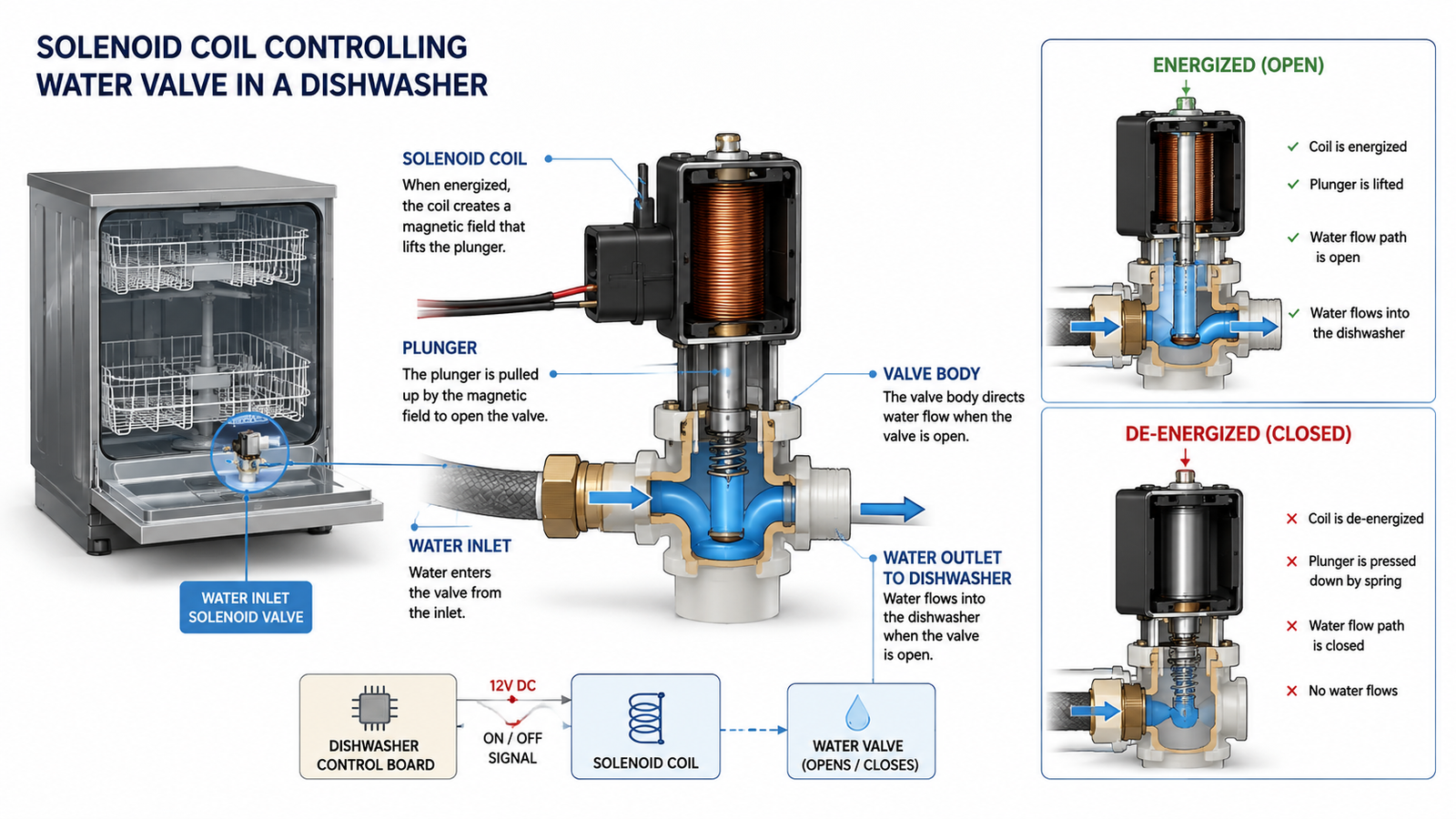
The function goes deeper than just opening and closing a valve. It's about precision and endurance. The dishwasher's cleaning cycle depends on specific water volumes at specific times.3 If the coil's response is slow or inconsistent, the entire wash performance suffers. For example, a delayed opening can lead to insufficient water for the main wash, leaving dishes dirty. A failure to close completely can cause a slow leak, or worse, a flood.4 For your customers, this translates directly to their perception of your brand's quality. A premium appliance must perform flawlessly. The coil is a small but critical part of delivering that promise. Over the appliance's lifespan, this coil will perform this action tens of thousands of times.5 Its function is to provide unwavering consistency.
How to Choose the Right Water Valve Coil for Dishwashers?
Choosing a supplier feels like a huge risk. Picking the wrong one can lock you into years of quality problems and warranty costs. You need a clear framework for making a decision that protects you.
To choose the right coil, you must focus on the specification sheet and the manufacturer's capabilities. Specify key material properties like insulation class and plastic type. Then, verify the supplier's quality systems, certifications, and their ability to provide engineering support.
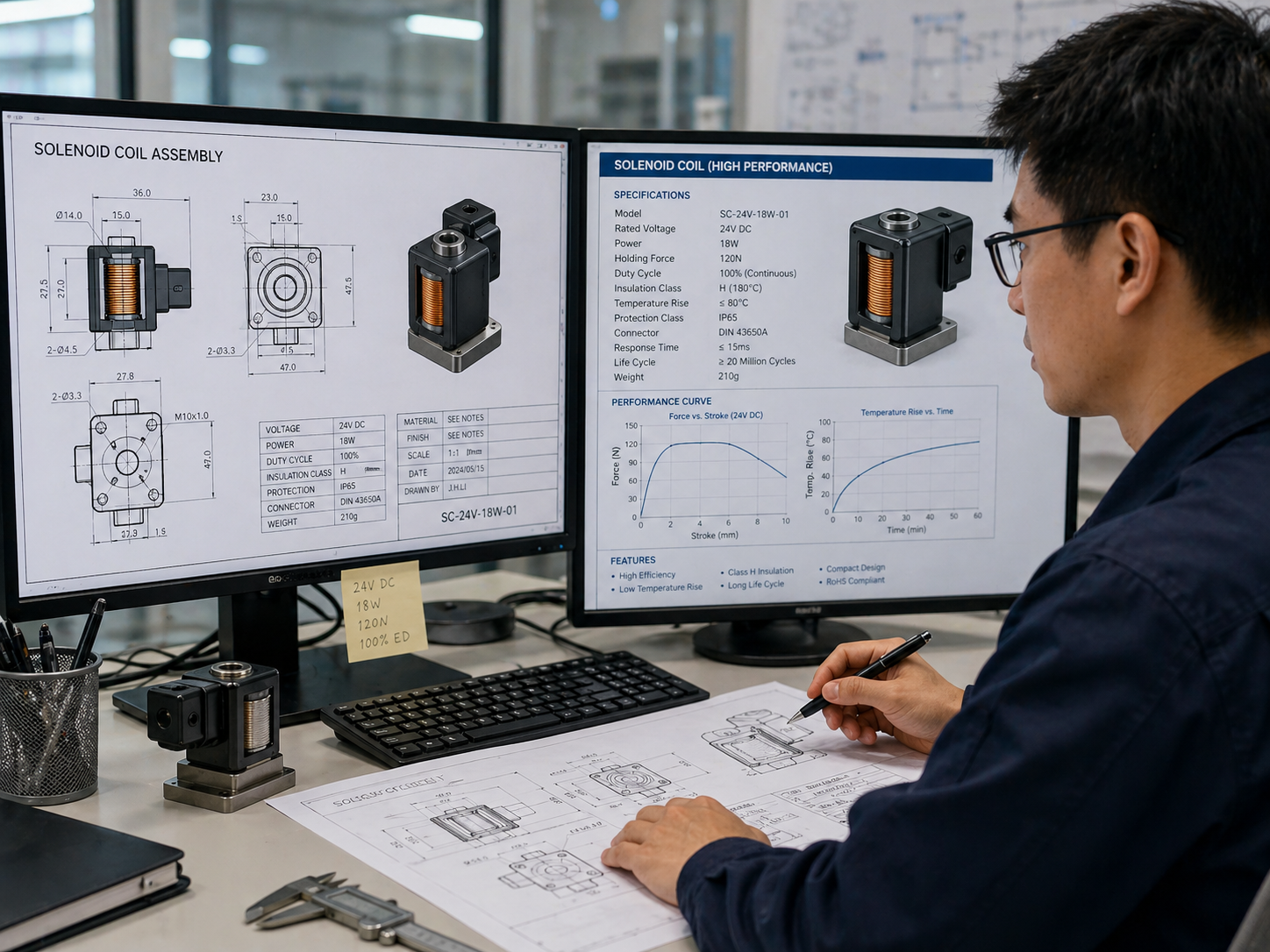
A technical specification sheet is your first line of defense against future failures. But you need to know what to look for. It's not just about dimensions and resistance. The real value is in the material and performance standards that prevent common failure modes. We always guide our partners to specify these critical details. A simple table can help you translate these technical terms into real business benefits.
| Specification | Why It Matters for a Dishwasher | Business Impact |
|---|---|---|
| Insulation Class F (155°C) or H (180°C)6 | Dishwasher drying cycles generate significant heat.7 The coil must withstand this thermal stress without degrading. | Prevents coil burnout and short circuits. Reduces field failures and warranty claims. |
| Bobbin Material (e.g., PA66+GF30%) | The plastic bobbin holds the copper winding. It must remain dimensionally stable under heat and humidity.8 | Avoids deformation that can lead to winding shorts, the root cause of many failures. |
| Certifications (UL, TUV, CE)9 | Proves that the coil and its materials meet internationally recognized safety and performance standards. | Ensures market access and compliance. Reduces liability risk. |
| 100% Outgoing Inspection | Every single coil is tested for key electrical parameters before it leaves the factory. | Guarantees that every unit you receive meets the spec. Eliminates the risk of installing a "dead on arrival" part. |
Looking at a spec sheet this way changes your focus from price to total cost of ownership. The few cents saved on a coil with a lower temperature rating can cost hundreds of dollars in a single warranty service call.
What Causes Dishwasher Water Valve Coil Failure?
Field failures are a procurement manager's worst nightmare. You get vague error codes and angry customer service calls. Tracing the problem back to a specific component is difficult, but often, the coil is the silent culprit.
The most common causes of coil failure are thermal stress, moisture, and electrical shorts.10 High temperatures from the drying cycle can degrade materials, while moisture can cause corrosion. Electrical shorts often happen when the thin insulation on the copper wire breaks down11, which is a sign of poor manufacturing.
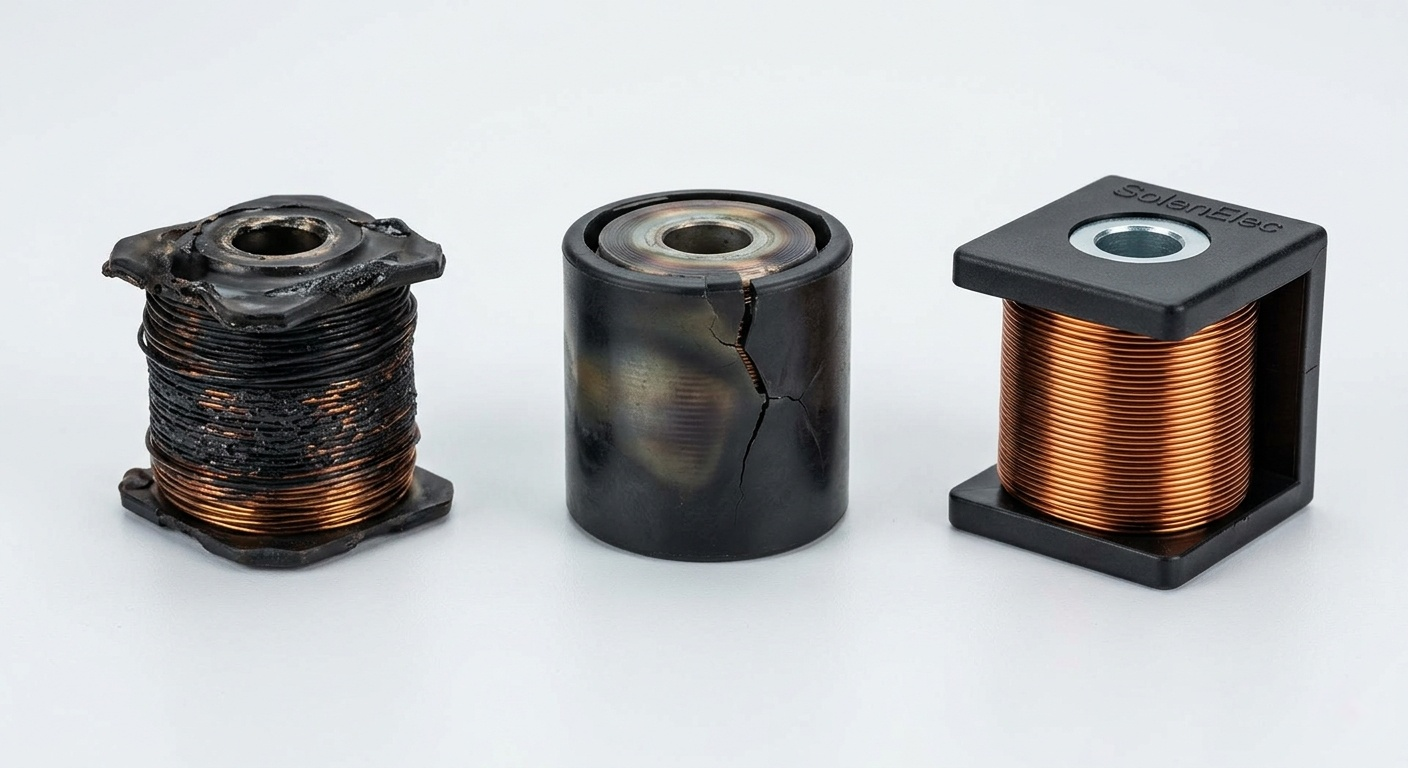
Let me share a story. A few years ago, a major European appliance brand came to us. They were facing a spike in warranty claims on a new, high-end dishwasher model. The error code pointed to a water inlet problem, and service technicians were replacing the entire water valve assembly, which was very expensive. The brand's reputation for reliability was at risk.
Their team had already confirmed the valve design was sound. They suspected the solenoid coil, which they were sourcing from another supplier. We were asked to investigate. Our engineers analyzed the failed coils from the field. On the surface, they looked fine. But when we cut them open and put them under the microscope, we found the problem. The plastic bobbin, the frame that holds the copper wire, had slightly deformed. The high heat of the dishwasher's drying cycle was causing the low-grade plastic to soften. This subtle change in shape put pressure on the ultra-thin copper windings, causing the insulation to scrape off and the coil to short-circuit. The failure was baked into the material choice of the original supplier. We replaced their coil with one using a high-temperature PA66 polymer, and the field failures stopped. This experience shows that the cause of failure is often a hidden material or manufacturing weakness.
How Do Solenoid Coils Control Water Flow in Dishwashers?
You know that coils open valves. But how does this simple action stay reliable across millions of units produced? Small variations in manufacturing can lead to big differences in performance, and that inconsistency is a risk for your brand.
Solenoid coils control water flow by converting an electrical signal into a precise mechanical force. This force must be strong and consistent enough to pull a plunger against a spring, opening the valve. The reliability of this control depends on the uniformity of the coil's magnetic field and the durability of its components.

Let's break down the control sequence and where things can go wrong.
- Signal Sent: The dishwasher's main controller (PCB) sends a specific voltage to the coil.
- Field Created: The coil energizes, creating a magnetic field. The strength of this field is determined by the number of turns in the copper winding and the current.12
- Plunger Moves: The magnetic field pulls a metal plunger, overcoming the force of a return spring.
- Valve Opens: The plunger's movement unseals the valve, allowing water to flow.
In an ideal world, this happens identically every time. In reality, manufacturing variations can disrupt this process. If the coil winding is not perfectly uniform, the magnetic field can be weaker than specified. This might not be enough to reliably pull the plunger, especially as the spring ages or if water pressure varies. This leads to intermittent "no water" errors that are difficult to diagnose. As a manufacturer, we eliminate this risk through automation and process control. Our automated winding machines ensure every coil has the exact same number of turns. We also use a Manufacturing Execution System (MES) to trace every component and process step for every coil we produce. This isn't just a fancy feature; it's your insurance against the kind of batch-to-batch variation that leads to unpredictable performance in the field.
Where to Find Reliable Dishwasher Water Valve Coil Manufacturers?
You need a partner, not just a parts supplier. Finding a manufacturer you can trust with your brand's reputation can feel overwhelming. You need a clear checklist to evaluate potential suppliers effectively.
You can find reliable manufacturers by looking beyond the price and evaluating their experience, quality systems, and engineering capabilities. A trustworthy partner will have proven experience with major brands, hold key certifications like ISO 9001, and offer transparent manufacturing processes.

For over 20 years, we've worked as an OEM/ODM partner for leading European brands. Based on this experience, I suggest using a simple framework to vet any potential manufacturer. Ask these questions during your evaluation process.
A Checklist for Vetting Coil Suppliers
- What is their OEM/ODM experience?
- Have they worked with appliance brands in your market (e.g., Europe)?
- Can they show a history of long-term partnerships? This indicates reliability and trust.
- What are their certifications and compliance standards?
- Look for factory-level certifications like ISO 9001 (quality management) or IATF 16949 (automotive quality, a very high standard).
- Confirm their products comply with CE, UL, RoHS, and REACH. This is non-negotiable for market access and safety.
- How do they control quality?
- Do they perform 100% outgoing inspection on all electrical parameters? Sampling is not enough for a critical component.
- What is their process for incoming material inspection? This prevents problems like the one in the case study I shared.
- What are their engineering capabilities?
- Do they have an in-house engineering team?
- Can they support you with material selection and design optimization to improve reliability and reduce cost? A true partner helps you solve problems.
A supplier who can give you confident, detailed answers to these questions is more than a vendor. They are a strategic partner who can help you reduce risk and build a more reliable product.
Conclusion
A dishwasher water valve coil is more than a simple component. Its reliability is a direct reflection of your brand's promise. Choosing the right manufacturing partner is your best defense against failure.
"Solenoid valve - Wikipedia", https://en.wikipedia.org/wiki/Solenoid_valve. Technical descriptions of solenoid valves state that energizing a coil produces a magnetic field that moves an armature or plunger to change the valve state. Evidence role: mechanism; source type: encyclopedia. Supports: A solenoid valve uses an energized coil to create a magnetic field that moves a ferromagnetic plunger or armature, thereby opening or closing a valve passage.. ↩
"How To Test A Dishwasher Water Inlet Valve (The Right Way)", https://www.youtube.com/watch?v=vrDSl24vwao. Appliance-control references describe dishwasher filling as an electrically controlled operation in which the controller energizes the inlet-valve solenoid to admit water. Evidence role: mechanism; source type: education. Supports: Dishwasher fill operation is initiated when the controller or timer energizes the water inlet valve solenoid.. Scope note: This supports the general control relationship; it may not verify the response time or control architecture of every dishwasher model. ↩
"[PDF] Energy Conservation Program: Test Procedure for Dishwashers", https://www.energy.gov/sites/default/files/2022-12/dishwashers%20TP%20FR.pdf. Government dishwasher test procedures measure water consumption within specified operating cycles, supporting the premise that controlled fill volumes are integral to dishwasher operation. Evidence role: general_support; source type: government. Supports: Dishwasher performance and energy or water-use testing are structured around defined cycles and measured water consumption, indicating the importance of controlled water fills.. Scope note: Such procedures document cycle-level water use rather than proving the effect of every individual fill event on cleaning quality. ↩
"[PDF] Notification of Part 21 re AP-1000 Solenoid Operated Valves Leakage.", https://www.nrc.gov/docs/ML1407/ML14079A551.pdf. Failure-mode references for solenoid valves identify incomplete closure and seat leakage as mechanisms that can allow unintended fluid flow. Evidence role: mechanism; source type: research. Supports: Valve failure modes include incomplete closure or seat leakage, which can permit unintended flow.. Scope note: This supports the leakage mechanism generally; the severity of flooding depends on appliance design, water pressure, and safety controls. ↩
"Average life expectancy of a dishwasher? : r/homeowners", https://www.reddit.com/r/homeowners/comments/13pyf9g/average_life_expectancy_of_a_dishwasher/. Government appliance-use assumptions report typical dishwasher cycle frequency, which can be combined with expected service life and fills per cycle to contextualize cumulative valve actuations. Evidence role: statistic; source type: government. Supports: Published dishwasher usage assumptions and expected appliance lifetimes can be used to estimate the number of inlet-valve actuations over service life.. Scope note: This is an inferred estimate unless the source directly reports inlet-valve actuation counts. ↩
"Insulation system - Wikipedia", https://en.wikipedia.org/wiki/Insulation_system. Electrical insulation standards classify thermal endurance ratings, including Class F at 155°C and Class H at 180°C. Evidence role: definition; source type: institution. Supports: Electrical insulation thermal classes define Class F at 155°C and Class H at 180°C maximum temperature ratings.. ↩
"[PDF] Novel Dishwasher with Thermal Storage and Thermoelectric Heat ...", https://docs.lib.purdue.edu/cgi/viewcontent.cgi?article=1371&context=ihpbc. Studies of dishwasher operation report elevated temperatures during wash and drying phases, providing context for thermal-stress requirements on internal components. Evidence role: general_support; source type: research. Supports: Dishwasher drying phases can create elevated internal temperatures that impose thermal loads on nearby components.. Scope note: The source may report chamber or cycle temperatures rather than the exact temperature at the valve coil location. ↩
"Mechanical Performance of Polyamid 66 and Influence of Glass ...", https://ui.adsabs.harvard.edu/abs/2014MTest..56..325S/abstract. Materials studies of glass-fiber-reinforced PA66 document its improved stiffness and dimensional stability compared with unfilled polyamide, while also noting that moisture absorption can influence dimensions and properties. Evidence role: mechanism; source type: paper. Supports: Glass-fiber-reinforced PA66 has mechanical and dimensional properties relevant to use under elevated temperature and humid conditions, while moisture absorption can still affect dimensions.. Scope note: This supports material behavior generally and may not directly test the exact bobbin geometry or dishwasher environment. ↩
"CE marking - Wikipedia", https://en.wikipedia.org/wiki/CE_marking. Institutional sources describe CE marking as a declaration of conformity with applicable EU requirements and UL or TUV marks as evidence of third-party safety testing or certification. Evidence role: definition; source type: institution. Supports: CE marking indicates conformity with applicable EU requirements, while UL and TUV are third-party safety testing or certification schemes.. Scope note: This does not by itself prove product performance in service, and CE marking is not equivalent to a third-party certification in all cases. ↩
"Degradation Monitoring of Insulation Systems Used in Low-Voltage ...", https://pmc.ncbi.nlm.nih.gov/articles/PMC7374401/. Failure-analysis literature on electromagnetic coils identifies overheating, moisture-related degradation, corrosion, and insulation short circuits as recurring causes of coil failure. Evidence role: expert_consensus; source type: paper. Supports: Reliability and failure-analysis literature identifies overheating, insulation degradation, moisture or corrosion, and short circuits as recurring coil failure mechanisms.. Scope note: The source may address electromagnetic coils broadly rather than dishwasher inlet-valve coils specifically. ↩
"Degradation Monitoring of Insulation Systems Used in Low-Voltage ...", https://pmc.ncbi.nlm.nih.gov/articles/PMC7374401/. Research on winding insulation failure shows that degradation of enamelled copper-wire insulation can produce turn-to-turn short circuits in electromagnetic coils. Evidence role: mechanism; source type: paper. Supports: Degradation or failure of the enamel insulation on copper winding wire can allow turn-to-turn short circuits in coils.. ↩
"Solenoids as Magnetic Field Sources - HyperPhysics", http://hyperphysics.phy-astr.gsu.edu/hbase/magnetic/solenoid.html. Introductory electromagnetism texts derive the solenoid field as proportional to current and the number of turns per unit length. Evidence role: mechanism; source type: education. Supports: For an ideal solenoid, magnetic field strength is proportional to the product of current and turn density.. Scope note: The ideal-solenoid relation simplifies real valve-coil geometry, magnetic-core effects, and saturation. ↩