
How Does a Linear Solenoid Actuator Work? (Theory and Practical Guide)
Do your linear solenoids fail early or overheat? Bad actuators ruin machines and cost you money. I will show you how they work and how to fix these issues.
A linear solenoid actuator works by sending electrical current through a copper coil. This creates a magnetic field. The magnetic field pulls or pushes a metal plunger in a straight line. When the power stops, a spring usually pushes the plunger back to its starting place.
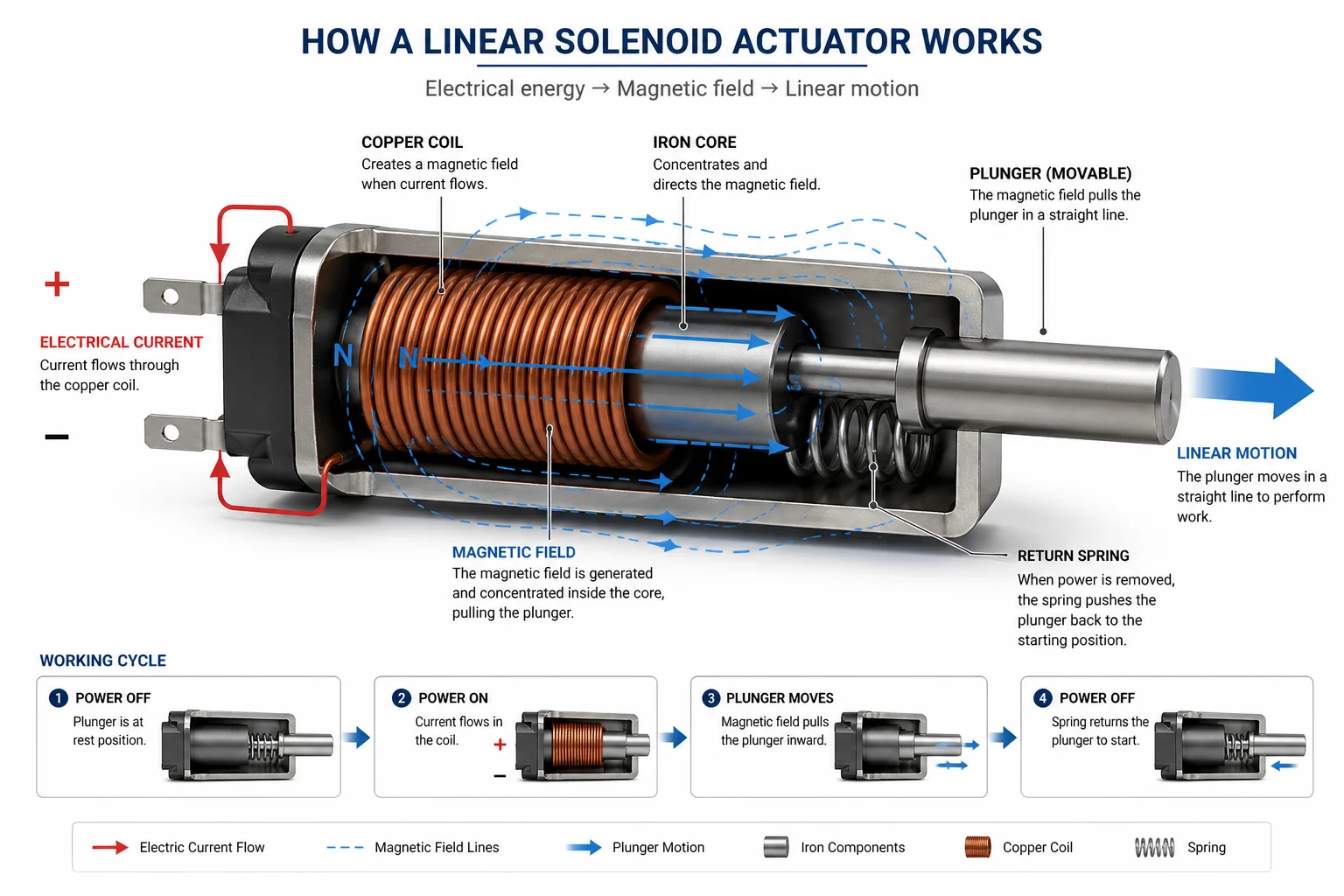
The basic idea is very simple. Anyone can understand it. But why do many of these parts fail in the real world? The answer is in the hidden details of our manufacturing process. Let us look closer at what really makes a good solenoid.
What Is the Working Principle of a Linear Solenoid Actuator?
Are you tired of weak pulling forces? A poorly made solenoid struggles to move parts. Let us look at the basic science to understand where the real power comes from.
The working principle relies on electromagnetism. Electric current flows through the coil and creates a magnetic field.1 This field concentrates inside the iron core and attracts the movable plunger. The strength of this pull depends heavily on wire quality, winding precision, and magnetic circuit design.2

The Gap Between Theory and Reality
In theory, you just apply power, get magnetic force, and pull the plunger. It sounds very easy. But in my 20 years of OEM experience at SolenElec, I see the truth. Almost 90% of product problems happen because of poor craftsmanship and cheap materials.3 Two factories can make the exact same design. But the pulling force will be very different if one factory has bad quality control.
Core Components of the Process
To get stable suction and fast reaction times, you must control three main areas.
| Component | Common Problem | Our Solution |
|---|---|---|
| Copper Wire | Impure copper causes weak force. | We use high-purity copper wire. |
| Coil Winding | Loose winding wastes space. | We use precision automated winding. |
| Magnetic Circuit | Bad design leaks magnetic fields. | We optimize paths to stop magnetic loss. |
You cannot just look at the basic drawing. You must look at how the factory builds the part. If the winding is not tight, the magnetic field is weak. If the copper is bad, the current flow is poor. The theory gets the plunger moving, but the craftsmanship decides if it keeps working for years.
How to Design a Linear Solenoid Actuator for Your Application?
Do your custom solenoids overheat quickly? Blindly guessing the design specs will destroy your product.4 I will show you the right way to design a safe and strong actuator.
To design a linear solenoid, you must first define your stroke length and force needs. Many people think adding more coil turns gives more force. This is a myth. You must optimize the magnetic circuit, control internal gaps, and reduce magnetic loss instead.

The Danger of Adding More Turns
Many purchasing managers and engineers make a big mistake. They think that winding more wire around the coil will increase the strength. This is not true. If you blindly add more turns, the coil will heat up very fast.5 This severe heating will shorten the life of your product.
A Real Vending Machine Story
Let me share a story about one of our European vending machine clients. They had a weak pulling force problem. Their old supplier tried to fix it by adding more coils. The result was terrible. The solenoids became extremely hot and failed in the machines.6
The Right Way to Design
They came to SolenElec for help. We did not add more power. We changed the design.
| Action Taken | Result |
|---|---|
| We optimized winding tension. | Tighter coils fit better inside the frame. |
| We controlled the core gap. | We left less empty space inside the tube. |
| We reduced magnetic loss. | The client got 30% more pulling force. |
We boosted their force by 30% without adding any extra power consumption. Good design is about smart geometry, not just more material.
What Factors Affect Force and Stroke in Linear Solenoids?
Is your solenoid force inconsistent across different batches? Unstable parts cause machine jams and angry customers. You need to know exactly what controls the power and movement.
The force and stroke depend on the input current, coil turns, and the air gap between the plunger and the frame.7 However, the true secret to stable force is tight manufacturing tolerances. Even a tiny change in gap size will completely change the pulling power.

Why Force Changes in the Same Model
You might buy 10,000 solenoids that look exactly the same. But some pull hard, and some pull weak. Why does this happen? The answer is the manufacturing process. Poor craftsmanship creates tiny differences inside the part. The air gap is the most important factor. If the gap between the iron core and the frame changes by just a fraction of a millimeter, the magnetic force drops fast.8
Key Factors for Stability
To keep the force and stroke stable, a factory must control every step.
| Factor | Impact on Performance | Manufacturing Control |
|---|---|---|
| Wire Tension | It affects coil density. | We use automated winding machines. |
| Plastic Bobbin | It holds the wire in place. | We use precision injection molding. |
| Assembly Gap | It controls magnetic pull. | We do 100% outgoing inspection. |
At SolenElec, we use automated injection molding and strict assembly rules. We make sure the gap is exactly the same every single time. This means your home appliances will work perfectly, batch after batch. You reduce your procurement risk and lower your warranty costs.
What Are the Common Types of Linear Solenoid Actuators?
Are you using the wrong actuator type for your project? Picking the wrong style wastes money and breaks machines. Let us explore the options so you choose correctly.
The most common types are pull-type and push-type linear solenoids.9 Pull-types draw the plunger inward when powered. Push-types extend a rod outward. You can also find tubular solenoids for long life and open-frame solenoids for cost-saving projects. Your choice depends on your specific needs.

Matching the Type to the Task
Every machine needs a different kind of movement. If you make a smart door lock, you might need a small push-type solenoid. If you make a large washing machine, you might need a strong tubular pull-type solenoid. The type you pick changes how the machine works.
Open-Frame vs. Tubular Types
We build many types for our European and South American clients. Here is a simple guide to help you.
| Solenoid Type | Best Feature | Typical Application |
|---|---|---|
| Open-Frame | It has low cost and simple design. | Vending machines and small appliances use this. |
| Tubular | It has a long life and enclosed body. | Industrial tools and heavy doors use this. |
| Latching | It keeps position without power. | Battery-powered smart locks use this. |
As a purchasing manager, you must balance cost and risk. An open-frame type saves money. But a tubular type might last longer in a tough environment. Because we have 8 production lines and an in-house engineering team, we help you pick the exact right type. We do not just sell parts. We provide customized solutions that fit your market strategy.
How to Choose the Right Linear Solenoid for Industrial Use?
Do you struggle to find a reliable supplier? Bad parts ruin your brand reputation. You must look beyond the price tag and check the factory's real capabilities.
To choose the right linear solenoid, check the manufacturer's quality control and certifications. Look for CE, UL, and RoHS compliance. Make sure the factory uses high-purity copper and heat-resistant plastics. A good partner will also offer strong customized solutions to match your specific industrial needs perfectly.

Look at the Factory, Not Just the Part
When you buy solenoids for large home appliance brands, you carry a lot of responsibility. If the part fails, the whole machine fails. Therefore, choosing a solenoid is really about choosing a factory. You need a stable and durable supply chain partner.
Our Standard for Quality
At SolenElec, we know what brand managers need. We have over 20 years of OEM and ODM experience. We do not guess. We measure everything.
| Quality Step | What We Do | Why It Matters For You |
|---|---|---|
| Incoming Material | We check RoHS and REACH. | You get safe and legal materials. |
| Production Control | We use MES systems. | You get full quality traceability. |
| Final Testing | We do 100% outgoing inspection. | No bad parts reach your assembly line. |
You need products that comply with CE, CB, UL, and TUV standards.10 We provide this every day. Our 8 production lines are certified under ISO 16949. We handle annual purchasing volumes over 5 million USD for top brands. When you choose a partner with deep engineering experience, you lower your after-sales costs and protect your brand reputation.
Conclusion
Linear solenoids have simple principles but need expert craftsmanship. Optimize your design, pick quality materials, and partner with a proven factory to ensure long-term success and stable performance.
"Magnetic fields of currents - HyperPhysics Concepts", http://hyperphysics.phy-astr.gsu.edu/hbase/magnetic/magcur.html. This source explains the basic principle of electromagnetism and how electric current generates a magnetic field. Evidence role: definition; source type: education. Supports: Electric current flowing through a coil generates a magnetic field, which is the basis of solenoid operation.. ↩
"[PDF] LCLS Gun Solenoid Design Considerations - Stanford University", https://www-ssrl.slac.stanford.edu/lcls/technotes/LCLS-TN-05-14.pdf. This source discusses factors like wire quality and winding precision that influence the performance of solenoids. Evidence role: mechanism; source type: research. Supports: The pulling strength of a solenoid is influenced by wire quality, winding precision, and magnetic circuit design.. ↩
"Detecting Solenoid Valve Deterioration in In-Use Electronic Diesel ...", https://pmc.ncbi.nlm.nih.gov/articles/PMC3231176/. This source provides statistical insights into the impact of manufacturing quality on solenoid reliability. Evidence role: statistic; source type: institution. Supports: A significant percentage of solenoid failures are attributed to poor craftsmanship and substandard materials.. Scope note: The statistic may vary across industries and regions. ↩
"[PDF] February 27, 2003 • Lecture #4 – Magnetic Forces and Stresses", https://ocw.mit.edu/courses/22-68j-superconducting-magnets-spring-2003/bebdae6c350efd235d88f92bb2258430_forces_stresses.pdf. This source explains the risks of improper design specifications in solenoid manufacturing. Evidence role: general_support; source type: education. Supports: Incorrect design specifications can lead to solenoid failure and product damage.. ↩
"[PDF] Reliability and life study of hydraulic solenoid valve. Part 2", https://www.eng.auburn.edu/~choeson/Publication/1132_2009_Reliability%20and%20life%20study%20of%20hydraulic%20solenoid%20valve-Part%202%20_S.%20V.%20Angadi,%20R.%20L.%20Jackson.pdf. This source discusses the relationship between coil turns and heat generation in solenoids. Evidence role: mechanism; source type: research. Supports: Adding excessive coil turns can lead to rapid heat generation in solenoids.. Scope note: The heating effect may depend on specific design parameters. ↩
"[PDF] WHAT CAUSED THE FAILURES OF THE SOLENOID VALVE ...", https://www.osti.gov/etdeweb/servlets/purl/20235292. This source provides case studies or examples of solenoid failures due to overheating. Evidence role: case_reference; source type: institution. Supports: Overheating caused solenoid failures in vending machines, as described in the example.. Scope note: The example may not represent all solenoid applications. ↩
"A Detailed Explanation of Solenoid Force - Academia.edu", https://www.academia.edu/87099324/A_Detailed_Explanation_of_Solenoid_Force. This source explains how input current, coil turns, and air gap influence solenoid force and stroke. Evidence role: mechanism; source type: education. Supports: The force and stroke of a solenoid are influenced by input current, coil turns, and the air gap.. ↩
"[PDF] Pressure and Force Dynamics in Artificial Muscle Actuators", https://pdxscholar.library.pdx.edu/cgi/viewcontent.cgi?article=8049&context=open_access_etds. This source discusses the sensitivity of solenoid magnetic force to changes in air gap size. Evidence role: mechanism; source type: research. Supports: Small changes in the air gap size can significantly affect the magnetic force of a solenoid.. Scope note: The sensitivity may vary depending on solenoid design. ↩
"Solenoid (engineering) - Wikipedia", https://en.wikipedia.org/wiki/Solenoid_(engineering). This source categorizes and explains the common types of linear solenoids, including pull-type and push-type. Evidence role: definition; source type: encyclopedia. Supports: Pull-type and push-type are the most common types of linear solenoids.. ↩
"[PDF] Qualification tests of solenoid valves by environ exposure to ...", https://www.nrc.gov/docs/ML1807/ML18078A980.pdf. This source lists CE, CB, UL, and TUV as common compliance standards for solenoid products. Evidence role: definition; source type: government. Supports: Solenoid products often need to comply with CE, CB, UL, and TUV standards.. Scope note: Compliance requirements may vary by region and industry. ↩