
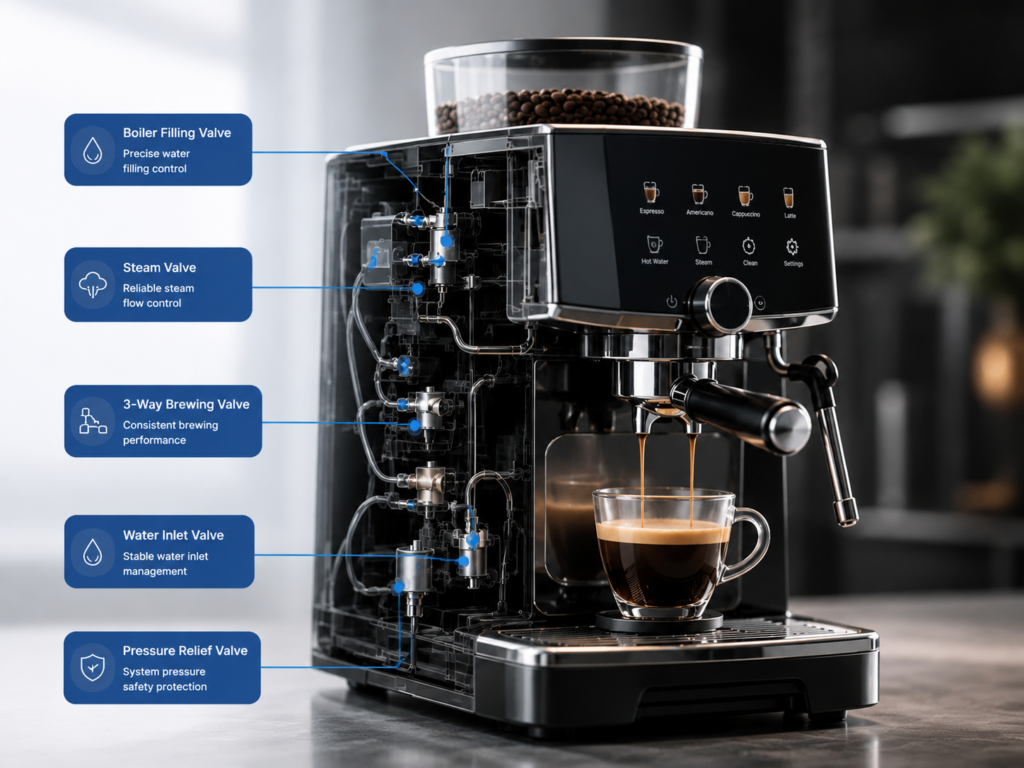
Coffee Machine Fluid Control Solutions
OEM solenoid valves and coils for espresso, bean-to-cup and commercial coffee machines. Spec brew, steam and drain circuits by orifice, seal, voltage and duty — not by brand list.
Applications
Product Highlights
Technical Specifications
| Parameter | Value |
|---|---|
| Valve Function | 2/2 NC, 3/2 NC (brew-group drain) |
| Port Size | G1/8", G1/4", 1/8 NPT |
| Orifice | 1.0 – 2.5 mm |
| Working Pressure | 0 – 10 bar |
| Media | Water / hot water / steam / air |
| Media Temperature | 0 – 140°C |
| Coil Voltage | DC 12/24 V, AC 110/220 V |
| Connector | DIN 43650 or flying leads |
| Body / Seal | Brass, SS304, PPS, PA66 / EPDM, FKM, silicone |
| Customization | Voltage, thread, seal, cable, mounting, function |
OEM engineering brief
Application Engineering Guide
Coffee-machine OEMs need a valve or coil that survives hot water and steam, holds brew pressure, and fits the existing group or boiler block. Use this page to pick the circuit, freeze the spec, and see why steam valves leak — before you send a drawing.
Where the valves sit
A typical espresso or bean-to-cup machine uses several small valves, not one. Identify the circuit first: a brew valve and a steam valve can share a footprint and still need different seals and coil duty.
- Brew / inlet waterMeters boiler or thermoblock fill. Needs a stable orifice, food-contact seals, and a fast close so shot pressure does not drift.
- Steam circuitIsolates the steam boiler or wand. Closed-state leak-through is what shows up as “machine not heating” or collapsing pressure.
- 3-way brew-group / drainDumps residual pressure after the shot. Debris or residual magnetism leaves the group weeping.
- Hot-water / milk / tankLower pressure, still food-contact. Often a different seal and voltage from the steam valve.
How to spec it
Send these with the drawing. Unknown lines are fine — we will propose a starting point from the machine type.
- Function2/2 NC for inlet/steam; 3/2 for brew-group drain. Ports G1/8, G1/4 or 1/8 NPT.
- Orifice1.0–2.5 mm. Oversizing a steam orifice makes leak-through much more damaging.
- Pressure0–10 bar covers most espresso boilers. Confirm peak steam pressure, not only brew pressure.
- Media & temperatureWater, hot water, steam up to 140°C. Coil ambient above the group is hotter than the room rating.
- SealEPDM for hot water; FKM or silicone for steam and oils. Do not copy a cold-water EPDM steam valve.
- CoilDC 12/24 V or AC 110/220 V; DIN 43650 or flying leads; Class F/H. Design for real duty, not catalogue ED.
Voltage and outline are only the first filters. Two 24 V DIN coils can still differ in resistance, temperature rise, magnetic force and connector sealing.
Why machines lose heat or leak steam
If a steam solenoid leaks through while closed, boiler pressure and temperature drop even with a healthy heater.
- Seat / seal not rated for steamHardening, extrusion or scale on the orifice.
- Coil too hotHigh ambient above the group, 100% ED on an intermittent steam coil, or undersized copper.
- Residual magnetismValve stays slightly open after power-off — more common on DC coils with the wrong residual gap.
- DebrisScale or gasket flash after a boiler redesign or a new water-treatment spec.
Swapping only the coil will not fix a steam leak if the armature, tube, orifice or seal is the root cause. For a coil-only replacement, match bore, magnetic length, power, duty and connector — not voltage alone.
OEM / ODM path
- Brief — drawing or sample, circuit (brew / steam / drain), voltage, pressure, media, annual volume.
- DFM — flange, coil envelope, connector exit and seal.
- Prototype — typically 5–7 working days for most valve/coil variants.
- Pilot — same process you will use in mass production; PPAP-style docs if required.
FAQ
Can I use the same valve for brew water and steam?
Only if orifice, seal, temperature class and coil duty were designed for steam. Most platforms keep two specs even when the brass body looks the same.
12 V, 24 V or 230 V?
24 V DC is the usual choice for new platforms. 230 V AC still appears on older commercial groups. We tool both; do not mix AC and DC coils on the same magnetic circuit.
The machine is not heating. Is it the solenoid?
If steam or brew pressure collapses with the heater on, check leak-through of the steam or 3-way valve before replacing the heating element.
Can you match a competitor outline?
Yes — send outline, bore, voltage, resistance/power and connector. We will say whether a catalogue coil can be adapted or a custom bobbin is required.
Send drawing, voltage, steam/water circuit, pressure and volume to cici@solenoidcn.com. Hardware: coffee-machine valves, coil series.
Have a drawing or sample?
Send voltage, media, pressure, duty and annual volume. We reply with a DFM note, not a catalogue dump.
Other OEM Applications
Related Industries
Same factory, different circuits. Open another application page if your machine is not the one above.

Coffee Machine
Precise water flow control for espresso machines and automatic coffee makers, ensuring consistent brewing quality.
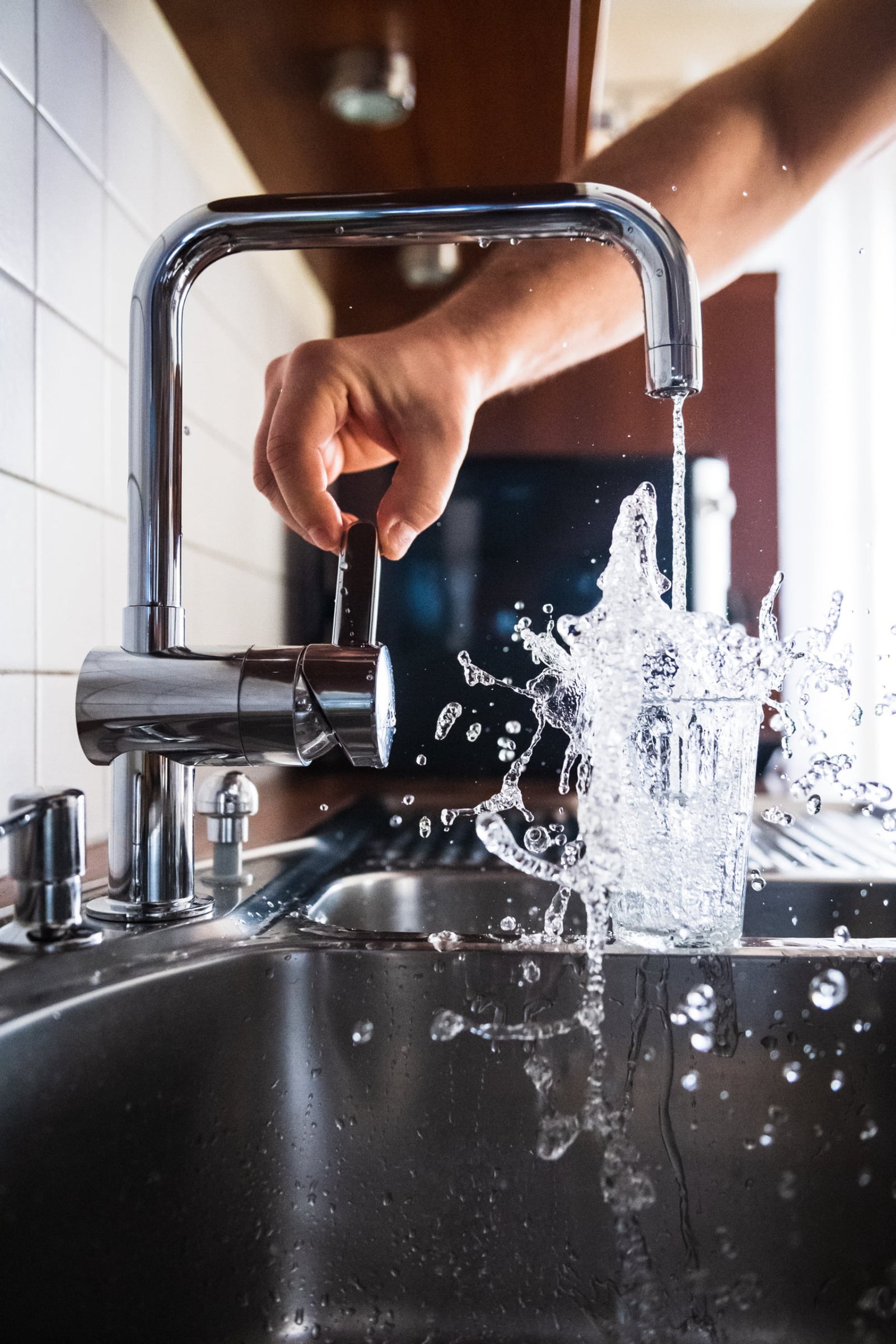
Water Dispenser
Reliable valve control for water purification systems and dispensing equipment with consistent performance.

Automotive
Reliable electromagnetic solutions for fuel systems, thermal management, and EV applications, ensuring stable performance in demanding automotive environments.
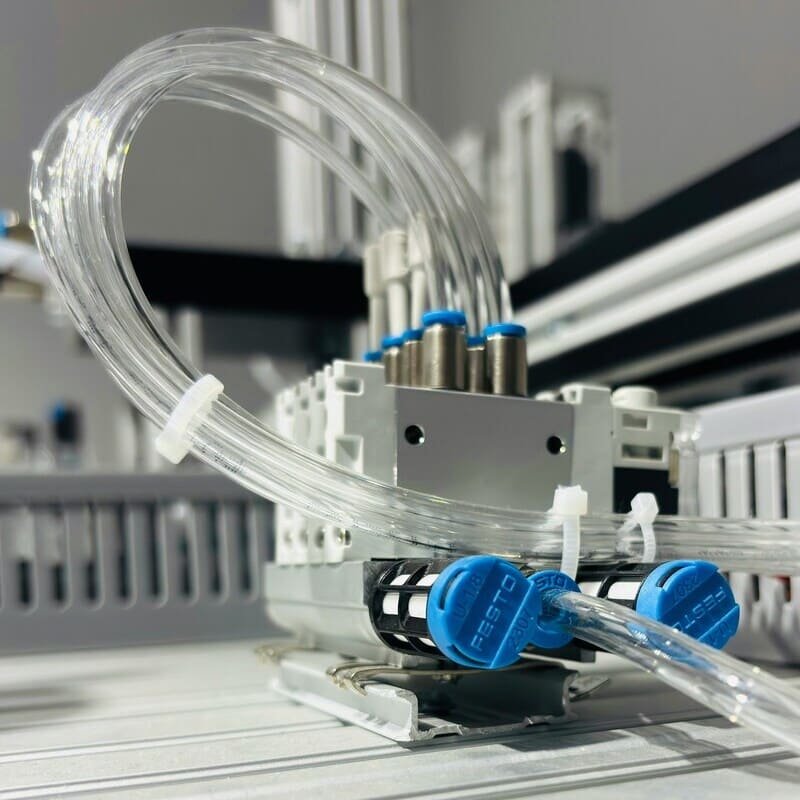
Pneumatic Industry
Designed for pneumatic valves and automation systems, providing precise air flow control, fast response, and dependable operation in industrial equipment.
Frequently Asked Questions
Professional answers for OEM/ODM and technical requirements from our engineering team.
OEM / ODM
Can you customize voltage and dimensions?
Do you support OEM/ODM projects?
Can you develop based on our drawings or samples?
Technical
What insulation classes are available?
What protection grades are supported?
Can the coils work continuously (100% ED)?
Technical Support
Engineering team ready to assist your project
At a Glance
Related Products
Explore more solenoid coil solutions for different applications and operating conditions.

Solenoid Valves for Coffee Machine
Solenoid Valves for Coffee Machine

Solenoid Coil Series
Solenoid Coil Series

Solenoid Pump Series
Solenoid Pump Series

Solenoid Valves for Water Purification
Solenoid Valves for Water Purification

High Pressure Solenoid Valve
High Pressure Solenoid Valve
Need a Custom Solution?
Our engineering team can help with OEM/ODM projects and technical requirements. Over 20 years of experience in solenoid coil design and manufacturing.
Customization Options
Customization Notes:
Send circuit (brew / steam / drain), drawing or sample, voltage, pressure, media, seal preference and annual volume. We confirm whether a catalogue valve/coil can be adapted or a custom bobbin/flange is required. Email: cici@solenoidcn.com