
How to Choose the Best Solenoid for Smart Lock Applications?
Choosing the wrong solenoid for your smart lock is a huge risk. It can lead to battery drain, overheating, or total failure1, causing costly recalls and damaging your brand.
The best solenoid for a smart lock is not simply the one with the highest force.2 It is the one whose force, power consumption, heat generation, and durability are perfectly balanced for your specific application's operational and business requirements, preventing costly field failures and protecting your bottom line.
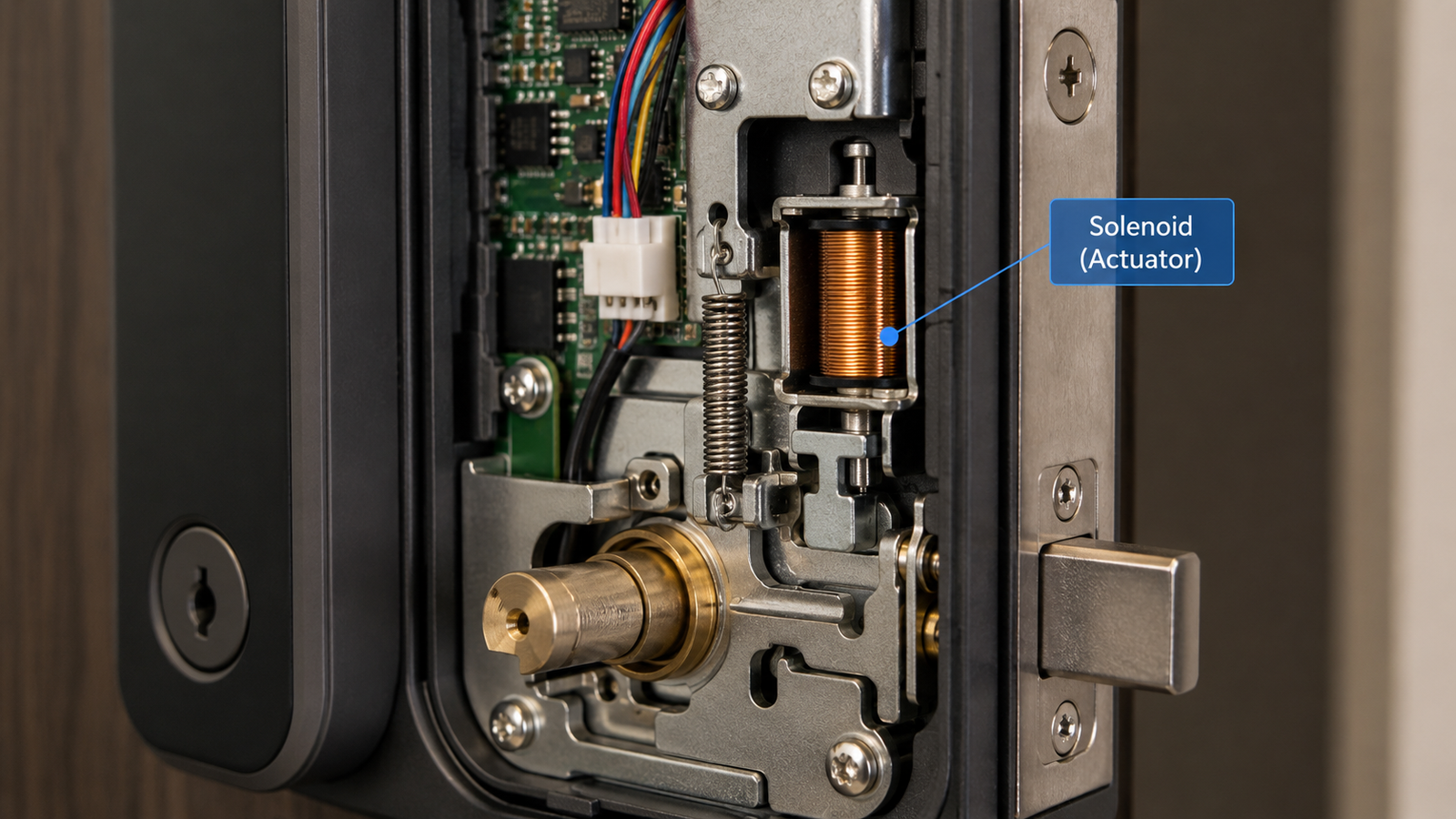
Choosing a component seems simple, but the details are what separate a market-leading product from a problematic one. The wrong choice can unravel your entire project, leading to performance issues that frustrate customers and tarnish your brand's reputation. It’s not just about finding a part that fits; it's about finding a partner who understands the risks and can help you navigate them. Let's break down how to avoid these pitfalls and select the perfect solenoid by asking the right questions from the start.
What Type of Solenoid Is Used in Smart Door Locks?
Are you unsure which solenoid type even fits a smart lock? Using the wrong one, like a push solenoid for a pull mechanism, can halt your project and lead to costly redesigns.
Smart locks most commonly use either latching solenoids3 for ultra-low power consumption or linear pull solenoids for simple, strong actuation. Latching models hold their position without power, saving battery, while linear models offer reliable force when energized. The choice depends entirely on your lock's design.

When we consult with smart lock designers, the first question is always about the power source and battery life target. This single factor often dictates the best solenoid type. The two main options serve very different needs.
- Latching Solenoids: These are bi-stable, meaning they have two stable positions (locked and unlocked) and only require a short pulse of electricity to switch between them.4 A permanent magnet holds the plunger in place, so they consume zero power to stay locked or unlocked.5 This is ideal for battery-powered residential locks where the goal is 12+ months of operation.
- Linear Pull Solenoids: These are simpler. When power is applied, the plunger pulls in. When power is cut, a spring returns it to its original position. They require continuous power during actuation6, but they often provide higher force in a smaller package.
Here is a quick comparison:
| Feature | Latching Solenoid | Linear Pull Solenoid |
|---|---|---|
| Power to Hold | None (uses magnets) | Continuous power required |
| Best For | Battery-powered devices | Mains-powered or high-force needs |
| Complexity | Higher (requires polarity-switching7) | Lower (simple on/off circuit) |
| Typical Use | Residential smart locks | Commercial access control, high-traffic doors |
If your primary product goal is achieving a 24-month battery life, a latching solenoid is the non-negotiable starting point for the design discussion.8
How Does a Smart Lock Solenoid Work?
You know a solenoid moves the lock, but what is actually happening inside? Misunderstanding this simple mechanism can lead you to misdiagnose failures as complex electronic issues when they are purely mechanical.
When your app sends the unlock signal, an electrical current flows through a coil of wire inside the solenoid, creating a powerful magnetic field.9 This field instantly pulls a metal plunger inward, which is physically linked to the lock's bolt, retracting it and unlocking the door.
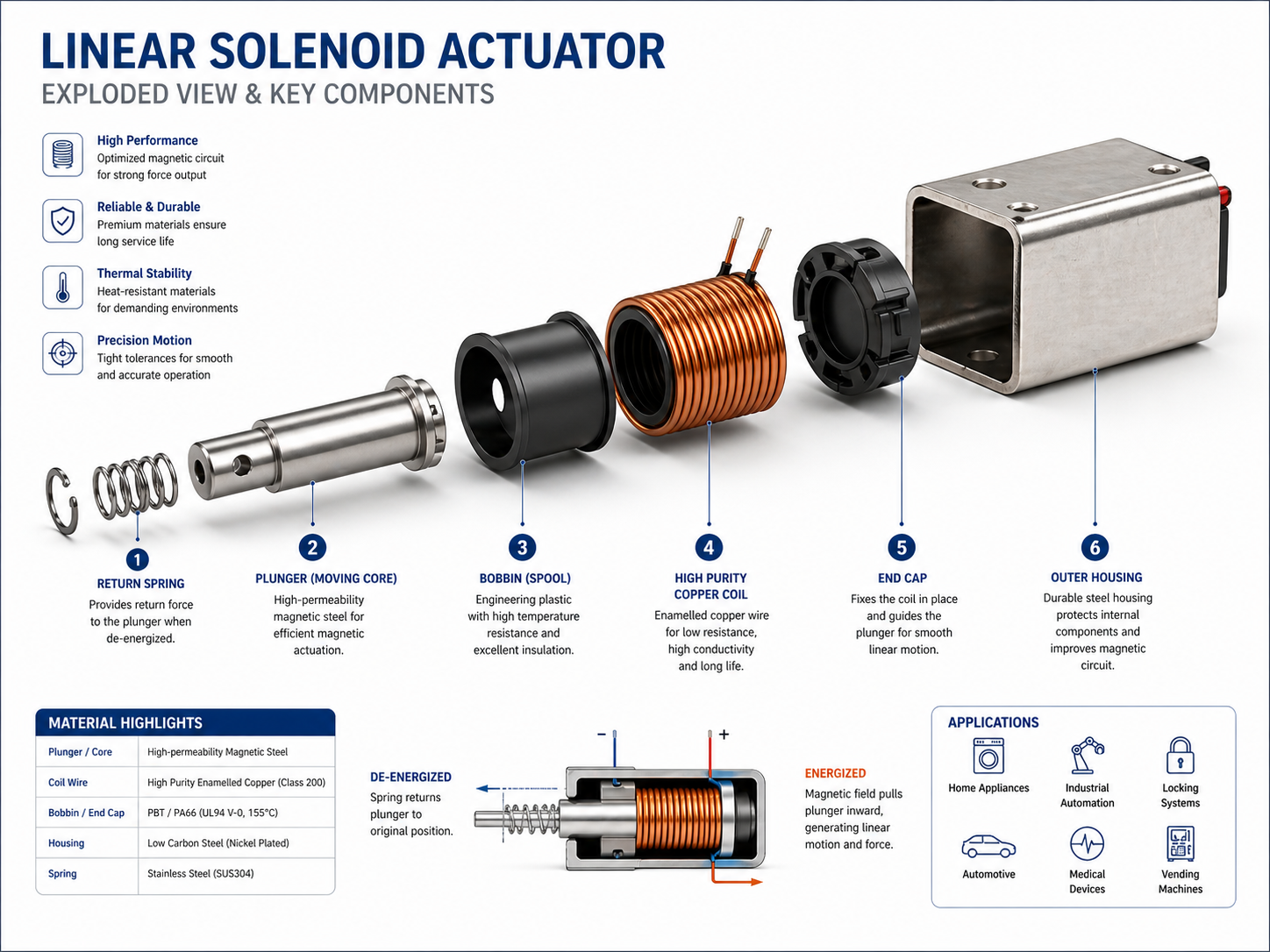
At its heart, a solenoid is a beautifully simple device that converts electrical energy into mechanical motion. I've spent 20 years working with them, and their reliability comes from this simplicity. Let's break it down into four distinct steps.
- Signal: The lock's circuit board receives a command—from a keypad, smartphone, or fingerprint reader—and sends a precise electrical current to the solenoid's coil.
- Electromagnetism: The copper wire coil, wrapped around a bobbin, instantly becomes a powerful electromagnet. The design of this coil determines how much force is generated and how much power is consumed.
- Actuation: This magnetic field attracts the iron plunger, pulling it rapidly into the center of the coil. The "click" you hear in a smart lock is the sound of this plunger hitting its stop. The distance it travels is called the stroke.
- Mechanical Work: The plunger is connected to the lock's bolt or latch mechanism. As the plunger moves, it pulls the bolt back, unlocking the door. When power is cut, a spring pushes the plunger back out, or in a latching solenoid, it stays put until a reverse current is applied.
Understanding this process is key for a product manager. The speed of this action determines the lock's responsiveness, while the power it draws dictates your battery life.
What Factors Affect Smart Lock Solenoid Performance and Reliability?
Are you worried your chosen solenoid will fail in the field, causing lockouts and recalls? A cheap component can pass initial tests in the lab but fail after just six months of real-world use.
The biggest factors are the trade-offs between force, power, and heat10, along with the solenoid's duty cycle and life cycle rating. A mismatch in any of these—like a high-power solenoid in a sealed plastic case—can lead to overheating, premature wear, and catastrophic product failure.
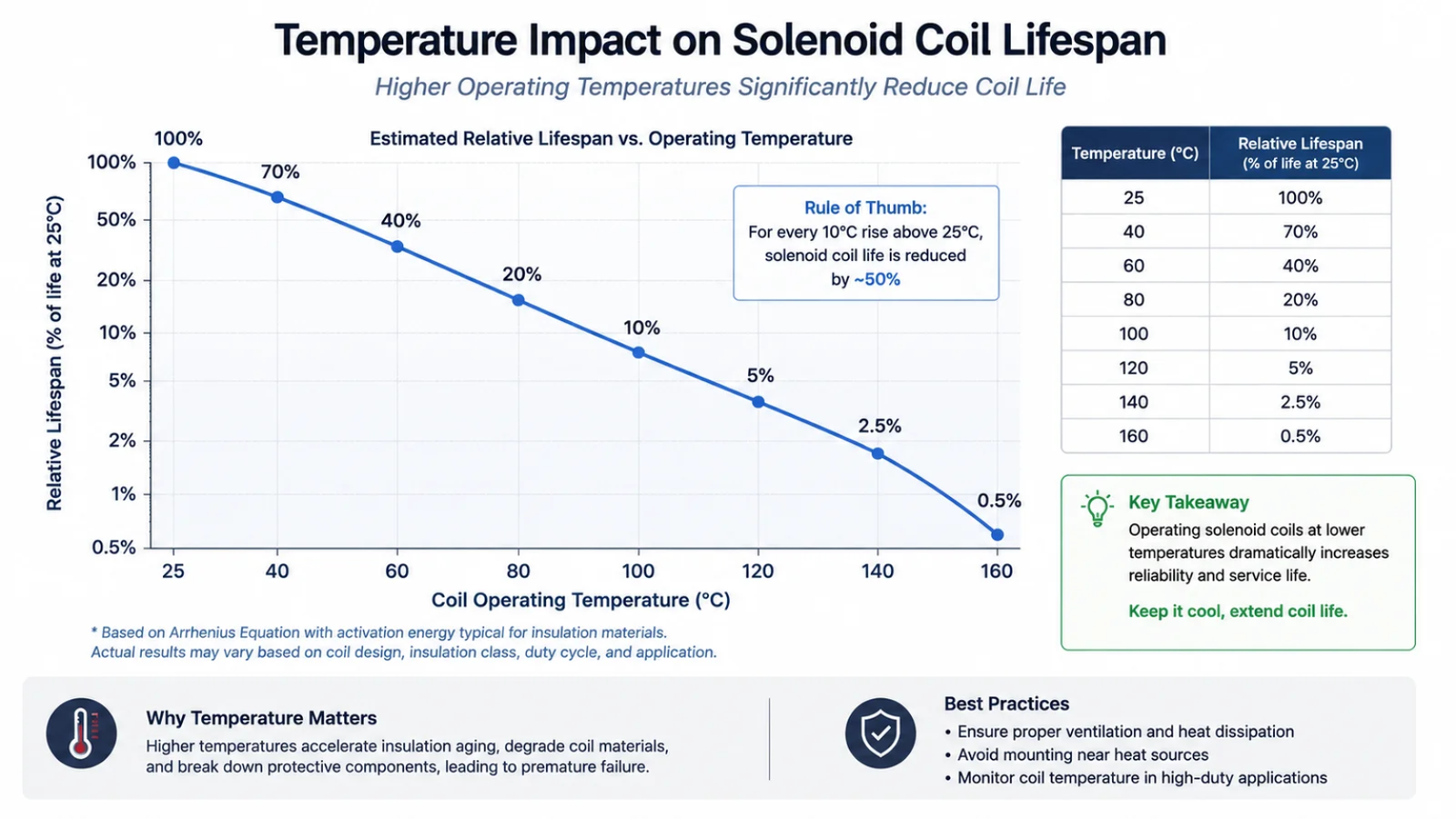
In my experience, most product failures trace back to overlooking one of four key parameters. These are not just technical specs; they are direct indicators of business risk.
1. Force vs. Power and Heat
A procurement manager might see a spec sheet for Solenoid A with a high 15N force and think it’s perfect for a robust feel. But it draws 2A at 12V (24W), causing a 65°C temperature rise. For a battery-powered lock, this is a non-starter. In contrast, Solenoid B offers only 8N, but at 0.8A (9.6W) with a manageable 30°C rise. If 8N is enough to move the bolt, choosing the "stronger" Solenoid A is a design failure that kills battery life and risks overheating.
2. Duty Cycle
A low-cost solenoid is advertised with an impressive 20N holding force, saving you $0.50 per unit. The hidden risk? Its 10% duty cycle means it can only be energized for 2 seconds out of every 20.11 A software bug or a user holding the 'unlock' button causes it to stay on for 5 seconds. It overheats past its 70°C thermal limit, the plastic bobbin melts, and the lock is permanently jammed. The business risk wasn't the force; it was the unexamined duty cycle.
3. Life Cycle Rating
How many times will your lock be used?
- Commercial Office Door: 500+ operations/day. Over 5 years, that's nearly 1,000,000 cycles.12 A solenoid rated for less will fail.
- Residential Bedroom Door: Maybe 10 operations/day. A 100,000-cycle rating is more than sufficient.
Choosing a commercial-grade solenoid for a residential lock is over-engineering and adds unnecessary cost. But putting a residential-grade solenoid in a commercial product guarantees field failures and warranty claims.
How to Select a Custom Solenoid for Electronic Lock Systems?
Do off-the-shelf solenoids never quite seem to fit your design or performance targets? Forcing a standard part into a unique product leads to compromises in size, power, or long-term reliability.
Instead of starting with a catalog of existing parts, you should start with your list of requirements. Define the "job" the solenoid must do: the force needed, the stroke length, the available space, the power budget, and the desired life cycle. A good manufacturer engineers a solution to meet those exact needs.
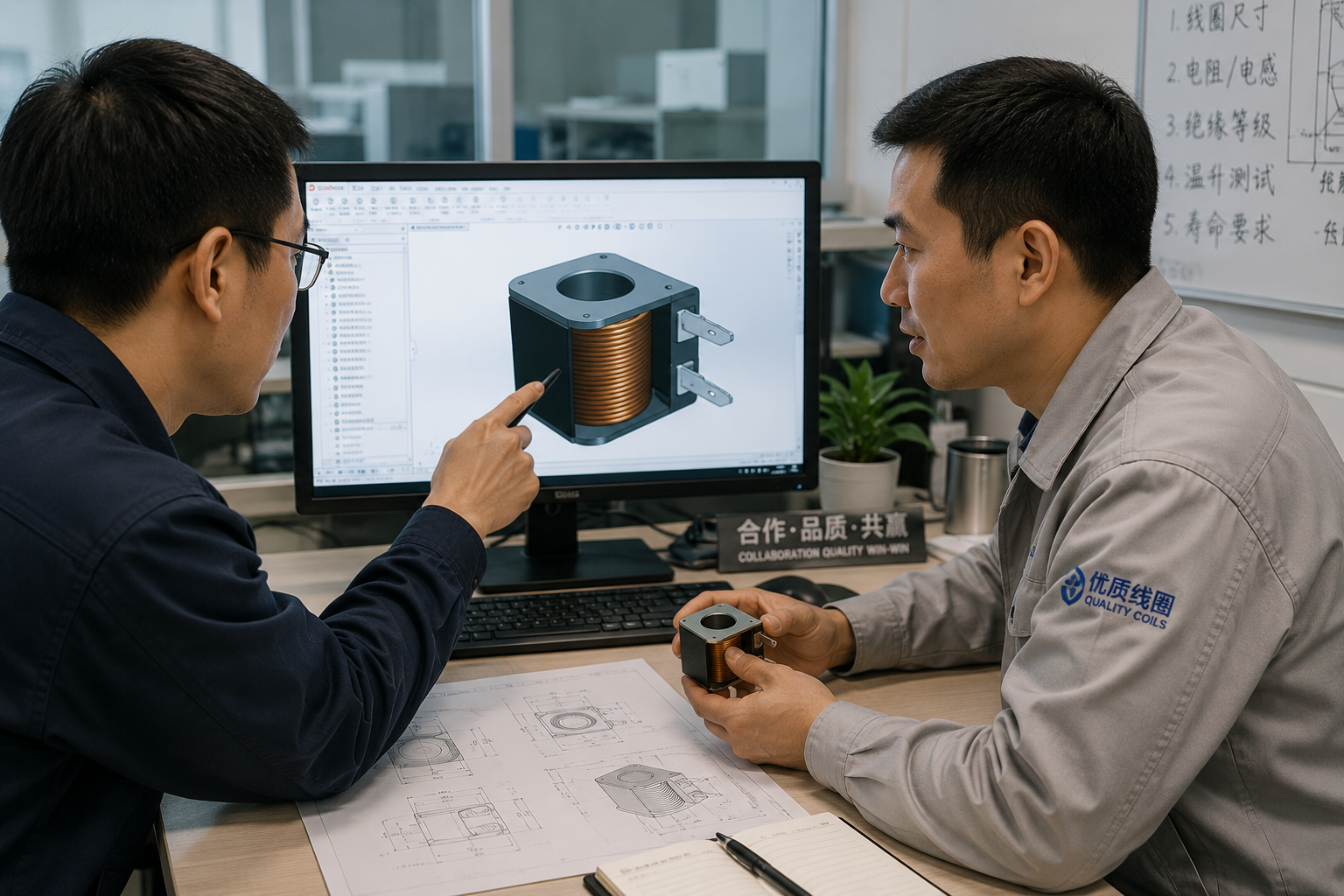
After two decades of helping brands, I've learned that the most successful projects begin when the customer stops asking "What do you have?" and we start discussing "What do you need to accomplish?". We reframe the questions to get to the core of the problem. This turns a simple procurement into a collaborative engineering process. Instead of asking for a specific part, we help you define the specific job.
Here’s how we shift the conversation from specs to solutions:
| The Old Way (Asking for a Part) | The Expert Way (Defining the Job) |
|---|---|
| "Do you have a 10N solenoid?" | "What is the mass and friction of the bolt you're moving?" |
| "Is this a 12V solenoid?" | "What is your battery's mAh rating and target life in months?" |
| "How much does it cost?" | "What is your target life cycle and acceptable failure rate?" |
| "How long can it stay on?" | "What's the maximum possible 'on' time in a worst-case scenario?" |
By asking about the load's friction, we might discover you only need 4N of force, allowing us to use a smaller, more efficient solenoid. By understanding your battery's capacity, we immediately set a maximum current draw that disqualifies dozens of unsuitable options. This collaborative process de-risks your project from day one.
Why Do Smart Lock Manufacturers Choose Custom Solenoid Solutions?
You see competitors with sleek, reliable locks and wonder what their secret is. They are not just getting lucky with standard parts; they are actively building a competitive advantage through engineering.
Top manufacturers choose custom solenoids to achieve a perfect balance of performance, size, and power efficiency that off-the-shelf parts simply cannot offer. This ensures product reliability, optimizes battery life, and protects their brand reputation, turning a simple component into a key market differentiator.

As an OEM/ODM partner for over 20 years, we've seen market leaders consistently invest in custom solutions for several key business reasons. It's not an expense; it's a strategic investment in the product's success.
First, Performance Optimization. A custom solution allows a brand to create a high-cycle commercial lock and an ultra-low-power residential lock using a similar design, but with perfectly tuned internal components. You're not forcing a one-size-fits-all part into two very different applications.
Second, Risk Mitigation. Remember the solenoid with the 10% duty cycle that melted? When we co-design a solenoid, we can build in thermal fuses, select higher-temperature plastics for the bobbin, and validate the design against worst-case software bugs. This virtually eliminates the risk of a thermal-related product recall.
Finally, Brand Experience and Supply Chain Control. The "feel" and sound of the lock are part of your brand. We can customize the plunger and mechanical stop to create a satisfying, solid "thunk" instead of a cheap, high-pitched "click." Furthermore, a custom part number ensures supply chain stability. You are not at the mercy of a catalog part that a distributor might discontinue. You have a dedicated production line and a long-term manufacturing partner.
Conclusion
Choosing the right smart lock solenoid isn't about finding the strongest part, but about executing the smartest process. It's about defining the job and managing risk to build a reliable product.
"Causes and remedies of solenoid overheating analysis", https://www.drsolenoid.com/news/causes-and-remedies-of-solenoid-overheating-analysis/. Reference works on electromagnets explain that coil current produces Joule heating (proportional to I^2R), which raises temperature and can cause failure if unmanaged, while higher power draw increases energy consumption and reduces battery life; this mechanistic background substantiates the risks of battery drain and overheating from an ill-specified solenoid. Evidence role: mechanism; source type: encyclopedia. Supports: That resistive (Joule) heating in energized coils increases with current/power, leading to temperature rise and potential failure, and that higher current draw shortens battery life.. Scope note: General electromechanical principles; not a case study of a specific smart lock. ↩
"Electromagnets - Physics Van - University of Illinois", https://van.physics.illinois.edu/ask/listing/2345. Engineering lecture materials on solenoid and electromagnet design emphasize that while force increases with ampere-turns, coil heating and insulation/duty-cycle limits constrain continuous operation, requiring designers to balance force with power and thermal management. Evidence role: expert_consensus; source type: education. Supports: That solenoid output force scales with ampere-turns and geometry but is limited by coil resistance, I^2R heating, and permissible duty cycle/insulation class, necessitating trade-offs in design.. Scope note: Provides general design guidance, not specific to a particular lock model. ↩
"Solenoid (engineering) - Wikipedia", https://en.wikipedia.org/wiki/Solenoid_(engineering). Encyclopedia entries on electronic locks state that actuators may be solenoids or electric motors, providing general support that solenoids are a standard actuator option in lock mechanisms. Evidence role: general_support; source type: encyclopedia. Supports: That electronic locks commonly employ solenoids as actuators, among other options like electric motors.. Scope note: Does not quantify prevalence between actuator types in the smart lock market. ↩
"Fast-acting long-stroke bistable solenoids with moving permanent ...", https://www.osti.gov/biblio/6433034. Peer‑reviewed descriptions of bistable solenoids characterize them as actuators with two stable positions that are toggled by brief pulses rather than sustained current, aligning with the bi‑stable and pulse‑driven operation described. Evidence role: definition; source type: paper. Supports: That bistable (latching) solenoids have two stable mechanical states and require only a short electrical pulse to transition between them.. Scope note: Supports the device principle broadly; not tied to any specific smart lock design. ↩
"Comprehensive Guide to Latching Solenoids! Energy-Saving & High ...", https://www.takano-sanki21.com/sanki/en/column/latching-solenoids_guide/. Technical literature on magnetically latched (bistable) solenoids reports that permanent magnets provide the holding force in either state, eliminating the need for holding current and thereby reducing power consumption. Evidence role: mechanism; source type: paper. Supports: That magnetically latched solenoids use permanent magnets to maintain position without steady-state power.. Scope note: Explains the mechanism generically; does not quantify power for a particular product. ↩
"Solenoid valve - Wikipedia", https://en.wikipedia.org/wiki/Solenoid_valve. Reference descriptions of linear solenoids indicate that electromagnetic force is generated only while the coil is energized, with a mechanical spring often providing return when power is removed, implying continuous power is required during actuation. Evidence role: definition; source type: encyclopedia. Supports: That standard linear solenoids produce force only when energized and are typically paired with a return spring when power is removed.. Scope note: General device description; exact duty/holding requirements vary by design. ↩
"Help in a project - how do I control a pulsed latching solenoid?", https://forum.arduino.cc/t/help-in-a-project-how-do-i-control-a-pulsed-latching-solenoid/167869. Educational materials on actuator drive circuits note that bistable solenoids are commonly actuated by reversing current polarity—often using an H‑bridge or equivalent—to switch between latched positions. Evidence role: mechanism; source type: education. Supports: That driving a bistable/latching solenoid typically involves reversing current polarity to toggle between states.. Scope note: Control strategies can vary; some designs use dual coils instead of polarity reversal. ↩
"What is energy? explained - EIA", https://www.eia.gov/energyexplained/what-is-energy/. Neutral technical summaries of latching actuators explain that they require energy only to switch state and not to hold, a property that reduces average power draw and supports extended battery operation compared to continuously energized devices. Evidence role: expert_consensus; source type: encyclopedia. Supports: That latching actuators consume energy primarily during state changes, reducing average power and aiding long battery life goals.. Scope note: General principle; does not establish that a latching solenoid is universally required for any specific battery-life target. ↩
"Solenoid - Wikipedia", https://en.wikipedia.org/wiki/Solenoid. Standard references on electromagnets state that an electric current in a coil generates a magnetic field, which is harnessed in linear solenoids to exert force on a ferromagnetic plunger. Evidence role: mechanism; source type: encyclopedia. Supports: That current in a coil produces a magnetic field used to actuate a ferromagnetic plunger in a solenoid.. ↩
"[PDF] Compliant Thermo- Mechanical MEMS Actuators LDRD #52553", https://www.sandia.gov/app/uploads/sites/145/2021/10/thermal_actuator_SAND-1.pdf. Engineering texts on electromechanical actuators describe how coil current (and thus force) is limited by I^2R heating and permissible temperature rise, formalizing the trade-offs among force, power consumption, and heat in solenoid design. Evidence role: expert_consensus; source type: education. Supports: That force output is linked to ampere‑turns and geometry while electrical power causes I^2R heating, requiring designers to balance performance against thermal constraints.. Scope note: Principle-level support; does not consider any specific enclosure or thermal management configuration. ↩
"Duty cycle - Wikipedia", https://en.wikipedia.org/wiki/Duty_cycle. Definitions of duty cycle describe it as the fraction of time a system is active within a cycle, so a 10% duty cycle corresponds to an on-time that is 10% of the total period (e.g., 2 seconds on in a 20-second interval). Evidence role: definition; source type: encyclopedia. Supports: The definition of duty cycle as the ratio of on-time to total cycle time, expressed as a percentage.. Scope note: Generic definition; specific thermal limits depend on device construction and environment. ↩
"49 CFR 571.206 -- Standard No. 206; Door locks and ...", https://www.ecfr.gov/current/title-49/subtitle-B/chapter-V/part-571/subpart-B/section-571.206. Summaries of ANSI/BHMA lock standards note that Grade 1 hardware is tested to approximately 1,000,000 operating cycles, providing context for the million‑cycle benchmark cited for commercial use. Evidence role: historical_context; source type: encyclopedia. Supports: That industry standards for Grade 1 commercial locks specify endurance testing on the order of 1,000,000 operating cycles.. Scope note: Standards apply to mechanical locksets; exact endurance requirements for a solenoid actuator within a smart lock may differ. ↩