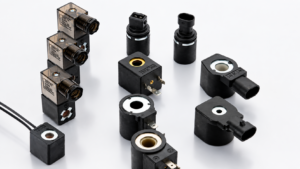

How to Choose the Right Rotary Solenoid?
Do your machines fail because of bad parts? A wrong rotary solenoid causes breakdowns and costs you money. I will show you how to pick the right one today.
To choose the right rotary solenoid, you must look beyond basic torque numbers. You need to match the torque, stroke angle, and duty cycle to your actual working environment. Focusing on long-term stability, heat management, and reliable manufacturing prevents premature failures and saves you money.

Many buyers make a big mistake here. They only read the basic data sheet and ignore the real-world conditions. This mistake leads to high warranty costs and angry customers. Let me walk you through the real secrets to making a safe and smart choice.
What Are the Key Factors in Selecting a Rotary Solenoid?
Are your current solenoids burning out too fast? Ignoring real use cases causes quick failure. You must focus on stability and heat, not just a paper spec sheet.
The key factors in selecting a rotary solenoid are long-term stability, heat resistance, and performance decay. Many people pick the wrong part because they only look at maximum torque. You must evaluate how the solenoid handles continuous heat during real operation to avoid early failure.

In my 20 years of manufacturing at SolenElec, I see many buyers make the same error. They buy a part based on the highest torque number. Then, the part fails in the field. Why does this happen? The answer is heat and performance decay.
The Hidden Danger of Heat
When a solenoid works, it gets hot. Heat increases the resistance of the copper wire1. This drops the power and lowers the torque. If you do not plan for this decay, your device will stop working.
Real World Stability
A good spec sheet means nothing if the part cannot survive your daily operations. You need a part that stays stable over millions of cycles.
| Factor | Why It Matters | What Happens If Ignored |
|---|---|---|
| Operating Heat | Changes wire resistance | Torque drops, part fails |
| Performance Decay | Reduces force over time | System jams or breaks |
| Daily Environment | Tests real limits | High warranty costs |
You must test the solenoid in your exact machine. Do not just test it on a clean lab table. This is how you find the true performance limits and secure your supply chain.
How Do Torque, Angle, and Duty Cycle Affect Rotary Solenoid Choice?
Do you think more torque is always better? Too much torque wastes power and creates extra heat. You need the exact match for your specific angle and duty cycle.
Torque, angle, and duty cycle define how a rotary solenoid works. Bigger torque is not always better. If you choose too much torque, the part wastes electricity, gets very hot, and dies early. You must balance the force with how often the part works.

I always tell my European home appliance clients that bigger is not better. A massive solenoid in a small lock is a bad idea.
Finding the Right Torque
Your torque must match your load. If you use a huge solenoid for a light job, you waste energy. The extra power turns into heat. This heat damages the internal coil and shortens the life of the product.
Understanding Angle and Duty Cycle
The angle is how far the part turns. The duty cycle is how long the part stays on compared to its rest time. If your duty cycle is high, the part needs more time to cool down.
| Parameter | Definition | Best Practice |
|---|---|---|
| Torque | Turning force | Match exactly to the load |
| Angle | Degrees of rotation | Choose the exact needed stroke |
| Duty Cycle | On/Off time ratio | Allow enough cooling time |
You must calculate your duty cycle carefully. A 10% duty cycle means the part rests for 90% of the time2. If you push a 10% part to run at 50%, it will burn out in hours. Always respect these three rules.
What Are the Different Types of Rotary Solenoids and Their Applications?
Are you using the wrong type of solenoid for your locks? A bad match causes slow reactions and jammed doors. You must pick the right type for fast movement.
There are several types of rotary solenoids, such as unidirectional, bidirectional, and latching types. Devices like smart parcel lockers and industrial locks require fast response times and precise angles. Choosing the right design ensures the door opens instantly and the lock stays secure every time.

Different jobs need different tools. At SolenElec, we make many custom designs for different machines. You cannot use a standard part for a highly specific job.
Smart Lockers and Fast Response
Think about a smart delivery locker. When a customer types a code, the door must pop open right away. This needs a rotary solenoid with a very fast reaction speed and an exact turning angle. If the angle is off by just one degree, the lock jams.
Industrial Locks and Precision
Industrial locks need extreme durability. They operate in tough places.
| Solenoid Type | Best Feature | Common Application |
|---|---|---|
| Unidirectional | Turns one way, spring return | Simple doors, sorting flaps |
| Bidirectional | Turns two ways with power | Complex routing machines |
| Latching | Holds position without power | Battery-powered smart locks |
Latching types are great for saving energy. They only use power when they move. Once they reach the end, permanent magnets hold them in place3. This keeps the part cool and saves battery life. Knowing these types helps you make the best choice.
How to Match a Rotary Solenoid to Your Industrial Application?
Does your new project face strict size and power limits? Guessing the specs leads to poor design. You must align the solenoid with your exact load and usage frequency.
To match a rotary solenoid to your application, you must measure the physical load, the available power, and the operating frequency. You need to know exactly how many times the device moves per day. This data helps you pick a part that stays cool.
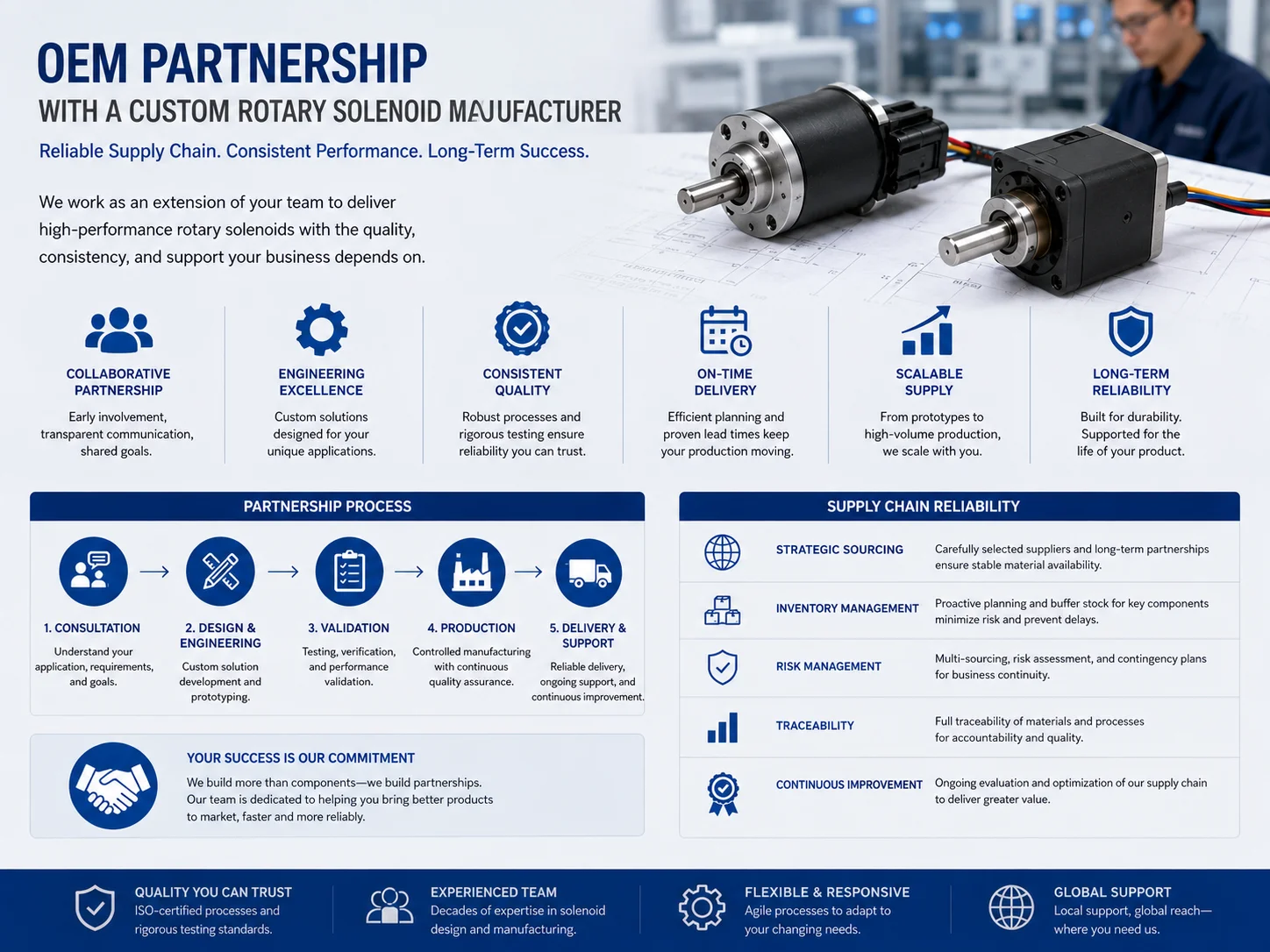
You cannot design a machine in the dark. I work with many brand managers who want a cheap part first, then try to make it fit. This is the wrong way.
Measure Your Actual Load
You must know the exact weight or friction the solenoid needs to push. Use a force gauge4. Do not guess. If your load changes with the weather, you must plan for the worst day.
Track Usage Frequency
How many times does the machine work in one hour? This frequency decides your duty cycle.
| Step to Match | Action Required | Result of Guessing |
|---|---|---|
| Load Testing | Measure force with tools | Part lacks power to move |
| Power Check | Verify voltage and current | Coil burns or moves slowly |
| Frequency Count | Track cycles per minute | Heat builds up and kills part |
You also need to check the space inside your machine. A rotary solenoid needs room to breathe and cool down. If you pack it too tight, the heat will stay trapped. Always test the part inside the final case to see the real temperature.
What Should You Look for in a Reliable Rotary Solenoid Manufacturer?
Do you suffer from bad batches and delayed shipments? A poor factory ruins your brand reputation. You need a partner with strict quality control and proven production experience.
A reliable rotary solenoid manufacturer must have excellent wire quality, precise winding processes, and strong structural engineering. Good factories prevent batch differences and reduce failure rates. You should look for strict incoming material inspections, automated production lines5, and international certifications like CE, UL, and RoHS.
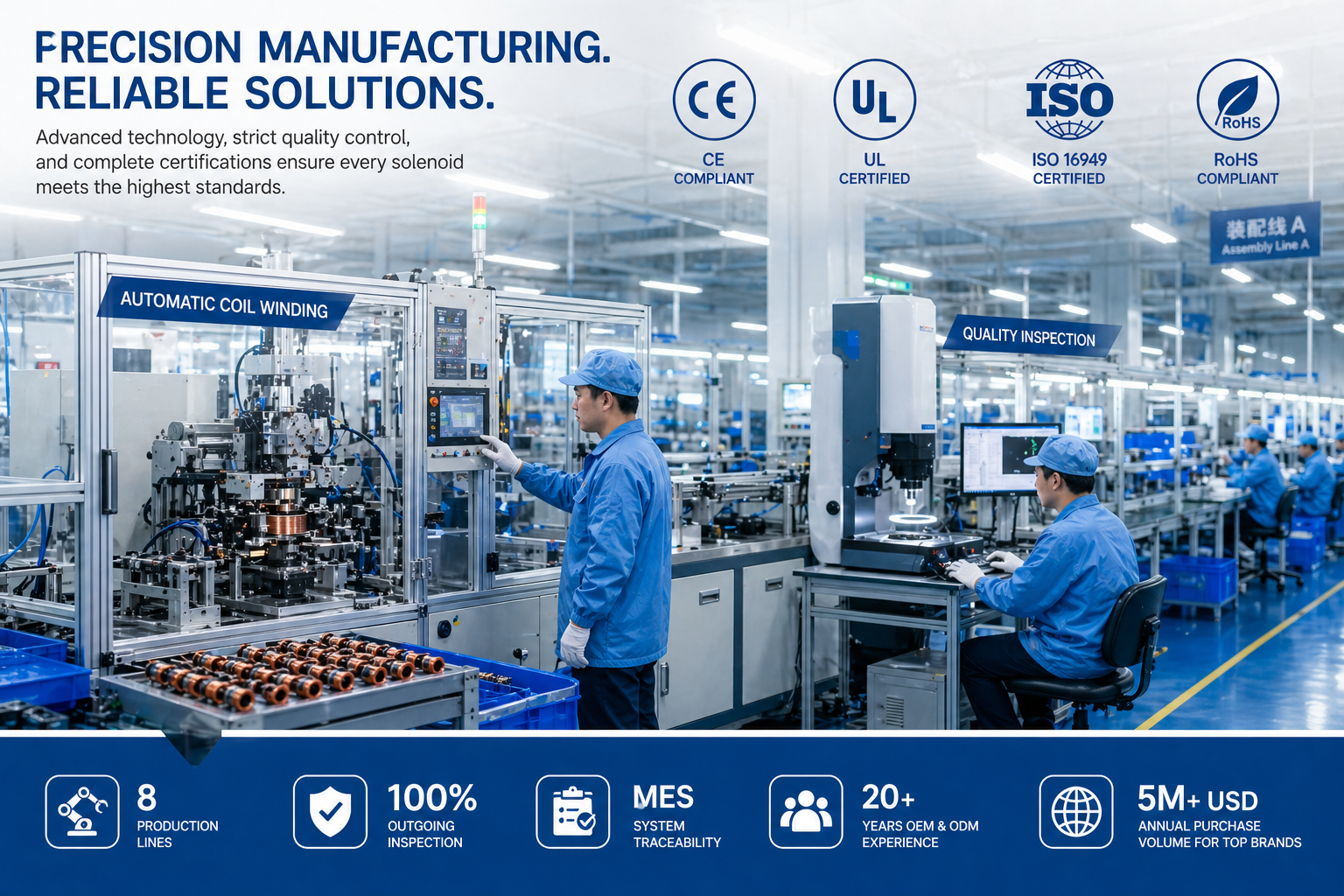
A great design means nothing if the factory makes it poorly. I have spent 20 years perfecting the OEM and ODM process at SolenElec. I know what makes a good factory.
The Importance of Materials
You must use high-purity copper wire6 and heat-resistant plastics7. Cheap wire has bad insulation. It will short-circuit and catch fire. Good wire ensures the coil lasts for years.
Strict Process Control
The winding process must be perfect. If the wire is loose, the torque changes. If the wire is too tight, it breaks.
| Factory Feature | Why You Need It | SolenElec Standard |
|---|---|---|
| Material Inspection | Stops bad parts early | 100% RoHS/REACH check |
| Automated Winding | Ensures every coil is the same | 8 ISO certified lines |
| Outgoing Testing | Guarantees final performance | 100% test before shipping |
You want zero batch differences8. Every single part in a batch of 10,000 must work exactly like the first sample. A strong partner gives you this peace of mind. They help you lower your after-sales costs and protect your brand name in the market.
Conclusion
Choosing the right rotary solenoid requires balancing torque, heat, and real-world stability. Partner with a reliable manufacturer to ensure precise performance, avoid early failures, and protect your brand reputation.
"Resistivity and Temperature Coefficient at 20 C - HyperPhysics", http://hyperphysics.phy-astr.gsu.edu/hbase/Tables/rstiv.html. Copper exhibits a positive temperature coefficient of resistance, with resistivity increasing approximately 0.4% per degree Celsius above 20°C, a well-documented property of metallic conductors. Evidence role: mechanism; source type: encyclopedia. Supports: the temperature-dependent increase in copper electrical resistance. Scope note: This describes the general physical property; the specific impact magnitude varies with solenoid design and operating conditions. ↩
"Duty cycle - Wikipedia", https://en.wikipedia.org/wiki/Duty_cycle. Duty cycle is defined as the ratio of active operation time to total cycle time, expressed as a percentage; a 10% duty cycle indicates the device is energized for one-tenth of each complete cycle period. Evidence role: definition; source type: education. Supports: the standard engineering definition of duty cycle. ↩
"What is a Latching Solenoid? General Technical Information", https://www.geeplus.com/latching-solenoids-general-technical-information/. Latching (bistable) solenoids incorporate permanent magnets that provide holding force at end positions, eliminating the need for continuous current to maintain state and significantly reducing power consumption. Evidence role: mechanism; source type: education. Supports: the use of permanent magnets in latching solenoids to maintain position. ↩
"[PDF] Methodologies for Combined Loads Tests Using a Multi-Actuator ...", https://ntrs.nasa.gov/api/citations/20130014926/downloads/20130014926.pdf. Engineering best practice for actuator selection involves direct measurement of mechanical loads using calibrated force gauges or load cells to ensure accurate specification rather than relying on estimates. Evidence role: general_support; source type: education. Supports: the use of force measurement instruments in actuator specification. ↩
"Benefits of Manufacturing Automation: Quality, Efficiency, Risk", https://www.automationnth.com/benefits-of-manufacturing-automation/. Automated manufacturing processes reduce human variability and improve repeatability, leading to more consistent product quality and reduced defect rates compared to manual production methods, particularly for precision assembly operations. Evidence role: expert_consensus; source type: education. Supports: the quality benefits of automated manufacturing processes. Scope note: Automation effectiveness depends on proper setup, maintenance, and process control; automation alone does not guarantee quality without appropriate design and monitoring systems. ↩
"[PDF] The electrical conductivity of commercial copper", https://nvlpubs.nist.gov/nistpubs/bulletin/07/nbsbulletinv7n1p103_A2b.pdf. Copper purity directly affects electrical conductivity, with high-purity copper (99.9%+ Cu) providing lower resistivity and reduced energy losses in electromagnetic coils compared to lower-grade alternatives. Evidence role: mechanism; source type: education. Supports: the importance of copper purity for electrical conductivity in electromagnetic applications. Scope note: While purity improves conductivity, other factors including wire gauge, insulation quality, and winding technique also significantly impact solenoid performance. ↩
"FFF 3D Printing in Electronic Applications: Dielectric and Thermal ...", https://pmc.ncbi.nlm.nih.gov/articles/PMC8587066/. Electromagnetic devices generating significant heat require housing materials with appropriate thermal stability, typically engineering plastics with continuous use temperatures exceeding 120°C to prevent deformation and maintain dimensional stability. Evidence role: general_support; source type: education. Supports: the need for thermally stable materials in electromagnetic device construction. Scope note: Specific material selection depends on operating temperature range, mechanical requirements, and environmental conditions of the application. ↩
"Batch‐to‐batch pharmacokinetic variability confounds current ... - PMC", https://pmc.ncbi.nlm.nih.gov/articles/PMC5102576/. Manufacturing quality control aims to minimize batch-to-batch variation through statistical process control, though achieving literally zero variation is practically impossible; high-capability processes typically target process capability indices (Cpk) of 1.33 or higher. Evidence role: expert_consensus; source type: education. Supports: the goal of minimizing batch variation in manufacturing. Scope note: Some degree of variation is inherent in all manufacturing processes due to material properties, environmental factors, and measurement uncertainty; the goal is to maintain variation within acceptable specification limits. ↩