Struggling to understand how a simple component can automate your product? Choosing the wrong part can lead to failure and high costs. Let's break down this essential device.
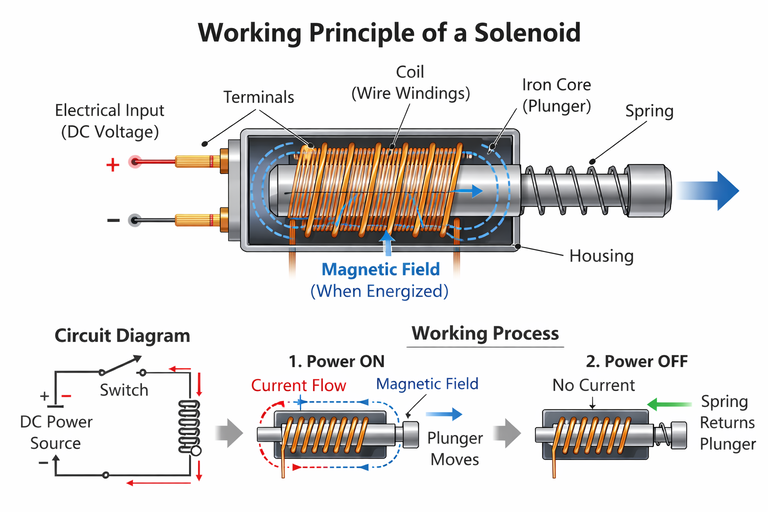
A solenoid is an electromagnetic component1 made of a wire coil and a movable metal core. When electricity flows through the coil, it creates a magnetic field2. This field moves the core, creating a simple push or pull motion. This action is used to automate a mechanical process3.
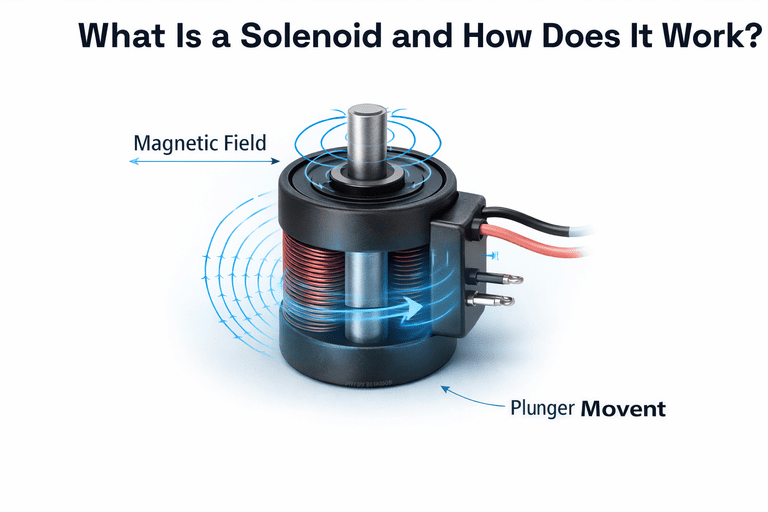
This simple push-pull action is the secret behind many automated devices we use every day. I've been manufacturing them for over 20 years, and their clever design never fails to impress me. They are the invisible muscles inside countless machines. But not all solenoids are the same. Let's explore the different types and what makes each one unique, so you can see how they might fit into your own projects.
What Is a Solenoid and How Does It Work?
Need a simple way to create automated motion in your design? Complex mechanical systems can be expensive and unreliable. A solenoid offers an effective solution by turning electricity into motion.
A solenoid works using electromagnetism4. When current flows through its wire coil, it creates a magnetic field2. This field pulls or pushes a metal core, called a plunger.5 This movement is used to operate another mechanism. When the power is off, the magnetic field disappears.
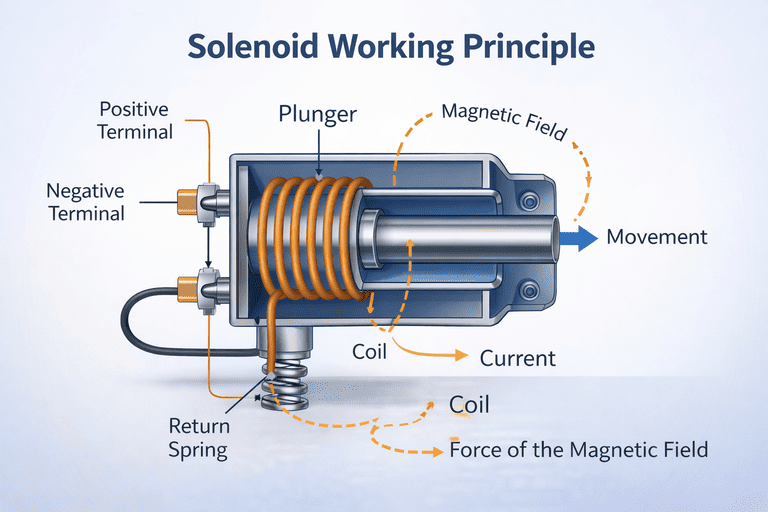
Let's dive deeper into this process. The magic happens with just a few key parts. The core principle is simple: electricity creates a magnet. This magnet moves a part. It is a very reliable way to create linear motion6 on demand. When we design a solenoid for a client, we focus on how these parts work together to create the exact force and movement they need.
The Core Components
| Component | Material | Function |
|---|---|---|
| Coil | High-purity copper wire | Creates a magnetic field when electric current passes through it. The number of turns in the coil affects the strength of the field. |
| Plunger (Core) | Ferromagnetic material7 (like iron) | Moves in and out of the coil in response to the magnetic field. This is the part that does the physical work. |
| Frame/Housing | Metal or plastic | Holds the coil and plunger, and helps concentrate the magnetic field for maximum efficiency. It also protects the internal parts. |
When the current is switched off, the magnetic field collapses instantly. In many designs I’ve worked on, a small spring is included. This spring pushes the plunger back to its starting position. This "spring-back" action is critical for applications that need to return to a default state, like a locking mechanism8.
What Are the Different Types of Solenoids?
Confused by terms like "push-type," "pull-type," or "latching"? Choosing the wrong type can mean your application simply will not work as intended. Let's clarify the main solenoid types.
The main types are push-type, pull-type, and latching solenoids9. Push-type solenoids extend a plunger when powered. Pull-type solenoids retract a plunger. Latching solenoids hold their position without continuous power, which saves energy. There are also rotary solenoids10 for turning motions.
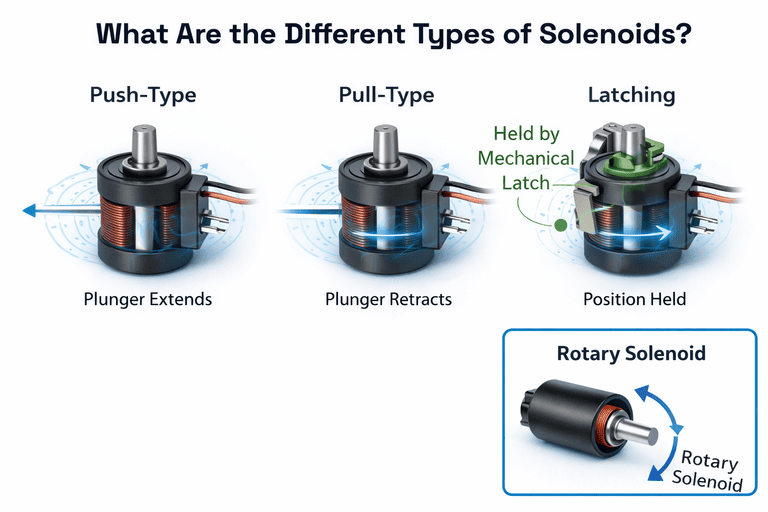
Each type is designed for a specific kind of job. The right choice depends entirely on the action you need to perform. In my 20 years of manufacturing, I have helped clients select the perfect type for everything from coffee machines11 to car door locks. The function dictates the form. For example, you wouldn't use a push-type solenoid where you need to pull a lock open. Understanding these basic differences is the first step in designing a reliable product. Let's look at them more closely.
Common Solenoid Designs
| Solenoid Type | Action When Powered | Power Consumption | Best For |
|---|---|---|---|
| Push-Type | The plunger extends out from the body. | Needs continuous power to stay extended. | Pushing levers, sorting items, opening latches. |
| Pull-Type | The plunger retracts into the body. | Needs continuous power to stay retracted. | Pulling cables, closing valves, retracting locks. |
| Latching | Moves and holds position with a short pulse of power. | Uses power only to switch states, not to hold. | Battery-powered devices, smart door locks, power-saving applications. |
| Rotary | The plunger rotates through an arc. | Typically needs continuous power to hold position. | Operating shutters, sorting gates, optical devices. |
In our factory, we produce a huge number of pull-type solenoids12. They are workhorses in the home appliance industry. But for a new generation of smart home devices, our clients are increasingly requesting latching solenoids9. Their energy efficiency is a huge advantage for battery-operated products.
Solenoid vs. Solenoid Valve: What’s the Difference?
Are a solenoid and a solenoid valve13 the same thing? This common confusion can lead to ordering the wrong part for your project. The difference is simple: a solenoid valve is a complete part that uses a solenoid to function.
A solenoid is just the component that creates motion from electricity. A solenoid valve is a full assembly that uses a solenoid to open or close a valve. The solenoid is the "engine," and the valve is the tool it operates to control fluid or gas flow.
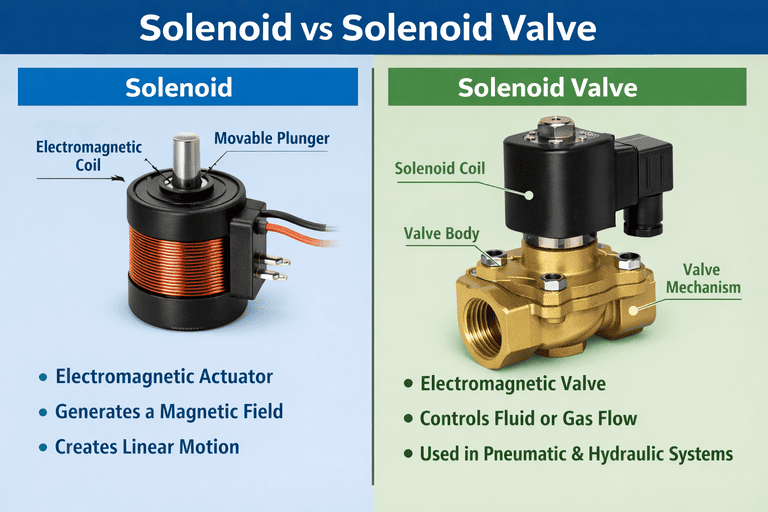
Think of it this way: a solenoid is an actuator14. It makes something move. A solenoid valve is a specific application of that movement. We manufacture the solenoid component that our clients then build into their final valve assemblies. I often explain it to new procurement managers like this: you can't control water with just a solenoid, you need the valve body too. The solenoid is simply the smart, automated finger that turns the valve on and off.
Breaking Down the Assembly
A solenoid valve is a system where the solenoid acts as the pilot.
| Part | Function in a Solenoid Valve |
|---|---|
| Solenoid | Provides the electromagnetic force to move the valve's internal parts. It's the "actuator14" or "motor." |
| Valve Body | The housing that contains the ports (inlet/outlet) and internal passages for the fluid or gas to flow through. |
| Seal or Diaphragm15 | The part, often made of rubber or plastic, that physically blocks or opens the flow path. The solenoid's plunger moves this part. |
A perfect example is a modern dishwasher. When it's time to let water in, a signal is sent to the solenoid. Its plunger pulls back, lifting a diaphragm inside the valve body. This opens a path for water to enter the machine. We provide the solenoid part of this equation for many leading European appliance brands. Our job is to make sure that "pull" is reliable every single time for years.
What Are the Common Applications of Solenoids in Industry?
Wondering where these simple devices are actually used? You might be surprised how many products rely on them for their most basic functions. Solenoids are the hidden workhorses in many industries.
Solenoids are used everywhere. In home appliances16, they control water in washing machines. In cars, they operate door locks and starters. In medical devices17, they manage air pressure in blood pressure cuffs. They are also essential in industrial automation18, vending machines, and security systems.
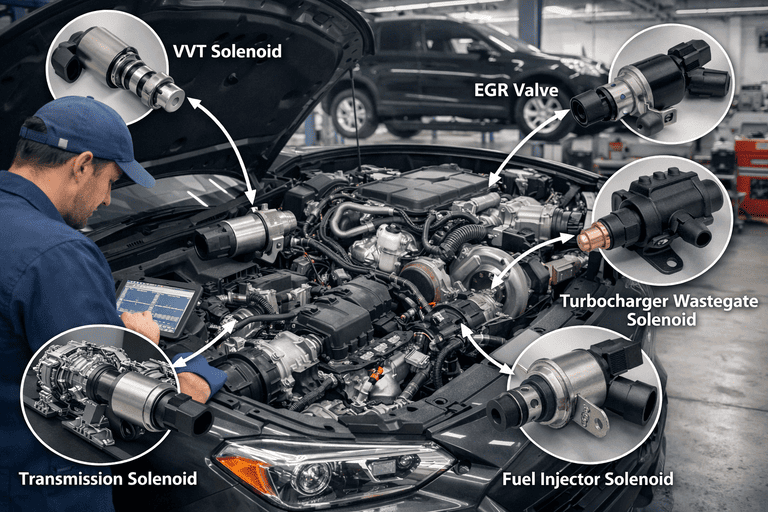
These components are successful because they are a cost-effective and very reliable way to create on-demand linear motion. For a brand manager or purchasing manager, that means a stable product with fewer field failures. I have personally overseen production lines making solenoids for some of the world's top brands. Let me share a few examples from my experience.
In Home Appliances
Here, solenoids are kings of control. Think of a high-end coffee machine. A solenoid controls the precise amount of hot water for a perfect espresso shot. In a smart refrigerator, a solenoid might operate the flap for the ice dispenser. They are used in:
- Smart door locks (latching type)
- Water dispensers (pull-type)
- Washing machine water inlets (pull-type)
In the Automotive Industry
The automotive sector uses solenoids extensively. I like to call them "automatic little fingers" that push, pull, and control things all over the car. They are used for:
- Remote door lock actuator14s
- Starter motor engagement (the "click" you hear)
- Transmission gear shifting
- Fuel injection control
In Medical Devices
Precision and reliability are critical in the medical field. A great example from my insights is the blood pressure monitor. A tiny solenoid controls a valve that inflates and slowly deflates the cuff. Their quick and precise action is perfect for such sensitive tasks.
How Do You Choose the Right Solenoid for Your Application?
Need to select a solenoid for your new product? Choosing based on price alone can lead to poor performance and costly failures. You must consider key factors to ensure you get a stable part.
To choose the right solenoid, consider the required force, stroke length, duty cycle, and voltage. Also, think about environmental factors like temperature and moisture. Most importantly, ensure it meets compliance standards19 like CE, UL, or RoHS for your target market.
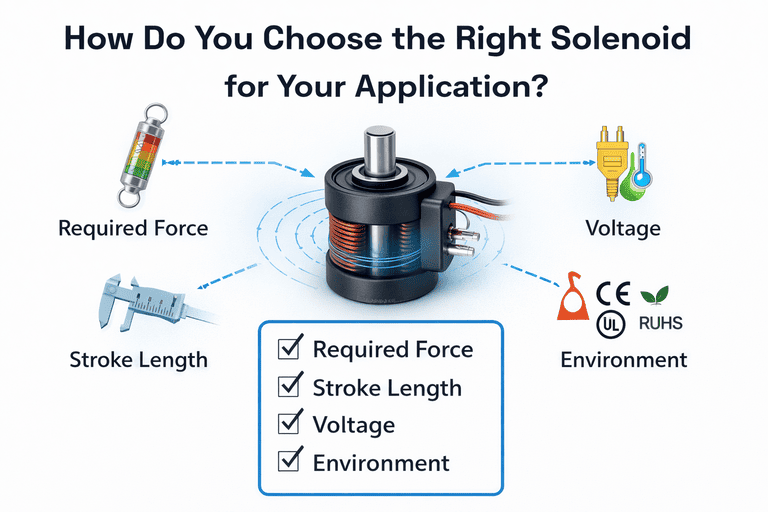
As an OEM/ODM partner for global brands for over 20 years, these are the first questions our engineering team asks a new client. Getting these specifications right from the start is the key to a successful project and a reliable end product. It helps us avoid problems and ensures the component we manufacture performs perfectly for its entire lifespan. A purchasing manager who understands these factors can have a much more effective conversation with a supplier.
Key Selection Criteria
| Parameter | What to Ask | Why It Matters for a Procurement Manager |
|---|---|---|
| Force (Newtons) | How much weight does it need to push or pull? | This is a primary performance metric. Too little force causes failure. Specifying too much force increases cost and size unnecessarily. |
| Stroke (mm) | How far does the plunger need to travel? | Mismatched stroke length can damage the solenoid or the mechanism it is operating, leading to warranty claims. |
| Duty Cycle (%) | Will it be on continuously or in short bursts? | A 100% duty cycle solenoid is for continuous operation but costs more. An intermittent-duty solenoid used continuously will overheat and fail. |
| Voltage (VDC/VAC) | What is your product's power source? | This must match your application's power supply. Ordering the wrong voltage is a common and costly mistake. |
| Compliance | What certifications are required (CE, UL, RoHS, REACH)? | This is a non-negotiable risk factor. Non-compliant parts can block your product from key markets like Europe and North America. |
Getting these details right is our job. We work with our clients to define these parameters and then design and manufacture a solenoid that meets them perfectly, every time.
Conclusion
Solenoids are simple, powerful components that enable automation18 in countless products. Understanding their types, functions, and key selection criteria is the first step toward building something reliable and successful.
Understanding electromagnetic components is crucial for grasping how solenoids function in automation. ↩
The magnetic field is the driving force behind the solenoid's motion, making it essential to understand its function. ↩
Solenoids are used to automate mechanical processes, making them vital for efficient and reliable automation. ↩
Understanding electromagnetism is crucial for grasping how solenoids convert electrical energy into mechanical motion, enhancing your design's efficiency. ↩
Understanding the plunger's role helps in selecting the right solenoid for precise mechanical actions in your projects. ↩
Linear motion is a key function of solenoids, essential for their role in various automated systems. ↩
Ferromagnetic material is used in the plunger to enhance the solenoid's magnetic response, vital for its function. ↩
Explore how solenoids are used in locking mechanisms to enhance security and efficiency in various applications, from smart locks to industrial systems. ↩
Latching solenoids hold their position without continuous power, making them energy-efficient for battery devices. ↩
Rotary solenoids provide rotational motion, important for applications like operating shutters. ↩
Discover how solenoids precisely control water flow for perfect espresso shots, enhancing your coffee machine's performance and reliability. ↩
Pull-type solenoids are used for retracting actions, essential for applications like closing valves. ↩
Understanding solenoid valves is crucial for applications involving fluid or gas control. ↩
Solenoids act as actuators, converting electrical energy into motion, essential for automation. ↩
Understanding the diaphragm's role in solenoid valves helps ensure precise fluid control, crucial for applications like dishwashers and medical devices. ↩
Solenoids are integral to home appliances, controlling functions like water flow in washing machines. ↩
Solenoids provide precise control in medical devices, essential for tasks like blood pressure monitoring. ↩
Explore how solenoids transform electrical energy into motion, simplifying automation in devices, and discover their diverse applications in industry. ↩
Compliance standards ensure solenoids meet safety and regulatory requirements, crucial for market access. ↩